脑机接口

Search documents
创新医疗(002173.SZ):博灵脑机产品赛博灵科AC5已于2025年10月正式上市销售,2025年共实现收入11.4万元
Ge Long Hui A P P· 2026-01-12 12:31
Core Viewpoint - The company, Innovation Medical (002173.SZ), has noted increased market attention on its brain-computer interface business, particularly through its subsidiary, Boling Brain Machine (Hangzhou) Technology Co., Ltd. [1] Group 1: Company Overview - Boling Brain Machine was established in early 2021 and is expected to be included in the company's consolidated financial statements by August 2025 [1] - The primary products are designed for rehabilitation training of patients with cerebrovascular diseases, mainly focusing on stroke and hemiplegia [1] Group 2: Product Development and Financial Performance - The product "Cyberlink AC5" was officially launched in October 2025, generating revenue of 114,000 yuan in that year [1] - The "Cyberlink AM5" has completed multi-center clinical trials but has not generated revenue in 2025 [1] - The operating losses for Boling Brain Machine were 6.60 million yuan in 2023 and 8.66 million yuan in 2024 [1]

上海发布脑机接口重磅文件,5年内全面实现临床应用
Di Yi Cai Jing Zi Xun· 2026-01-12 12:28
他对记者解释,在脑机接口系统中,"硬件"如同肉体,由脑虎科技、景昱医疗等公司提供的电极或外设 构成;"灵魂"则是介于大脑与外设之间的算法系统,脑电分析解码是它们专注研究的领域。 作为我国脑机接口技术发展的前沿阵地,上海已形成覆盖侵入式、半侵入式和非侵入式技术的完整研发 体系。未来五年,上海将多层次培育更多脑机接口技术和产品应用落地。 日前公布的《上海市脑机接口未来产业培育行动方案(2025-2030年)》(下称"方案")提出,2027年 前,实现高质量脑控,半侵入式脑机接口产品在国内率先实现临床应用,侵入式脑机接口研发取得突 破,脑机接口创新生态初步构建。具体围绕加速脑机接口产品化、构建共性技术研发服务平台、推动临 床试验与应用示范、健全产品标准与检测体系、培育产业创新生态等方面展开。 2024年6月以来,上海围绕强化科技创新策源功能,聚焦脑机接口等未来产业新赛道,健全"比选寻优、 动态优化"未来产业培育机制,建立专业化项目经理队伍,实施全生命周期项目管理。 去年12月举行的"2025脑机接口大会"上,多项新技术和产品首发,并揭牌了"脑机接口产业联盟长三角 分联盟"。"上海在脑机接口技术领域取得了系列阶段性突 ...


航天长峰:目前公司未实际开展脑机接口等相关业务
Xin Jing Bao· 2026-01-12 12:09
Group 1 - The core business of the company is divided into three main sectors: military electronics, public safety, and high-end medical equipment [1] - The company has not yet engaged in brain-computer interface related businesses or commercial aerospace activities [1]

渤海证券研究所晨会纪要(2026.01.12)-20260112
BOHAI SECURITIES· 2026-01-12 12:03
Macro and Strategy Research - The US manufacturing PMI has further declined in December 2025, marking the largest month-on-month drop since 2024, indicating a prolonged downturn for 10 months, while the service sector PMI remains strong, highlighting structural divergence in the US economy [2][3] - In China, the manufacturing PMI returned above the threshold in December 2025, with improvements in both supply and demand, while the non-manufacturing sector also showed unexpected recovery [3] Fixed Income Research - In December 2025, the central bank's liquidity net injection exceeded 800 billion, with money market rates remaining low, while the yield on 10Y government bonds rose by 1 basis point to 1.85% by the end of December [7][9] - The bond market is expected to maintain a range-bound pattern, with inflation and monetary policy acting as anchors for the upper and lower bounds of this range [9] Industry Research - The listing of Rebio Biotech on the Hong Kong Stock Exchange has increased attention on the small nucleic acid sector, with significant developments in the industry including the approval of new drugs and strategic partnerships [10][12][13] - The SW pharmaceutical index rose by 6.13% in the week of January 5-8, 2026, with all sub-sectors experiencing gains, indicating a strong market performance [13]
创新医疗称博灵脑机产品赛博灵科AC52025年共实现收入11.4万元
Bei Jing Shang Bao· 2026-01-12 11:49
Core Viewpoint - Innovation Medical (002173) has experienced significant stock price fluctuations, with a cumulative increase of over 20% in closing prices over three consecutive trading days, indicating heightened market interest in the company's brain-computer interface business [1] Group 1: Stock Performance - The company's stock price showed abnormal volatility on January 8, 9, and 12, with a cumulative price deviation exceeding 20% [1] - This fluctuation is in accordance with the trading rules of the Shenzhen Stock Exchange, categorizing it as an abnormal trading situation [1] Group 2: Business Overview - The company's subsidiary, Boling Brain Machine (Hangzhou) Technology Co., Ltd., was established in early 2021 and is focused on brain-computer interface products [1] - The primary applications of Boling Brain Machine's products are for rehabilitation training of patients with cerebrovascular diseases, particularly those suffering from stroke-related paralysis [1] - The product "Cyberlink AC5" was officially launched in October 2025, generating revenue of 114,000 yuan in that year [1] - The "Cyberlink AM5" has completed multi-center clinical trials but has not yet generated revenue as of 2025 [1] Group 3: Financial Performance - Boling Brain Machine reported operating losses of 6.6017 million yuan in 2023 and 8.6641 million yuan in 2024 [1]
创新医疗:博灵脑机产品赛博灵科AC5于2025年实现收入11.4万元
Xin Lang Cai Jing· 2026-01-12 11:46
Core Viewpoint - The company, Innovation Medical, has noted increased market attention on its brain-computer interface business, particularly through its subsidiary, Boling Brain Technology [1] Group 1: Company Overview - Boling Brain Technology was established in early 2021 and is expected to be included in the company's consolidated financial statements by August 2025 [1] - The primary products are designed for rehabilitation training of patients with cerebrovascular diseases, mainly focusing on stroke and hemiplegia [1] Group 2: Product Development and Financial Performance - The product "Cyberling Science AC5" was officially launched in October 2025, generating revenue of 114,000 yuan in that year [1] - The "Cyberling Science AM5" has completed multi-center clinical trials but has not generated revenue in 2025 [1] - The operating losses for Boling Brain Technology were 6.6017 million yuan in 2023 and 8.6641 million yuan in 2024 [1]
上海瀚讯:公司目前暂未开展脑机接口相关业务
Zheng Quan Ri Bao Wang· 2026-01-12 11:16
证券日报网讯1月12日,上海瀚讯(300762)在互动平台回答投资者提问时表示,公司目前暂未开展脑 机接口相关业务。公司长期聚焦于特种宽带通信及低轨卫星领域,致力于为行业客户提供高可靠通信解 决方案。 ...

创新医疗最新公告:博灵脑机产品赛博灵科AC5已于2025年10月正式上市销售2025年共实现收入11.40万元
Sou Hu Cai Jing· 2026-01-12 11:16
Core Viewpoint - The company has noted increased market attention on its brain-computer interface business, particularly through its subsidiary, Boling Brain Technology (Hangzhou) Co., Ltd, which was established in early 2021 and included in the consolidated financial statements in August 2025 [1] Group 1: Company Overview - Boling Brain Technology focuses on rehabilitation training for patients with cerebrovascular diseases, primarily targeting stroke and hemiplegia patients, both in medical institutions and at home [1] - The product "Cyberlink AC5" was officially launched in October 2025, generating revenue of 114,000 yuan in that year [1] - The "Cyberlink AM5" product has completed multi-center clinical trials but has not yet generated revenue as of 2025 [1] Group 2: Financial Performance - The operating losses for Boling Brain Technology were 6.60 million yuan in 2023 and 8.66 million yuan in 2024 [1]
宏观金融日报-20260112
Yi De Qi Huo· 2026-01-12 11:13
1. Report Industry Investment Rating - No relevant content provided 2. Core Views - The stock index futures market had a significant rise on Monday, with the Shanghai Composite Index reaching a 17 - day consecutive increase and hitting a ten - year high. After the previous sharp rise, the index may experience short - term oscillations and adjustments. If the trading volume can remain above 3 trillion, the market risk is relatively low; otherwise, attention should be paid. It is recommended to focus on the structure rather than the index and pay attention to the possible impact of the annual report performance announcements at the end of January. Industries such as domestic computing power & equipment, autonomous driving & robots, AI applications, and non - bank finance are worth following, as well as themes like controlled nuclear fusion and brain - computer interfaces [4]. - The bond market sentiment improved due to the escalation of geopolitical tensions. The bearish positions in treasury bond futures left the market, driving the market to rebound. Although the equity market is still strong, the allocation demand for bonds by macro funds may increase for hedging purposes under geopolitical risks. It is not advisable to short long - term bonds at present, and it is recommended to try to go long on TL2603 with a light position [8]. - The precious metals sector strengthened in the Asian market today, with silver leading the rise. The criminal investigation of the Fed Chairman may increase the internal divergence of the Fed in subsequent monetary policy decisions, which is bullish for precious metals in the medium term. After a short - term fermentation, the market is expected to return to the fundamentals, maintaining the trend of being easy to rise and hard to fall. It is recommended to hold the positions entered at a low level during the commodity index re - balancing last week, and those with heavy positions can reduce their positions appropriately. It is not advisable to chase high at the current price [10][12][13]. - The container shipping index's main contract EC2604 rose significantly on Monday due to the shipping companies' price increase for February online booking rates and the convergence of inter - month spreads. The adjustment of the photovoltaic tax - refund policy brings the expectation of a shipping rush on the European route in the first quarter. Enterprises with pre - holiday spot shipping contracts can close their long hedging positions in the futures market, and the positive arbitrage between EC2604 and EC2608 contracts can be held [15]. 3. Summary by Relevant Catalogs 3.1. Current Affairs News - US President Trump is considering various options to interfere in Iran, including sending a carrier strike group to the Middle East, launching cyberattacks and information warfare. He will meet with senior advisors on the 13th to discuss Iran - related issues [2]. - The Chinese Foreign Ministry Spokesperson Mao Ning responded to Trump's remarks about Venezuela's oil, stating that Latin American countries are sovereign and independent and can choose their cooperation partners independently. China will continue to deepen practical cooperation with Latin American countries [2]. - The US Department of Justice launched a criminal investigation into Fed Chairman Powell, focusing on the $2.5 billion over - budget for the headquarters renovation project and whether he lied to Congress about the project details. Powell responded that the investigation is an excuse for the Fed's independent interest - rate setting [3]. - Four Chinese government departments jointly issued work methods for the layout planning and investment guidance of government - investment funds, marking a shift from extensive management to refined management, which is of great significance for improving the efficiency of fiscal funds, guiding social capital, and serving national strategies [3]. 3.2. Stock Index Futures - On Monday, the Shanghai Composite Index rose 1.09%, and the trading volume of the Shanghai and Shenzhen stock markets was 36,013 billion yuan, expanding compared with the previous trading day. The CSI 300 rose 0.65%, the SSE 50 rose 0.30%, the CSI 500 rose 2.39%, and the CSI 1000 rose 2.80%. Among the Shenwan primary industries, the media, computer, and military sectors led the rise, while only the petroleum & petrochemical, coal, and real - estate sectors closed down [4]. - The index futures contracts also showed different degrees of increase. For example, IF2601 rose 0.67% (basis - 0.52 points), IH2601 rose 0.34% (basis - 1.94 points), IC2601 rose 2.56% (basis 24.67 points), and IM2601 rose 3.23% (basis 38.19 points) [4]. 3.3. Treasury Bond Futures - On Monday, the central bank conducted 86.1 billion yuan of 7 - day reverse repurchase operations, with 50 billion yuan of reverse repurchases maturing, resulting in a net injection of 36.1 billion yuan. The overnight repurchase rate was 1.33%, indicating a loose money market [8]. - Affected by geopolitical tensions, the bond market sentiment improved, and the bearish positions in treasury bond futures left the market, driving the price of TL2603 back above the 5 - day moving average. In recent three trading days, the trend of treasury bonds has gradually become independent of the stock market [8]. 3.4. Precious Metals - In the Asian market today, the precious metals sector strengthened, with the domestic silver, gold, platinum, and palladium rising 14.42%, 2.57%, 4.65%, and 3.59% respectively, and the first two hitting new historical highs [10]. - The criminal investigation of the Fed Chairman may increase the internal divergence of the Fed in subsequent monetary policy decisions, which is bullish for precious metals in the medium term. After a short - term fermentation, the market is expected to return to the fundamentals [12][13]. 3.5. Container Shipping Index - On Monday, the container shipping index's main contract EC2604 rose significantly due to the shipping companies' price increase for February online booking rates and the convergence of inter - month spreads. The adjustment of the photovoltaic tax - refund policy brings the expectation of a shipping rush on the European route in the first quarter [15]. - The Shanghai Shipping Exchange announced that the Shanghai Export Containerized Freight Index for basic ports in Europe in week 2 was 1956.39 points, a week - on - week increase of 8.9%, slightly exceeding expectations, which will support the 02 contract [15]. 3.6. Key Data in the Next 24 Hours - Tonight at 17:30, the Eurozone's January Sentix Investor Confidence Index will be released, with a previous value of - 6.2 and a forecast of - 4.9 [17]. - Tomorrow at 07:00, FOMC permanent voter and New York Fed President Williams will give a speech; at 21:30, the US December CPI annual rate unadjusted and core CPI annual rate unadjusted will be released, with forecasts of 2.7% and 2.7% respectively; at 23:00, the US October seasonally - adjusted annualized total of new home sales will be released, with a forecast of 70.5 million [18].
权益类FOF上周最高收益率超6%,公募近期重点调研医药生物行业
Mei Ri Jing Ji Xin Wen· 2026-01-12 11:04
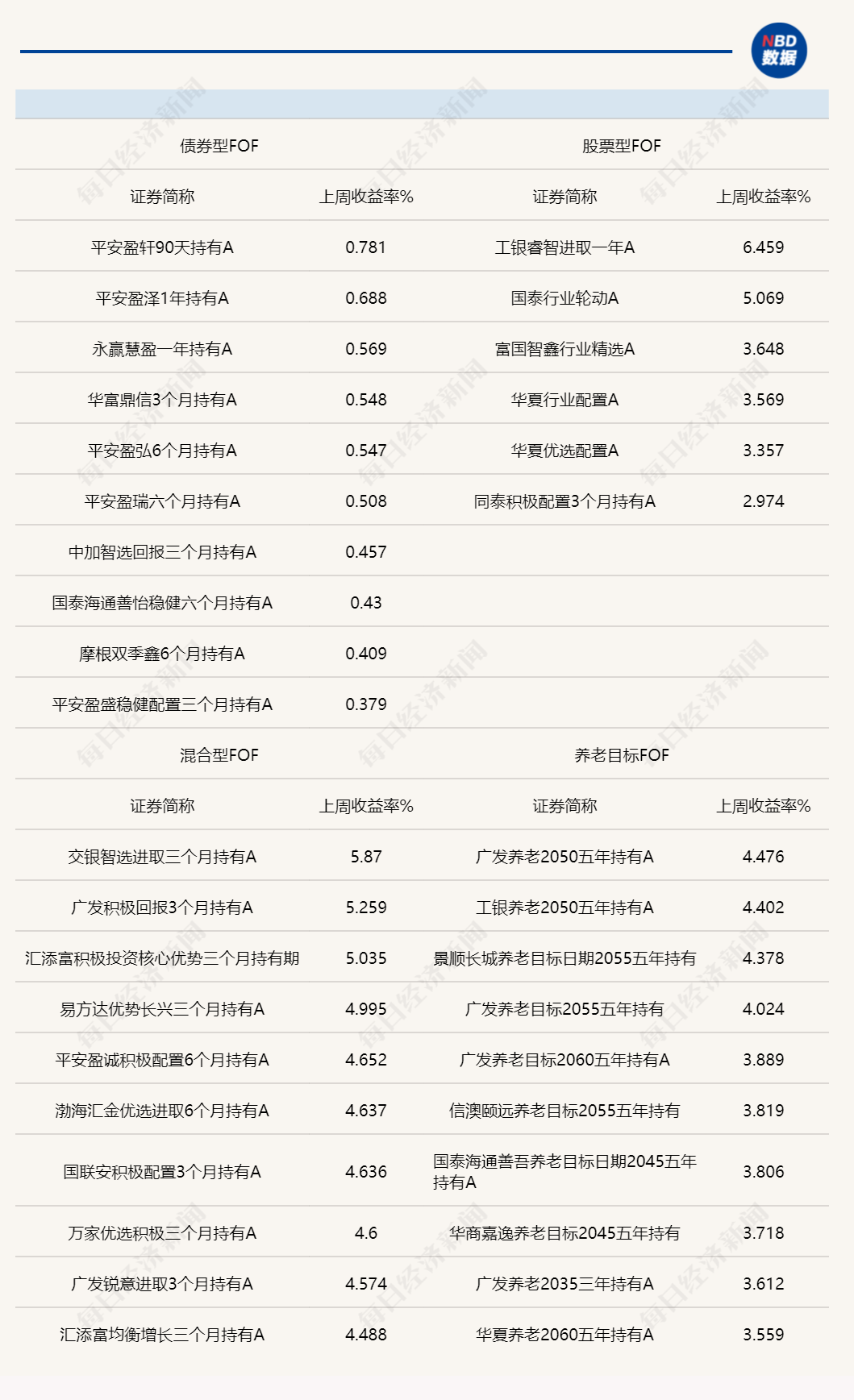
Group 1 - The Shanghai Composite Index has shown a continuous upward trend, achieving a 16-day winning streak and surpassing 4100 points, with significant gains in various sectors including defense, media, and non-ferrous metals [1][3] - Equity FOF funds have performed well, with stock-type FOFs showing the highest weekly returns, some exceeding 6%, indicating strong investor demand for asset allocation products [1][3] - The issuance of public funds has increased, with 91 new funds launched in early 2026, reflecting optimistic expectations for equity assets among institutions [2][3] Group 2 - The brain-computer interface sector has gained attention following Elon Musk's announcement regarding Neuralink's plans for large-scale production, with market forecasts predicting the medical application market could reach $40 billion by 2030 [2][3] - The pharmaceutical and biotechnology sectors have been a focus for public fund research, with 89 investigations in the past week, indicating strong interest in this area [3][4] - The Hong Kong pharmaceutical sector has seen significant growth driven by ongoing medical demand and supportive policies, attracting substantial investment and boosting related indices [4]