脑机接口

Search documents
航天长峰:未实际开展脑机接口等相关业务、不从事商业航天相关业务
Ge Long Hui A P P· 2026-01-12 11:03
Core Viewpoint - Aerospace Changfeng's stock price has experienced a significant increase of 65.95% over a 12-day trading period from December 24, 2025, to January 12, 2026, indicating potential risks of a price correction in the near future [1] Business Segments - The company operates in three main business segments: military electronics, public safety, and high-end medical equipment [1] - Currently, the company has not engaged in brain-computer interface technologies or commercial aerospace-related businesses [1]

创新医疗:连续三日股价涨幅偏离值超20%,提示交易风险
Xin Lang Cai Jing· 2026-01-12 10:55
Core Viewpoint - The company's stock experienced an abnormal fluctuation with a cumulative closing price increase exceeding 20% over three consecutive trading days in January 2026, despite no significant changes in its operations or external environment [1] Group 1: Stock Performance - The stock price deviation occurred on January 8, 9, and 12, 2026, indicating unusual market activity [1] - The company confirmed that there were no corrections or supplementary disclosures to previously released information [1] Group 2: Business Operations - The company noted high market interest in its brain-computer interface business [1] - The subsidiary, Boling, launched the Cyberlink AC5 product in October 2025, generating revenue of 114,000 yuan in 2025 [1] - The Cyberlink AM5 product did not generate any revenue, and Boling is expected to incur operating losses in 2023 and 2024 [1] Group 3: Investor Advisory - The company advised investors to make rational investment decisions in light of the stock's volatility and the current business performance [1]

17连阳!“AI+”涨疯了
Ge Long Hui A P P· 2026-01-12 10:47
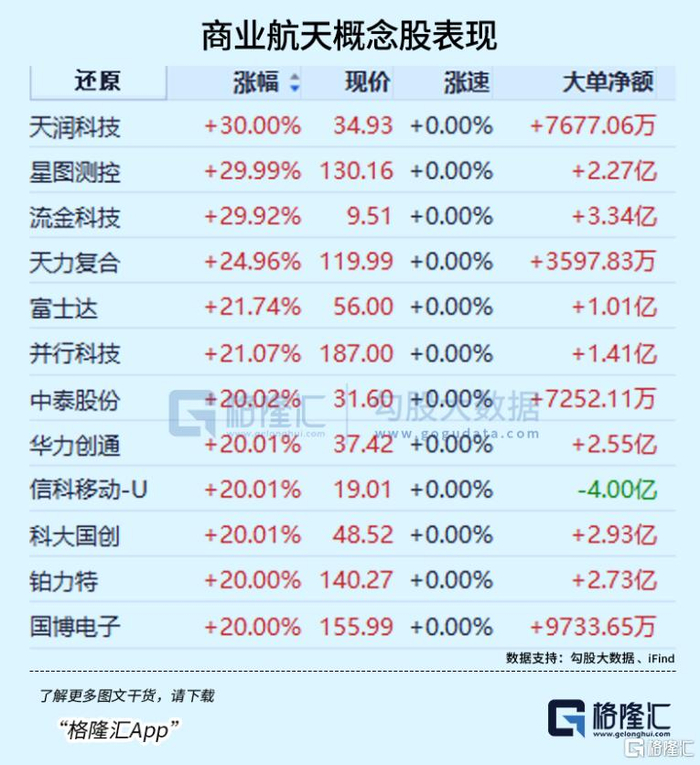
Core Viewpoint - The A-share market is experiencing a significant surge, with the Shanghai Composite Index rising by 1.09%, marking a 17-day consecutive increase and reaching a new high not seen in over a decade [1]. Market Performance - The single-day trading volume exceeded 3.6 trillion yuan, setting a new historical record, indicating heightened market enthusiasm [2]. - The "AI+" concept has seen a resurgence, with sectors such as AI healthcare, AI marketing, and various AI-related concepts leading in gains. The medical device ETF (562600) rose by 2.27% today and has increased by 11.66% year-to-date [3]. Sector Analysis - The "AI+" concept has concentrated its explosive growth, with sectors like AI applications, commercial aerospace, photovoltaics, retail, and precious metals showing significant gains, while oil and coal sectors faced declines [4]. - Notable stocks in the commercial aerospace sector include Luxin Venture Capital, which has seen 10 trading limits in 12 days, and other companies like Goldwind Technology and Tongyu Communication also performed well [4]. Specific Stock Performance - In the commercial aerospace sector, stocks such as Tianrun Technology (+30.00%), Xingtou Measurement Control (+29.99%), and Liujin Technology (+29.92%) have shown remarkable increases [6]. - The photovoltaic sector has also benefited from advancements in perovskite batteries and space photovoltaic concepts, with companies like Dongfang Risheng and Maiwei Shares leading the gains [7]. AI Applications - The AI application sector has collectively strengthened, with stocks like Yidian Tianxia and Liou Shares hitting the daily limit [9]. - Recent developments in AI applications include Walmart's collaboration with Google to enhance shopping experiences through AI [11]. Future Outlook - The AI industry is shifting focus from "computing power competition" to "application value," with 2026 expected to be a pivotal year for AI applications transitioning from "technology validation" to "commercial promotion" [14]. - The medical device ETF (562600) is highlighted for its significant exposure to the brain-computer interface sector, with a 23.79% concentration in this area, making it a key investment vehicle [20]. Investment Trends - The medical device ETF has seen a net inflow of 1.31 billion yuan over the past five days, indicating strong investor interest [22]. - The Hang Seng Medical ETF (159892) is also noted for capturing the trend of Chinese biopharmaceuticals going global, with significant inflows and a 13.56% increase year-to-date [24]. Conclusion - The integration of technology and healthcare is at a critical juncture, with investment strategies focusing on quality index tools to capitalize on long-term growth opportunities in AI healthcare and brain-computer interfaces [26].


公募基金指数跟踪周报(2026.01.05-2026.01.09):权益市场交投活跃,顺势而为避免追高-20260112
HWABAO SECURITIES· 2026-01-12 10:43
Report Industry Investment Rating No relevant content provided in the report. Core Viewpoints of the Report - In the first week of 2026 (01.05 - 01.09), the A - share market continued its upward trend, with the Shanghai Composite Index achieving 16 consecutive positive days and standing above 4100 points. The market trading remained highly active, with Friday's turnover reaching 3 trillion and the margin trading balance exceeding 2.6 trillion. The market was mainly driven by bottom - up growth themes, with technology - related sectors like AI applications, commercial space, and brain - computer interfaces rotating. The small and medium - cap style was dominant [3][12]. - In the short term, the overseas US employment market has resilience but also structural pressure. Inflation data is not expected to have a strong rebound, and the market has digested the possibility of the Fed not cutting interest rates in January. Overseas markets may experience high - level volatility in the short term, with limited impact on the domestic market. The overall supply - demand of market funds is neutral to optimistic, and with the profit - making effect, off - market funds may continue to flow in, and the market is expected to continue its upward trend [3][14]. - Last week (01.05 - 01.09), the bond market showed a "V - shaped reversal", with long - term yields generally weakening. The short - term sentiment in the bond market has stabilized slightly, but the possibility of interest rate cuts in the medium and short term is still low. The bond market lacks positive catalysts, and it may have a short - term rebound but is likely to remain neutral in the medium term, with a dominant wait - and - see sentiment [4][15]. Summary According to Relevant Catalogs 1. Weekly Market Observation 1.1. Equity Market Review and Observation - Market Performance: In the first week of 2026 (01.05 - 01.09), the A - share market continued to rise, with major broad - based indices generally increasing and reaching new stage highs. The trading volume on Friday returned to the peak of 3 trillion, and the margin trading balance exceeded 2.6 trillion. The market was driven by growth themes such as AI applications, commercial space, and brain - computer interfaces, with the small and medium - cap style being dominant [12]. - Sector Analysis: The brain - computer interface sector was active this week. Expectations of Neuralink's mass production, the establishment of Gestalt Technology in China, and market expectations for the "14th Five - Year Plan" drove the sector's sentiment. The sector may maintain its popularity with the upcoming "2026 Brain - Computer Interface Developers Conference" and other positive news. The aerospace sector had a continuous rally, driven by factors such as the IPO boom in the commercial space field, policy support, and satellite constellation plans. The growth of the growth sector was also related to the CES 2026 exhibition, with the intelligent vehicle and robot sectors being catalyzed by the "physical AI" concept and the focus on the autonomous driving ecosystem and mass production plans at the CES 2026 [12][13]. - Outlook: Overseas markets may experience high - level volatility in the short term with limited impact on the domestic market. The market funds' supply - demand is neutral to optimistic, and off - market funds may continue to flow in. However, the establishment of a fundamental one - sided trend still needs the verification of better - than - expected domestic demand. It is recommended that funds that missed the previous rally wait patiently for policy clues during the "Two Sessions" to seek more certain allocation opportunities [14]. 1.2. Pan - Fixed - Income Market Review and Observation - Bond Market: Last week (01.05 - 01.09), the bond market showed a "V - shaped reversal", with the 1 - year Treasury yield falling 4.35BP to 1.29%, the 10 - year yield rising 3.55BP to 1.88%, and the 30 - year yield rising 4.95BP to 2.30%. The short - term sentiment in the bond market has stabilized slightly, but the possibility of interest rate cuts in the medium and short term is low, and it may have a short - term rebound but remain neutral in the medium term [4][15]. - US Treasury Bonds: The US Treasury yield curve flattened last week, with short - term yields rising and long - term yields falling. The 1 - year yield rose 5BP to 3.52%, the 2 - year yield rose 7BP to 3.54%, and the 10 - year yield fell 1BP to 4.18%. The market believes the probability of the Fed cutting interest rates in the short term is small [15][16]. - REITs: The CSI REITs Total Return Index rose 1.89% last week, closing at 1028.93 points. Four new public REITs made progress in the primary market [16]. 2. Fund Index Performance Tracking 2.1. Equity Strategy Theme - Based Index - **Active Stock Fund Selection Index**: The index selects 15 funds in each period, with equal - weight allocation. It selects active equity funds based on performance competitiveness and style stability in value, balanced, and growth styles, and matches the style distribution of the CSI Equity - Oriented Fund Index. The performance benchmark is the CSI Equity - Oriented Fund Index (930950.CSI) [20]. 2.2. Investment Style - Based Index - **Value Stock Fund Selection Index**: It includes both deep - value and quality - value styles. It selects 10 funds of deep - value, quality - value, and balanced - value styles based on multi - period style classification. The performance benchmark is the CSI 800 Value Index (H30356.CSI) [20]. - **Balanced Stock Fund Selection Index**: Balanced - style fund managers balance stock valuation and growth. The index selects 10 relatively balanced, value - growth style funds based on multi - period style classification. The performance benchmark is the CSI 800 (000906.SH) [22]. - **Growth Stock Fund Selection Index**: The growth style aims to capture the double - click opportunities of performance and valuation. It selects 10 funds of active - growth, quality - growth, and balanced - growth styles based on multi - period style classification. The performance benchmark is the 800 Growth Index (H30355.CSI) [24][26]. 2.3. Industry Theme - Based Index - **Pharmaceutical Stock Fund Selection Index**: It selects funds based on the intersection market value of fund equity holdings and the constituent stocks of the representative index (CITIC Pharmaceutical). The average purity in the past 3 years/inception should be no less than 60%. It constructs an evaluation system and selects 15 funds. The performance benchmark is the pharmaceutical theme fund index (fitted by Huabao Securities) [28]. - **Consumer Stock Fund Selection Index**: It selects funds based on the intersection market value of fund equity holdings and the constituent stocks of representative indices (CITIC Automobile, Home Appliances, etc.). The average purity in the past 3 years/inception should be no less than 50%. It constructs an evaluation system and selects 10 funds. The performance benchmark is the consumer theme fund index (fitted by Huabao Securities) [31]. - **Technology Stock Fund Selection Index**: It selects funds based on the intersection market value of fund equity holdings and the constituent stocks of representative indices (CITIC Electronics, etc.). The average purity in the past 3 years/inception should be no less than 60%. It constructs an evaluation system and selects 10 funds. The performance benchmark is the technology theme fund index (fitted by Huabao Securities) [34]. - **High - end Manufacturing Stock Fund Selection Index**: It selects funds based on the intersection market value of fund equity holdings and the constituent stocks of representative indices (CITIC Construction, etc.). The average purity in the past 3 years/inception should be no less than 50%. It constructs an evaluation system and selects 10 funds. The performance benchmark is the high - end manufacturing theme fund index (fitted by Huabao Securities) [37]. - **Cyclical Stock Fund Selection Index**: It selects funds based on the intersection market value of fund equity holdings and the constituent stocks of representative indices (CITIC Petroleum & Chemicals, etc.). The average purity in the past 3 years/inception should be no less than 50%. It constructs an evaluation system and selects 5 funds. The performance benchmark is the cyclical theme fund index (fitted by Huabao Securities) [41]. 2.4. Money - Market Enhancement Index - **Money - Market Enhancement Strategy Index**: It aims at liquidity management, pursuing a curve that exceeds money - market funds and is smooth and upward. It mainly allocates money - market funds with relatively good performance and inter - bank certificate of deposit index funds in passive index - bond funds. The performance benchmark is the CSI Money - Market Fund Index (H11025.CSI) [44]. 2.5. Pure - Bond Index - **Short - Term Bond Fund Selection Index**: It aims at liquidity management, pursuing a smooth and upward curve while ensuring drawdown control. It mainly allocates 5 funds with stable long - term returns, strict drawdown control, and significant absolute - return ability. The performance benchmark is 50% * Short - Term Pure - Bond Fund Index + 50% * Ordinary Money - Market Fund Index [46]. - **Medium - and Long - Term Bond Fund Selection Index**: It invests in medium - and long - term pure - bond funds, pursuing stable returns while controlling drawdowns. It selects 5 funds with both return and drawdown control, and adjusts the duration and the ratio of credit - bond funds and interest - rate - bond funds according to market conditions. [48] 2.6. Fixed - Income + Index - **Low - Volatility Fixed - Income + Selection Index**: The equity center is 10%. It selects 10 funds with an equity center (considering convertible bond and stock holdings) within 15% in the past three years and recently. The performance benchmark is 10% CSI 800 Index+90% ChinaBond New Composite Full - Price Index (CBA00303.CS) [49][52]. - **Medium - Volatility Fixed - Income + Selection Index**: The equity center is 20%. It selects 5 funds with an equity center between 15% - 25% in the past three years and recently. The performance benchmark is 20% CSI 800 Index+80% ChinaBond New Composite Full - Price Index (CBA00303.CS) [52]. - **High - Volatility Fixed - Income + Selection Index**: The equity center is 30%. It selects 5 funds with an equity center between 25% - 35% in the past three years and recently. The performance benchmark is 30% CSI 800 Index+70% ChinaBond New Composite Full - Price Index (CBA00303.CS) [56]. 2.7. Other Pan - Fixed - Income Index - **Convertible Bond Fund Selection Index**: It selects bond - type funds with the average proportion of convertible bond investment in bond market value no less than 60% in the latest period and no less than 80% in the past four quarters as the sample space. It constructs an evaluation system and selects 5 funds [59]. - **QDII Bond Fund Selection Index**: It selects 6 funds with stable returns and good risk control based on credit and duration conditions, with underlying assets being overseas bonds [61]. - **REITs Fund Selection Index**: It selects 10 funds with stable operation, reasonable valuation, and certain elasticity based on the underlying asset type [62].
A股五张图:今夕是何年?
Xuan Gu Bao· 2026-01-12 10:35
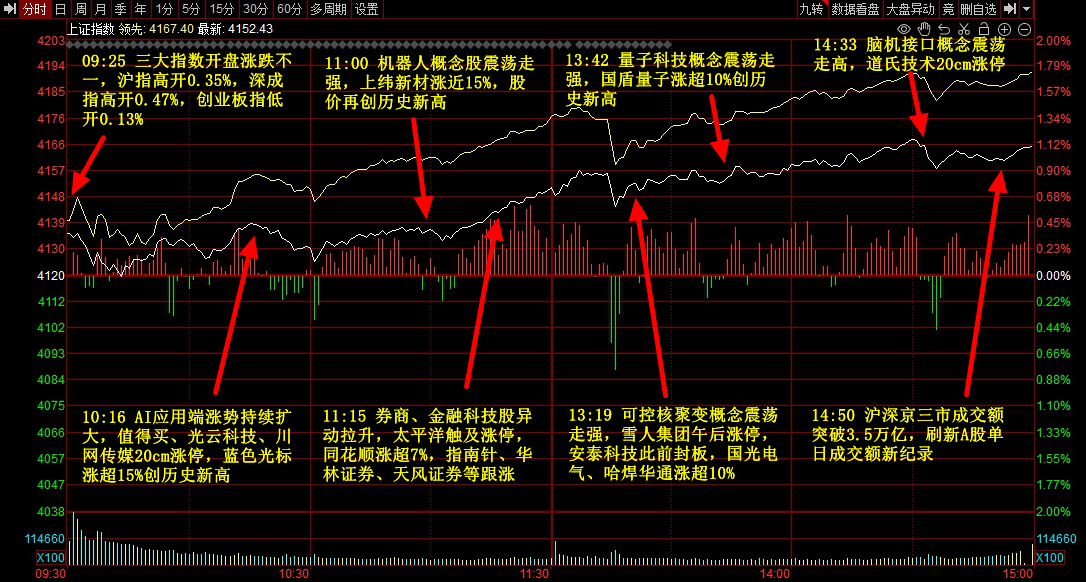
Market Overview - A-shares experienced a significant surge, reminiscent of a bull market, with major sectors like AI applications, aerospace, and finance seeing substantial gains [3] - The Shanghai Composite Index, Shenzhen Component Index, and ChiNext Index rose by 1.09%, 1.75%, and 1.82% respectively, with over 4,100 stocks advancing and more than 1,100 declining [3] - The total trading volume exceeded 3.6 trillion yuan, setting a new historical record for A-shares [3][15] AI Applications - AI application stocks saw a rare and violent surge, with multiple companies hitting the daily limit up [4] - Notable stocks included博瑞传播, 恒为科技, and 利欧股份, which all experienced consecutive limit-up days [4] - The AI marketing sector rose over 14%, alongside significant gains in AI programming and various AI application concepts [7] Aerospace Sector - The aerospace sector continued its strong performance, with stocks like 银河电子 and 金风科技 achieving consecutive limit-up days [12] - The sector saw a daily increase of 7.38%, driven by ongoing policy support and media coverage [13] Trading Volume and Financial Sector - The trading volume surpassed 1 trillion yuan within the first 20 minutes of trading, indicating a likely record-breaking day [15] - Financial and brokerage stocks responded positively, with 太平洋 and 大智慧 hitting the limit up, and other financial technology stocks rising over 10% [15] Company Specifics - 科蓝软件 attempted to leverage the GEO concept in its communications, but initially struggled to maintain momentum in its stock price [17] - The company has a history of aligning its messaging with trending concepts, including aerospace and brain-computer interfaces, but its effectiveness in capitalizing on these trends has been questioned [18][19]
17连阳!“AI+”涨疯了
格隆汇APP· 2026-01-12 10:29
Core Viewpoint - The A-share market is experiencing a significant surge, with the Shanghai Composite Index rising 1.09% and achieving a 17-day consecutive increase, reaching a 10-year high [2][3]. Group 1: Market Performance - The daily trading volume exceeded 3.6 trillion yuan, setting a new historical record, indicating heightened market enthusiasm [3]. - The "AI+" concept has seen a resurgence, with sectors such as AI healthcare, AI marketing, and various AI-related concepts leading in gains. The Medical Device ETF (562600) rose by 2.27% today and has increased by 11.66% year-to-date [4]. Group 2: Sector Analysis - AI applications, commercial aerospace, photovoltaics, retail, and precious metals sectors showed significant gains, while oil and coal sectors faced declines [5]. - Notable stocks in the commercial aerospace sector include Lushin Investment, which achieved 10 boards in 12 days, and Jin Feng Technology, which has seen a five-day consecutive increase [5]. Group 3: Commercial Aerospace - The commercial aerospace sector is highlighted by stocks such as Tianrun Technology (+30.00%), Xingtum Control (+29.99%), and Liujin Technology (+29.92%), among others, showcasing substantial net buying [6]. Group 4: Photovoltaic Sector - The photovoltaic sector is boosted by perovskite batteries and space photovoltaic concepts, with companies like Dongfang Risen, Maiwei Co., and Jiejia Weichuang leading the gains [7][8]. - The increasing focus on space power supply systems is expected to enhance the cost-effectiveness of photovoltaic systems [9]. Group 5: AI Applications - AI applications are gaining traction, with stocks like Yidian Tianxia and Liou Shares hitting the daily limit. Recent news indicates that major companies are rapidly entering various AI application scenarios [9][10]. - The GEO (Generative Engine Optimization) concept is emerging, focusing on optimizing content for AI searches, differing from traditional SEO strategies [11]. Group 6: AI in Healthcare - OpenAI has launched "ChatGPT Health," integrating health-related dialogues and electronic medical records, marking a significant step in AI's role in healthcare [12]. - The medical sector is witnessing a transformation from AI as an auxiliary tool to a comprehensive lifecycle management system, with high-value data creating competitive advantages for specialized firms [21][22]. Group 7: Investment Opportunities - The Medical Device ETF (562600) has a significant focus on brain-computer interface (BCI) technologies, with a 23.79% concentration in this area, making it a key investment vehicle [28]. - The Hang Seng Medical ETF (159892) is positioned to capture the trend of Chinese biopharmaceuticals going global, with a notable inflow of funds and a year-to-date increase of 13.56% [30][32]. Group 8: Future Outlook - The integration of technology and healthcare is at a pivotal point, with investors encouraged to leverage quality index tools to capitalize on long-term growth opportunities [34]. - The current low valuations in the Hong Kong pharmaceutical sector present a compelling case for investment, particularly in innovative drug development and AI applications [30][35].

VIP机会日报AI应用概念全线爆发 栏目精选精选“GEO”主题研报并解读 提及多家公司大涨
Xin Lang Cai Jing· 2026-01-12 10:28
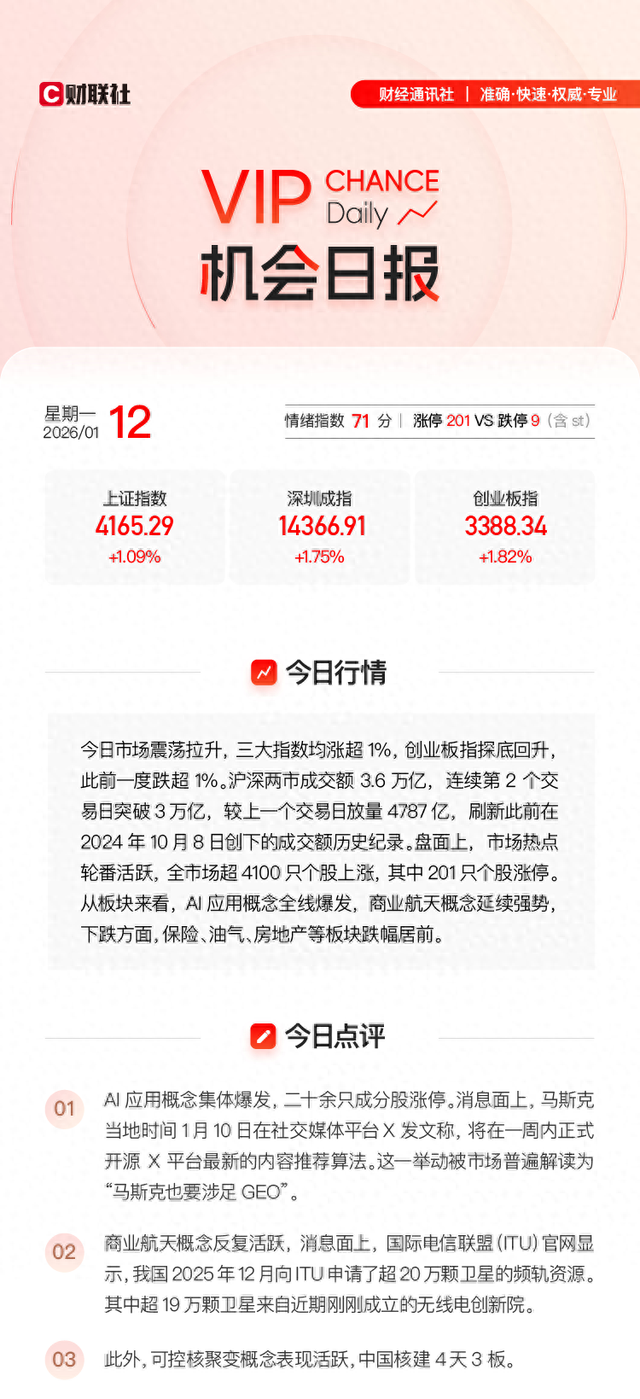
Group 1: AI Applications - Elon Musk announced on January 10 that he will open-source the latest content recommendation algorithm for the X platform, interpreted as a move into Generative AI Optimization (GEO) [4] - GEO, based on generative AI, aims to enhance the visibility of AI search results and is expected to evolve advertising marketing models, potentially creating a market worth billions [5] - Companies like Zhejiang Wenlian, BlueFocus, and Insai Group have seen significant stock price increases, with respective gains of 10.61%, 27.21%, and 25.63% as of January 12 [5] Group 2: AI in Healthcare - OpenAI's release of ChatGPT Health is seen as a significant step into the trillion-dollar AI healthcare market, with institutions identifying healthcare as a key application area for AI [8] - Weining Health achieved a 20% price limit increase following the news, reflecting strong market interest [8] Group 3: AI Marketing - JD.com launched an AI agent named "Jing Xiaotong," with projections indicating that the AIGC advertising market could grow tenfold to 150 billion yuan by 2030 [10] - Yidian Tianxia, a Google partner, has benefited from this trend, experiencing a stock price increase of 42.86% [10][11] Group 4: Commercial Aerospace - The Guangzhou government plans to build a globally influential "Sky City" and a new hub for commercial aerospace by 2035, with the market expected to reach 7.8 trillion yuan by 2030 [14] - Companies like Tongyu Communication and Mengsheng Electronics have seen stock price increases of 41.05% and 26.07%, respectively, as of January 12 [14] Group 5: Satellite Technology - The commercial aerospace sector is entering a new phase of rapid development, with a significant increase in satellite applications, including 200,000 new satellite applications in China [25] - China Satellite's stock reached a limit increase following this news, reflecting strong investor interest [25][26] Group 6: Brain-Computer Interfaces - Strong Brain Technology has reportedly submitted a confidential IPO application in Hong Kong, indicating a significant move in the brain-computer interface sector [33] - The company completed a 2 billion yuan financing round, positioning itself as a key player in the market, second only to Neuralink [33][34]
麦捷科技(300319.SZ):公司产品暂未应用于脑机接口细分领域
Ge Long Hui· 2026-01-12 10:28
Group 1 - The core viewpoint of the article is that 麦捷科技 (MikroTech) has not yet applied its products in the brain-computer interface sector but is actively monitoring emerging industry trends to expand its business layout [1] Group 2 - The company is focusing on the development trends of new industries [1] - 麦捷科技 aims to broaden its business scope in response to market opportunities [1]

半导体设备ETF(159516)净流入1.77亿份,连续5日吸金超23亿元,行业周期韧性与AI驱动逻辑获市场验证
Mei Ri Jing Ji Xin Wen· 2026-01-12 10:22
Group 1 - The core viewpoint is that the semiconductor equipment ETF (159516) has seen a net inflow of 177 million shares, accumulating over 2.3 billion yuan in five consecutive days, indicating market validation of industry resilience and AI-driven logic [1][2]. - The semiconductor industry is currently in a global technology supercycle, driven by AI computing power expansion, data center growth, and the electronic upgrade of smart vehicles, leading to rapid growth in communication hardware demand [2]. - The upward cycle of the semiconductor industry, which began in Q1 2023, has lasted over nine quarters, significantly surpassing previous cycles driven by consumer electronics, showcasing structural depth and capital expenditure resilience [2]. Group 2 - The AI hardware sector's strength is primarily due to marginal changes in profit growth, with no significant turning point observed yet, and it is expected to continue in a favorable valuation environment [2]. - The AI application sector is transitioning from a technological follower to a core commercial player, supported by policy backing, demand release, ecosystem maturity, and increased capital investment, with domestic models approaching the international top tier [2]. - The semiconductor equipment ETF tracks the semiconductor materials and equipment index (931743), focusing on key materials and equipment suppliers necessary for semiconductor manufacturing, reflecting the overall performance of upstream enterprises in the semiconductor industry [2].
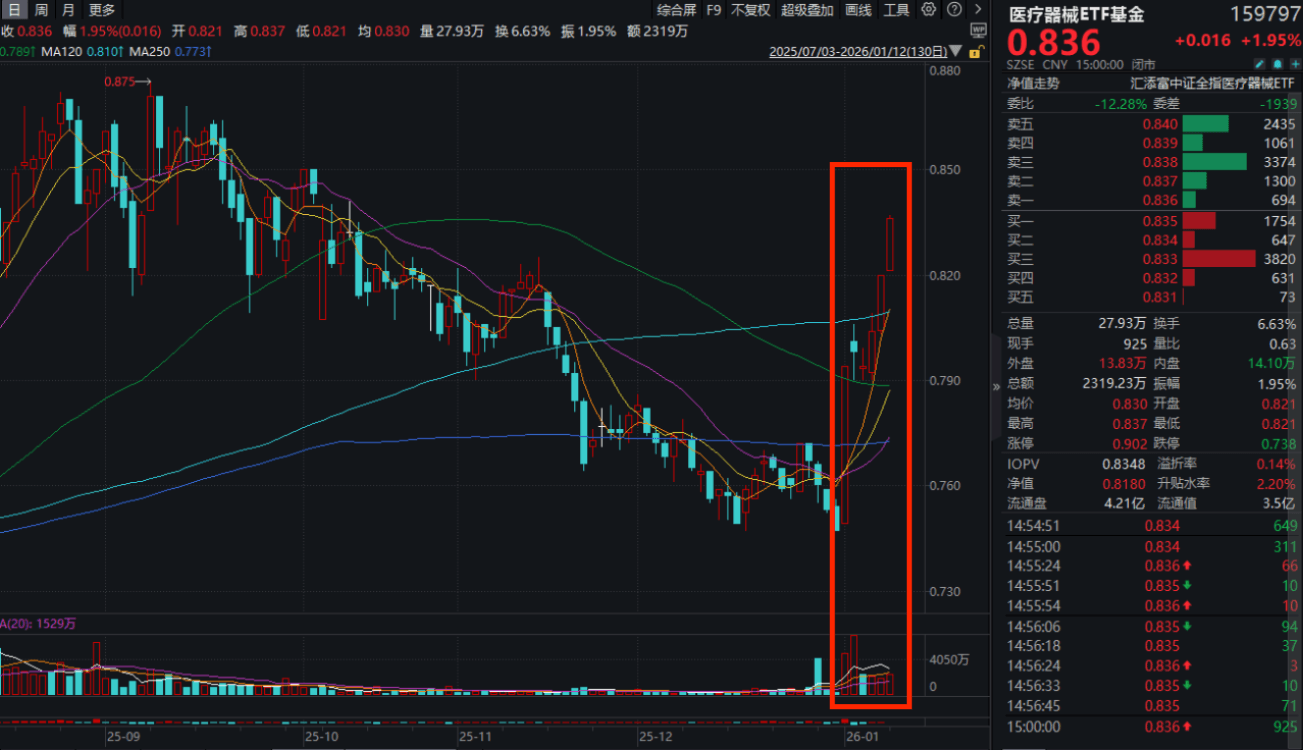
人类首次“太空脑机接口实验”!强脑科技以保密形式提交香港IPO申请!同类费率最低档的医疗器械ETF基金(159797)收涨近2%强势三连阳!
Sou Hu Cai Jing· 2026-01-12 10:18
Group 1: Brain-Computer Interface (BCI) Industry - Strong Brain Technology has submitted a confidential IPO application in Hong Kong, indicating a significant step in the BCI sector [1] - The Tianjin University BCI and Human-Machine Integration Laboratory has developed a comprehensive layout from high-performance devices to system integration, focusing on non-invasive BCI technology [1] - The BCI industry is experiencing a golden period of development, with a projected market size of $2.94 billion by 2025 and expected to grow to approximately $12.4 billion by 2034, reflecting a compound annual growth rate of 17.35% [7] Group 2: Clinical Applications and Innovations - The Tianjin University has launched a series of innovative medical devices for clinical applications, covering areas such as stroke rehabilitation, spinal cord injury assistance, depression treatment, and auditory disorders [1] - The BCI technology has been successfully applied in aerospace, including the development of a brain-machine interaction system for space stations, enhancing astronaut performance and emotional state monitoring [1] Group 3: Market Trends and Investment Opportunities - The BCI sector is characterized by active investment and financing activities, with the U.S., EU, and Japan leading in strategic initiatives [4] - The medical device ETF fund (159797) has shown strong performance, with significant net subscriptions, indicating investor confidence in the medical device sector [5][8] - The ETF fund covers core areas of medical devices, including high-value consumables and in vitro diagnostics, with the top ten weighted stocks accounting for 45.04% of the fund [8]