
指数投资

Search documents
时隔14年!主动权益大厂,再度布局ETF
Zhong Guo Zheng Quan Bao· 2025-09-30 04:37
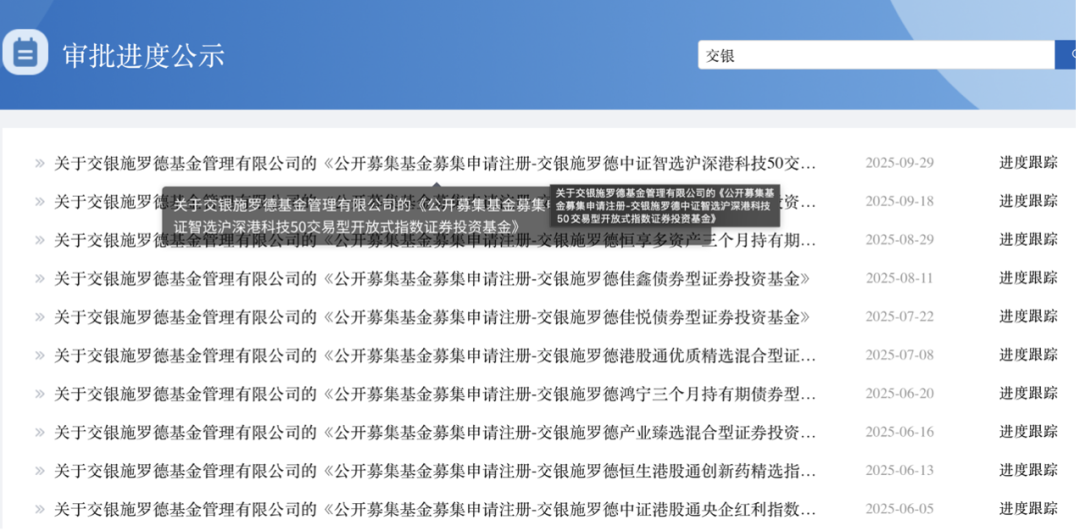
Group 1 - On September 29, the company reported the launch of the CCB Schroder CSI Selected Hong Kong and Shanghai Technology 50 ETF, marking a significant return to the ETF market after 14 years since the establishment of the CCB Schroder Shenzhen 300 Value ETF in September 2011 [1][2][4] - The ETF aims to reflect the performance of 50 technology companies with strong research capabilities and good fundamentals selected from the mainland and Hong Kong markets, with the top five industries by weight being electronics, machinery, communications, power equipment, and computers [4] - The ETF market in China has seen significant expansion, with total ETF assets increasing from 373 billion to 547 billion this year, representing a growth of over 46% [6] Group 2 - On September 25, another active equity firm, Xingzheng Global Fund, submitted its first ETF product, the Xingzheng Global CSI 300 Quality ETF, indicating a trend among active managers to diversify into ETF offerings [5] - Major fund companies such as Huaxia Fund and E Fund have seen their ETF management scales exceed 800 billion, while other firms like Huatai-PB and Southern Fund have also reported substantial growth in their ETF assets [6][7] - Several "super products" in the ETF market have attracted significant capital this year, with the Fortune CSI Hong Kong Internet ETF leading with an increase of over 70 billion, followed by other major ETFs with substantial growth figures [7]

行情回暖基金发行提速 超50只新产品节后“蓄势待发”
Zhong Guo Zheng Quan Bao· 2025-09-28 23:26
Group 1 - The core viewpoint of the articles highlights a significant increase in the issuance of public funds in the A-share market, with over 50 new funds scheduled for release after the National Day holiday, primarily focusing on "rights-containing" products [1][2][4] - In October, there are more than 50 new public funds set to be issued, with nearly 20 products launched on October 9 alone, indicating a strong market response [2][4] - The number of newly issued public funds has surpassed 1,100 in the first three quarters of this year, approaching the total expected for the entire year of 2024, with a notable increase in the third quarter [4][5] Group 2 - The upcoming public funds include a variety of products, with 19 passive index funds and 12 equity mixed funds scheduled for issuance in October, featuring well-known fund managers [2][3] - Several new public fund products have set initial fundraising caps, such as 10 billion yuan for some funds and 20 billion yuan for others, indicating a strategic approach to fundraising [3][4] - The issuance of FOF (Fund of Funds) products has also seen a resurgence, with over 20 new FOF products reported since September, reflecting a growing demand for diversified asset allocation [6][7]
行情回暖 基金发行提速 超50只新产品节后“蓄势待发”
Zhong Guo Zheng Quan Bao· 2025-09-28 22:13
Core Insights - The public fund industry in China is experiencing a significant revival, with over 50 new public funds scheduled for issuance after the National Day holiday, primarily focusing on "rights-containing" products [1][2][4] - The number of newly issued public funds has surpassed 1,100 in the first three quarters of this year, nearing the total expected for 2024, with a notable increase in the third quarter [4] - Major fund managers are leading the issuance of new products, including well-known names such as Jin Zicai from Caitong Fund and Yao Jiahong from Guojin Fund [2][4] Fund Issuance Trends - In October, more than 50 new public funds are set to be issued, with nearly 20 products launching on October 9 alone [2] - Passive index funds dominate the new offerings, with 19 planned for issuance, covering various growth and dividend style indices [2] - Active equity products are also gaining traction, with 12 new mixed equity funds scheduled for release [2] Fundraising Limits - Several upcoming public fund products have set initial fundraising caps, such as 1 billion yuan for some funds and 2 billion yuan for others [3] Market Performance - The A-share market's upward trend has led to a significant increase in public fund issuance, with monthly new product numbers rising from around 120 in Q2 to approximately 150 in Q3 [4] - The number of newly issued passive index funds has exceeded 480 in the first three quarters, with index-enhanced funds also seeing substantial issuance [4] Investor Interest - The AI sector has attracted considerable investor interest, as evidenced by the high subscription rates for newly launched AI-related funds [5] New Product Developments - Xingsheng Global Fund has reported its first ETF product, the Xingsheng Global CSI 300 Quality ETF, marking a significant move into the ETF space [6] - The FOF (Fund of Funds) market is also seeing increased activity, with over 20 new FOF products reported since September, reflecting a growing demand for diversified asset allocation [6][7]
超50只新产品节后“蓄势待发”
Zhong Guo Zheng Quan Bao· 2025-09-28 20:46
Core Viewpoint - The A-share market is experiencing a surge in public fund issuance, with over 50 new funds scheduled for release after the National Day holiday, primarily focusing on "rights-containing" products [1][2]. Fund Issuance Trends - More than 1,100 public funds have been launched in the first three quarters of this year, nearing the total expected for 2024, with a significant increase in new fund numbers in Q3 compared to Q2 [3][4]. - In October, there are over 50 new funds set to be issued, with nearly 20 launched on October 9 alone, indicating strong market activity [1][3]. Types of Funds - The upcoming funds include 19 passive index funds covering various indices such as the ChiNext Composite and the STAR 50, as well as 12 actively managed equity funds led by notable fund managers [2][3]. - The issuance of index-enhanced funds has also increased, with a focus on major indices like the CSI 300 and the Hang Seng Index [2][3]. Fund Management Companies - Fund management companies like Fortune Fund and Huaxia Fund have been particularly active, with Fortune Fund launching over 50 new public funds this year, including 37 passive index funds [4]. - Other major players such as E Fund and Southern Fund have also reported high numbers of new fund launches, with Southern Fund raising over 40 billion yuan from new products [4]. New Product Highlights - The recent trend includes several funds setting initial fundraising caps, such as 1 billion yuan for certain products, indicating a strategic approach to manage fund sizes [3]. - The introduction of the first ETF by Xingzheng Global Fund has garnered significant attention, marking a notable entry into the ETF market by a brokerage-affiliated fund company [5]. FOF Product Development - The FOF (Fund of Funds) market has seen a revival, with over 20 new FOF products reported since September, reflecting a growing demand for diversified asset allocation among investors [6]. - The recent regulatory changes have led to more detailed performance benchmarks for FOF products, enhancing their appeal to investors seeking diversified investment strategies [6].
周报 | 理财公司加快布局指数投资,华夏理财再发5只指数产品
2 1 Shi Ji Jing Ji Bao Dao· 2025-09-24 10:16
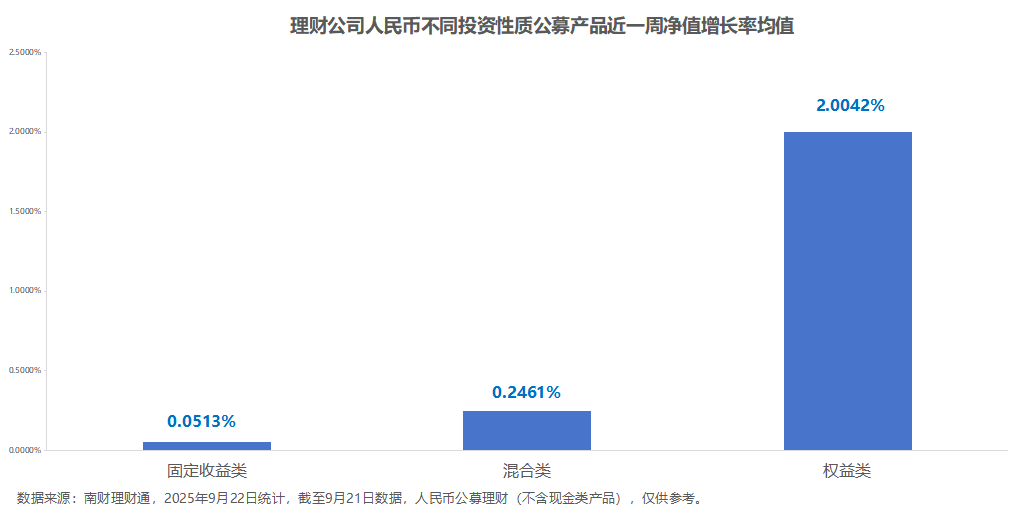
Market Overview - The bond market experienced fluctuations with a tight funding environment, as indicated by a weighted average of DR007 at 1.5096% and a 10-year government bond yield closing at 1.88% [2] - The A-share market showed wide fluctuations, with the ChiNext Index and the Sci-Tech Innovation 50 Index increasing by 2.34% and 1.84% respectively, while the Shanghai Composite Index and the CSI 300 Index decreased by 1.30% and 0.44% respectively [2] Product Performance - The number of products below net asset value remains low, with 26,354 public wealth management products in existence, of which 285 have a cumulative net value below 1, resulting in a comprehensive break-even rate of 1.08% for bank wealth management [3] - The break-even rates for equity and mixed wealth management products are 18.37% and 3.04% respectively, while fixed income public wealth management products have a break-even rate of 0.95% [3] New Product Issuance - A total of 467 wealth management products were issued by 32 wealth management companies from September 15 to September 19, with the highest issuance from joint-stock banks [5] - The newly issued products primarily consist of R2 (medium-low risk), closed-end net value type, and fixed income public products, with mixed and equity products each issuing 5 products [5] - Pricing varied across different term products, with a notable increase of 7 basis points for 3-6 month term products, while 1-3 month and 2-3 year term products saw significant declines of 25 basis points [5] Investment Strategies - Huaxia Wealth Management has intensified its investment in equity products, issuing 5 index tracking products on September 18, which track various indices related to AI, high dividends, and military electronics [6] - The products have a fundraising scale of around 2 million, with the highest being 2.3581 million for the "Tian Gong Ri Kai Product 19" [6] - Other wealth management companies, such as Zhuhai Wealth Management and Jiangyin Wealth Management, are also accelerating their index investment strategies [7] Yield Performance - Fixed income wealth management products saw a slight recovery in average net value growth rate to 0.0513%, while mixed and equity products had average growth rates of 0.2461% and 2.0042% respectively [8] - Among fixed income products, those with a term of over 3 years had the highest average net value growth rate of 0.0975% [8] Industry Trends - Recent announcements from listed companies indicate a shift towards wealth management, primarily using self-owned funds for investments in structured deposits and bank wealth management products, typically with terms of 6 months to 1 year [14] - The demand for wealth management is driven by the need for stable returns and liquidity, with expectations for steady growth in corporate wealth management scale [14] Notable Developments - Zhong Postal Wealth Management participated in the successful IPO of Hesai Technology, marking a significant event in the return of Chinese concept stocks to the market [15] - Shanghai Pudong Development Bank Wealth Management launched its first "Shanghai Sci-Tech Financial Theme" wealth management product, aligning with national innovation strategies [16] - Jianxin Wealth Management successfully issued its first structured wealth management product, combining fixed income assets with derivatives linked to gold [17]
市场行情分化,投资者该如何应对?
天天基金网· 2025-09-23 05:26
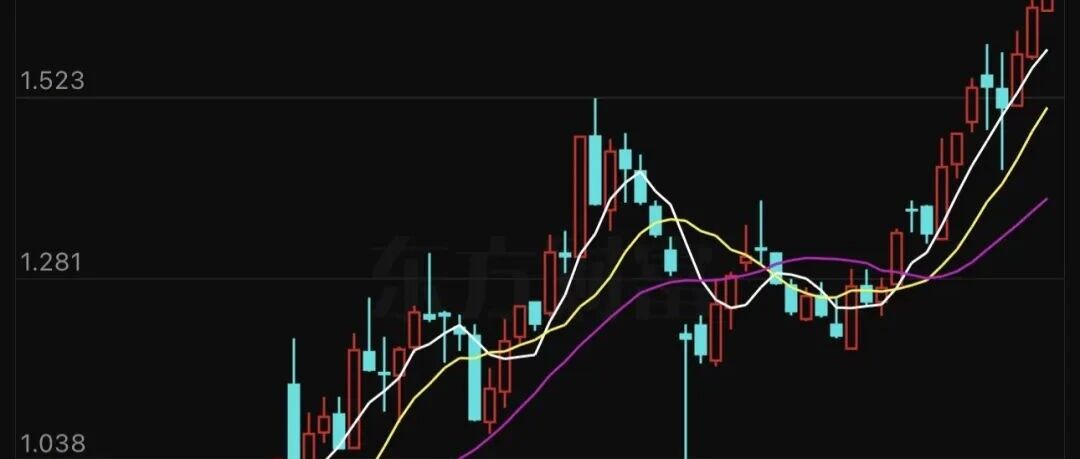
Core Viewpoint - The article discusses the divergence between market indices reaching new highs and individual account performances, emphasizing the need for investors to adapt their strategies in a changing market environment [2][4]. Group 1: Market Dynamics - Recent market behavior shows that while the Shanghai Composite Index has reached a ten-year high, most industries have only returned to their 2020-2021 levels, indicating a concentration of gains in a few sectors like banking, electronics, and food and beverage [2][3]. - The current market structure reflects a shift towards stronger companies, with a focus on sectors that exhibit high growth potential, particularly in artificial intelligence and technology [4]. Group 2: Investment Strategies - The article suggests that investing in index funds may be more beneficial than stock picking, as many individual stocks have not reached their previous highs, with only about 1,000 stocks surpassing their 2015 peaks [5][8]. - Index funds offer lower fees, higher transparency, and diversification, making them a preferable choice for average investors in a market where outperforming individual stocks is increasingly difficult [5][8]. Group 3: Investor Guidance - Investors with profitable positions are advised to consider taking profits and rebalancing their portfolios, while those with low exposure should assess their entry timing and maintain discipline [10][12]. - A step-by-step investment strategy is recommended for those looking to build positions, suggesting a gradual approach to investing in ETFs and technology sectors [16]. - The article emphasizes the importance of maintaining a balanced investment philosophy, focusing on understanding market trends and personal risk tolerance rather than comparing oneself to others [19][20].

一个“信仰级别”的赛道指数分析
佩妮Penny的世界· 2025-09-23 03:53
Core Viewpoint - The article discusses the investment landscape in the context of the robotics sector, emphasizing the advantages of ETF investments over individual stock trading, particularly in a high-volatility market like A-shares [3][5]. Group 1: Investment Strategy - The article highlights that the A-share market is characterized by high volatility and long-term low returns, suggesting that passive investment strategies, such as ETFs, are more effective for most investors [3][5]. - It mentions that the majority of returns in the A-share market come from ETF index funds rather than individual stocks, due to the intense competition and speculation in individual stock trading [3][5]. - The author plans to introduce a series of analyses on index investments, focusing on themes of interest to potentially include in their portfolio [3][5]. Group 2: Robotics ETF Analysis - The article focuses on the robotics ETF as a significant investment theme, driven by trends such as aging populations, automation, and the upgrading of manufacturing processes [5][8]. - It notes that the largest segment within the robotics sector is humanoid robots, with Tesla being a key player in this narrative [5][8]. - The article provides data on the performance of a specific robotics ETF, which has seen its scale exceed 10 billion yuan and a return of 66% since inception, largely due to the high representation of humanoid robot-related stocks [8][12]. Group 3: ETF Performance Metrics - The article presents performance metrics for the robotics ETF, indicating a year-to-date increase of 43.29% and a one-year return of 102.87%, outperforming the average of similar funds [12]. - It highlights the increasing institutional ownership in the ETF, which rose to 44.19% as of June 30, 2025, compared to 37.20% at the end of 2024 [13]. - The article discusses the valuation metrics of the robotics sector, indicating that current PE and PB ratios are relatively high, reflecting strong future growth expectations from investors [15]. Group 4: Future Outlook - The article suggests that the robotics industry is a "faith-based" sector with high growth and high expectations, but also significant volatility [15]. - It anticipates that practical applications in the robotics field may begin to materialize by Q4 2025, with potential catalysts including the release of Tesla's next-generation robot [15]. - The recommendation is to maintain a watchful eye on the sector and consider gradual entry at reasonable costs while waiting for long-term developments [15].
华夏基金走进中国石油大学,北京公募基金高质量发展在行动
Xin Lang Ji Jin· 2025-09-23 00:53
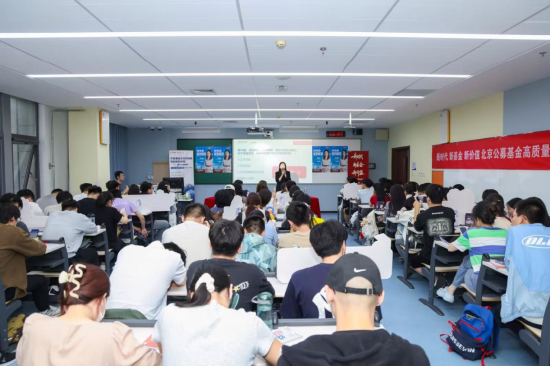
Group 1 - The event series aims to promote high-quality development of public funds in Beijing, enhancing its role as a national financial management center [1] - The activities will include multi-level and multi-form interactions to drive the transformation and upgrading of the public fund industry, improve service capabilities for the real economy, and strengthen investor education and protection [1][7] - As of the end of August, Beijing has 36 public fund companies and 3 public fund managers, with a total asset management scale of 81,433.18 billion yuan across 2,986 public fund products [7] Group 2 - The lecture by Huaxia Fund's senior strategy analyst focused on the basics of index funds and investment strategies, discussing global asset allocation through index investment tools [3] - Students expressed that they gained a deeper understanding of index fund mechanisms and market performance, broadening their financial perspectives [5] - Huaxia Fund has established a comprehensive investor education service system, covering various public fund products and targeting different life stages of investors [8] Group 3 - Huaxia Fund's investor education initiatives include a structured curriculum, diverse offline activities, a multi-level communication system, and a dedicated investor education base [8] - The company conducts targeted thematic research to understand investor satisfaction and improve educational efforts [9]

3个步骤,搭建自己的投资体系|投资小知识
银行螺丝钉· 2025-09-22 13:51
Core Viewpoint - The article emphasizes the importance of value investing principles applied to index funds, highlighting their lower risk due to diversification and the potential for long-term gains [3][4]. Group 1: Investment Philosophy - The investment philosophy is based on the equation: good variety + good price + long-term holding = good returns [4]. - Value investing, when applied to index funds, mitigates the risk of individual stock failures, as index funds consist of a diversified basket of stocks [3]. Group 2: Market Trends - The number of index fund options in the A-share market has increased, allowing for the application of the same investment principles to excellent industries and active funds [5]. Group 3: Framework and Detail - A solid investment framework is likened to a skeleton; it requires additional details and inputs to be effective. The method of "output driving input" is used to enhance understanding through various forms of content [6]. Group 4: Psychological Resilience - Understanding investment knowledge is one aspect, but the ability to remain steadfast during market fluctuations is crucial for success [7].

每经热评 | 药捷安康股价异动背后,是一堂ETF生态的“共修课”
Mei Ri Jing Ji Xin Wen· 2025-09-22 12:03
Group 1 - The recent stock price volatility of Hong Kong innovative drug company Yaojie Ankang (02617.HK) has drawn attention to the ETF tracking the Hong Kong Stock Connect Innovative Drug Index, highlighting issues within the ETF ecosystem [1] - The interconnected nature of the ETF ecosystem means that any minor flaw in index compilation, product management, liquidity provision, or investor education can lead to significant repercussions [1] - This incident emphasizes the new challenges and responsibilities faced by fund companies as key market participants in the era of rapid index investment development, necessitating proactive risk management even for passive products [1] Group 2 - The rapid growth of the ETF market has led to an influx of homogeneous ETFs, as many fund companies launch products tracking the same index, increasing investor selection difficulty and potentially causing short-term impacts on index constituent stocks [2] - Fund companies are encouraged to adopt a forward-looking approach, reducing blind issuance of products and focusing on long-term value, while enhancing research capabilities and service quality for differentiated development [2] - The improvement of the ETF ecosystem requires collaboration among regulators, index companies, fund companies, and sales institutions [2] Group 3 - Index providers are urged to optimize their methodologies, particularly regarding liquidity considerations for Hong Kong stocks, to minimize the impact of passive investment trading on small float stocks [3] - Enhancing pre-announcement and information disclosure transparency for index adjustments is crucial for maintaining market fairness and allowing all participants to respond timely [3] - Investors need to deepen their understanding of index investments, recognizing the specific risks associated with passive products, and fund companies should take responsibility for educating investors on risk-return characteristics [3]