
产业升级

Search documents
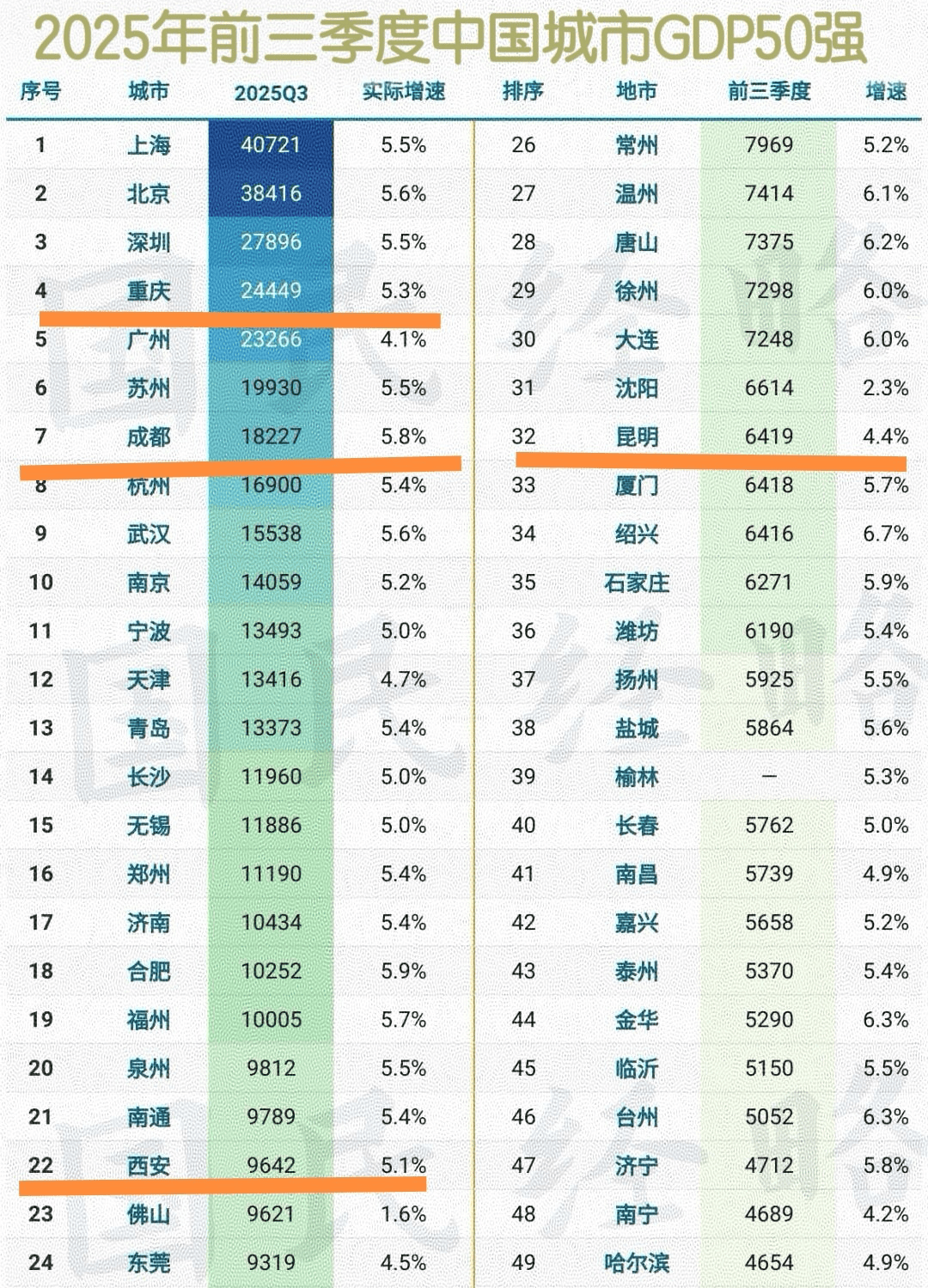
2025前三季度GDP50强揭榜:重庆稳压广州,西部仅4城入围,区域差距何解?
Sou Hu Cai Jing· 2025-11-16 04:01
Core Insights - The GDP rankings of China's top 50 cities for the first three quarters of 2025 reveal a continued economic disparity, with Shanghai, Beijing, and Shenzhen occupying the top three positions, while Chongqing maintains its fourth place, significantly ahead of Guangzhou [1][3] Group 1: Economic Performance - Shanghai leads with a GDP of 40,721 billion, growing at 5.5% [2] - Beijing follows with a GDP of 38,416 billion, showing a growth rate of 5.6% [2] - Shenzhen ranks third with a GDP of 27,896 billion, also growing at 5.5% [2] - Chongqing's GDP stands at 24,449 billion, with a growth rate of 5.3%, while Guangzhou's GDP is 23,266 billion, growing at 4.1% [2][3] Group 2: Regional Disparities - Over 70% of the top 50 cities are located in the eastern and coastal regions, highlighting the economic vitality of these areas [4] - Only four cities from the western region—Chongqing, Chengdu, Xi'an, and Kunming—made it to the top 50, with most rankings in the lower tier [4][5] - The eastern provinces, such as Jiangsu and Guangdong, dominate the list with 9 and 7 cities respectively, showcasing their economic strength [4] Group 3: Challenges in the West - The limited number of western cities in the rankings reflects challenges in industrial structure and population attraction [5] - Many western cities still rely on traditional resource-based industries, leading to insufficient growth momentum [5] - Population outflow is a significant issue, as cities like Xi'an and Kunming struggle to attract talent compared to eastern second-tier cities [5] Group 4: Future Strategies for the West - To narrow the gap with the east, western cities need to focus on three key areas: accelerating industrial upgrades, enhancing open cooperation, and optimizing talent policies [6] - The rise of Chongqing and Chengdu indicates potential for western cities, but innovation and openness are crucial for future competitiveness [6]

上海人社部门通过制度性创新 增强技能人才培养与新质生产力发展适配
Jie Fang Ri Bao· 2025-11-16 00:04
Core Insights - The article emphasizes the importance of high-quality labor as a key element of new productive forces, highlighting Shanghai's efforts to enhance vocational skills training and align it with industry needs [1][7] Group 1: Skills Training Initiatives - Shanghai has implemented a series of reforms in vocational skills training, focusing on three leading industries and addressing urgent labor shortages, with 679,200 subsidized training sessions conducted this year [1][3] - The city has introduced a dynamic analysis system for industry skill demands, utilizing big data to predict future skill trends and adjust training programs accordingly [2][6] - New training programs have been developed, such as the "Artificial Intelligence Promoter," aimed at equipping individuals with the skills to communicate AI technologies effectively [2][3] Group 2: Employment Outcomes - The employment rate for participants in targeted training programs, such as those for elderly care and home organization, has reached 100%, demonstrating the effectiveness of these initiatives [5][6] - The Shanghai government has provided substantial financial support for skills training, with a total of 471,000 individuals receiving subsidies amounting to 710 million yuan [3][7] Group 3: Future Directions - Shanghai plans to conduct a large-scale vocational skills enhancement campaign over the next three years, focusing on new and high-demand skills in key industries [7][9] - The city is also working on a gradient-based skills enhancement subsidy system, increasing support for critical sectors like integrated circuits and artificial intelligence by 30% [7][8] - The upcoming 48th World Skills Competition in Shanghai is expected to further promote the importance of skilled labor in national development [9]
10月经济:新动能加快塑造,政策持续加力
21世纪经济报道· 2025-11-15 23:31
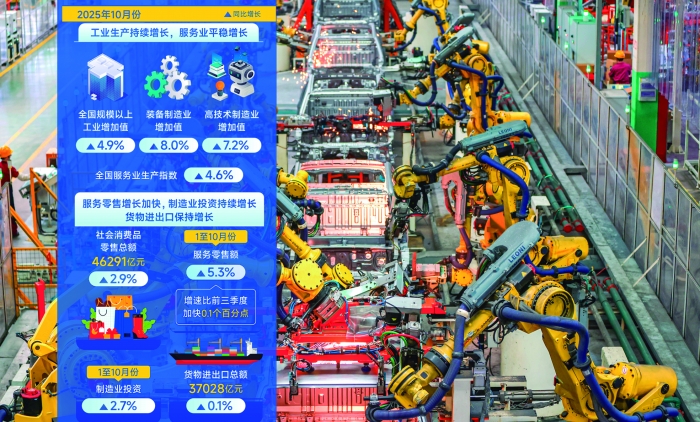
Economic Overview - In October, economic indicators showed a downward trend due to factors such as last year's high base, deep adjustments in the real estate sector, and weak domestic demand [1][4] - Despite the downturn, there were positive signs in the economy, particularly in service retail sales, which rebounded due to the National Day and Mid-Autumn Festival holidays, indicating significant consumption potential [1][11] Production and Investment - The industrial added value and service production index both recorded their lowest monthly growth rates of the year in October, with industrial added value growing by 4.9%, down 1.6 percentage points from the previous month [5][11] - Fixed asset investment (excluding rural households) decreased by 1.7% year-on-year from January to October, with infrastructure investment down by 0.1% and real estate development investment down by 14.7% [6][12] Trade and Exports - In October, the total import and export volume grew by only 0.1%, with exports declining by 0.8% and imports increasing by 1.4%, reflecting a significant drop in growth compared to previous months [7][11] Policy Measures - The State Council is implementing measures to enhance the adaptability of supply and demand in consumer goods, aiming to stimulate consumption and improve project funding arrangements [2][12] - Recent policies include the accelerated deployment of 500 billion yuan in new policy financial tools and the utilization of 500 billion yuan in local government debt limits to boost effective investment [12][14] Economic Challenges and Outlook - The economy faces challenges from weak domestic demand and structural issues, necessitating stronger growth policies to reverse the current downward trend and promote recovery [13][14] - Despite the pressures, achieving the annual growth target of around 5% remains likely, with expectations for further fiscal and monetary policy support in the coming months [13][14]

中美激烈交锋,全世界安静得有点可怕
Xin Lang Cai Jing· 2025-11-15 10:23
Group 1 - The article discusses the current state of the US-China rivalry, highlighting that while both nations engage in intense competition, other countries remain silent and passive, indicating a lack of influence in the ongoing conflict [1][4][7] - It notes that the US has raised tariffs on China to over 50%, but both sides have shown restraint, maintaining tariffs around 10% to avoid severe economic repercussions [5][6] - The article emphasizes that the competition revolves around trade rules, technological dominance, and resource control, with both nations carefully managing the crisis to avoid total breakdown [6][10] Group 2 - The impact of the US-China rivalry on third-party countries is significant, as they suffer from reduced competitiveness and market access due to the tariffs imposed by both superpowers [9][12] - South Korea is highlighted as a case study, attempting to align with the US while still needing to maintain ties with China, resulting in a precarious position that has led to a decline in its semiconductor exports [12][13] - The article concludes that the silence of other nations stems from their realization of their limited power in the geopolitical landscape, with many caught between the competing interests of the US and China [15][17]
关于促消费,国常会重点部署!
Jin Rong Shi Bao· 2025-11-15 10:12
Core Insights - The contribution of consumption to economic growth in China reached 53.5% in the first three quarters, an increase of 9 percentage points from the previous year [1] - The Chinese government is focusing on enhancing the adaptability of supply and demand in consumer goods to further promote consumption [1] - There is a dual push for consumption and industrial upgrades, shifting consumer focus from availability to quality [1] Group 1: Government Policies - The State Council, led by Premier Li Qiang, is implementing measures to better match supply with diverse consumer demands [1] - Policies include subsidies for consumers, such as "national subsidies" to make purchases more affordable and improving the business environment to enhance consumer confidence [1] - Recent policies aim to alleviate consumer burdens and stimulate spending through targeted financial support [2] Group 2: Market Trends - The shift in consumer behavior emphasizes quality over mere availability, with specific demands for smart health devices and energy-efficient appliances [1] - New consumption scenarios and business models are emerging, driven by advancements in artificial intelligence and renewable energy [2] - The growth of service consumption, both online and offline, is being supported by policies that clear consumption barriers and protect consumer rights [2]
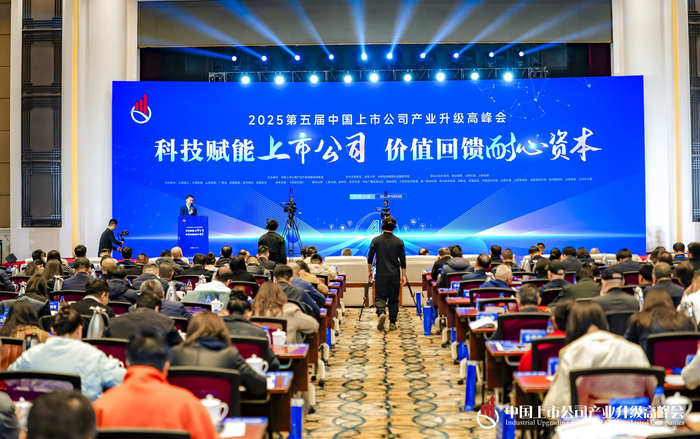
耐心资本赋能产业升级 第五届中国上市公司产业升级会议成功举办
Zheng Quan Ri Bao Zhi Sheng· 2025-11-15 04:42
Core Viewpoint - The 2025 Fifth China Listed Companies Industrial Upgrade Conference highlighted the integration of patient capital with industrial upgrades, emphasizing the importance of technology innovation in driving transformation and the need for long-term strategic investment [1][3]. Group 1: Conference Highlights - The conference gathered experts, scholars, executives from listed companies, and representatives from financial institutions to discuss the future of patient capital and industrial upgrades [1]. - The event featured discussions on the significant technological changes expected in 2025, particularly in key areas like "Artificial Intelligence+" [3]. Group 2: Key Insights from Speakers - Wang Yili, President of Shanxi Securities, emphasized the integration of investment banking, equity investment, and industry research to support the real economy and enhance financial support capabilities [5]. - Yin Yanlin, former Deputy Director of the Central Financial and Development Committee, outlined six areas for promoting high-quality development of listed companies, including deepening the real economy and increasing R&D investment [7]. - Li Yang, Chairman of the National Financial and Development Laboratory, stressed the importance of a vibrant capital market and the role of mergers and acquisitions in optimizing resource allocation and driving structural changes in the economy [8]. Group 3: Forum Discussions - The conference included two forums focusing on financial services for new productive forces and the role of listed company executives in industrial upgrades [11][13]. - Suggestions from forum participants included accelerating the listing process for mainland companies in Hong Kong, optimizing the investment framework, and enhancing liquidity in equity investments [11]. - Various company leaders discussed the importance of technology innovation and collaboration with financial institutions to drive industry upgrades and enhance product value [12].

2025上市公司跨境并购典型案例汇编-上交所
Sou Hu Cai Jing· 2025-11-15 02:17
Group 1 - The report compiles 16 representative cases of cross-border mergers and acquisitions (M&A) by companies listed on the Shanghai Stock Exchange, showcasing how these companies leverage global resources to drive industrial upgrades [1][7][9] - M&A strategies exhibit innovative characteristics, including cash acquisitions, cash and stock privatizations, cross-border share swaps, and private equity fund acquisitions, with a focus on both mature and emerging industries [1][2][9] - Key cases highlight strategic orientation and synergy effects, such as Wanhua Chemical's acquisition of BC Company, which resulted in a 145.19% overachievement of performance commitments [2][12][56] Group 2 - The report indicates a clear trend of policy support for cross-border M&A, with initiatives like the "M&A Six Guidelines" simplifying processes and lowering barriers for companies [3][9] - Challenges include complex cross-border regulatory approvals, cultural integration difficulties, and geopolitical risks, which companies are addressing through compliance reviews and risk hedging mechanisms [3][9] - Successful cross-border M&A requires a clear strategic direction aligned with industrial upgrade needs, innovative transaction structures, and deep integration of technology, market, and management post-acquisition [3][9][56] Group 3 - The report emphasizes the importance of a clear internationalization strategy, as seen in Wanhua's proactive approach to overseas expansion and M&A during the 2008 financial crisis [57] - The acquisition of BC Company not only enhanced Wanhua's global footprint but also established a benchmark for Chinese enterprises in cross-border M&A and state-owned enterprise reform [56][57] - The successful integration of BC Company into Wanhua Chemical's operations led to significant profitability improvements, with net profits exceeding commitments by 53.35 million [56][55]



透视10月经济“成绩单”:转型加快,结构优化,韧性增强
Shang Hai Zheng Quan Bao· 2025-11-14 18:39
Economic Overview - The national economy is operating steadily despite complex international conditions, with macro policies continuing to release dividends, supporting stable growth [2][6] - Investment and consumption data showed slight declines in growth rates, but structural optimization and resilience in development are evident [2][6] Industrial and Service Sector Performance - From January to October, the industrial added value and service production index grew by 6.1% and 5.7% year-on-year, respectively, indicating robust growth [2][3] - In October, the industrial added value increased by 4.9% year-on-year, while the service production index rose by 4.6% [2] Investment Trends - Fixed asset investment decreased by 1.7% year-on-year from January to October, a slowdown of 1.2 percentage points compared to the previous three quarters [4] - Manufacturing investment continued to grow, with aerospace and equipment manufacturing investment increasing by 19.7% and information service investment rising by 32.7% [4] Employment and Price Stability - The urban survey unemployment rate was 5.1% in October, down 0.1 percentage points from September, indicating overall employment stability [5] - Consumer prices showed positive changes, with the Consumer Price Index (CPI) rising by 0.2% year-on-year in October, and core CPI increasing by 1.2% [5] Future Economic Outlook - Experts believe that with coordinated policy efforts and the strengthening role of high-tech industries, the internal driving force for economic growth is expected to solidify, making it likely to achieve the annual growth target of over 5% [6][7] - There is potential for further fiscal and monetary policy support to stimulate consumption and investment, given the current low levels of government debt and prices [6]
国务院常务会议解读|增强消费品供需适配性 国务院作出系列部署
Xin Hua She· 2025-11-14 14:45
Core Viewpoint - The State Council meeting on November 14 emphasized enhancing the adaptability of supply and demand to further promote consumption policies, highlighting the importance of this relationship in the market economy [1][2]. Group 1: Supply and Demand Adaptability - Enhancing supply-demand adaptability is an effective measure to release consumption potential and facilitate economic circulation [1]. - The concept of supply-demand adaptability involves improving the matching degree between supply and demand to address issues such as excess low-end supply and insufficient high-quality supply [1][2]. Group 2: Consumer Trends and Industry Upgrades - There is a shift in consumer behavior from quantity satisfaction to quality enhancement, with trends towards diversified, personalized, and high-quality consumption [1][2]. - The meeting called for aligning industrial upgrades with consumption upgrades, leveraging new demands to guide new supply, and creating new demands through new supply [1][2]. Group 3: Policy Measures and Innovations - The meeting outlined several policy measures, including accelerating the application of new technologies and models, supporting enterprises in expanding the supply of high-quality consumer goods, and developing flexible manufacturing to meet personalized consumer needs [2]. - It emphasized the need for companies to identify new supply directions from emerging consumer trends, focusing on better services and innovative business models [2].
国务院常务会议解读丨增强消费品供需适配性 国务院作出系列部署
Xin Hua Wang· 2025-11-14 14:31
Core Points - The State Council meeting on November 14 emphasized enhancing the adaptability of supply and demand to further promote consumption policies [1][2] - The shift in consumer behavior from quantity to quality highlights the need for industry and consumption upgrades to create a positive interaction between consumption and investment [1][2] Group 1 - The meeting identified that enhancing supply-demand adaptability is an effective measure to release consumption potential and facilitate economic circulation [1] - The Director of the Market Circulation Research Office at the Development Research Center of the State Council noted that consumers are willing to pay a premium for products and experiences that fulfill emotional value [1][2] - The concept of supply-demand adaptability aims to address the mismatch between excess low-end supply and insufficient high-quality supply, thereby unlocking consumption potential [1][2] Group 2 - The meeting outlined a series of measures to adapt supply and demand, including leading industrial upgrades through consumption upgrades and accelerating the application of new technologies [2] - It was emphasized that businesses should identify new directions for supply based on emerging consumer trends, focusing on quality service and innovative business models [2] - The meeting aimed to shift the supply system from "producing more" to "producing better," thereby stimulating and releasing consumption potential for sustainable economic growth [2]