国产替代

Search documents
AI医疗概念火爆,台积电业绩爆表!资金集中抢筹医疗设备ETF(159873),芯片ETF天弘(159310)标的指数涨超3%
Sou Hu Cai Jing· 2026-01-16 03:31
Group 1 - The medical device sector is experiencing volatility, with the medical device ETF (159873) achieving a trading volume of 48.6 million yuan and a turnover rate exceeding 26%, leading in its category [1] - The medical device ETF has seen a net inflow of over 60 million yuan in the past 10 days, with a net subscription of 57 million units in the latest session [1] - TSMC's fourth-quarter earnings report exceeded expectations, with a net profit growth of 35% year-on-year, signaling a sustained AI boom [1] Group 2 - The medical device ETF (159873) tracks the healthcare index and has a high concentration of brain-computer interface stocks, accounting for over 17% of its holdings [2] - The ETF includes significant exposure to innovative domestic companies and is expected to undergo a comprehensive valuation recovery due to accelerated exports and new technologies [2] - The chip ETF Tianhong (159310) tracks the semiconductor industry index and benefits directly from domestic substitution and technological breakthroughs in the semiconductor sector [2]

ETF盘中资讯|国产AI登顶全球!智谱+华为联手!资金逢跌抢筹,科创人工智能ETF华宝(589520)近4日狂揽1.4亿元!
Sou Hu Cai Jing· 2026-01-16 03:04
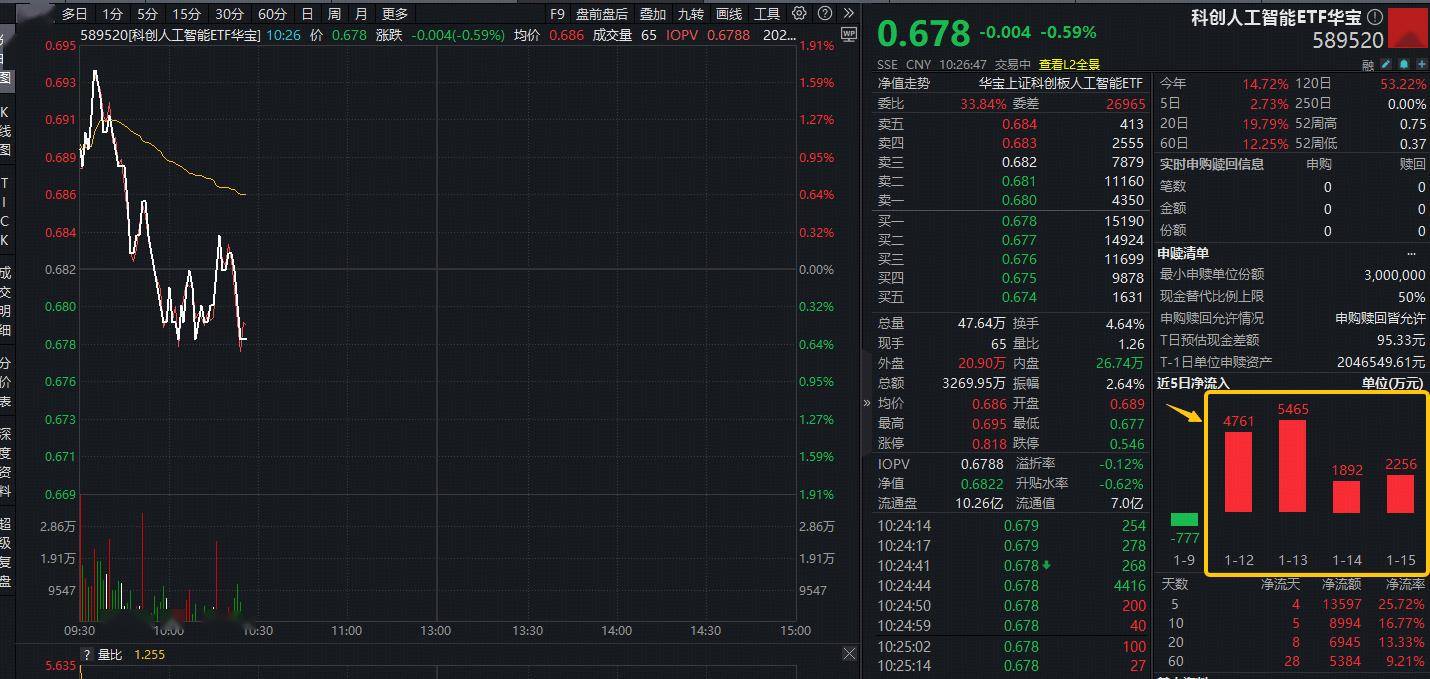
Core Viewpoint - The domestic AI industry chain is gaining traction, as evidenced by the performance of the Huabao Science and Technology Innovation AI ETF (589520), which has attracted significant capital inflow and reflects investor confidence in the sector [1][5]. Group 1: ETF Performance - The Huabao Science and Technology Innovation AI ETF (589520) saw an early morning surge of over 1.7% before stabilizing near the waterline, currently down 0.59% [1]. - Over the past four days, the ETF has attracted a total of 144 million yuan, indicating strong investor interest in the domestic AI industry chain [1]. - Leading stocks within the ETF include Tianzhun Technology, which rose over 7%, and several others like Aobi Zhongguang and Zhongke Xingtou, which increased by more than 3% [1]. Group 2: Technological Advancements - The GLM-Image model, developed by Zhipu and Huawei, has topped the Hugging Face platform's Trending list, showcasing its international recognition and breaking the reliance on American chips [3][4]. - The model utilizes Huawei's Ascend Atlas 800T A2 chips and MindSpore framework, addressing the core issue of dependency on foreign chips for AI training [3]. - Zhipu's innovative architecture for GLM-Image combines autoregressive and diffusion decoder techniques, achieving high accuracy in generating Chinese text, which was a challenge for previous AI models [4]. Group 3: Industry Trends - The AI industry chain is transitioning from cloud-based solutions to edge computing, moving towards self-sufficiency and independence from foreign technologies [5][6]. - The Huabao Science and Technology Innovation AI ETF focuses on key segments of the AI industry, including application software, terminal applications, and chips, with a high concentration in semiconductor stocks [6]. - According to CITIC Securities, the synergy between self-control and AI is expected to drive strong performance in related sectors by 2025, with trends likely to strengthen further into 2026 [4].

计算机ETF(512720)近10日资金净流入超2亿元,测试设备步入国产替代突破的进阶期
Mei Ri Jing Ji Xin Wen· 2026-01-16 02:58
Group 1 - The computer ETF (512720) has seen a net inflow of over 200 million yuan in the past 10 days, indicating a significant investment interest in semiconductor testing equipment as it enters a critical phase of domestic substitution breakthroughs [1] - The semiconductor testing equipment industry is experiencing a cyclical recovery and structural upgrade, driven by three main factors: AI computing power, advanced packaging, and automotive electronics, leading to a period of simultaneous increase in both volume and price [1] - The complexity of AI computing chips has resulted in an exponential increase in testing vector depth, significantly extending the testing time per chip and driving demand for testing machines [1] Group 2 - The demand for testing equipment is further amplified by the extreme requirements for active thermal management and signal integrity posed by kilowatt-level power chips, increasing the value of each machine [1] - Advanced packaging has made KGD testing a necessity, pushing testing nodes forward, while heterogeneous integration is driving demand for system-level testing beyond traditional ATE processes [1] - The number of automotive electronic chips has doubled, and the stringent AEC-Q100 standards for thermal cycling tests have rigidly expanded the demand for thermal cycling testing equipment [1]
存储扩产-先进制程扩产-半导体设备投资价值解读
2026-01-16 02:53
Summary of Semiconductor Equipment Market Conference Call Industry Overview - The semiconductor equipment market is experiencing stable growth driven by increasing demand for consumer electronics, with wafer manufacturing equipment accounting for approximately 90% of the market share [1][3] - The Chinese semiconductor equipment market is growing rapidly, currently holding about 40% of the global market share [1][3] Key Technologies and Processes - **Lithography Technology**: Critical in chip manufacturing, with EUV lithography machines currently monopolized by ASML, presenting high technological barriers [1][5] - **Etching Process**: A subtractive process that removes materials to form circuits, with a domestic etching equipment replacement rate of about 28%, higher than lithography [1][9][10] - **Thin Film Deposition**: An additive process with methods including CVD, PVD, and ALD, where ALD excels in precise thickness control for nanoscale applications [1][7] Market Dynamics - The GPU market significantly drives semiconductor chip demand, particularly due to the growth of AI industries, with China’s cloud computing market accounting for about 20-30% of global computing power demand [1][12] - The memory market, dominated by DRAM and NAND, is experiencing rapid demand growth due to AI chip shipments, leading to supply shortages and rising contract prices for DRAM expected to increase by 5%-60% in Q1 2026 [1][4][14] Domestic Development and Challenges - Despite rapid growth, China still relies on imports for advanced equipment like EUV lithography, necessitating increased R&D investment for domestic substitution [1][8] - The domestic semiconductor equipment market is gradually improving its penetration rate, with varying levels of domestic replacement across different segments [1][10][11][15] Investment Opportunities - The semiconductor equipment ETF (159,516) is recommended for investors, focusing on high-quality technology companies across various segments, with a historical valuation lower than mainstream chip indices, indicating better cost-effectiveness [1][17] - Overseas capital expenditure exceeding expectations positively impacts the domestic semiconductor equipment market, suggesting a strong correlation between storage expansion and semiconductor equipment demand [1][16] Future Trends - The trend towards 3D NAND technology is expected to increase the importance of thin film deposition and etching processes, with leading manufacturers already producing over 300 layers of 3D NAND chips, potentially reaching 1,000 layers by 2030 [1][14] - The semiconductor industry is anticipated to continue its growth trajectory, driven by advancements in AI technology and increasing global demand for high-performance computing solutions [2][4][18]
瑞银-中国股票市场及宏观经济展望
瑞银· 2026-01-16 02:53
Investment Rating - The report indicates a strong rebound in the Chinese stock market in 2025, with the total market capitalization of A-shares surpassing 100 trillion RMB and daily trading volume frequently exceeding 3 trillion RMB, leading to a historical high annual trading volume of 400 trillion RMB [4][5]. Core Insights - The attractiveness of Chinese assets is expected to further increase in 2026, supported by innovation capabilities, favorable policies, ample liquidity, and potential capital inflows from domestic and international institutional investors [5][6]. - Foreign investment interest in the Chinese stock market has significantly increased, with the number of overseas investors from Europe and the US rising by over 30% compared to last year [7]. - The overall earnings growth for A-shares in 2026 is projected to be around 8%, with a breakdown of 5% revenue growth, 4% valuation uplift, and 1% from buyback expectations [10][18]. Summary by Sections Market Performance - In 2025, the Chinese stock market showed a strong performance, with A-shares' total market value exceeding 100 trillion RMB and daily trading volumes reaching historical highs [4][5]. Future Outlook - The report anticipates that the attractiveness of Chinese assets will continue to rise in 2026, driven by strong innovation, supportive policies, and liquidity [5][6]. Foreign Investment - There is a notable increase in foreign interest in the Chinese stock market, with foreign holdings rising from a low of 2.6% at the end of 2023 to 1.3% currently [7]. Earnings Growth - The expected earnings growth for A-shares in 2026 is around 8%, with contributions from revenue growth, valuation uplift, and profit margin improvements [10][18]. Sector Preferences - Preferred sectors include AI, internet, brokerage, photovoltaic, and overseas companies, with a focus on the growth potential in these areas [11].
天承科技20260115
2026-01-16 02:53
Summary of Tiancheng Technology Conference Call Company Overview - **Company**: Tiancheng Technology - **Industry**: Semiconductor and Electronic Chemicals Key Points and Arguments R&D and Technological Advancements - Tiancheng Technology has established a 3D R&D platform encompassing platform R&D, product development, and application development, enabling material development from scratch [2][3] - The company utilizes AI models to design additive molecules, enhancing competitiveness in advanced nodes and packaging fields [2][3] - Significant progress has been made in the semiconductor division, aiming to become the market leader in domestic market share and brand recognition within three years [3][4] Domestic Market and Industry Position - The domestic storage industry is rapidly advancing in 2.5D and 3D packaging technologies, with Tiancheng Technology positioned on par with international leaders [2][9] - The company is focusing on high-end process copper and cobalt additives, achieving breakthroughs in TSV technology through collaborations with major institutions like Huawei and Fudan University [2][6] Market Strategy and Growth Projections - Tiancheng Technology aims for a tenfold sales increase in the coming year, targeting millions in sales by 2026 and a 20% market share within three years [4][15] - The company plans to leverage partnerships with major equipment manufacturers to provide comprehensive solutions, enhancing market competitiveness [16][23] Product Focus and Applications - The company specializes in functional electronic chemicals for the electric vehicle market, particularly in circuit boards and advanced plating solutions [7][21] - Tiancheng Technology is also exploring opportunities in the Micro LED display sector, recognizing its significant market potential [7][8] Financial Expectations - The semiconductor plating liquid business is expected to maintain a gross margin of 90% to 95%, with projections of reaching 1 billion RMB in revenue by 2026, translating to a net profit of 50 million RMB [22][28] - The overall revenue expectation for 2026, including semiconductor business, is projected to reach several tens of millions [28] Challenges and Opportunities - The integration of domestic and foreign chemical solutions presents challenges, particularly in material substitution due to foreign restrictions [18] - However, collaboration with leading domestic equipment manufacturers is seen as a way to overcome these challenges and enhance R&D efficiency [18] Competitive Advantages - Tiancheng Technology holds a leading position in the domestic market for electronic chemicals, particularly in PCB and advanced packaging sectors [19][20] - The company has invested over 100 million RMB in R&D facilities, ensuring a strong foundation for future product development and customer applications [20] Future Development Strategies - The company plans to strengthen collaborations with large fabs and memory manufacturers, focusing on the rollout of new products in advanced packaging and front-end processes [24] - Emphasis will be placed on leveraging existing data and successful case studies to accelerate market penetration and client acquisition [24] Additional Important Information - The company has established a clean production facility to ensure stable product quality and meet customer demands [7][6] - Tiancheng Technology is actively addressing the challenges of logic and storage chip requirements, with a focus on achieving domestic substitution in high-stability applications [10][11]

台积电财报炸裂,半导体设备ETF(159516)再创新高!
Sou Hu Cai Jing· 2026-01-16 02:43
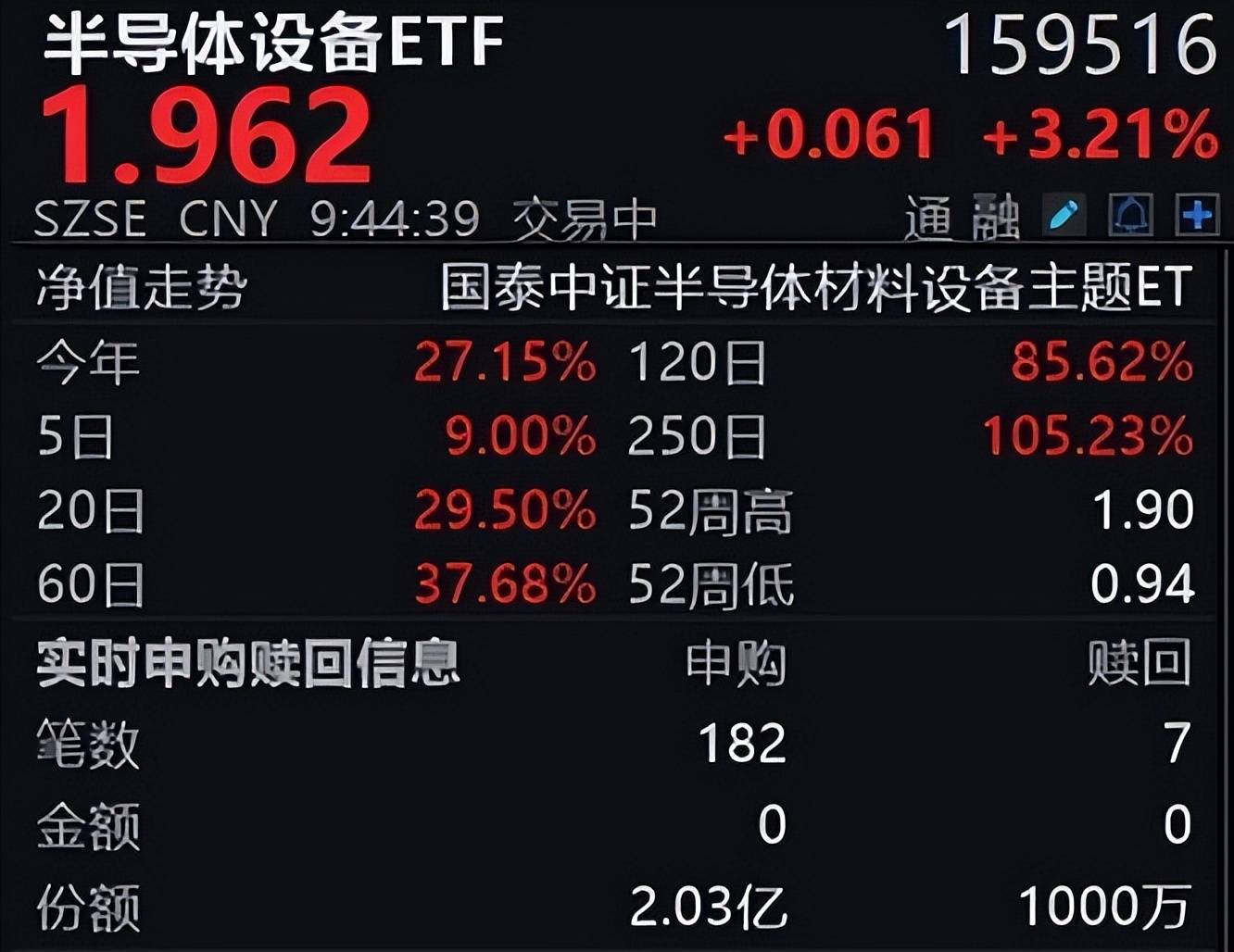
Group 1 - The semiconductor equipment ETF (159516) has seen significant inflows, with over 2 billion shares flowing in during the trading session and a net inflow exceeding 5 billion yuan over the past 20 trading days, reaching a total scale of over 15 billion yuan by January 15, 2026, making it the largest in its category [2] - Two main reasons contribute to the strong performance of the semiconductor equipment ETF: the expansion of advanced process production and rising storage prices. Advanced process production involves techniques like chip stacking to achieve production of chips equivalent to 7nm and 5nm, despite current limitations in direct mass production [2] - Rising storage prices lead to increased production efforts by manufacturers, which in turn drives demand for critical equipment such as etching and thin-film deposition tools essential for high-performance storage chips [2] Group 2 - TSMC's performance has exceeded expectations, reigniting enthusiasm for AI, as it remains a key player in the global computing power supply chain, with major companies like Nvidia and Broadcom relying on TSMC for manufacturing and testing [3] - TSMC's expansion pace surpasses expectations, indicating a growth in North American AI demand, while the global storage industry is entering an expansion cycle, benefiting domestic storage companies from rising prices [3] - According to CITIC Securities, TSMC is expected to achieve record earnings in 2025, with a significant increase in capital expenditures in 2026, highlighting the ongoing benefits from AI computing power and advanced processes [3]
英大证券晨会纪要-20260116
British Securities· 2026-01-16 02:09
Market Overview - The A-share market is expected to experience short-term fluctuations and adjustments, but this does not indicate a reversal of the overall trend [2][11] - Recent actions by regulatory authorities, such as increasing financing margin ratios and halting multiple companies for review, signal a cooling intention in the market [1][10] - The market's trading volume has significantly decreased, with a total turnover of 29,056 billion yuan, down over 10 billion from the previous day [1][12] Short-term Market Dynamics - The market is likely to maintain a cautious sentiment due to profit-taking by investors and technical adjustment needs [2][11] - Historical data suggests that high trading volumes often correspond to market peaks, making it difficult for subsequent capital to sustain upward momentum [10] - Key data releases expected in late January may impact market sentiment, particularly for certain technology sectors where earnings visibility is uncertain [10][11] Sector Performance - Precious metals have shown strength, with significant price increases attributed to factors such as the onset of a Federal Reserve rate-cutting cycle and increased geopolitical tensions [6][8] - The new energy sector, including energy metals and batteries, remains active, driven by ongoing demand for lithium batteries, photovoltaics, and wind energy [7][8] - The semiconductor sector has also seen positive performance, benefiting from domestic policy support for local manufacturing and the ongoing global digital transformation [9][10] Investment Strategy - Investors are advised to adopt a cautious approach in the short term, particularly regarding stocks that have seen excessive price increases and are driven by speculative trading [2][11] - For stocks with reasonable valuations and strong earnings certainty, it is recommended to take advantage of market pullbacks to build positions [2][11] - The long-term outlook remains positive, supported by macroeconomic liquidity conditions and a trend of reallocating household wealth into the stock market [2][11]
投资者如何看待A股走牛的结构与延续性?
Qi Huo Ri Bao Wang· 2026-01-16 01:55
Group 1 - The A-share market has shown strong performance since the beginning of 2026, with a steady increase in trading volume and margin financing balance, indicating a robust market sentiment and activity [1][2] - The increase in trading volume is characterized by a gradual upward trend rather than impulsive spikes, suggesting a stable market rally [1] - The margin financing balance has reached historical highs, but the proportion of margin financing relative to the A-share market capitalization remains low, indicating rational use of leverage [4] Group 2 - The driving forces behind the current A-share market rally have shifted, with macroeconomic indicators such as the manufacturing PMI returning to expansion territory and significant government investment plans enhancing growth expectations [2] - There is a notable shift in capital preferences towards sectors like cultural media, small metals, semiconductors, and AI applications, reflecting a move from traditional defensive blue-chip stocks to growth-oriented sectors [2] - International capital has become a significant bullish force in the market, with major investment banks expressing optimism about the Chinese stock market [3] Group 3 - Different types of capital are playing varied roles in the current market, with domestic long-term capital showing strong support for equity investments, particularly from insurance funds [3] - The "national team" represented by Central Huijin has increased its holdings significantly, particularly in ETFs, indicating confidence in the market [3] - Institutional investors are advised to adopt diversified strategies, focusing on undervalued, high-dividend assets while also allocating a portion of their portfolio to high-growth sectors [5][6] Group 4 - Market sentiment remains high, but there are potential risks and challenges that need to be monitored, particularly regarding the sustainability of the upward trend in corporate earnings [4] - The market's future trajectory will depend on the alignment between corporate valuation recovery and fundamental improvements [4] - Investors are encouraged to develop differentiated strategies based on their risk tolerance and investment horizons, with a focus on rational investment practices [5][6][7]
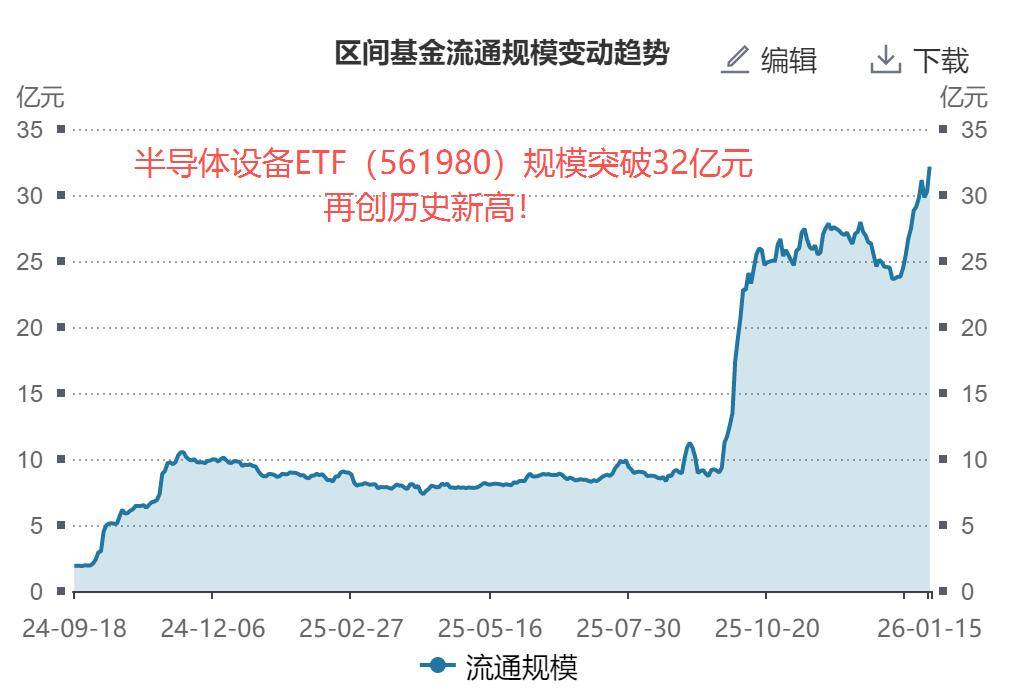
首次破万亿!半导体炸裂财报公布,半导体设备ETF(561980)规模再创历史新高!
Sou Hu Cai Jing· 2026-01-16 01:44
Group 1 - TSMC reported Q4 2025 revenue of $33.67 billion, marking a significant milestone by surpassing NT$1,046.09 billion; net profit increased by 35% year-on-year, achieving growth for the eighth consecutive quarter [1] - TSMC plans to increase its capital expenditure for 2026 to a maximum of $56 billion, a substantial 37% increase from the actual expenditure of $40.9 billion in 2025, setting a new historical high for the company [1] - The semiconductor supply chain has been positively impacted, with strong performance across equipment, packaging and testing services, and materials sectors; the semiconductor equipment ETF (561980) saw a single-day increase of over 4%, reaching a historical high of over NT$3.2 billion [1] Group 2 - As DRAM and NAND architectures evolve towards 3D structures, there will be a significant increase in demand for etching and thin film deposition equipment, with the corresponding service market for 3D DRAM and NAND expected to grow approximately 1.7 times and 1.8 times, respectively [3] - Domestic semiconductor equipment companies, represented by Northern Huachuang and Zhongwei Company, are expected to gradually strengthen their market position [3] - The semiconductor equipment ETF (561980) tracks the CSI index and focuses on domestic equipment, materials, and design leaders, showing higher elasticity with a 94.69% increase since 2025 and over 640% in the previous semiconductor cycle since 2018, leading among similar indices [3] Group 3 - The top ten weighted stocks in the ETF have a concentration close to 80%, covering leading companies in various segments such as Zhongwei Company (etching equipment), Northern Huachuang (multi-field equipment), and SMIC (manufacturing leader), with over 90% of the index comprising equipment, materials, and chip design sectors [5]