
红利投资

Search documents
期待小微盘的下一次大跌
雪球· 2025-08-12 08:42
Core Viewpoint - The article discusses the current distribution of market capitalization among major indices in the A-share market, highlighting a significant decline in the proportion of the CSI 300 index compared to other indices, particularly in the context of recent market volatility and liquidity issues [2][3][5]. Market Capitalization Distribution - As of August 8, the CSI 300 index accounts for only 45.75% of the total A-share market capitalization, a notable decrease from previous levels [3][5]. - The distribution of free float market capitalization among major indices is as follows: CSI 300 at 19.82 trillion, CSI 500 at 7.22 trillion, CSI 1000 at 6.77 trillion, CSI 2000 at 5.94 trillion, and the remaining micro-cap stocks at 3.57 trillion [5]. Historical Context and Volatility - The article references significant drops in the CSI 2000 index, including a 12.83% decline in a single day in April and a cumulative drop of 35.86% over 54 trading days from late 2023 to early 2024 [10][11]. - The author suggests that a rapid decline in micro-cap stocks relative to the CSI 300 could occur again, drawing parallels to past market behaviors [13][14]. Investment Strategy and Risk Management - The article emphasizes the importance of maintaining a balanced portfolio that includes both dividend stocks and micro-cap stocks, suggesting that investors should be prepared for potential downturns in micro-cap stocks [19][20]. - It highlights two specific micro-cap funds, the Guotai Junan CSI 1000 Index Fund and the Nuon Multi-Strategy Fund, showcasing their performance and the potential for significant returns following market corrections [22][25]. - The article advocates for a strategic approach to investing in micro-cap stocks, suggesting that while volatility and drawdowns are expected, they can lead to substantial long-term gains if managed correctly [27][29].


“会分红的”中证A50ETF指数基金(560350)、中证A500ETF摩根(560530)走强涨近1%,市场或震荡偏高运行
Xin Lang Cai Jing· 2025-08-12 02:42
Group 1 - The China A50 ETF index fund (560350) increased by 0.61% with a transaction volume of 22.5469 million yuan, while the underlying index, the China A50 Index (930050), rose by 0.46% [1] - The China A500 ETF Morgan (560530) saw a rise of 0.67% with a transaction volume of 35.0079 million yuan, and the underlying index, the China A500 Index (000510), also increased by 0.46% [1] - The A50 ETF index fund (560350) experienced a significant growth of 4 million shares over the past two weeks, ranking among the top two in terms of new shares issued compared to similar funds [1] Group 2 - Leveraged funds are increasingly investing in the market, with the China A500 ETF Morgan (560530) receiving net purchases of leveraged funds for three consecutive days, peaking at a net buy of 18.8624 million yuan in a single day [2] - As of August 5, the margin trading balance exceeded 2 trillion yuan, but remains at historical average levels, significantly lower than the peak in 2015 [2] - The Morgan China A50 ETF focuses on core A-share assets and has implemented a quarterly mandatory dividend mechanism, accumulating nearly 100 million yuan in dividends for 2024 [2] Group 3 - In the context of a new normal for interest rates, Morgan Asset Management aims to provide investors with opportunities to invest in relatively "certain" quality assets through its international "Dividend Toolbox" series of preferred funds [3]
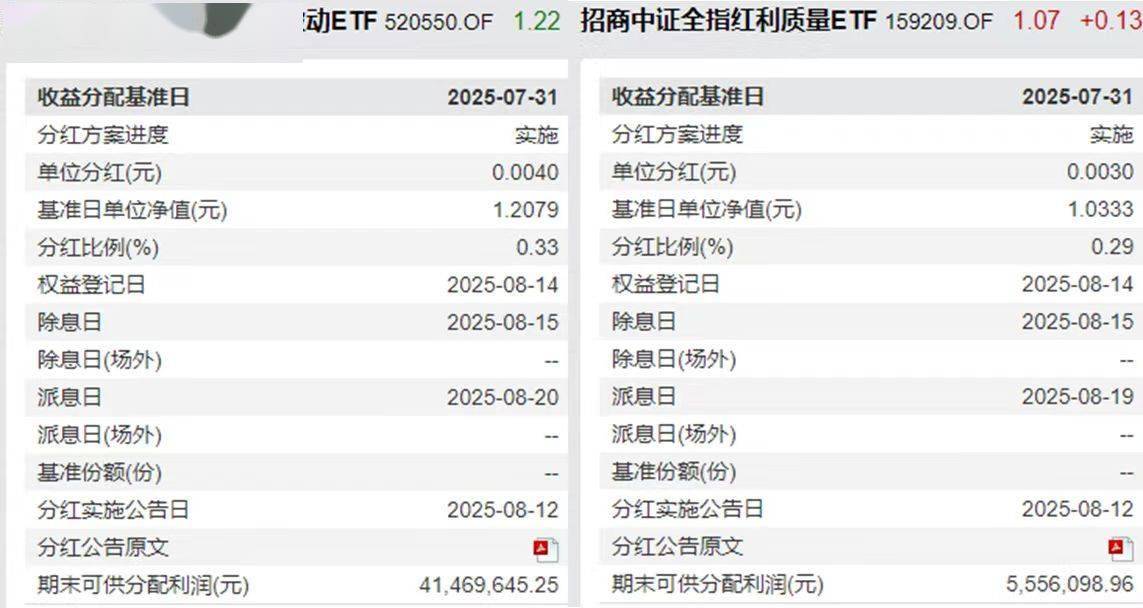
双红利ETF同步分红!港股红利低波ETF(520550)、中证红利质量ETF(159209)于8月14日权益登记
Sou Hu Cai Jing· 2025-08-12 01:13
Core Viewpoint - Two dividend ETFs under China Merchants Fund have implemented dividend distributions, highlighting the growing trend of dividend investment strategies in the market [1][2]. Group 1: Dividend Distribution Details - The CSI Dividend Quality ETF (code: 159209) distributed a cash dividend of 0.003 yuan per share, with a distribution ratio of 0.3% [1]. - The Hong Kong Dividend Low Volatility ETF (code: 520550) distributed a cash dividend of 0.004 yuan per share, with a distribution ratio of 0.33% [1]. - The Hong Kong Dividend Low Volatility ETF linked funds (Class A 024029/Class C 024030) have fully opened for subscription and redemption [1]. Group 2: Investment Strategies - The market has formed two main dividend investment strategies: - Deep Value Strategy: Represented by the Hong Kong Dividend Low Volatility ETF, which tracks the Hang Seng High Dividend Low Volatility Index, focusing on "high dividend + low volatility" factors, with a current dividend yield exceeding 8% [1]. - Value Growth Strategy: The CSI Dividend Quality ETF focuses on "high dividend + high profitability quality," selecting high-quality fundamentals in sectors like consumer and pharmaceuticals, with a historical yield of 3%-5% [1]. Group 3: Investment Recommendations - Current allocation suggestions recommend a dynamic balance to seize dividend opportunities, allowing investors to choose based on their risk preferences [2]. - Conservative investors may focus on the Hong Kong Dividend Low Volatility ETF, while aggressive investors may pay attention to the CSI Dividend Quality ETF [2]. - For portfolio allocation, a "barbell strategy" is suggested to dynamically adjust the proportion of the two product types, with regular rebalancing recommended [2].
高股息低门槛!标普红利ETF拆分啦
Xin Lang Ji Jin· 2025-08-11 05:50
Core Viewpoint - The article discusses the split of the S&P Dividend ETF, which aims to lower trading thresholds and enhance market activity, while highlighting the strong historical performance of the underlying index. Group 1: ETF Split Details - The S&P Dividend ETF will undergo a 1-for-2 share split, effective on August 8, 2025, with the ex-rights date on August 11, 2025 [4][3]. - Before the split, the total fund shares were 139,039.63 million with a net value of 1.1932 yuan, while after the split, the total shares will increase to 278,079.26 million with a net value of 0.5966 yuan [3][4]. Group 2: Historical Performance - From January 1, 2005, to June 30, 2025, the cumulative return of the S&P A-Share Dividend Total Return Index reached 2,469.11%, indicating a more than 24-fold increase over 20 years [5][12]. - The annualized return of the S&P A-Share Dividend Index is reported at 17.73%, with a dividend yield of 4.84% as of July 31, 2025 [2][12]. Group 3: Investment Appeal - The S&P Dividend Index focuses on 100 A-share companies with consistent high dividends, characterized by high profitability, quality, and low valuation, making it attractive in a low-interest-rate environment [9][11]. - Historical data shows that the dividend index has a better risk-reward profile compared to mainstream indices, with lower volatility and drawdowns, making it suitable for long-term investors seeking stability [11][12]. Group 4: Policy Support - Recent policies, including the "New Nine Articles," aim to encourage companies to increase dividend payouts, which supports the long-term growth of dividend assets [12].

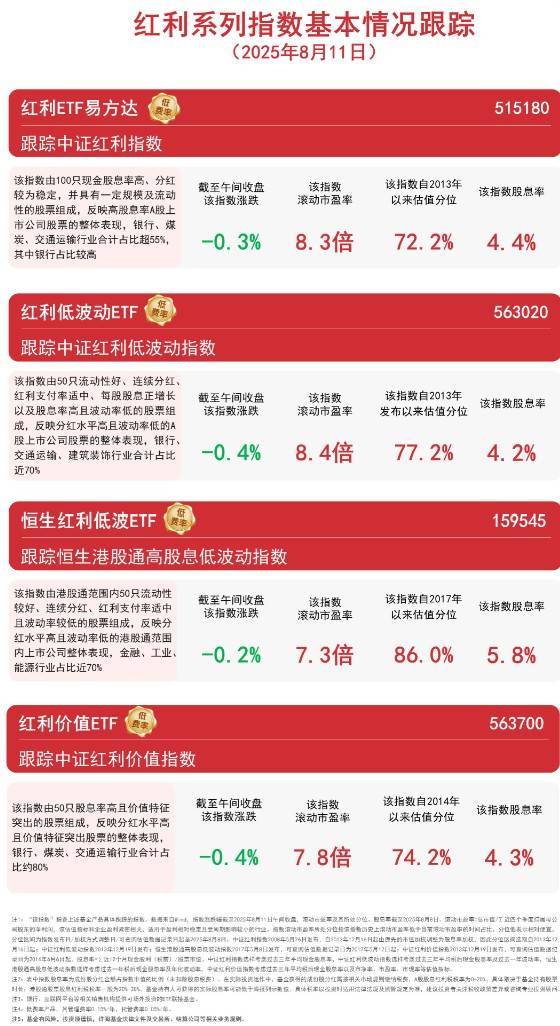
红利回调,资金逆势加仓,恒生红利低波ETF(159545)半日获超5400万份净申购
Sou Hu Cai Jing· 2025-08-11 05:24
Core Viewpoint - The performance of various dividend-focused indices and ETFs in the Hong Kong and A-share markets shows a slight decline, with specific indices experiencing net inflows, indicating ongoing investor interest in high-dividend stocks despite market fluctuations [1][2]. Group 1: Index Performance - The Hang Seng High Dividend Low Volatility Index decreased by 0.2% [1] - The CSI Dividend Index fell by 0.3% [1] - The CSI Dividend Low Volatility Index and CSI Dividend Value Index both dropped by 0.4% [1] Group 2: ETF Inflows - The Hang Seng Dividend Low Volatility ETF (159545) saw a net subscription of 54.6 million units in the first half of the day [1] - This ETF has experienced net inflows for four consecutive trading days, reaching a record size of 4.14 billion yuan [1] Group 3: Index Composition and Characteristics - The CSI Dividend Index consists of 100 stocks with high cash dividend yields and stable dividends, with a significant representation from the banking, coal, and transportation sectors, accounting for over 55% [2] - The CSI Dividend Low Volatility Index includes 50 stocks with good liquidity and continuous dividends, with a focus on low volatility, primarily from the banking, transportation, and construction sectors, making up about 70% [2] - The Hang Seng Dividend Low Volatility Index is composed of 50 stocks within the Hong Kong Stock Connect that have good liquidity and moderate dividend payout ratios, with nearly 70% from the financial, industrial, and energy sectors [2]
红利类基金实操:长期持有是否需要止盈?又该如何止盈?
Sou Hu Cai Jing· 2025-08-05 10:30
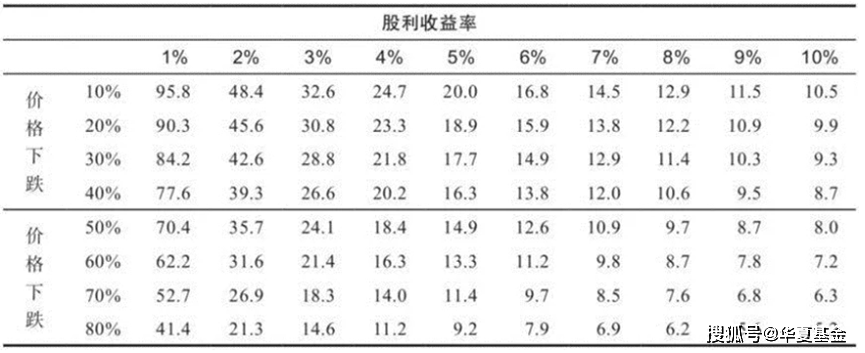
Group 1 - The article discusses the current macroeconomic changes and the impact on global capital markets, highlighting the volatility and challenges faced by traditional income-generating investments like fixed deposits and money market funds [2][3]. - In this context, dividend funds are gaining popularity among investors as a stable investment option due to their high dividend yields [4]. - The article raises the question of whether investors should take profits from dividend funds and explores the underlying logic of high dividend strategies in balancing short-term fluctuations and long-term value [5]. Group 2 - The concept of "not cutting losses" in dividend fund investments is emphasized, where investors focus on the dual benefits of capital appreciation and stable dividend income [6]. - High dividend yields can significantly reduce the time required for investors to recover from price declines, with the article providing data on how different dividend yields affect recovery times [10][12]. - Historical market practices validate this logic, showing that investors who held onto dividend funds during downturns were able to benefit from subsequent market recoveries [13]. Group 3 - The article discusses the importance of scientific profit-taking strategies, suggesting that asset allocation rebalancing can help manage floating profits without the need for precise market timing [20][21]. - Historical data indicates that implementing annual rebalancing can reduce volatility and improve the stability of returns compared to static portfolios [22]. - The article also mentions that the frequency of rebalancing should be moderate to avoid eroding the benefits of dividend reinvestment [24]. Group 4 - The essence of dividend investing is to anchor investments in companies that consistently generate cash flow and share profits with shareholders, emphasizing the importance of patience during market downturns [30]. - The article concludes that whether to take profits or not should align with individual risk tolerance and investment goals, advocating for a long-term perspective in dividend investing [30][34].
兴业证券-基金经理们如何看十大问题?——25Q2基金季报观点汇总
2025-08-05 03:20
Summary of Key Points from the Conference Call Industry or Company Involved - The conference call discusses the investment outlook for various sectors in China, particularly focusing on AI, technology, new energy, and the implications of macroeconomic policies. Core Insights and Arguments 1. **Investment Opportunities in H2 2025**: The domestic economy is expected to maintain a GDP growth rate above 5%, driven by strong export performance and advancements in AI and advanced manufacturing, which are seen as key to enhancing economic output and structural transformation [6][10][12]. 2. **AI Investment Outlook**: AI is viewed as a central theme in global technological innovation, with significant investments expected in AI hardware and applications. The domestic demand for AI is strong, and supply bottlenecks are gradually easing, indicating a positive trajectory for AI-related investments [20][21][22]. 3. **Technology Sector Growth**: The technology sector is anticipated to experience robust growth, particularly in semiconductors and advanced manufacturing. The potential for breakthroughs in these areas is expected to drive long-term growth and competitiveness [25][26]. 4. **New Energy and Environmental Policies**: The transition to new energy sources and the implementation of green policies are seen as critical for sustainable growth. The manufacturing sector is expected to benefit from technological upgrades and innovations aimed at reducing carbon emissions [28][36]. 5. **Consumer Behavior and Market Dynamics**: There is a shift towards quality over price in consumer preferences, which is expected to influence various industries, including real estate and consumer goods. This "anti-involution" trend is likely to reshape market competition and drive companies to focus on quality and brand value [32][35][37]. 6. **Macroeconomic Policies and Global Context**: The call highlights the importance of macroeconomic policies in shaping investment landscapes, particularly in light of ongoing geopolitical tensions and trade dynamics. The focus is on maintaining economic stability and fostering innovation [10][17][18]. Other Important but Possibly Overlooked Content 1. **Long-term Economic Confidence**: Despite short-term challenges, there is a strong belief in the long-term potential of the Chinese economy, driven by technological advancements and structural reforms [7][13][14]. 2. **Sector-Specific Insights**: Different sectors are expected to recover at varying rates, with some industries like real estate facing more significant challenges than others. The recovery in corporate earnings is anticipated to be uneven, influenced by sector-specific dynamics [9][15][18]. 3. **Investment Strategy**: The emphasis on identifying and investing in companies with strong competitive advantages and sustainable business models is highlighted as a key strategy for navigating the current market environment [8][12][19]. This summary encapsulates the key points discussed in the conference call, providing insights into the investment landscape and sectoral dynamics in China for the latter half of 2025.

红利投资再赢良机,上证180ETF指数基金(530280)近半年新增份额居可比基金首位
Xin Lang Cai Jing· 2025-08-04 02:10
Group 1 - The introduction of VAT on interest from newly issued government bonds presents new investment opportunities in dividend stocks, highlighting their advantages over bonds [1] - The Shanghai Stock Exchange 180 Index employs a barbell strategy with 90% in dividend stocks and 10% in technology, providing a good option for dividend asset allocation while benefiting from technological advancements [1] - As of August 4, 2025, the Shanghai Stock Exchange 180 Index has seen a slight increase of 0.20%, with notable gains in constituent stocks such as Shandong Gold (up 4.10%) and Shanghai Pudong Development Bank (up 3.64%) [1] Group 2 - The Shanghai Stock Exchange 180 ETF closely tracks the Shanghai Stock Exchange 180 Index, which includes 180 large-cap, liquid securities from the Shanghai market, reflecting the overall performance of core listed companies [2] - As of July 31, 2025, the top ten weighted stocks in the Shanghai Stock Exchange 180 Index account for 25.4% of the index, including major companies like Kweichow Moutai and Ping An Insurance [2]
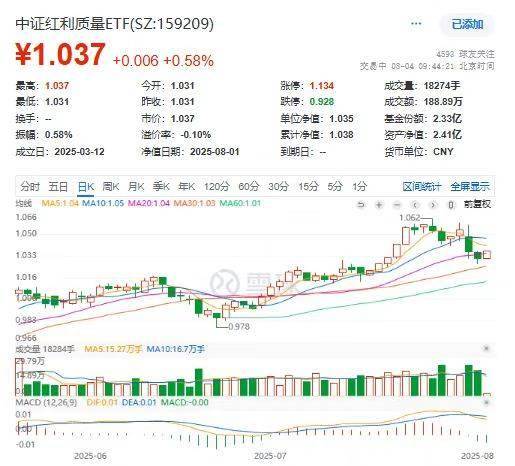
红利为盾,质量为矛!中证红利质量ETF(159209)涨近0.6%引领红利类ETF
Sou Hu Cai Jing· 2025-08-04 01:56
Core Insights - The market is showing increased interest in the China Securities Dividend Quality Index, which focuses on high-quality companies with stable high dividends and strong fundamentals [1] - The current macroeconomic environment emphasizes high-quality development and certainty, aligning with the demand for "cash cows" and growth potential during economic transformation [1] - The downward trend in interest rates enhances the attractiveness of high-dividend assets, while quality factor screening helps avoid pitfalls associated with purely high-yield investments [1] Product Design - The China Securities Dividend Quality ETF (159209) features a cost structure of "0.15% + 0.05%", which is the lowest in the market, providing a significant cost advantage for long-term holders [1] - The fund employs a monthly assessment dividend mechanism, which better meets investors' cash flow needs and enhances the holding experience [1]
恒生红利低波ETF(159545)7月“吸金”超15亿元,最新规模近40亿元,创历史新高
Sou Hu Cai Jing· 2025-08-01 11:47
Core Insights - The recent performance of various dividend indices shows a decline, with the CSI Dividend Index down 2.6%, the CSI Low Volatility Dividend Index down 2.0%, and the Hang Seng High Dividend Low Volatility Index down 3.4% [1][3] - Long-term logic for dividend investment remains strong due to low interest rates and policy requirements for companies to enhance shareholder returns, with a focus on opportunities in central state-owned enterprises and undervalued stocks [1] Index Performance Summary - The CSI Dividend Index has a dividend yield of 4.5% and a rolling P/E ratio of 8.1 times, with a rolling P/E percentile of 66.9% [3][4] - The CSI Low Volatility Dividend Index has a dividend yield of 4.2% and a rolling P/E ratio of 8.2 times, with a rolling P/E percentile of 76.2% [3][4] - The Hang Seng High Dividend Low Volatility Index has a dividend yield of 5.8% and a rolling P/E ratio of 7.2 times, with a rolling P/E percentile of 84.8% [3][4] - The CSI Dividend Value Index has a dividend yield of 4.4% and a rolling P/E ratio of 7.6 times, with a rolling P/E percentile of 72.1% [3][4] Recent Fund Flows - The Hang Seng Dividend Low Volatility ETF (159545) attracted over 1.5 billion yuan in July, reaching a record size of nearly 4 billion yuan [1] Historical Performance - Over the past month, the CSI Dividend Index has decreased by 0.2%, while the CSI Low Volatility Dividend Index has decreased by 2.5% [6] - Year-to-date, the CSI Dividend Index is down 1.7%, while the CSI Low Volatility Dividend Index is up 1.9% [6] - Over the past year, the CSI Dividend Index has increased by 7.7%, and the CSI Low Volatility Dividend Index has increased by 12.0% [6] Sector Composition - The CSI Low Volatility Dividend Index consists of 50 stocks with high dividend levels and low volatility, with over 60% of the index composed of banking, coal, and transportation sectors [4] - The Hang Seng High Dividend Low Volatility Index also includes 50 stocks, with over 60% from financial, real estate, and energy sectors [4] - The CSI Dividend Value Index is heavily weighted towards banking, coal, and transportation sectors, which account for approximately 80% of the index [4]
