
股息率

Search documents
山煤国际(600546):Q2以量补价业绩回升 分红与弹性兼备
Xin Lang Cai Jing· 2025-08-29 02:27
Core Viewpoint - The company reported a significant decline in revenue and net profit for the first half of 2025, indicating challenges in the coal market and operational performance [1][2]. Financial Performance - For H1 2025, the company achieved revenue of 9.66 billion yuan, a year-on-year decrease of 31.28%, and a net profit attributable to shareholders of 655 million yuan, down 49.25% [1]. - In Q2 2025, revenue was 5.16 billion yuan, a year-on-year decrease of 33.03%, but a quarter-on-quarter increase of 14.56%. The net profit for Q2 was 400 million yuan, down 43.45% year-on-year but up 56.91% quarter-on-quarter [1]. - The company's coal production for H1 2025 was 17.82 million tons, an increase of 15.9% year-on-year, while sales were 17.88 million tons, a decrease of 14.1% year-on-year [1]. Production and Sales - In Q2 2025, the company produced 8.73 million tons of coal, an 11.0% year-on-year increase, but a 3.9% decrease quarter-on-quarter. Self-produced coal sales were 5.93 million tons, down 8.1% year-on-year but up 34.3% quarter-on-quarter [1]. - The company implemented a mechanism for inventory classification and flexible production to stabilize production levels amid market pressures [2]. Pricing and Costs - The average selling price of self-produced coal in H1 2025 was 556 yuan per ton, down 18.9% year-on-year, while the cost was 275 yuan per ton, down 10.4% year-on-year [1]. - In Q2 2025, the selling price dropped to 528 yuan per ton, a decrease of 25.2% year-on-year, and the cost increased slightly to 278 yuan per ton, a 9.1% decrease year-on-year [1]. Dividend and Investment Outlook - The estimated dividend yield is approximately 3.97%, with a commitment to distribute at least 60% of the annual distributable profit in cash from 2024 to 2026 [3]. - The company anticipates a recovery in performance in the second half of 2025, supported by rising coal prices and seasonal demand, leading to upward revisions in profit forecasts for 2025-2027 [3].

周大生(002867):25Q2点评:收入降幅环比收窄,利润实现较好增长
Xinda Securities· 2025-08-28 14:47
Investment Rating - The investment rating for the company is "Buy" [1] Core Views - The company's revenue for H1 2025 was 4.597 billion yuan, a year-on-year decrease of 43.9%, while the net profit attributable to the parent company was 594 million yuan, down 1.27% year-on-year. The gross profit margin improved to 30.34%, an increase of 11.96 percentage points year-on-year [1] - The company plans to distribute a cash dividend of 0.25 yuan per share for H1 2025, leading to an annualized dividend of 0.9 yuan per share, resulting in a dividend yield of 6.8% based on the closing price on August 28 [2] - The decline in revenue and gross profit was primarily attributed to pressure on income and margins from franchise channels, with online channel revenue decreasing by 1.9% and offline self-operated channel revenue decreasing by 7.6% [3] Financial Performance Summary - For H1 2025, the company reported revenues of 4.597 billion yuan, with a gross profit margin of 30.34% and a net profit margin of 12.92% [1] - The company experienced a significant decline in franchise channel revenue, which fell by 59.12%, while self-operated channels showed a more stable performance with a revenue decrease of 7.6% [3] - The company’s expense ratio increased to 12.07%, primarily due to the higher proportion of direct sales, impacting overall profitability [4] - The company expects revenues of 11.8 billion yuan in 2025, with a projected net profit of 1.089 billion yuan, reflecting a year-on-year growth of 8% [5]
五粮液(000858):2Q25业绩符合预期 关注股息率托底
Xin Lang Cai Jing· 2025-08-28 10:40
Core Viewpoint - The company reported its 2Q25 performance, showing a slight revenue increase but a decline in net profit, indicating challenges in the current consumption environment and increased expenses [1][3]. Financial Performance - In 1H25, the company achieved revenue of approximately 52.771 billion yuan, a year-on-year increase of 4.19%, and a net profit of about 19.492 billion yuan, up 2.28% year-on-year [1]. - For 2Q25, revenue was 15.831 billion yuan, a marginal increase of 0.10% year-on-year, while net profit was 4.632 billion yuan, reflecting a decline of approximately 7.58% year-on-year [1]. Development Trends - The company's direct sales channels and low-alcohol products performed well in the first half of the year, with 1H25 revenue from Wuliangye products reaching 40.998 billion yuan, a year-on-year increase of 4.57% [2]. - The sales volume of Wuliangye products increased by 12.75%, while the price decreased by 7.25%, primarily due to the contribution from direct sales channels [2]. - The revenue from the series of wines in 1H25 was 8.122 billion yuan, up 2.73% year-on-year, with a significant increase in sales volume but a decrease in price [2]. - The company’s sales cash collection in 2Q25 was 31.23 billion yuan, a year-on-year increase of 12%, attributed to the concentration of bill maturities [2]. Profitability and Outlook - The net profit margin for 2Q25 decreased by 2.4 percentage points to 29.3%, mainly due to a weak consumption environment and increased expenses for promotions and logistics [3]. - The company plans to maintain high expenditure levels to support distributor confidence during peak seasons like the Mid-Autumn Festival and National Day [3]. - The company commits to a dividend payout of no less than 70% for 2025, projecting a dividend yield of 4.3% for the year [3]. Earnings Forecast and Valuation - Due to industry demand pressures, the company has revised its revenue forecasts for 2025 and 2026 down by 5.4% to 88.545 billion yuan and 92.717 billion yuan, respectively [4]. - The net profit forecasts for 2025 and 2026 have been reduced by 9.9% and 9.0% to 30.126 billion yuan and 32.133 billion yuan, respectively [4]. - The target price is maintained at 174 yuan, corresponding to a price-to-earnings ratio of 22.4x for 2025 and 21.0x for 2026, with the current stock price reflecting a significant upside potential of 37.4% [4].

招银国际:降华润万象生活(01209)目标价至43.86港元 维持“买入”评级
智通财经网· 2025-08-28 09:12
Core Insights - The core net profit of China Resources Vientiane Life (01209) increased by 15% year-on-year in the first half of the year, meeting expectations, while revenue grew by 7%, slightly below expectations [1] - The core business of shopping center operations showed robust performance with a revenue growth of 19% and a gross margin increase of 6 percentage points, reaching a record high gross profit contribution of 68% [1] - The target price for China Resources Vientiane Life has been revised down from HKD 45.27 to HKD 43.86, reflecting profit adjustments, while maintaining a "Buy" rating [1] Financial Guidance - The company has lowered its revenue growth guidance for the fiscal year 2025 to single digits from the previous double-digit forecast, but it maintains a double-digit growth guidance for core net profit, indicating an improvement in profit margins [1] - The company announced a 100% payout ratio, resulting in a dividend yield of 5.1% [1] Market Reaction - The company's stock price fell by 9% on the previous day (27th), which is viewed as a good entry opportunity considering its higher growth compared to peers, diversified layout, and the attractiveness of being a state-owned enterprise with a high dividend yield [1]
成都银行(601838):业绩加速好于预期,不良生成率降至近年新低
Changjiang Securities· 2025-08-28 08:16
Investment Rating - The investment rating for Chengdu Bank is "Buy" and is maintained [8]. Core Views - Chengdu Bank's performance in the first half of the year exceeded expectations, with revenue growth of 5.9% year-on-year and net profit growth of 7.3% [2][6]. - The bank's net interest income increased by 7.6%, reflecting a stabilization in net interest margin and rapid loan growth [2][12]. - The non-performing loan (NPL) generation rate dropped to a near-record low of 0.18%, with the NPL ratio remaining stable at 0.66% [2][12]. Summary by Sections Financial Performance - Revenue growth for the first half of the year was 5.9%, with a quarterly increase of 8.5% in Q2. Net profit grew by 7.3%, with Q2 showing an 8.7% increase [2][6]. - Net interest income growth was 7.6%, with Q2 showing a significant increase to 11.6% [12]. - Total assets grew by 9.8% compared to the beginning of the year, with loans increasing by 12.4% [12]. Asset Quality - The NPL ratio remained stable at 0.66%, with a provision coverage ratio of 453% [2][12]. - The NPL generation rate decreased to 0.18%, significantly better than industry peers [12]. Loan and Deposit Growth - Total loans increased by 921 billion, with a year-on-year increase of 12.4% [2][12]. - Deposits grew by 11.2%, with a decrease in the proportion of demand deposits [12]. Interest Margin and Cost Management - The net interest margin was 1.62%, slightly down from the previous year but showing signs of stabilization [12]. - The cost-to-income ratio improved, driven by stable credit impairment provisions and tax rates [12]. Investment Recommendations - The bank's return on equity (ROE) and asset quality metrics are industry-leading, with a projected dividend yield of 5.3% for 2025 [12]. - The stock is recommended for purchase, with a price-to-book (PB) ratio of 0.86x and a price-to-earnings (PE) ratio of 5.7x [12].

中国外运2025年中报简析:净利润同比增长0.08%,盈利能力上升
Zheng Quan Zhi Xing· 2025-08-27 22:56
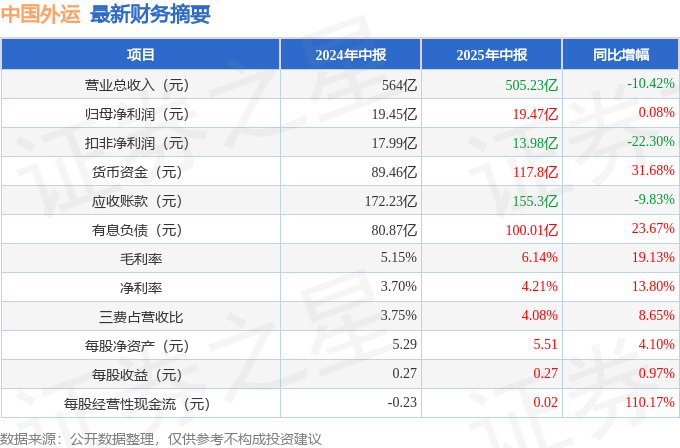
Core Viewpoint - China National Freight Forwarding (中国外运) reported a decline in total revenue for the first half of 2025, while net profit showed a slight increase, indicating mixed financial performance amidst challenging market conditions [1]. Financial Performance - Total revenue for the first half of 2025 was 50.523 billion yuan, a decrease of 10.42% year-on-year [1]. - Net profit attributable to shareholders was 1.947 billion yuan, reflecting a marginal increase of 0.08% year-on-year [1]. - In Q2 2025, total revenue was 26.751 billion yuan, down 16.66% year-on-year, while net profit for the quarter was 1.302 billion yuan, up 14.05% year-on-year [1]. Profitability Metrics - Gross margin improved to 6.14%, an increase of 19.13% year-on-year [1]. - Net margin rose to 4.21%, reflecting a year-on-year increase of 13.80% [1]. - The total of selling, administrative, and financial expenses was 2.06 billion yuan, accounting for 4.08% of revenue, which is an increase of 8.65% year-on-year [1]. Cash Flow and Assets - Cash flow per share was 0.02 yuan, a significant increase of 110.17% year-on-year [1]. - The company reported a total of 111.78 billion yuan in cash and cash equivalents, up 31.68% year-on-year [1]. - Accounts receivable decreased to 15.53 billion yuan, down 9.83% year-on-year [1]. Debt and Equity - Interest-bearing debt increased to 10 billion yuan, a rise of 23.67% year-on-year [1]. - Book value per share was 5.51 yuan, reflecting a year-on-year increase of 4.10% [1]. - Earnings per share remained stable at 0.27 yuan, with a slight increase of 0.97% year-on-year [1]. Investment Insights - The company's return on invested capital (ROIC) was 8.34%, indicating average capital returns [3]. - The estimated dividend yield is 4.59% [3]. - Analysts expect the company's performance in 2025 to reach 3.997 billion yuan, with an average earnings per share forecast of 0.55 yuan [3].


险资举牌银行股,驱动估值修复
Sou Hu Cai Jing· 2025-08-27 05:05
Group 1 - The recent surge in bank stocks, such as Agricultural Bank and Shanghai Pudong Development Bank, has raised questions about the sudden attractiveness of these stocks after years of being undervalued [1][3] - Regulatory changes, particularly the new accounting standards for insurance, have significantly increased institutional investment in bank stocks, with a reported increase of 12.6 billion in holdings [3] - The market's perception of bank stock valuations has shifted, with the new accounting rules allowing for previously unrecognized losses to be reported as profits, thus redefining the concept of "undervalued" [3][11] Group 2 - Institutional investor behavior has shown a consistent accumulation of bank stocks since 2022, despite stagnant stock prices, indicating a strategic long-term investment approach [6][10] - In contrast, the white wine sector has seen a withdrawal of institutional funds, highlighting the volatility and differing investment strategies between sectors [10] - The current banking stock rally is attributed to changes in market rules, emphasizing the need for investors to adapt their valuation models to align with evolving market conditions [11]
A股中期分红超1300亿,Top20分红名单出炉,20家股息率超5%
21世纪经济报道· 2025-08-22 09:25
Core Viewpoint - The A-share market has shown significant upward movement, with the Shanghai Composite Index surpassing 3800 points and the Sci-Tech Innovation 50 Index rising over 8%, marking a three-year high. Key sectors such as computing power, semiconductors, and securities have led the gains, with notable stocks like Cambrian and CloudWalk hitting their daily limits [1][2]. Group 1: Market Performance - On August 22, the A-share market experienced a strong rally, with the Shanghai Composite Index reaching above 3800 points and the Sci-Tech Innovation 50 Index increasing by over 8% [1]. - The computing power sector saw a broad surge, with stocks like CloudWalk hitting their daily limit, while semiconductor and securities sectors also performed well [1][2]. Group 2: Dividend Announcements - As of August 21, over 200 A-share companies have announced mid-term dividend plans, totaling over 130 billion yuan, with 14 companies planning dividends exceeding 1 billion yuan [3][5]. - China Mobile leads with a proposed dividend of 54.083 billion yuan, followed by China Telecom at 16.581 billion yuan, and China Petroleum at 10.67 billion yuan [5][6]. Group 3: High Dividend Companies - Notably, 15 companies have announced dividend ratios exceeding 100%, with Shuoshi Biological's ratio reaching an extraordinary 7142.28%, despite a net profit of only 399 million yuan [11][12]. - Companies like Jibite and Fuyou Glass have also reported significant dividends, with Jibite proposing a cash dividend of 66 yuan per 10 shares, amounting to 4.74 billion yuan [6][7]. Group 4: Dividend Yield - As of August 21, 60 companies have a dividend yield exceeding 3%, with 20 companies yielding over 5%. Notably, Thinking Control has a yield of over 10% [13][14]. - The dividend yield reflects the company's profitability and cash flow stability, indicating a potential for sustainable dividends [15].







红利指数,有哪些不同的分类呢?|投资小知识
银行螺丝钉· 2025-08-21 14:03
Group 1 - The classic dividend indices, such as the Shanghai Dividend Index and the CSI Dividend Index, rely on dividend yield for stock selection [2] - In recent years, dividend indices have been evolving continuously [3] - Dividend yield is calculated as dividends divided by market capitalization, indicating that the evolution focuses on either dividends or market value (stock price) [4] Group 2 - There are currently three main categories of dividend indices: 1. Dividend + Leader: Companies that are industry leaders with strong competitive advantages and stable dividends [5] 2. Dividend + Quality: Companies with high Return on Equity (ROE) and high dividends, indicating strong profitability and stable dividends [5] 3. Dividend + Growth: Companies with sustained profit growth and increasing dividends [5] - In overseas markets, there are dividend aristocrat indices that select companies with a history of increasing dividends for 10-20 consecutive years, which are not yet present in the domestic market [6] Group 3 - There are stock selection criteria based on industry or company type: 1. Dividend + Industry: For example, consumer dividends, as the consumer sector generally has stronger profitability and stable dividends compared to other sectors [7] 2. Dividend + State-Owned Enterprises: Central and state-owned enterprises have strong competitive advantages in society and stable dividends [7] - The underlying goal of these criteria is to select companies with stable profitability, which in turn leads to more stable dividends [7] Group 4 - There are also criteria based on market value volatility: - Dividend + Low Volatility: In cases of equal returns, lower volatility enhances the investor experience [8]

沪深300指数仍有上行空间
Qi Huo Ri Bao· 2025-08-19 22:37
Group 1 - A-shares have accelerated upward, with the Shanghai Composite Index breaking the high of 3731.69 points from February 2021, reaching 3741.29 points, marking a new high since August 2015 [1] - Since the beginning of 2025, global stock markets have shown strong performance, with the Korean Composite Index rising by 32.4%, the Hang Seng Index by 25.6%, and the German DAX by 22.1% [1] - The current low-risk interest rate environment, with the 10-year government bond yield between 1.65% and 1.80%, has driven A-share market performance, supported by dividend advantages and policy-driven capital inflows [1] Group 2 - The dynamic price-to-earnings (P/E) ratios for the CSI 300 Index and the SSE 50 Index are currently 13.5 times and 11.6 times, respectively, which are at the 75% to 85% historical percentile levels [2] - Compared to major overseas indices, A-share core indices have relatively low absolute P/E ratios, with the S&P 500 at 28.6 times and the FTSE 100 at 20 times [2] - The ChiNext Index and the STAR 50 Index have P/E ratios of 37.1 times and 149.5 times, respectively, indicating that domestic technology and growth sectors do not have a significant valuation advantage compared to overseas counterparts [2] Group 3 - The risk premium for the CSI 300 Index is currently at 5.6%, which is at a high historical percentile of 64.7%, indicating a favorable investment return compared to government bonds [3] - The dividend yield for the CSI 300 Index is 2.69%, which is at the 68.1% historical percentile, suggesting attractive dividend returns for core A-share assets [3] - Historical trends show that a declining dividend yield often accompanies a strengthening market, and the current yield remains significantly higher than the 10-year government bond yield [4] Group 4 - The current low interest rate environment enhances the attractiveness of A-shares for institutional investors seeking stable returns, with potential for significant upward movement in the CSI 300 Index if valuations align with overseas markets [4] - If the dividend yield of the CSI 300 Index approaches the current risk-free rate of around 1.75%, it could correspond to an index level of 6500 points, indicating substantial upside potential [4] - The analysis suggests that the current A-share market rally is primarily driven by valuation, with strong dividend appeal and policy support for capital inflows [4]