
双碳战略

Search documents
石化化工交运行业日报第73期(20250604):2025年欧美SAF政策落地,国内SAF出口渠道顺利打通-20250605
EBSCN· 2025-06-05 06:38
Investment Rating - The report maintains an "Overweight" rating for the petrochemical and transportation sectors [5] Core Insights - The demand for biodiesel is expected to grow significantly due to its environmental benefits and the expansion of its application in various sectors, including aviation and power generation [1][2] - The introduction of mandatory Sustainable Aviation Fuel (SAF) blending requirements in the EU starting in 2025 is anticipated to drive up prices for related products in the supply chain [2] - The successful establishment of export channels for domestic bio-jet fuel marks a significant milestone for China's biofuel industry, allowing for international market access [3] Summary by Sections 1. Industry Overview - Biodiesel is recognized for its renewable nature and broad raw material sources, contributing to sustainable economic development and energy transition [1] - The International Air Transport Association (IATA) projects that by 2050, 65% of emissions reductions in aviation will come from the use of biofuels [1] 2. Policy Impact - The EU's SAF mandate requires a minimum of 2% SAF in aviation fuel by 2025, increasing to 6% by 2030 and 70% by 2050, which is expected to accelerate the growth of the SAF market [2] - China's "14th Five-Year Plan" emphasizes the development of non-grain biomass liquid fuels, including biodiesel and bio-jet fuel, aligning with the country's carbon neutrality goals [1] 3. Market Dynamics - The export volume of domestic kitchen waste oil is projected to grow from 730,000 tons in 2019 to 2.78 million tons by 2024, reflecting a compound annual growth rate of 23% [2] - As of June 4, 2025, the average market prices for domestic waste oil and biodiesel are reported at 6,200 RMB/ton and 7,925 RMB/ton, respectively, showing increases of 36% and 17% from their October 2024 lows [2] 4. Investment Recommendations - The report suggests focusing on undervalued, high-dividend, and well-performing companies in the "three barrels of oil" and oil service sectors, including China National Petroleum, Sinopec, and CNOOC [4] - It also highlights opportunities in domestic material companies benefiting from the trend of local substitution, as well as in the pesticide and fertilizer sectors [4]




石化化工交运行业日报第73期:2025年欧美SAF政策落地,国内SAF出口渠道顺利打通
EBSCN· 2025-06-05 05:50
Investment Rating - The report maintains an "Overweight" rating for the petrochemical and transportation sectors [5] Core Insights - The demand for biodiesel is expected to grow significantly due to its environmental benefits and the expansion of its application in various sectors, including aviation and power generation [1][2] - The introduction of mandatory Sustainable Aviation Fuel (SAF) blending requirements in the EU starting in 2025 is anticipated to drive up prices for related products in the supply chain [2] - The recent approval of export channels for domestic bio-jet fuel marks a significant development for China's biofuel industry, allowing for international trade and enhancing competitive advantages for leading companies [3] Summary by Sections 1. Industry Overview - The report highlights the strategic importance of biodiesel in achieving sustainable economic development and reducing environmental pollution, with a focus on its growing applications in transportation and energy sectors [1] 2. Policy Impact - The EU's SAF blending mandate will require at least 2% SAF in aviation fuel by 2025, increasing to 6% by 2030 and 70% by 2050, which is expected to significantly boost demand for biofuels [2] 3. Market Developments - The export approval for bio-jet fuel from Jiangsu province represents a breakthrough for the domestic biofuel industry, allowing for a production capacity of 372,400 tons in 2025 [3] 4. Investment Recommendations - The report suggests focusing on undervalued, high-dividend companies in the oil and gas sector, as well as those benefiting from domestic substitution trends in materials and chemicals [4]
石化化工交运行业日报第73期:2025年欧美SAF政策落地,国内SAF出口渠道顺利打通-20250605
EBSCN· 2025-06-05 05:01
Investment Rating - The report maintains an "Overweight" rating for the petrochemical and transportation sectors [5] Core Viewpoints - The demand for biodiesel is expected to grow significantly due to its environmental benefits and the expansion of its application in various sectors, including aviation and power generation [1][2] - The introduction of mandatory Sustainable Aviation Fuel (SAF) blending requirements in the EU is anticipated to drive up prices for related products in the supply chain [2] - The establishment of export channels for domestic bio-jet fuel marks a significant development for China's biofuel industry, allowing for international market access [3] Summary by Sections 1. Industry Overview - Biodiesel is recognized for its renewable nature and broad raw material sources, contributing to sustainable economic development and energy transition [1] - The International Air Transport Association (IATA) projects that by 2050, 65% of emissions reductions in aviation will come from the use of biofuels [1] 2. Policy Impact - The EU mandates a minimum of 2% SAF in aviation fuel starting January 2025, increasing to 6% by 2030 and 70% by 2050, which is expected to significantly boost the SAF market [2] - China's "14th Five-Year Plan" emphasizes the development of non-grain biomass liquid fuels, including biodiesel and bio-jet fuel, aligning with the country's carbon neutrality goals [1] 3. Market Dynamics - The export volume of domestic kitchen waste oil is projected to grow from 730,000 tons in 2019 to 2.78 million tons by 2024, reflecting a compound annual growth rate of 23% [2] - As of June 4, 2025, the average market prices for domestic waste oil and biodiesel are reported at 6,200 RMB/ton and 7,925 RMB/ton, respectively, showing increases of 36% and 17% from their October 2024 lows [2] 4. Investment Recommendations - The report suggests focusing on undervalued, high-dividend, and well-performing companies in the "three barrels of oil" and oil service sectors, as well as companies benefiting from domestic substitution trends in materials [4]
郭磊:发展醇氢电动,加快能源自主
Zhong Guo Qi Che Bao Wang· 2025-06-05 01:47
Core Viewpoint - The company emphasizes the importance of methanol-hydrogen electric technology as a sustainable solution for commercial vehicles, addressing energy security and environmental concerns in China's transportation sector [2][4][12]. Group 1: Industry Context - China's energy structure is heavily reliant on fossil fuels, with over 72% of oil dependence on imports, posing significant energy security challenges [3]. - The transportation sector consumes more than 70% of the country's oil, with commercial vehicles accounting for 51% of this consumption, leading to substantial carbon emissions [3]. - The transition to new energy commercial vehicles is crucial for reducing carbon emissions and pollution, as commercial vehicles contribute 56% of CO2 emissions and 80% of particulate matter emissions from all automobiles [3]. Group 2: Technological Development - The company has developed a unique methanol-hydrogen electric power system, which combines the advantages of methanol and electric drive, providing a more efficient solution for commercial vehicles [2][6]. - Methanol is recognized as a "liquid electricity" and "liquid hydrogen," capable of storing hydrogen efficiently, with 1 cubic meter of liquid methanol containing approximately 148 kg of hydrogen [4]. - The methanol-hydrogen electric technology can meet the diverse needs of commercial vehicles across various operating conditions, significantly reducing harmful emissions compared to traditional diesel vehicles [6]. Group 3: Market Opportunities - China produces over 60% of the world's methanol, positioning itself as the largest producer and consumer, with a strong potential for green methanol supply [5]. - The company has initiated several large-scale green methanol production projects, with plans for an annual capacity exceeding 24 million tons by 2024 [5]. - The transition to methanol as a fuel can leverage existing infrastructure, with minimal costs for retrofitting fuel stations, making it a cost-effective solution for the energy transition [9]. Group 4: Economic Benefits - The methanol-hydrogen electric vehicles offer significant cost savings in fuel consumption compared to diesel and LNG vehicles, with a reported fuel cost saving of over 34% [7][11]. - The total cost of ownership (TCO) for methanol-hydrogen electric vehicles is competitive, with lower purchase costs compared to hydrogen fuel cell and pure electric vehicles [10][11]. - The company aims to enhance logistics efficiency and reduce operational costs in the transportation sector, which currently has a logistics cost-to-GDP ratio of 14.1%, significantly higher than that of developed countries [8]. Group 5: Strategic Partnerships - The company has formed strategic partnerships with major industry players like Bosch and ZF to advance the development of methanol-hydrogen electric technology and expand its market presence [12]. - The government has introduced over 50 supportive policies for the promotion of methanol vehicles, indicating a favorable regulatory environment for the industry [12].



2025年中国新能源汽车零部件行业相关政策、产业链、发展现状、重点企业分析及未来趋势研判:新能源汽车行业高速增长,为零部件产业增长带来强劲动力[图]
Chan Ye Xin Xi Wang· 2025-06-05 01:29
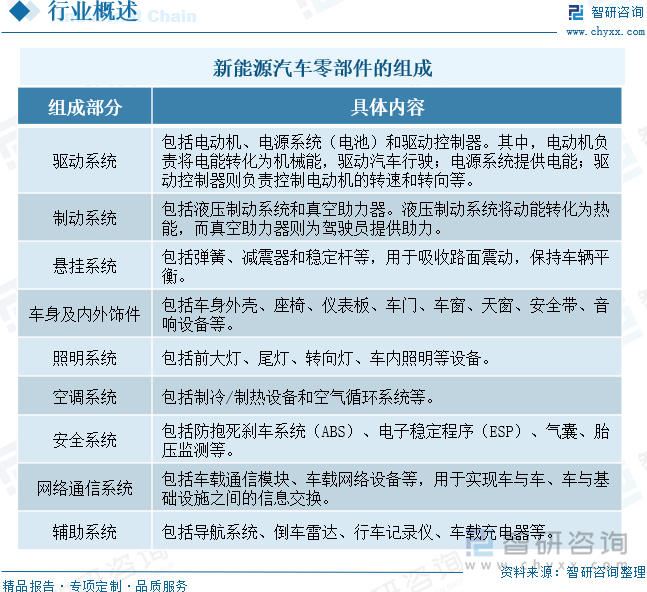
Core Viewpoint - The rapid development of China's new energy vehicle (NEV) components industry is driven by domestic economic growth, the fast expansion of the vehicle market, supportive national policies, and increased global sourcing efforts, with projected revenue reaching approximately 1.903 trillion yuan in 2024 [1][14]. Industry Overview - NEV components are essential units that make up various parts of new energy vehicles, playing a critical role in vehicle performance, safety, and reliability [3][12]. - The main components include the drive system, brake system, suspension system, body and interior/exterior parts, lighting system, air conditioning system, safety system, network communication system, and auxiliary systems, with the "three electric systems" (battery, motor, and electronic control) being the core [3][4]. Policy Support - The Chinese government has introduced multiple policies to support the NEV components industry, aligning with the "dual carbon" strategy to promote sustainable development [5][7]. - Key policies include the promotion of new power batteries and critical materials, as well as the establishment of standards for key components and intelligent network technologies [5][7]. Industry Chain - The NEV components industry chain consists of upstream raw material supply, midstream production, and downstream manufacturers, including vehicle manufacturers and repair shops [8]. Cost Structure - The cost structure of NEV components shows significant characteristics of electrification and intelligence, with the battery system accounting for 30% to 45% of the total vehicle cost [10][12]. - The electric drive system constitutes about 10% to 15% of the total cost, while the body and chassis account for 15% to 25% [10]. Market Growth - The production of NEVs in China has grown from 340,500 units in 2015 to an estimated 12.888 million units in 2024, with a compound annual growth rate (CAGR) of 49.74% [12]. - In the first quarter of 2025, NEV production and sales reached 3.182 million and 3.075 million units, respectively, marking year-on-year growth of 50.4% and 47.1% [12]. Key Enterprises - Major players in the NEV components industry include CATL, BYD, and others, with CATL projected to generate 253 billion yuan in revenue from battery systems in 2024 [23]. - BYD is also a significant player, with projected revenue of 617.4 billion yuan from its automotive and related products in 2024 [25]. Development Trends - The industry is experiencing a shift towards high-tech areas, with advancements in solid-state batteries and intelligent driving technologies [27][28]. - Regional industrial clusters are reshaping the components industry landscape, enhancing supply chain resilience and reducing logistics costs [28][29].



2025年中国高效节能电机行业产量、市场规模、重点企业经营情况及发展趋势研判:“双碳”战略深入推进,高效节能电机成为驱动绿色转型核心引擎[图]
Chan Ye Xin Xi Wang· 2025-06-05 01:23
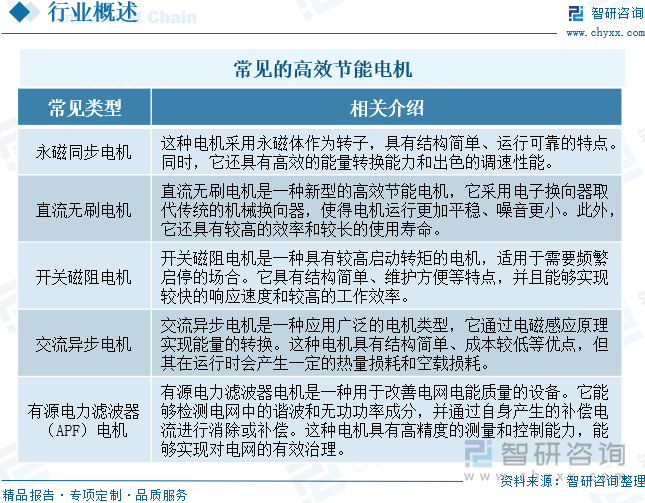
Core Insights - The efficient energy-saving motor has become a core equipment for promoting industrial green upgrades, playing a strategic role in achieving carbon neutrality goals [1][15] - The market size of China's efficient energy-saving motor is projected to grow from 17.638 billion yuan in 2018 to 23.963 billion yuan in 2024, with a compound annual growth rate (CAGR) of 5.24% [1][15] - The demand for efficient energy-saving motors is expected to increase further due to the rapid development of emerging fields such as new energy vehicles and smart grids [1][15] Industry Overview - Efficient energy-saving motors are designed to improve energy conversion efficiency, reduce energy consumption, and minimize energy waste, achieving efficiency levels of GB18613 grade II and above [3] - The market for efficient energy-saving motors in China is experiencing growth due to the implementation of national energy-saving and emission reduction policies and the transformation of the manufacturing industry [1][15] - The production of efficient energy-saving motors in China is expected to increase from 9.6 million kilowatts in 2019 to 19.3 million kilowatts in 2024, with a CAGR of 14.99% [13] Market Dynamics - The efficient energy-saving motor industry chain includes upstream raw material suppliers (silicon steel, copper, aluminum, rare earth permanent materials), midstream manufacturing, and downstream application fields such as industrial, household appliances, and renewable energy [6][10] - The industrial sector is a significant downstream application market for efficient energy-saving motors, with demand closely linked to industrial production scale [10] Key Companies - Major players in the efficient energy-saving motor industry include Shanghai Electric, Wolong Electric, and Xiangdian Co., with each company holding a competitive edge in various segments [18][19] - Shanghai Electric focuses on a wide range of motor products and has a strong presence in large projects, while Wolong Electric has a diversified business model that includes industrial internet solutions [20][23] - Companies like Dayang Electric and Dechang Electric are innovating in the new energy vehicle motor sector and micro-motor manufacturing, respectively [19][23] Future Trends - The industry is expected to see technological upgrades that enhance energy efficiency, including new electromagnetic designs and smart control systems [25] - The application of efficient energy-saving motors is expanding into emerging markets, necessitating customized solutions and flexible manufacturing [26] - The focus is shifting from single equipment manufacturing to integrated system solutions, with companies evolving into energy efficiency partners [27]


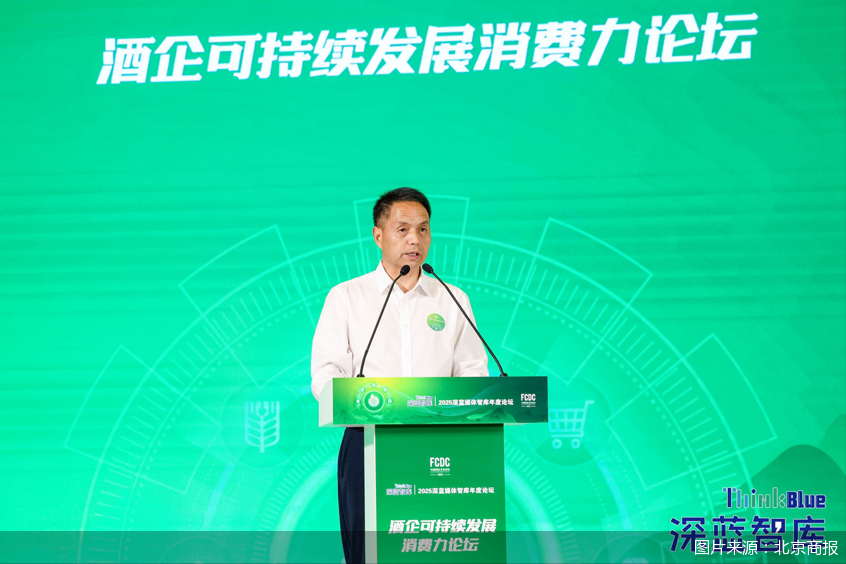
深度挖掘可持续消费力 西凤酒打出“创新+绿色”组合拳
Bei Jing Shang Bao· 2025-06-04 11:58
Core Viewpoint - The recent forum on sustainable development in the liquor industry highlighted the achievements and initiatives of Shaanxi Xifeng Liquor Factory in integrating green development into its production processes [1][11]. Group 1: Sustainable Development Initiatives - Xifeng Liquor emphasizes the importance of green development throughout its production chain, from raw materials to consumer delivery, embodying the philosophy of "green and responsibility" [3][11]. - The company has implemented a "dual carbon" strategy since 2014, removing all coal-fired boilers, which has led to a reduction of approximately 280 tons of sulfur dioxide, 53 tons of nitrogen oxides, and 540 tons of smoke dust emissions annually [11][12]. - Xifeng Liquor has achieved 100% recycling of cooling water used in production, saving 850,000 tons of water resources each year [11][12]. Group 2: Traditional Craftsmanship and Innovation - The brewing process of Xifeng Liquor is characterized by a commitment to traditional craftsmanship, with significant innovations made over the years, including eight major improvements to production techniques [5][9]. - The company has developed a digital expression system called "16999," which outlines a comprehensive production cycle and stages, ensuring quality and consistency in its products [5][10]. - Xifeng Liquor has been recognized for its traditional brewing techniques, which have been included in the national intangible cultural heritage list and have received various accolades [8][12]. Group 3: Technological Advancements - Xifeng Liquor has embraced digital innovation over the past two decades, integrating industrial internet and artificial intelligence to enhance the precision of its brewing processes [9][10]. - The company has secured 136 effective technology patents and has made significant advancements in optimizing its brewing techniques through modern microbiological technology [10][12]. - The establishment of a fully traceable supply chain ensures that every grain used in production is monitored and controlled, reflecting the company's commitment to quality [10][11]. Group 4: Recognition and Awards - Xifeng Liquor has received numerous accolades for its sustainable development efforts, including the "Green Factory" certification and the "Shaanxi Quality Award" for its excellence in quality management and innovation [12][13]. - The company aims to maintain high standards in product quality, which is seen as essential for gaining consumer trust amidst market competition [13].
新疆喀什光伏装机超千万千瓦 能源转型加速推进
Zhong Guo Xin Wen Wang· 2025-06-04 09:02
Core Insights - Xinjiang's Kashgar region has surpassed 10.242 million kilowatts of installed photovoltaic capacity, becoming the fifth and second million-kilowatt-level renewable energy base in Xinjiang and southern Xinjiang respectively, marking a significant achievement in the energy transition and the national "dual carbon" strategy [1][2] Group 1: Photovoltaic Capacity Development - The Kashgar region's geographical advantages, including over 2800 hours of annual sunlight, provide ideal conditions for large-scale photovoltaic base construction, positioning it as a key pillar in southern Xinjiang's new power system [1] - The National Grid Xinjiang Electric Power Company has implemented online application processes for grid connection to address the surge in photovoltaic installations, ensuring that renewable energy projects are connected as soon as possible [1] Group 2: Energy Storage and Stability - The development of large-scale energy storage resources is being prioritized to address the inherent volatility of renewable energy, with a focus on constructing water-solar complementary bases and utilizing various energy types to enhance supply stability and efficiency [2] - As of now, the new energy storage capacity in southern Xinjiang has reached 5.9675 million kilowatts, accounting for 49.9% of the total in Xinjiang, with advanced technologies being applied prominently [2] Group 3: Grid Infrastructure and Energy Distribution - The construction of the 750 kV ring network around the Tarim Basin is enhancing the optimization of energy resource allocation within Xinjiang and significantly improving the capacity for electricity export [2] - The photovoltaic power generation in southern Xinjiang effectively addresses the electricity demand during peak hours in eastern and central provinces, demonstrating the initial value of "ensuring internal supply and strengthening external delivery" [2]
环保双碳跟踪:碳市场扩容进度达60%,绿证基本实现全核发
Changjiang Securities· 2025-06-04 02:18
Investment Rating - The industry investment rating is "Positive" and is maintained [10] Core Viewpoints - The report tracks marginal changes in the carbon market since 2025, indicating a 60% expansion progress in the carbon market, with expectations for quota prices to rebound in the second half of the year [2][4] - The issuance of green certificates (绿证) is expected to achieve full coverage by the end of 2024, with a year-on-year increase in trading volume of 3.64 times, indicating an upward price trend [2][5] - The market activity of CCER (China Certified Emission Reduction) is anticipated to continue expanding due to methodological expansion [2][7] - The dual carbon strategy is accelerating, with sectors such as waste incineration, carbon monitoring, CCUS, hydrogen energy, electric sanitation vehicles, and recycling resources expected to benefit [2][8] Summary by Sections Quotas - After the compliance period, quota prices have declined, with a current market expansion progress of 60%. The price dropped from over 100 yuan per ton at the end of last year to 68.46 yuan per ton by May 30, 2025, primarily due to weak demand during the non-compliance period [4][22] - The carbon market's coverage of carbon dioxide emissions is expected to increase from about 40% to over 60% with the inclusion of the steel, cement, and aluminum industries [4][24] Green Certificates - The issuance of green certificates has accelerated since mid-2024, with a completion rate of 95% for centralized renewable energy projects by the end of 2024. A total of 4.677 billion green certificates were issued, with wind, conventional hydropower, solar power, and biomass power accounting for 40.77%, 33.73%, 17.18%, and 8.15% respectively [5][29] - The trading volume of green certificates in 2024 increased by 3.64 times year-on-year, with the manufacturing sector consuming nearly 70% of the total [5][35] CCER - Since October 2023, the progress of CCER has accelerated, with the release of new methodologies and the establishment of a basic institutional framework for voluntary emission reduction trading [7][45] - The price of CCER is expected to maintain a moderate upward trend as more industries are included in the carbon quota management [49] Investment Strategy - The dual carbon strategy is advancing rapidly, with the carbon market construction accelerating. The report highlights potential investment opportunities in waste incineration, carbon monitoring, CCUS, hydrogen energy, electric sanitation vehicles, and recycling resources [8][52] - Companies such as Huanlan Environment, Guangda Environment, and Weiming Environment are expected to benefit from the green certificate replacing national subsidies, improving cash flow [52][53]
中天科技: 江苏中天科技股份有限公司2024年年度股东大会会议资料
Zheng Quan Zhi Xing· 2025-06-03 09:23
江苏中天科技股份有限公司 二〇二五年六月十一日 江苏中天科技股份有限公 司 2024 年年度股 东大会会议资料 江苏中天科技股份有限公司 时间:2025 年 6 月 11 日(星期三)下午 2:30 地点:江苏省南通经济技术开发区中天路三号中天黄海宾馆会议室 参会人员:江苏中天科技股份有限公司(以下简称"中天科技股份"或"公 司")股东及股东代表、董事、监事、高级管理人员及公司聘请的见证律师 会议议程: 议案二:关于《江苏中天科技股份有限公司第三期员工持股计划(草案)》 议案三:关于《江苏中天科技股份有限公司第三期员工持股计划管理办法》 议案七:江苏中天科技股份有限公司关于募集资金年度存放与使用情况的专 议案十二:关于续聘中兴华会计师事务所(特殊普通合伙)为公司 2025 年 江苏中天科技股份有限公 东大会会议资料 司 2024 年年度股 十、由见证律师宣读为本次股东大会出具的法律意见书 十一、宣布本次股东大会闭会 议案一 关于调整公司第二期员工持股计划相关事项的议案 尊敬的各位股东及股东代表: 为保证本次员工持股计划顺利实施,进一步优化绩效考核结果及解锁比例,调动公司部分董事、高级 管理人员、核心业务骨干的 ...
