
双碳目标

Search documents
加点“料” 老工艺焕新(唠“科”)
Ren Min Ri Bao· 2025-11-21 22:25
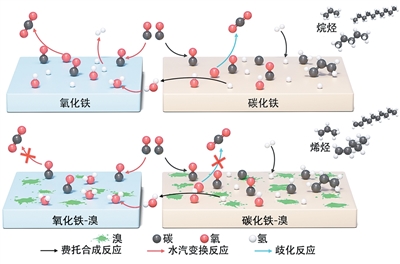
Core Insights - The article discusses the breakthrough in Fischer-Tropsch synthesis, a nearly century-old process that converts syngas (a mixture of carbon monoxide and hydrogen) into valuable chemical products, including liquid fuels and olefins, which remains a backbone of the global energy and chemical industry [1][2] Group 1: Technology and Innovation - Researchers have discovered a method to significantly reduce carbon dioxide emissions during the Fischer-Tropsch synthesis by adding a trace amount of halogenated methane (e.g., bromomethane) at a concentration of 20 parts per million (ppm), which reduces CO2 generation from 30% to less than 1% under specific conditions [2][3] - The addition of bromine atoms creates a protective layer on the catalyst's surface, effectively altering the reaction environment and preventing unwanted side reactions, thus enhancing the efficiency of the process [3] Group 2: Environmental Impact - This innovation addresses the challenge of high carbon emissions in the Fischer-Tropsch synthesis, providing a new pathway for the green transformation of carbon resources such as coal, natural gas, and biomass in alignment with China's carbon neutrality goals [2][3] - The technique not only improves the efficiency of traditional energy industries but also has the potential to be applied to other catalytic systems, indicating a significant shift in carbon resource utilization strategies [3]
加点“料”,老工艺焕新(唠“科”)
Ren Min Ri Bao· 2025-11-21 22:12
Core Insights - The F-T synthesis process, a nearly century-old technology, converts syngas (a mixture of carbon monoxide and hydrogen) into valuable chemical products like liquid fuels and olefins, remaining a backbone in the global energy and chemical sectors [1] - A recent breakthrough involves adding a trace amount of halogenated methane (e.g., bromomethane) to significantly reduce CO2 emissions during the F-T synthesis process, achieving a drop in CO2 generation from 30% to less than 1% with just 20 ppm of bromomethane [2][3] - This innovative approach not only enhances efficiency but also transforms carbon resource utilization, indicating a promising direction for the future of green chemistry [3] Industry Implications - The new method addresses the longstanding challenge of high carbon emissions in the F-T synthesis process, aligning with China's dual carbon goals and providing a pathway for the green transformation of carbon resources like coal, natural gas, and biomass [2] - The principle behind this technology involves the halogen atom acting as a protective layer on the catalyst surface, effectively preventing unwanted side reactions and guiding the reaction towards desired products [3] - This strategy of using minimal additives to control the microenvironment of catalysts could be applicable to other reaction systems, representing a significant advancement in chemical engineering and a potential key direction for future green chemical processes [3]

【参会通知+参会名单】2大院士领衔! 近50场报告!第五届非粮生物质高值化利用论坛,11.27-29,杭州!
合成生物学与绿色生物制造· 2025-11-21 15:52
Core Points - The "2025 (Fifth) Non-Grain Biomass High-Value Utilization Forum" will be held from November 27-29, 2025, in Hangzhou, Zhejiang, focusing on innovations and commercialization in the non-grain biomass sector [2] - The forum aims to promote large-scale applications of non-grain biomass utilization to support carbon neutrality goals [2] Event Details - The forum will feature nearly 50 presentations discussing key strategic areas such as green pretreatment of biomass, non-grain sugars, biomass-based chemicals and materials, and biomass energy including methanol, fuel ethanol, biogas, and sustainable aviation fuel (SAF) [2] - Registration and check-in will occur on November 27 from 12:00 to 20:00, with various activities scheduled throughout the event [4][9] Organizing Institutions - The forum is co-hosted by DT New Materials and the National Key Laboratory of Biomass Transportation Fuel Technology, with notable figures from various academic and research institutions involved [8][6] Agenda Highlights - The agenda includes a youth forum on non-grain biomass innovations, a SAF industry exchange meeting, and thematic forums on biomass chemicals, materials, and energy [9][30] - Keynote speakers include prominent researchers and industry leaders discussing advancements in biomass utilization and sustainable fuel technologies [23][30] Supporting Units - The event is supported by several academic institutions and associations, including Zhejiang University and various research laboratories focused on biomass materials and technologies [8][6]

专访中央结算公司深圳分公司吴程彧:为湾区债券市场贡献中债力量
2 1 Shi Ji Jing Ji Bao Dao· 2025-11-21 13:43
Core Viewpoint - The Central Securities Depository and Clearing Company (CSDCC) is enhancing its role in the Guangdong-Hong Kong-Macao Greater Bay Area by establishing a Shenzhen branch, focusing on bond market services and green finance innovation [1][2]. Group 1: Company Functions and Strategies - CSDCC plays a crucial role in supporting the development of the Greater Bay Area's bond market, including participation in the initial operations of the Macau Central Securities Custody and Clearing Institution [2]. - The company has established a financial technology innovation center and successfully completed a national blockchain innovation application pilot project, facilitating the issuance of digital bonds [2][3]. - CSDCC provides comprehensive lifecycle services for local government bonds, supporting the issuance of 13 trillion yuan in local bonds across South China and Southwest regions [3]. Group 2: Green Finance Initiatives - During the 14th Five-Year Plan period, CSDCC established a green finance innovation center in Shenzhen, focusing on developing green financial products and creating a green bond database, which is the first of its kind globally [4]. - The company has led the release of the first local standard for financial institutions' green investment and financing environmental information disclosure requirements [4]. Group 3: Support for Private Enterprises - CSDCC has developed a high-yield bond market construction plan tailored to the financing characteristics of private enterprises, particularly in the technology sector, which has received recognition from the Shenzhen Financial Society [5][6]. - The company has explored financial technology solutions to address the information asymmetry in bond financing for private enterprises, earning accolades for its research outcomes [7]. Group 4: Cross-Border Financial Cooperation - CSDCC collaborated on a study regarding the development of the Asian offshore technology innovation bond market, which received approval from regulatory authorities [8].

张玉清:“十五五”时期能源安全是我国能源产业的首要任务
2 1 Shi Ji Jing Ji Bao Dao· 2025-11-21 13:22
Core Viewpoint - The conference highlighted the achievements and future goals of China's energy industry, emphasizing the importance of energy security and the transition to a low-carbon economy during the 14th and 15th Five-Year Plans [1][2]. Group 1: Achievements in Energy Sector - During the 14th Five-Year Plan, China's energy consumption structure improved, and the supply capacity of renewable energy significantly increased [1]. - Over the past decade, the average cost of wind power projects has decreased by over 60%, and the cost of photovoltaic power projects has dropped by over 80%, largely due to China's innovation and manufacturing capabilities [1]. Group 2: Future Goals and Strategies - The primary task for the 15th Five-Year Plan is to ensure energy security, which includes increasing oil and gas exploration and development, aiming for an additional natural gas production of 20 billion cubic meters annually [2][3]. - The development and utilization of renewable energy must accelerate, with a target for non-fossil energy consumption to exceed 30% by 2035 and a total installed capacity of wind and solar power to reach over 360 million kilowatts [3]. - Enhancing energy efficiency is crucial, focusing on key technologies, promoting zero-carbon parks and factories, and advancing the digitalization of the energy sector [3].
皖能电力拟与战略合作方东方风电成立合资公司
Zhi Tong Cai Jing· 2025-11-21 13:02
Core Viewpoint - The company is actively responding to the national "dual carbon" goals by establishing a joint venture with strategic partner Dongfang Electric Wind Power Co., Ltd to promote high-quality development in the renewable energy sector [1] Group 1: Company Actions - Anhui Waneng Energy Trading Co., Ltd, a wholly-owned subsidiary of Waneng Power, is investing cash to form a joint venture with Dongfang Electric Wind Power [1] - The joint venture will have Waneng Energy Trading holding a 51% stake, while Dongfang Electric Wind Power will hold 49% [1] Group 2: Strategic Goals - The establishment of the joint venture aims to achieve resource complementarity and shared risk between the two companies [1]

皖能电力(000543.SZ):子公司拟与东方风电共同成立合资公司
Ge Long Hui A P P· 2025-11-21 12:45
Core Viewpoint - The company is actively responding to the national "dual carbon" goals by establishing a joint venture with Dongfang Electric Wind Power Co., Ltd to promote high-quality development in the renewable energy sector [1] Group 1: Joint Venture Details - The wholly-owned subsidiary of the company, Anhui Waneng Energy Trading Co., Ltd, has formed a joint venture with Dongfang Electric, holding 51% of the shares while Dongfang Electric holds 49% [1] - The registered capital of the joint venture is 185,683.0205 million yuan, with Dongfang Electric contributing 100% equity of Muli Dongji New Energy Co., Ltd valued at 90,984.68 million yuan based on an asset evaluation report [1] - The company contributed 94,698.3405 million yuan in cash to the joint venture [1]
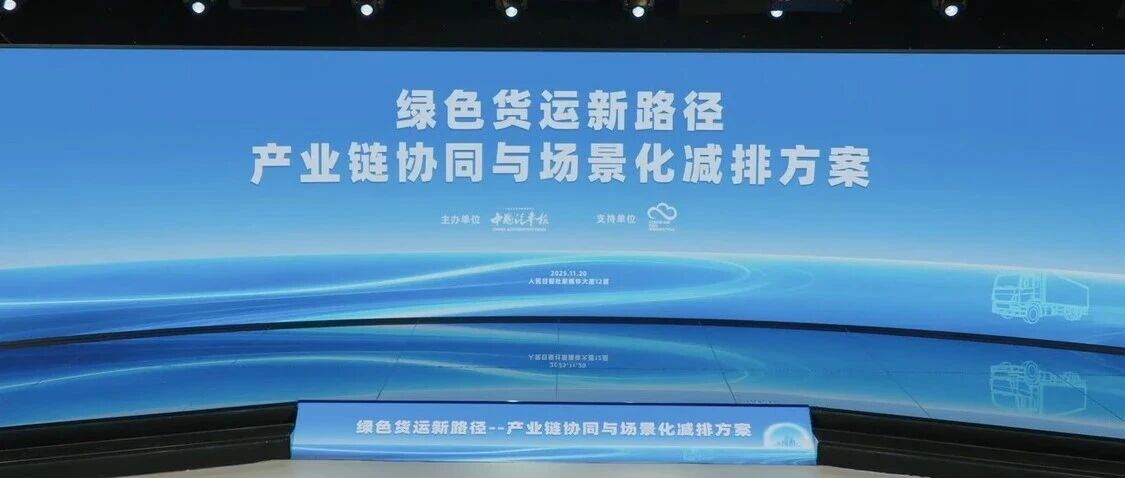
绿色货运新路径研讨会举办,探索产业链协同与场景化减排方案
中国能源报· 2025-11-21 12:29
Core Viewpoint - The green transformation of the freight industry is crucial for high-quality development in the context of achieving China's "dual carbon" goals, with road freight playing a foundational role in the logistics system [3]. Group 1: Industry Overview - In the first three quarters of this year, China's road freight volume reached 319.1 billion tons, reflecting a year-on-year growth of 4.9%, indicating strong resilience in the sector [3]. - The rapid development of new energy commercial vehicles is a significant support for green freight, with domestic sales reaching 649,000 units in the first ten months of 2025, marking a year-on-year increase of 60.2% [3]. Group 2: Challenges and Solutions - The development of green freight faces challenges such as insufficient regional collaboration, an imperfect industrial chain coordination mechanism, and lagging infrastructure construction [3]. - The green transformation of urban logistics, particularly through light-duty trucks, is essential as they account for over 70% of urban last-mile logistics demand, directly impacting traffic congestion, air quality, and carbon footprint reduction [3]. Group 3: Key Practices and Innovations - The green transformation of light-duty trucks has progressed from concept promotion to practical implementation, focusing on three main areas: energy structure transformation, innovative operating models, and technology-driven efficiency improvements [5]. - Key experiences in the transformation include policy "combination punches" to unblock transition bottlenecks, activating ecological vitality through the role of leading enterprises, and breaking through technical and resource bottlenecks via industrial chain collaboration [5]. Group 4: Sector-Specific Insights - In the short-haul heavy-duty transport sector, the rapid adoption of new energy heavy trucks is evident, particularly in the steel industry, which accounts for about half of the market share [5][7]. - The promotion of new energy heavy trucks in the steel industry is driven by policy guidance, continuous technological advancements, and significant reductions in acquisition costs [7]. Group 5: Urban Logistics and Technology - Urban logistics delivery is a critical link between production and consumption, with the green transformation directly affecting emission reduction targets and urban ecological optimization [10]. - Challenges in the operation of new energy light-duty trucks include battery range, load limitations, and insufficient refueling infrastructure, particularly in winter [10]. Group 6: Long-Distance Transport - The clean transformation of medium and long-distance transport is vital for the green development of the industry, with a focus on diverse technological pathways [16]. - Hydrogen fuel cell heavy trucks are highlighted for their unique advantages in medium and long-distance scenarios, requiring national-level planning for hydrogen energy corridors to promote coordinated development [18].
打破常规,比亚迪、宁德时代诞生汽车产业链企业首批院士
2 1 Shi Ji Jing Ji Bao Dao· 2025-11-21 11:58
Core Insights - The election results for the 2025 Chinese Academy of Sciences and Chinese Academy of Engineering academicians were announced, with key figures from the new energy vehicle (NEV) industry, including BYD's Lian Yubo and CATL's Wu Kai, being elected as academicians, marking a significant shift in representation from traditional academia to industry leaders [1][3]. Group 1: Key Figures and Their Contributions - Wu Kai, as the chief scientist at CATL, is recognized for his foundational work on core products like the Kirin battery and the Shenzhou supercharging battery, which have set global standards for energy density and charging speed in power batteries [1][3]. - Lian Yubo's career reflects a cross-disciplinary approach, transitioning from aircraft manufacturing to leading electric vehicle technology development at BYD, where he has been pivotal in establishing the company's early electric vehicle technology framework [1][2]. Group 2: Industry Impact and Growth - Lian Yubo's election underscores the strategic value of plug-in hybrid technology in enabling China's automotive industry to achieve competitive advantages over international giants, with BYD's plug-in hybrid vehicle sales skyrocketing from 48,000 units in 2020 to 1.43 million units by 2023, representing a growth of approximately 30 times [2][3]. - The rise of plug-in hybrid technology is becoming a core competitive advantage for China's NEV industry, with data indicating that plug-in and hybrid models have replaced pure electric vehicles as the new growth point in exports during the first nine months of 2025 [2][3].


填补空白、领跑国际 “十四五”以来我国新建国家计量基准34项
Yang Shi Xin Wen· 2025-11-21 10:19
Core Insights - Since the "14th Five-Year Plan," China has established 34 new national measurement standards, representing an 89% increase compared to the "13th Five-Year Plan," with many reaching international advanced levels [1] Group 1: Measurement Standards Achievements - The newly established "Regional Law Surface and Subsurface Structure Geometric Parameter Standard Device" has overcome the challenges of measuring micro three-dimensional shapes and deep-layer defects, achieving international leadership in this field [1] - In aerospace, the "Vacuum Secondary Standard Device" can accurately measure pressures nine orders of magnitude lower than atmospheric pressure, laying a solid foundation for manned spacecraft sealing tests and gravitational wave detector development [1] - The "Shock Tube Dynamic Pressure Standard Device" and "Pulse Dynamic Pressure Standard Device" fill the gap in China's step and pulse dynamic pressure measurement sources, addressing measurement challenges in aerospace equipment and deep space exploration [1] Group 2: Applications in Various Fields - The Radiation Heat Flow Standard Device can accurately replicate radiation heat flows of 1000 to 4000 kilowatts per square meter, meeting the testing needs for rocket equipment and high-temperature material performance [1] - In deep space exploration, the "Microwave Bright Temperature Standard" captures weak radiation signals with an error of only 0.3%, aiding satellites in accurately detecting planetary surface compositions and geological activities [1] - In marine exploration, the "Mid-Frequency Underwater Sound Pressure Standard" utilizes laser interference technology to calibrate underwater sound sensors, facilitating precise positioning of underwater vehicles and black boxes from downed aircraft [2] - The Airflow Speed Standard Device can detect extremely weak wind speeds, comparable to the flapping of a butterfly's wings, supporting the development of the wind power industry and the achievement of national "dual carbon" goals [2]