
人民币国际化

Search documents
1月末外储规模 环比上升1.23% 为连续第六个月增加
Zhong Guo Zheng Quan Bao· 2026-02-08 23:16
Core Viewpoint - As of January 2026, China's foreign exchange reserves reached $339.91 billion, marking an increase of $41.2 billion or 1.23% from December 2025, driven by factors such as changes in major economies' fiscal and monetary policies and a decline in the US dollar index [1][2]. Group 1: Foreign Exchange Reserves - China's foreign exchange reserves have increased for six consecutive months, reaching the highest level since December 2015, primarily due to a significant decline in the US dollar index and rising global stock indices [2]. - The US dollar index fell by 1.4% to 97.0 in January 2026, contributing to the overall increase in foreign exchange reserves [2]. - The current foreign exchange reserves, exceeding $3 trillion, are considered adequately sufficient, providing support for maintaining the RMB exchange rate at a reasonable equilibrium level [2]. Group 2: Gold Reserves - As of January 2026, China's gold reserves stood at 7.419 million ounces, with an increase of 40,000 ounces, marking the 15th consecutive month of gold accumulation by the People's Bank of China [3]. - The strategy of diversifying international reserves and increasing gold holdings is expected to continue, enhancing the credibility of the sovereign currency and supporting the cautious internationalization of the RMB [3].
1月末外储规模环比上升1.23%
Zhong Guo Zheng Quan Bao· 2026-02-08 20:22
中银证券全球首席经济学家管涛分析,2026年1月,我国外汇储备规模连续第六个月增加,增幅创2024 年1月以来新高。当月,受美国经济基本面变化等因素影响,美元指数走势一波三折,连续第三个月走 弱,累计下跌1.4%至97.0。同期,全球主要金融资产价格总体上涨。 "截至2026年1月末,我国外汇储备规模已连续六个月处于3.3万亿美元之上,创2015年12月以来最高。 这背后主要是受2025年以来美元指数大幅下降,全球主要股指上涨,以及美债收益率有所下行、美债价 格走高等因素的影响。"东方金诚首席宏观分析师王青说。 国家外汇局表示,我国经济运行稳中有进,发展韧性进一步彰显,为外汇储备规模保持基本稳定提供支 撑。 按不同标准测算,我国当前逾3万亿美元的外储规模处于适度充裕状态。王青表示,综合考虑各方面因 素,我国外汇储备规模有望保持基本稳定。在外部环境波动幅度加大的背景下,适度充裕的外汇储备规 模能为保持人民币汇率处于合理均衡水平提供重要支撑,也能成为抵御各类潜在外部冲击的压舱石。 推进国际储备多元化 ● 本报记者 彭扬 国家外汇管理局2月7日发布的数据显示,截至2026年1月末,我国外汇储备规模为33991亿美元 ...
连续15个月增持 金价波动不改央行增持节奏
Sou Hu Cai Jing· 2026-02-08 17:01
外储连续6个月站上3.3万亿美元 目前,我国外储规模已连续6个月处于3.3万亿美元之上。 谈及1月外汇储备规模环比继续上升,外汇局表示,受主要经济体财政政策、货币政策及预期等因素影 响,美元指数下跌,全球主要金融资产价格总体上涨。在汇率折算和资产价格变化等因素综合作用下, 当月外汇储备规模上升。 中国央行连续15个月增持黄金。 2月7日,国家外汇管理局发布的最新统计数据显示,截至2026年1月末,我国外汇储备规模为33991亿美 元,较2025年12月末上升412亿美元,升幅为1.23%,续创十年以来新高。 同日公布的官方储备资产数据还显示,2026年1月末,中国官方黄金储备为7419万盎司,较2025年12月 末增加4万盎司,为连续15个月增持黄金。 1月份受多重因素叠加影响,美元延续弱势,美元信用风险高企。美联储委员释放鹰派信号,加之沃什 当选美联储主席的预期发酵,美债震荡上行,全球资产价格整体上涨。 民生银行首席经济学家温彬分析,汇率方面,1月份,美元指数下跌1.4%至97.0,月中一度跌至四年来 低点95附近。非美元货币齐涨,日元、欧元、英镑对美元分别上涨1.23%、0.9%、1.6%。资产价格方 面 ...
中外资机构:期待中国股市“盈利牛”
Zhong Guo Ji Jin Bao· 2026-02-08 08:43
【导读】中外资机构:期待中国股市"盈利牛",短期波动不会改变黄金、白银避险属性 【编者按】 中国基金报每月会邀请中外资金融机构的代表,分享他们对全球经济及重大事件的分析与评判。 进入2026年,地缘政治风云突变,各类资产坐上史诗级"过山车",全球尤其是中国的经济及金融市场将 如何发展?中国基金报记者采访了以下机构专业人士。 贝莱德大中华区投资策略师 陆文杰 汇丰环球私人银行及财富管理中国首席投资总监 匡正 南方东英CIO 王毅 惠理集团投资组合总监 盛今 中国银河国际首席宏观策略师 成亚曼 全国两会重点关注 政策取向如何匹配中长期目标 中国基金报:全国两会即将举行,你会关注哪些热点? 陆文杰:中国政策连续性强,方向明确,不会因两会而发生根本性转向。 在基础性周期性政策上,如财政赤字、发债额度等占GDP的比重,预计与去年大致相当,不会有太大意 外。 我们真正关注的是政策取向如何与"十五五"规划等中长期目标配合。例如,"投资于人"的具体含义是什 么?财政支出是更侧重民生保障,还是通过给中小企业减税来促进就业和收入?这些具体的结构性安排 是最值得关注的。 成亚曼:2026年作为"十五五"开局之年,政策或趋于务实,淡 ...
美元霸权开始塌方,全球去美元化加速,人民币为何还不出手?
Sou Hu Cai Jing· 2026-02-08 07:15
Core Viewpoint - The article discusses the evolving dynamics of global currency, particularly focusing on the decline of the US dollar's dominance and the strategic positioning of the Chinese yuan in the international market [1][3][5]. Group 1: Dollar's Decline - The US dollar's share in global foreign exchange reserves has decreased from 71% to 59% over the past 20 years, indicating a loosening of its absolute dominance [5] - Countries are diversifying their reserves and reducing reliance on the dollar, reflecting a trend towards a more multipolar currency system [5][15] - The article emphasizes that while the dollar remains strong, its supremacy is being challenged by countries like China and Russia, which are seeking alternatives to dollar-based transactions [3][5] Group 2: China's Strategy - China is not aggressively pursuing the status of the world's leading currency but is instead focusing on a strategic approach to internationalize the yuan [7][15] - The Chinese Cross-Border Interbank Payment System (CIPS) connects with 189 countries and regions, facilitating trade without relying on Western financial systems [9][7] - The goal is to ensure that the yuan can be used for essential commodities like energy and food during critical times, rather than aiming for immediate dominance over the dollar [9][11] Group 3: Economic Foundations - The yuan is backed by China's extensive industrial capabilities and supply chain networks, providing it with a tangible basis compared to the dollar, which is increasingly seen as backed by US debt [11][13] - The article argues that the true strength of a currency lies in its ability to secure real goods during crises, rather than its perceived value in financial markets [11][13] - China's approach aims to avoid the pitfalls of dollar hegemony, such as economic disparity and industrial hollowing, by promoting a healthier global financial system [13][15] Group 4: Future Outlook - The future may see a coexistence of multiple currencies rather than a return to a single dominant currency, as countries continue to diversify their payment methods and reserve holdings [15][17] - The article suggests that the focus should be on strengthening domestic industries, technology, and financial infrastructure to prepare for global economic shifts [17]

我国外汇储备规模已经连续6个月稳定在3.3万亿美元以上 黄金储备持续增加
Sou Hu Cai Jing· 2026-02-07 23:02
Group 1 - As of January 2026, China's foreign exchange reserves have remained stable above $3.3 trillion for six consecutive months, reaching $33,991 billion, an increase of $412 billion or 1.23% from December 2025 [1] - The increase in foreign exchange reserves is attributed to the depreciation of the US dollar and the overall rise in global financial asset prices, influenced by fiscal and monetary policies of major economies [1] - The People's Bank of China has increased its gold reserves for the 15th consecutive month, with gold reserves reported at 74.19 million ounces [2] Group 2 - The global central bank gold purchases in 2025 totaled 863 tons, which is lower than the previous three years but still at historically high levels, with 95% of surveyed central banks expecting to increase their gold reserves in the next 12 months [2][3] - The increase in gold reserves by central banks is seen as a strategic move to diversify foreign exchange reserves and reduce reliance on the US dollar, enhancing the stability and autonomy of national financial systems [3] - The demand for gold from global central banks is expected to remain high in 2026, indicating that the trend of increasing gold reserves is a long-term strategy not significantly affected by short-term factors [3]
在五常中只有中国中立,买俄石油货币互换,冲击美元霸主
Sou Hu Cai Jing· 2026-02-07 21:47
Group 1 - China has significantly increased its imports of Russian oil, surpassing 100 million tons in 2023 and projected to reach 108 million tons in 2024, accounting for 20% of its total oil imports [1] - The "Power of Siberia" pipeline delivered over 11.7 billion cubic meters of gas to China last winter, nearly doubling the previous year's volume, with a projected annual supply increase to 44 billion cubic meters [3] - The trade between China and Russia has shifted to local currencies, with over 95% of transactions now conducted in RMB and Rubles, and the Russian Finance Minister reporting a 99.1% settlement in local currencies [3] Group 2 - China's exports to Russia have surged, particularly in automobiles, machine tools, and chips, filling the gap left by Western companies [3] - The economic relationship between China and Russia is strengthening, with Russia shifting its energy exports towards China, now relying on it for over half of its energy exports [5] - The collaboration is characterized as normal business transactions, with both countries benefiting from favorable pricing and stable supply chains, without any coercion involved [5]
外储规模创十年来新高!人民银行买金仍是大方向
Bei Jing Shang Bao· 2026-02-07 11:54
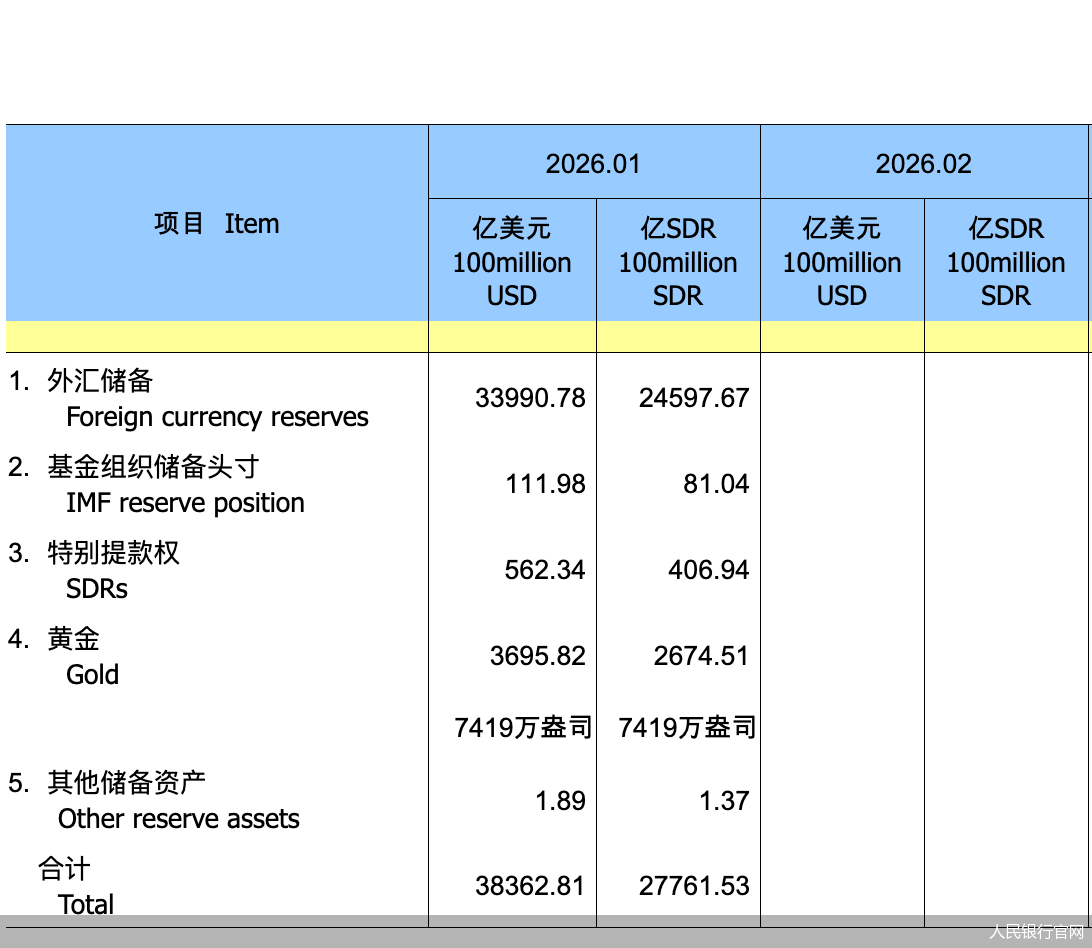
Core Viewpoint - As of the end of January 2026, China's foreign exchange reserves reached a record high of $339.91 billion, marking a 1.23% increase from December 2025, driven by a decline in the US dollar index and an overall rise in global financial asset prices [1][3][5]. Foreign Exchange Reserves - China's foreign exchange reserves stood at $33990.78 million as of January 2026, up by $412 million from December 2025, the highest level since December 2015 [2][3]. - The increase in reserves is attributed to a 1.2% drop in the US dollar index and rising global financial asset prices, with the latter being influenced by factors such as AI investment trends [3][4][5]. - The reserves have remained above $3.3 trillion for six consecutive months, reflecting the resilience of China's economic performance [5][10]. Gold Reserves - As of January 2026, China's gold reserves were reported at 7.419 million ounces, a slight increase from 7.415 million ounces in December 2025, marking the 15th consecutive month of gold accumulation by the People's Bank of China [1][6]. - The ongoing increase in gold reserves is linked to a strong upward trend in international gold prices, with significant gains observed since September 2022 [6][7]. - The strategy of gradual accumulation of gold is seen as a way to mitigate market volatility and optimize the structure of international reserves, especially in light of geopolitical uncertainties [7][9]. Market Implications - The increase in foreign exchange reserves and gold holdings is expected to stabilize market expectations and enhance the attractiveness of RMB-denominated assets, providing greater flexibility for future monetary and exchange rate policies [8][9]. - The People's Bank of China is likely to continue its strategy of increasing gold reserves while moderately reducing US Treasury holdings, aiming to diversify its international reserves [9][10].
外储近3.4万亿创十年新高 黄金连增15个月藏深层考量
Sou Hu Cai Jing· 2026-02-07 11:13
Core Insights - China's foreign exchange reserves have reached approximately $3.4 trillion, marking a ten-year high, with a notable increase of $41.2 billion or 1.23% from December 2025 to January 2026 [1][3] - The increase in foreign reserves is attributed to multiple factors, including a weaker US dollar and rising global financial asset prices, which have positively impacted the valuation of non-USD assets [3][4] - The People's Bank of China (PBOC) has been steadily increasing its gold reserves for 15 consecutive months, reaching 7.419 million ounces, with a cautious monthly increase of 40,000 ounces [3][4] Foreign Exchange Reserves - As of January 2026, China's foreign exchange reserves stand at $33,991 billion, just shy of the $3.4 trillion mark, reflecting a consistent upward trend since July 2025 [3][4] - The stability of foreign reserves is seen as a significant achievement amid global economic fluctuations, providing a solid foundation for the Chinese economy [3][5] Gold Reserves - The PBOC's strategy for gold accumulation is characterized by a "small steps" approach, with monthly increases kept below 100,000 ounces since March 2025, indicating a cautious and strategic accumulation [4][5] - The rationale behind increasing gold reserves includes optimizing the reserve structure and mitigating risks associated with global uncertainties, as gold serves as a non-credit asset [4][5] Economic Implications - The combination of stable foreign reserves and cautious gold accumulation is aimed at strengthening the economic safety net for China, supporting the stability of the RMB exchange rate and providing resilience against external shocks [5] - The long-term goal of increasing gold reserves is to enhance the international credibility of the RMB, facilitating cross-border trade and investment [5]

最新公布:中国外汇储备规模达33991亿美元,央行连续15个月增持黄金!专家:美元延续弱势,金价可能在相当长一段时间内易涨难跌
Mei Ri Jing Ji Xin Wen· 2026-02-07 08:39
Core Viewpoint - As of January 2026, China's foreign exchange reserves reached $339.91 billion, marking an increase of $41.2 billion from December 2025, representing a growth rate of 1.23% [1] Group 1: Current Foreign Exchange Reserves - The foreign exchange reserves are at a relatively high level of over $3.3 trillion [2] - The increase in reserves in January was driven by a combination of factors, including a decline in the US dollar index and a general rise in global financial asset prices [2][3] - The dollar index fell by 1.2% to 97.1 in January, with non-US currencies appreciating against the dollar [2][3] Group 2: Economic Analysis - The increase in foreign reserves is supported by the resilience of China's economy and the ongoing enhancement of cross-border investment and financing policies [1][5] - The strong performance of exports, particularly in the machinery and equipment sectors, has contributed to the stability of foreign reserves [5] - The capital market's attractiveness to foreign investors is expected to continue growing, bolstered by favorable economic conditions [5] Group 3: Gold Reserves - As of January, China's gold reserves stood at 7.419 million ounces, with a slight increase of 40,000 ounces from the previous month [6] - The central bank's gold accumulation is seen as a strategy to optimize the international reserve structure amid rising geopolitical risks and fluctuating international gold prices [6][7] - The current gold reserve proportion is approximately 9.7%, significantly lower than the global average of around 15%, indicating a need for continued accumulation of gold reserves [6][7]
