
城市高质量发展

Search documents
房地产重磅信号:“顶层设计”出炉!
第一财经· 2025-08-29 03:36
Core Viewpoint - The article discusses the recently released "Opinions on Promoting High-Quality Urban Development" by the Central Committee of the Communist Party of China and the State Council, outlining a blueprint for future urban development in China, with significant implications for the real estate industry [3][4]. Group 1: Urban Development Transition - Urban development in China is shifting from large-scale expansion to improving existing stock, focusing on quality and efficiency [5][6]. - By 2030, significant progress is expected in modernizing urban living, with policies adapting to high-quality urban development, and by 2035, a modern urban framework is anticipated to be established [6][14]. Group 2: Activation of Existing Resources - The "Opinions" emphasize the need to assess urban housing, facilities, and land resources comprehensively, including the renovation of old factories and underutilized commercial properties [7]. - As of August 18, over 4,300 parcels of idle land have been earmarked for storage, covering more than 22 million square meters, with a total value exceeding 550 billion yuan [7][8]. Group 3: Quality Housing Development - The document highlights the importance of constructing "good houses" and renovating urban villages, aiming to meet diverse housing needs through improved design, construction, and service levels [10][11]. - The trend of "original demolition and reconstruction" is gaining traction, where old buildings are replaced with new ones on the same site, supported by government subsidies [11][12]. Group 4: Safety in Housing and Infrastructure - A comprehensive safety management system for housing is proposed, including regular safety inspections and quality insurance throughout the lifecycle of buildings [13]. - The initiative to conduct regular housing inspections is expected to create a market worth nearly 100 billion yuan, reflecting the growing need for maintaining aging residential properties [13].


中共中央、国务院发布关于推动城市高质量发展的意见,股市强势反弹,债市承压走弱
Dong Fang Jin Cheng· 2025-08-29 03:12
Report Summary 1. Investment Rating - No investment rating for the industry is provided in the report. 2. Core View - On August 28, the overall capital market showed a complex trend with the stock market strongly rebounding, the bond market under pressure and weakening, the convertible bond market's main indexes rising collectively but most individual convertible bonds falling, and the yields of U.S. Treasury bonds at different maturities diverging while the 10 - year Treasury bond yields of major European economies generally declining [1]. 3. Summary by Directory 3.1 Bond Market News - **Domestic News** - The "Opinions of the CPC Central Committee and the State Council on Promoting High - quality Development of Cities" was released, aiming to establish a sustainable urban construction and operation investment and financing system by 2030 and basically build a modern people - centered city by 2035 [3]. - In July 2025, the total issuance of local government bonds was 1.2135 trillion yuan, and the balance of local government debt at the end of July was 52.7627 trillion yuan [4]. - The State Administration for Market Regulation promoted the return of market competition to a benign and orderly track [5]. - From January to July 2025, the total social logistics volume exceeded 200 trillion yuan, with a year - on - year increase of 5.2% [6]. - **International News** - The annualized quarterly - on - quarterly growth rate of the U.S. real GDP in the second quarter was revised up to 3.3%, mainly driven by business investment [7]. - **Commodities** - On August 28, international crude oil futures prices turned up, and international natural gas prices continued to rise [8]. 3.2 Capital Market - **Open Market Operations** - On August 28, the central bank conducted 416.1 billion yuan of 7 - day reverse repurchase operations, with a net capital injection of 163.1 billion yuan [9]. - **Funding Rates** - On August 28, the capital market was generally balanced and loose. DR001 decreased by 0.11bp to 1.313%, and DR007 increased by 2.72bp to 1.540% [10]. 3.3 Bond Market Dynamics - **Interest - rate Bonds** - On August 28, the bond market was under pressure and weakened. The yield of the 10 - year Treasury bond active bond 250011 rose by 2.50bp to 1.7900%, and the yield of the 10 - year CDB bond active bond 250215 rose by 3.35bp to 1.8875% [13]. - Information on bond tenders is provided, including the issuance scale, winning bid yield, and other data of multiple bonds [15]. - **Credit Bonds** - One industrial bond's trading price deviated by more than 10%, with "H1 Bidi 03" rising by more than 104% [15]. - Multiple companies, including Qingdao Beer Group, Weihai Thermal Power Group, and HeSteel Group, cancelled bond issuances due to market fluctuations [16]. - Huaxia Bank's operating income in the first half of the year was 45.522 billion yuan, a year - on - year decrease of 5.86%, and its net profit was 11.47 billion yuan, a year - on - year decrease of 7.95% [16]. - **Convertible Bonds** - On August 28, the three major A - share stock indexes rose collectively, and the main indexes of the convertible bond market also rose. The convertible bond market's trading volume was 122.512 billion yuan, an increase of 3.217 billion yuan from the previous trading day [17]. - Jinchengxin's convertible bond issuance obtained the CSRC's registration approval [18]. - **Overseas Bond Markets** - On August 28, the yields of U.S. Treasury bonds at different maturities diverged, with the 2 - year yield rising by 2bp to 3.62% and the 10 - year yield falling by 2bp to 4.22% [20]. - The 10 - year Treasury bond yields of major European economies generally declined, except for Germany's which rose by 1bp to 2.70% [23]. - Information on the daily price changes of Chinese - funded US dollar bonds is provided, including the price changes of bonds of multiple companies [25].





冠通期货早盘速递-20250829
Guan Tong Qi Huo· 2025-08-29 02:24
Group 1: Hot News - The "Opinions of the Central Committee of the Communist Party of China and the State Council on Promoting High - quality Urban Development" was released, aiming to make important progress in building modern people - centered cities by 2030 and basically complete the construction by 2035 [3] - The Indian government extended the exemption period for cotton import tariffs from September 30, 2025, to December 31, 2025 [3] - As of the week ending August 28, rebar production increased, factory inventory decreased, social inventory increased for the seventh consecutive week, and apparent demand increased for the second consecutive week. Rebar social inventory was 453.77 million tons, up 21.26 million tons (4.92% increase), and apparent demand was 204.21 million tons, up 9.41 million tons (4.83% increase) [3] - The Dalian Commodity Exchange added Siyang Dekang Agriculture and Animal Husbandry Co., Ltd. as a sub - warehouse of Sichuan Dekang Agriculture and Animal Husbandry Food Group Co., Ltd. and Guangxi Nongken Yongxin Animal Husbandry Group Shengtang Animal Husbandry Co., Ltd. as a non - group delivery warehouse for live pigs [3] - As of August 28, the total inventory of domestic soda ash manufacturers was 186.75 million tons, down 4.33 million tons (2.27% decrease) from last Thursday. Light soda ash inventory was 74.53 million tons, down 2.78 million tons, and heavy soda ash inventory was 112.22 million tons, down 1.55 million tons. It was also down 2.06 million tons (1.09% decrease) from Monday. Soda ash supply slightly decreased this week, and manufacturer inventory decreased slightly, but it was still at a historically high level [4] Group 2: Plate Performance - Key focus: Urea, apple, crude oil, lithium carbonate, PP [5] - Night - session performance: Non - metallic building materials rose 2.82%, precious metals rose 26.83%, chemicals rose 12.19%, grains rose 1.22%, and agricultural and sideline products rose 3.29%. Other plate performances include: oilseeds and fats rose 12.07%, coal, coke, steel, and minerals rose 14.81%, and energy rose 3.13% [5][6] Group 3: Plate Position - The chart shows the changes in commodity futures plate positions in the past five days, including positions in agricultural and sideline products, grains, chemicals, energy, coal, coke, steel, and minerals, non - ferrous metals, etc. [7] Group 4: Performance of Major Asset Classes | Asset Class | Name | Daily Return (%) | Monthly Return (%) | Year - to - Date Return (%) | | --- | --- | --- | --- | --- | | Equity | Shanghai Composite Index | 1.14 | 7.57 | 14.67 | | | SSE 50 | 1.45 | 6.65 | 10.28 | | | CSI 300 | 1.77 | 9.52 | 13.44 | | | CSI 500 | 2.17 | 12.60 | 22.45 | | | S&P 500 | 0.32 | 2.56 | 10.55 | | | Hang Seng Index | - 0.81 | 0.91 | 24.62 | | | German DAX | - 0.03 | - 0.11 | 20.75 | | | Nikkei 225 | 0.73 | 4.28 | 7.36 | | | FTSE 100 | - 0.42 | 0.92 | 12.77 | | Fixed - Income | 10 - year Treasury bond futures | - 0.19 | - 0.64 | - 1.04 | | | 5 - year Treasury bond futures | - 0.09 | - 0.25 | - 1.01 | | | 2 - year Treasury bond futures | - 0.03 | 0.02 | - 0.59 | | Commodity | CRB Commodity Index | 0.00 | 0.32 | 1.35 | | | WTI Crude Oil | 0.19 | - 7.15 | - 10.64 | | | London Spot Gold | 0.57 | 3.83 | 30.17 | | | LME Copper | 0.64 | 2.20 | 11.80 | | | Wind Commodity Index | - 0.18 | - 0.30 | 15.27 | | Other | US Dollar Index | - 0.33 | - 2.18 | - 9.78 | | | CBOE Volatility Index | 0.00 | - 11.18 | - 14.41 | [9]
国新证券每日晨报-20250829
Guoxin Securities Co., Ltd· 2025-08-29 02:16
Domestic Market Overview - The domestic market experienced wide fluctuations and a strong rebound on August 28, with the Shanghai Composite Index closing at 3843.6 points, up 1.14%, and the Shenzhen Component Index closing at 12571.37 points, up 2.25% [1][4] - The STAR 50 index rose by 7.23%, and the ChiNext index increased by 3.82%. The total trading volume of the A-share market was 300.09 billion yuan, showing a decrease compared to the previous day [1][4] - Among the 30 first-level industries of CITIC, 22 industries declined, with significant gains in communication, electronics, and comprehensive finance, while coal, agriculture, forestry, animal husbandry, and fishery saw the largest declines [1][4] Overseas Market Overview - On August 28, the three major U.S. stock indices experienced slight gains, with the Dow Jones up 0.16%, the S&P 500 up 0.32%, and the Nasdaq up 0.53%. Notably, Google rose over 2% [2][4] - The U.S. technology giants index increased by 0.47%, with significant gains from companies like Cisco and Salesforce, which rose over 1% [2][4] - Chinese concept stocks showed mixed results, with Ctrip Group rising nearly 15% and Newegg falling over 18% [2][4] Key News - The Central Committee of the Communist Party of China and the State Council issued opinions on promoting high-quality urban development, aiming for significant progress in modern urban construction by 2030 [3][11] - The Central Education Working Group released an action plan for optimizing the adjustment of higher education disciplines and majors from 2025 to 2027, focusing on establishing a coordinated mechanism and improving the talent supply-demand matching system [3][12] - The 28th China-Canada Economic and Trade Joint Committee was held in Ottawa, focusing on improving bilateral economic relations and addressing trade concerns [3][13][14] - The "2025 China Top 500 Private Enterprises" list was released, with JD Group, Alibaba, and Hengli Group ranking in the top three, and the total revenue of these enterprises reaching 43.05 trillion yuan [3][16]
新华鲜报|重大部署!中国城市高质量发展“路线图”公布
Xin Hua She· 2025-08-29 02:10
Core Viewpoint - The document outlines the "Opinions on Promoting High-Quality Urban Development" released by the Central Committee of the Communist Party of China and the State Council, emphasizing the transformation of urban development methods and the promotion of high-quality urban growth [1][4]. Group 1: Urban Development Goals - The main goal is to achieve significant progress in building modern urban environments by 2030, with improvements in policies, living quality, green transformation, safety, cultural appeal, and governance levels [4][5]. - By 2035, the basic establishment of modern urban environments is targeted, reflecting a shift from rapid urbanization to stable development [4][6]. Group 2: Key Tasks for Urban Development - The document identifies several key tasks, including optimizing urban systems, fostering new urban development dynamics, creating high-quality living spaces, promoting green low-carbon transitions, enhancing urban safety resilience, and advancing cultural prosperity [5][6]. - Specific measures include promoting urban integration, enhancing the competitiveness of large cities, and improving the carrying capacity of smaller cities and towns [6]. Group 3: Implementation and Governance - The document emphasizes the need for a unified leadership structure for urban work, with clear responsibilities at different governance levels, and the establishment of legal frameworks for urban planning, construction, and governance [6][7]. - It highlights the importance of tailored urban development strategies based on local resources and conditions, focusing on human-centered, sustainable, and culturally rich urban growth [6].
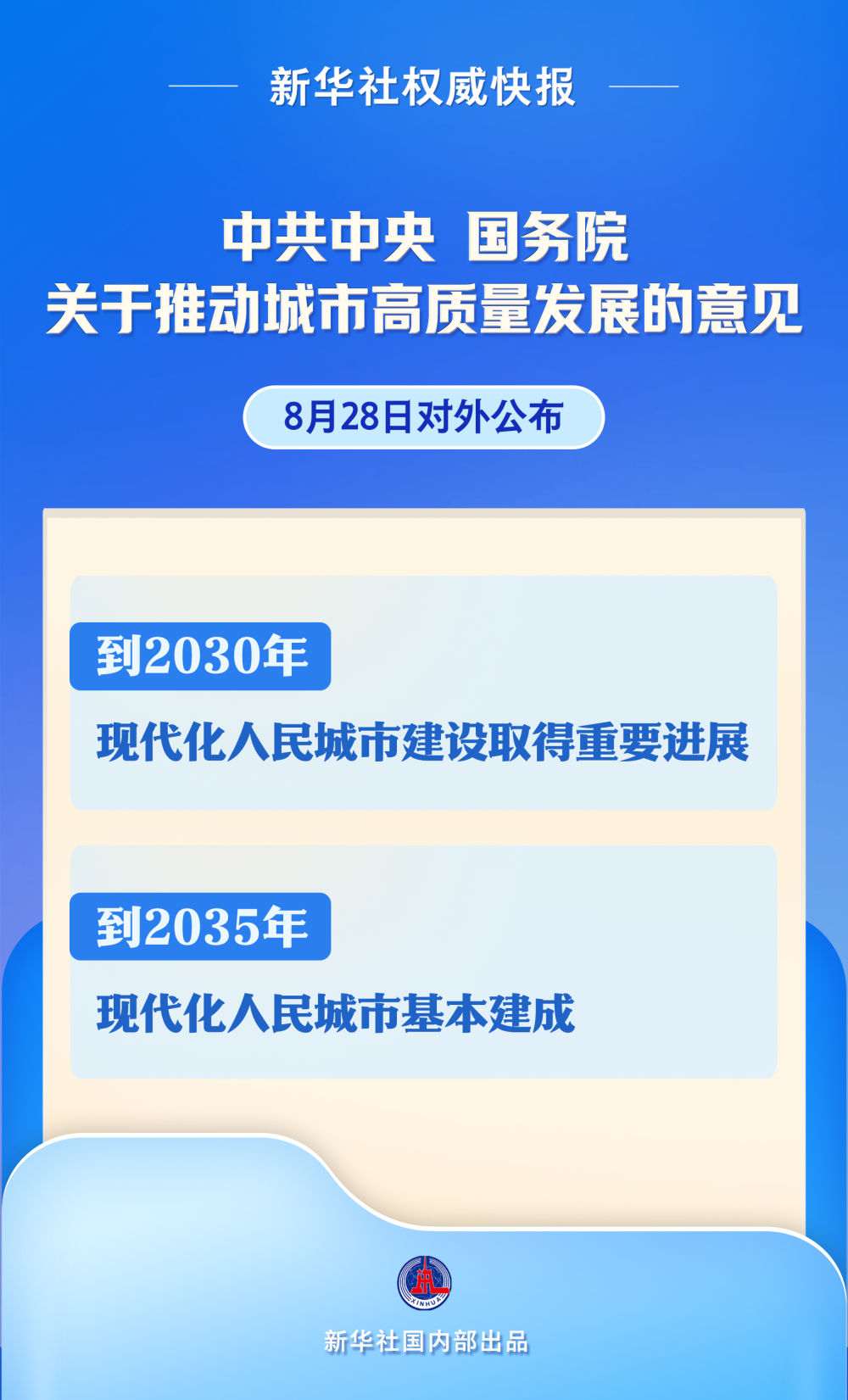
《中共中央 国务院关于推动城市高质量发展的意见》近日发布
Yang Guang Wang· 2025-08-29 01:58
Core Viewpoint - The document outlines the "Opinions on Promoting High-Quality Urban Development" issued by the Central Committee of the Communist Party of China and the State Council, emphasizing the importance of urban modernization and high-quality development in line with Xi Jinping's thoughts and directives [1][2]. Group 1: Goals and Objectives - By 2030, significant progress in modern urban construction is expected, with improved policies for high-quality urban development, accelerated transformation of old and new growth drivers, enhanced living quality, deepened green transition, solidified safety foundations, and increased cultural appeal [2] - By 2035, the basic establishment of modern urban cities is anticipated [2]. Group 2: Key Requirements - The document specifies requirements in several areas: optimizing the modern urban system, fostering new growth drivers for urban development, creating high-quality urban living spaces, promoting green and low-carbon urban transformation, enhancing urban safety resilience, encouraging cultural prosperity, and improving urban governance capabilities [2].
中共中央、国务院:稳步推进城中村和危旧房改造
Feng Huang Wang· 2025-08-29 01:34
Group 1 - The central government emphasizes the need to activate the potential of existing urban resources to foster new development momentum in cities [2] - A comprehensive assessment of urban assets, including buildings, facilities, and land, is necessary to optimize resource utilization [2] - The plan includes the renovation of old factories, inefficient buildings, and idle traditional commercial facilities, along with establishing a planning adjustment mechanism that aligns with functional conversion and mixed-use demands [2] Group 2 - The initiative aims to enhance the management of existing urban infrastructure assets to improve operational efficiency [2] - Policies for property rights collection, integration, replacement, and registration will be optimized to revitalize underutilized land [2] - The construction of high-quality living spaces will be systematically advanced, focusing on the development of "good houses" and complete communities [2] Group 3 - A new model for real estate development will be accelerated to better meet the rigid and diverse housing improvement needs of the population [2] - The entire chain of housing design, construction, maintenance, and service levels will be enhanced, promoting safe, comfortable, green, and smart housing [2] - Actions to improve property service quality will be implemented, alongside steady progress in the renovation of urban villages and dilapidated housing [2] Group 4 - The plan advocates for integrated planning of population, industry, urban areas, and transportation to create innovative industrial and business communities [2] - Special urban renewal plans will be scientifically developed and implemented to promote urban inspections and updates [2] - The goal is to create a favorable urban environment that is conducive to work, living, leisure, and tourism, while promoting the integration of industry and city, and balancing work and residence [2]
万联晨会-20250829
Wanlian Securities· 2025-08-29 00:46
Core Insights - The A-share market saw a collective rise in the three major indices on Thursday, with the Shanghai Composite Index increasing by 1.14%, the Shenzhen Component Index by 2.25%, and the ChiNext Index by 3.82%. The total market turnover was 30,009 billion, a decrease of 1,969 billion from the previous day, with over 2,800 stocks rising across the market. Technology sectors such as copper cable high-speed connections, CPO, photolithography machines, satellite communications, and semiconductors led the gains, while sectors like agriculture, innovative pharmaceuticals, liquor, education, and pork experienced declines [2][7]. Important News - On August 28, the Central Committee of the Communist Party of China and the State Council issued the "Opinions on Promoting High-Quality Urban Development," proposing 23 measures across various aspects including optimizing modern urban systems, fostering new urban development momentum, creating high-quality urban living spaces, promoting green and low-carbon urban transformation, enhancing urban safety resilience, advancing cultural prosperity, and improving urban governance capabilities [3][8]. - The Ministry of Commerce announced that Li Chenggang, the international trade negotiation representative and deputy minister, will lead a delegation to Washington, USA, to meet with relevant officials after attending the China-Canada Economic and Trade Joint Committee meeting in Canada from August 24-27 [3][8].
城市高质量发展路线图公布,支持老旧住房自主更新、原拆原建
Di Yi Cai Jing Zi Xun· 2025-08-29 00:41
Core Viewpoint - The "Opinions" released by the Central Committee and the State Council emphasize that urban renewal will be a crucial driver for high-quality urban development, transitioning from rapid urbanization to stable development, focusing on improving existing urban resources rather than expanding new ones [1][2][4] Group 1: Urban Renewal as a New Growth Driver - Urban renewal is identified as a new momentum for urban development, aimed at activating the potential of existing urban resources [1] - The plan includes a comprehensive assessment of urban assets such as buildings, facilities, and land, and emphasizes the need for a mechanism to adapt planning to the conversion and mixed-use demands of buildings [1][3] Group 2: Key Components of Urban Renewal - Important components of urban renewal include the renovation of urban villages, dilapidated housing, and old residential areas, which can enhance urban development, improve land use efficiency, and address safety concerns [2][3] - The "Opinions" advocate for steady progress in the renovation of urban villages and dilapidated housing, supporting self-renovation of old housing [2][3] Group 3: Addressing Urban Issues - The urban renewal strategy must be tailored to local conditions and guided by problem identification, aiming to create a favorable urban environment that promotes integration of industry and city [3] - A survey of nearly 1 million residents across 299 cities revealed issues such as imbalance in job-housing proximity and a shortage of affordable housing, which need systematic solutions through urban renewal [3] Group 4: Enhancing Public Services - The "Opinions" also highlight the need to improve the quality and balance of public services, including employment services and social security systems for various employment groups [4] - The focus is on increasing the supply of affordable housing and promoting flexible employment participation in housing funds [4] Group 5: Local Government Initiatives - Various local governments have begun to implement urban renewal plans in line with the "14th Five-Year Plan," with cities like Shanghai and Beijing outlining specific strategies and policies for urban renewal [5][6] - Jiangsu Province has proposed a dynamic project database for urban renewal, which will prioritize projects for funding and support [6] Group 6: Policy Coordination - The "Opinions" call for a coordinated approach among central, provincial, and municipal levels to enhance the effectiveness of urban planning, construction, and governance [6] - There is an emphasis on establishing legal frameworks and policies to ensure the coherence of urban development initiatives [6]
城市高质量发展路线图公布 支持老旧住房自主更新、原拆原建
Di Yi Cai Jing· 2025-08-29 00:40
Core Viewpoint - The "Opinions" released by the Central Committee and State Council emphasize that urban renewal will be a crucial driver for high-quality urban development, transitioning from rapid urbanization to stable development, focusing on improving existing urban resources [1][2]. Group 1: Urban Renewal as a New Growth Driver - Urban renewal is identified as a new growth driver, aimed at activating the potential of existing urban resources, including buildings, facilities, and land [1]. - The plan includes the renovation of old factories, inefficient buildings, and idle commercial facilities, establishing a mechanism for planning adjustments that align with functional transformations [1][2]. Group 2: Key Components of Urban Renewal - Important components of urban renewal include the transformation of urban villages, dilapidated housing, and old residential areas, which can enhance urban development, improve land use efficiency, and address safety concerns [2]. - The "Opinions" advocate for steady progress in the renovation of urban villages and dilapidated housing, supporting self-renovation of old housing [2][3]. Group 3: Addressing Urban Issues - The urban renewal strategy must be tailored to local conditions and guided by existing problems, aiming to create a favorable urban environment that promotes integration of industry and city [3]. - A survey of nearly 1 million residents across 299 cities highlighted issues such as imbalance in job-housing distribution and a shortage of affordable housing, which need systematic solutions through urban renewal [3]. Group 4: Enhancing Public Services - The "Opinions" also stress the need to improve the quality and balance of public services, including employment services and social security systems for various employment groups [4]. - The focus is on increasing the supply of affordable housing and promoting flexible employment participation in housing provident fund systems [4]. Group 5: Local Government Initiatives - Local governments are actively planning urban renewal initiatives, with cities like Shanghai and Beijing outlining specific strategies and policies to enhance urban renewal efforts [5][6]. - By 2026, a comprehensive urban renewal project database will be established, allowing prioritized access to funding and support for projects [6]. Group 6: Policy Coordination - The "Opinions" call for a coordinated approach among central, provincial, and municipal levels to enhance policy synergy in urban planning, construction, and governance [6].