
基础研究

Search documents
不做基础研究局外人
Jing Ji Ri Bao· 2025-08-18 21:21
Group 1 - The Shanghai government has introduced measures to support enterprises in enhancing basic research, offering financial subsidies based on the level of investment in basic research, with amounts ranging from 2 million to 10 million yuan [1] - There is a recognition that while R&D spending by Chinese enterprises has been increasing, a significant portion is directed towards experimental development rather than basic research, indicating a gap in contributions from enterprises in this area [1][2] - The importance of basic research as the foundation of technological innovation is emphasized, with a call for enterprises to transition from being passive responders to active participants in basic research [2][3] Group 2 - The article highlights the need for enterprises to increase their investment in basic research, which is characterized by long cycles and high risks, and suggests that government incentives such as subsidies and tax benefits are necessary to motivate enterprises [2] - It points out that the current concentration of basic research talent in universities and research institutions limits the involvement of enterprises, suggesting reforms to facilitate the sharing of research resources and enhance collaboration between enterprises and academic institutions [2] - The global innovation landscape is described as increasingly competitive, urging enterprises to commit to long-term basic research efforts to lead in the upcoming technological revolution and industrial transformation [3]
创新能力:自立自强有底气
Jing Ji Ri Bao· 2025-08-16 21:47
Core Viewpoint - The article emphasizes China's commitment to advancing technological self-reliance and innovation during the "14th Five-Year Plan" period, highlighting significant achievements in research and development, as well as the establishment of a robust national innovation system [1][2][4]. Group 1: R&D Investment and Innovation Achievements - China's R&D expenditure is projected to increase by nearly 50% compared to the end of the "13th Five-Year Plan," reaching an additional 1.2 trillion yuan, with an R&D intensity of 2.68%, approaching the OECD average [2]. - The number and quality of basic research outcomes have significantly improved, with total basic research investment rising to 249.7 billion yuan, accounting for 6.91% of total R&D spending [3]. - The artificial intelligence industry in China is expected to exceed 700 billion yuan in scale, maintaining a growth rate of over 20% for several consecutive years [6]. Group 2: Technological Advancements and Industry Impact - The launch of the domestically developed general-purpose processor, Longxin 3C6000, marks a significant milestone in China's semiconductor industry, with a 72.6% increase in integrated circuit production compared to the end of the "13th Five-Year Plan," adding approximately 190 billion units [5]. - The aerospace sector has seen substantial growth, with the number of civil unmanned aerial vehicle companies reaching 809 and product numbers exceeding 3.74 million [7]. - The automotive industry achieved record production and sales, with new energy vehicles accounting for 44.3% of total new car sales in the first half of the year [7]. Group 3: Strategic Goals and Future Directions - The 20th National Congress of the Communist Party of China set a strategic goal for achieving high-level technological self-reliance and building a strong technological nation by 2035 [8]. - The establishment of the Central Science and Technology Committee and the restructuring of the Ministry of Science and Technology aim to enhance the management and leadership of scientific research [10]. - The focus on nurturing young talent in scientific research is evident, with over 5 million graduates in science, technology, engineering, and mathematics each year, contributing to the country's innovation capacity [12].
最高法:规范金融机构单方面增加发放贷款条件行为|营商环境周报
2 1 Shi Ji Jing Ji Bao Dao· 2025-08-12 09:50
Group 1: National Carbon Measurement Center - The State Administration for Market Regulation has issued guidelines to establish national carbon measurement centers by the end of 2030, focusing on key industries and sectors to support carbon peak and carbon neutrality goals [1][2] - Eight key tasks for the national carbon measurement centers include policy research, establishing a traceability system, enhancing measurement verification capabilities, and promoting international cooperation [1] Group 2: Financial Support for New Industrialization - The People's Bank of China and six other departments have released guidelines to enhance financial support for new industrialization, aiming for a mature financial system by 2027 that supports high-end, intelligent, and green development in manufacturing [3][4] - The guidelines emphasize optimizing financial policy tools to support key technological products and enhancing financial services for major enterprises in the industrial chain [4][5] Group 3: Promoting Private Economy - The Supreme People's Court has issued guidelines to promote the healthy development of the private economy, proposing 25 measures to address challenges faced by private enterprises and ensure equal legal protection [7][8] - The guidelines stress the importance of fair competition and the regulation of financial institutions' loan practices to protect the rights of private economic organizations [8] Group 4: Credit System in Zhejiang - Zhejiang Province aims to establish a credit evaluation mechanism for key sectors by the end of 2025, enhancing the credit information sharing and evaluation system [10][11] - The plan includes comprehensive data collection, a differentiated regulatory approach based on credit ratings, and the promotion of credit commitment mechanisms [12] Group 5: Support for Basic Research in Shanghai - The Shanghai government has introduced measures to support enterprises in enhancing basic research, including financial subsidies of up to 10 million yuan annually for companies with significant research investments [13][14] - The initiatives aim to create a favorable environment for basic research and encourage collaboration between enterprises and research institutions [15] Group 6: Employment Services in Hubei - Hubei Province is developing a "2+6+10+N" smart service system to improve employment services and match labor supply with demand [16][17] - The system includes databases for labor resources and enterprise employment needs, along with analytical systems to support decision-making in employment services [17][18]
五年“三跨越” 按下科技强国建设“快进键”
Ke Ji Ri Bao· 2025-08-07 09:20
Group 1: Major Innovations and Achievements - The first self-exploration and development ultra-deepwater gas field "Deep Sea No. 1" commenced production in June 2021 [1] - The first domestically produced electromagnetic catapult aircraft carrier "Fujian" was launched in June 2022 [1] - The first large domestic cruise ship "Aida·Magic City" began trial operations in December 2023 [1] - The first ocean drilling vessel "Dream" was officially completed and commissioned in November 2024 [1] - The first ultra-deep exploration well "Deep Earth Tower No. 1" was successfully drilled to a depth of 10,910 meters in February 2025 [1] Group 2: Strategic High Technology Developments - Significant advancements in strategic high technology have been made over the past five years, supporting industrial upgrades and high-quality economic development [6] - The "Deep Sea No. 1" energy station, the world's first 100,000-ton deepwater semi-submersible production and storage platform, has been fully operational since June 2023, with a daily output of over 15 million cubic meters of natural gas [5] - The high-speed rail technology continues to innovate, with the "Fuxing" high-speed train operating over 48,000 kilometers, accounting for more than two-thirds of the global high-speed rail operating mileage [7] Group 3: Advancements in Basic Research - China has made significant breakthroughs in basic research, including the discovery of over 1,000 pulsars by the "China Sky Eye" (FAST) telescope [2] - In quantum technology, China achieved the preparation and verification of 51 superconducting qubit cluster states, setting a world record for entangled qubits [3] - The first complete spatial distribution map of single cells in the macaque brain was created, providing unprecedented insights into primate brain structure and evolution [3] Group 4: Innovation Ecosystem and Investment - China's R&D investment reached a new high, with a nearly 50% increase compared to the end of the 13th Five-Year Plan, amounting to an additional 1.2 trillion yuan [9] - The proportion of high-tech manufacturing in total manufacturing increased from 15.3% in 2020 to 16.9% in the first half of this year [8] - The number of high-impact papers from China accounted for 48.4% of the global total, maintaining the top position worldwide [4]
【科技日报】五年“三跨越” 按下科技强国建设“快进键”
Ke Ji Ri Bao· 2025-08-07 01:28
Group 1 - The launch of the third-generation autonomous superconducting quantum computer "Benyuan Wukong" and the successful return of samples from the "Chang'e 6" mission highlight China's advancements in technology and innovation [1][4] - The "14th Five-Year Plan" emphasizes the importance of innovation, aiming to build a technology powerhouse with leading global scientific strength and innovation capabilities [4][12] - Significant breakthroughs in foundational research have been achieved, including the detection of the first continuously active repeating fast radio bursts and advancements in quantum technology [5][6] Group 2 - The "Deep Sea No. 1" project, the world's first deep-water gas field developed independently, has begun full production, marking a significant milestone in China's deep-sea oil and gas development [2][8] - The launch of the first domestically produced large cruise ship "Aida·Modu" and the ongoing construction of the second ship "Aida·Huacheng" reflect advancements in China's shipbuilding industry [10] - The high-speed rail technology continues to innovate, with the CR450 train showcasing China's leadership in global high-speed rail operations [9] Group 3 - The rapid development of the new energy vehicle industry, which has maintained the highest global production and sales, demonstrates China's progress in automotive technology [11] - The establishment of the world's largest and most advanced 5G network has facilitated the digital transformation across various industries [11] - China's investment in research and development has reached new heights, with a nearly 50% increase in R&D funding compared to the end of the "13th Five-Year Plan" [12]
上海出台举措支持企业加强基础研究
Ren Min Ri Bao· 2025-08-06 22:10
Core Viewpoint - The recent release of "Several Measures to Support Enterprises in Strengthening Basic Research and Enhancing High-Quality Development New Momentum" by Shanghai aims to stimulate the vitality of basic research and original innovation in enterprises through government guidance and service support [1] Group 1: Financial Support Measures - The measures emphasize guiding and supporting enterprises to increase their investment in basic research [1] - Enterprises with strong technological innovation capabilities and significant basic research investments will receive an annual one-time financial subsidy of up to 10 million yuan [1] - Support is also provided for enterprises to establish or donate to basic research public welfare funds, with the government matching 50% of the contributions made to supported basic research projects [1]
上海出台多条措施强化企业基础研究 推动科技创新与产业深度融合
Huan Qiu Wang· 2025-08-05 06:05
Group 1 - The core viewpoint of the article is the introduction of measures by Shanghai to enhance enterprise participation in basic research, aiming to strengthen the integration of basic research, technological innovation, and industrial application [1] - The "Explorer Program" encourages qualified enterprises to increase investment in basic research, offering a one-time financial subsidy of up to 10 million yuan per year for companies with strong technological innovation capabilities and high basic R&D investment [3] - Shanghai's basic research investment accounts for 11% of the total R&D expenditure, which is higher than the national average but still has room for improvement compared to international innovation center goals [3][4] Group 2 - The measures broaden funding sources by encouraging enterprises to establish or donate to basic research public welfare funds, with a 50% matching support for related projects [4] - The Shanghai Qiyuan State-owned Assets Innovation Source Public Welfare Fund, established by 16 state-owned enterprises, focuses on cutting-edge fields such as quantum technology and brain science, supporting youth talent and innovative projects [4] - Collaboration between universities and enterprises is emphasized, with nearly 20% of Shanghai's university technology funding coming from enterprise contributions, and nearly a thousand joint research platforms established [4]


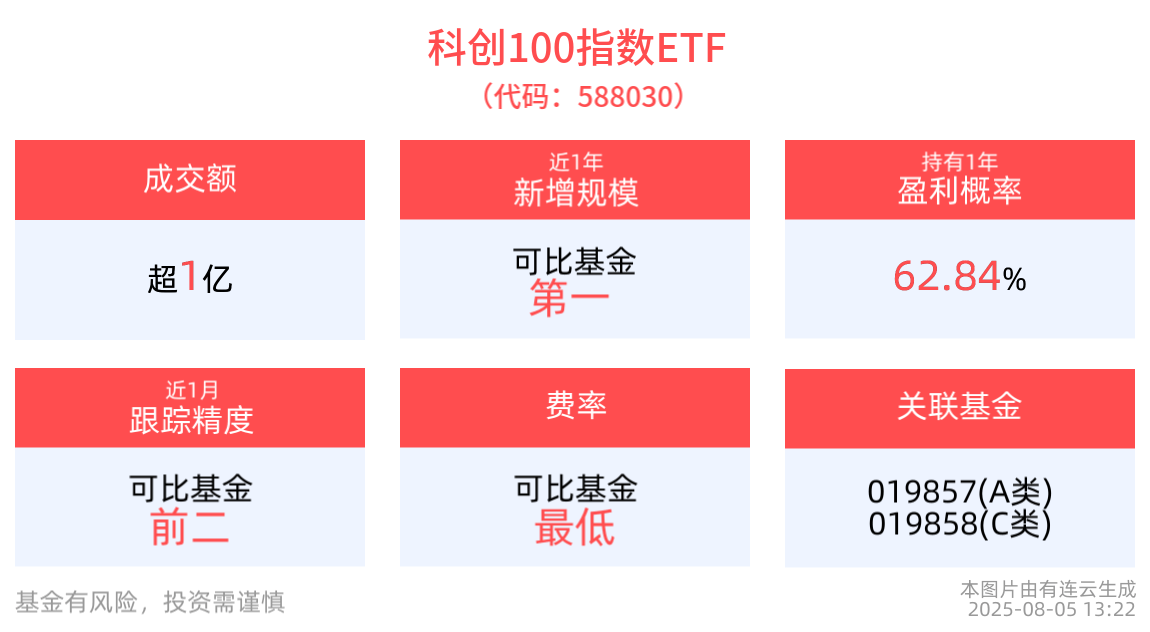
科创100指数ETF(588030)拉升翻红,近1年日均成交额超4亿元,上海政策支持企业加大基础研究投入力度
Sou Hu Cai Jing· 2025-08-05 05:41
Group 1 - The Shanghai Stock Exchange Sci-Tech Innovation Board 100 Index (000698) has shown a slight increase of 0.28% as of August 5, 2025, with notable gains from individual stocks such as Borui Pharmaceutical (688166) up by 6.56% and Huaheng Biological (688639) up by 5.88% [3][4] - The Sci-Tech 100 Index ETF (588030) has reported a 1.74% increase over the past week, with a current price of 1.11 yuan and a trading volume of 1.14 billion yuan [3][4] - The ETF has experienced a significant growth in scale, increasing by 13.55 million yuan over the past year, ranking first among comparable funds [4] Group 2 - The Shanghai Municipal Government has issued measures to support enterprises in enhancing basic research, particularly in critical fields such as integrated circuits, biomedicine, and artificial intelligence [4] - According to CITIC Securities, mainstream and niche storage prices are expected to rise in Q3 2025, with a focus on recommending leading storage chip design companies [4] - The latest financing buy-in amount for the Sci-Tech 100 Index ETF reached 11.4961 million yuan, with a financing balance of 177 million yuan [4] Group 3 - The Sci-Tech 100 Index ETF has achieved a net value increase of 22.98% over the past six months, ranking in the top 9.90% among equity funds [5] - The ETF has a management fee rate of 0.15% and a custody fee rate of 0.05%, which are among the lowest in comparable funds [5] - The ETF closely tracks the Sci-Tech Innovation Board 100 Index, which consists of 100 securities selected for their market capitalization and liquidity [6]


上海出台重磅政策全力支持企业加强基础研究
Zhong Guo Jing Ji Wang· 2025-08-05 03:56
Core Viewpoint - The Shanghai government has issued measures to support enterprises in enhancing basic research and fostering high-quality development through government guidance and service assurance [1][2] Group 1: Measures and Initiatives - The measures consist of three main areas and nine specific initiatives aimed at stimulating corporate basic research and original innovation [1] - The "Explorer Program" was established to transform engineering challenges faced by industries into basic scientific problems, facilitating collaboration between enterprises and scientific institutions [1] - The number of participating companies in the "Explorer Program" has expanded from 2 to 22, covering various sectors such as integrated circuits, biomedicine, information technology, aviation, and advanced materials [1] Group 2: Financial Support and Collaboration - The measures provide financial support through subsidies, funding matching, and tax incentives to encourage enterprises to engage in basic research [2] - Enterprises are granted greater decision-making power in basic research, along with support for utilizing shared scientific instruments and improving evaluation systems [2] - Various Shanghai departments are collaborating to support enterprise research activities, including the establishment of the "Coordination Innovation Center" and the "Qiyuan Public Welfare Foundation" [2]
上海发布支持企业加强基础研究《若干措施》及“探索者计划”细化配套政策 激励领军企业在技术底层创新突破
Jie Fang Ri Bao· 2025-08-05 01:43
Core Viewpoint - The Shanghai government has introduced measures to enhance corporate investment in fundamental research, aiming to strengthen the role of enterprises in technological innovation and improve original innovation capabilities in key and future industries [1] Group 1: Policy Measures - The "Explorer Program" is a detailed policy under the measures to solidify effective policies and expand the scale of cooperating enterprises [1] - The measures include both "giving fish" and "teaching to fish" policies to encourage corporate investment in fundamental research [2] - Financial incentives are provided for companies based on their annual investment in fundamental research, with subsidies ranging from 200 million to 1 billion yuan [2] Group 2: Corporate Participation - As of now, 22 enterprises have joined the "Explorer Program," including state-owned, private, and foreign companies [3] - The program encourages collaboration between enterprises and research institutions to address scientific problems behind technological challenges [3] - Companies like United Imaging Healthcare have successfully launched clinical trials for innovative technologies supported by the program [3] Group 3: Collaborative Innovation - The measures promote deep integration of industry and academia through collaborative innovation centers, enhancing project-based cooperation [4] - United Imaging Healthcare has established partnerships with Shanghai Jiao Tong University and Ruijin Hospital to advance research in medical imaging technology [5] Group 4: Philanthropic Initiatives - The measures support the establishment of public welfare funds by enterprises to promote fundamental research, with matching support from the government [5] - Titan Technology has set up a non-public fundraising foundation to support original research projects in materials science and chemistry [6] - A new public welfare fund initiated by 16 state-owned enterprises aims to support fundamental research, marking a significant step in corporate involvement in scientific exploration [6]