AGI(通用人工智能)

Search documents
分食OpenAI
投中网· 2025-09-24 07:17
Core Viewpoint - OpenAI is undergoing a significant restructuring to transition from a non-profit to a for-profit model, aiming to facilitate future financing and an IPO, with a total valuation of $500 billion [2][6][14]. Group 1: Restructuring Details - OpenAI's restructuring involves converting its current structure into a "public benefit corporation," allowing investors to have full shareholder rights and removing the previous cap on returns [8][12]. - Microsoft will hold a 28% stake in OpenAI post-restructuring, valued at approximately $140 billion, making it the largest shareholder [12][14]. - Other investors will receive varying equity stakes, ranging from 1% to 13%, based on their investment rounds from 2019 to 2025 [3][12]. Group 2: Financial Implications - OpenAI's total spending is projected to reach $115 billion over the next five years, with significant increases in cash consumption expected [21][26]. - The company anticipates a total expenditure of $85 billion in 2024 alone, with training costs rising to $30 billion and operational costs significantly increasing [24][26]. - Despite a projected revenue of $12.7 billion in 2025, OpenAI's expenses will still outpace income, leading to substantial losses [25][26]. Group 3: Historical Context and Future Outlook - OpenAI was initially founded as a non-profit with a mission to ensure AGI benefits all humanity, but the current restructuring raises questions about its commitment to these ideals [16][17]. - The competitive landscape for AGI has intensified, prompting OpenAI to seek traditional funding methods to support its capital-intensive operations [19][27]. - The transition to a for-profit model may lead to a concentration of AGI capabilities in the hands of a few wealthy investors, contrasting with the original vision of equitable access to AGI technology [27][28].



目标AGI,马斯克称Grok 5将开始训练,算力投入或再度大幅增长
Xuan Gu Bao· 2025-09-17 23:31
Group 1: AI Model Development - Elon Musk announced on X platform that the Grok 5 model will begin training in a few weeks, expressing optimism that xAI could achieve AGI through Grok 5, a thought he had not considered before [1] - The computational power invested in the Grok series models has significantly increased with each generation, with Grok 4's reinforcement learning (RL) computational power being 10 times greater than that of Grok 3, and RL power now exceeding pre-training computational power [1] - It is anticipated that by 2025, model iterations will accelerate, with leading companies releasing new models every two months, pushing the limits of model performance [1] Group 2: Industry Trends - The rapid iteration of model vendors is expected to have a significant impact on the global AI industry, particularly in areas such as computational infrastructure, driven by a competitive arms race among tech giants in the frontier model field, explosive growth in computational power due to scaling laws, and enhanced reasoning capabilities unlocking more application scenarios [1] Group 3: Company Developments - Sanbian Technology announced plans to establish a wholly-owned subsidiary in the United States in 2024, with their main transformer being integrated into Musk's xAI supercomputer center [2] - Changxin Bochuang's self-developed AOC optical transceiver chips hold a leading global market share, with their 800G multi-mode AOC for data centers having completed multi-platform verification [2]
7 小时连续重构不掉线!一骑绝尘的Claude 终于遇到对手:Greg Brockman亲自解读AI编程重大突破
Xin Lang Cai Jing· 2025-09-17 18:13
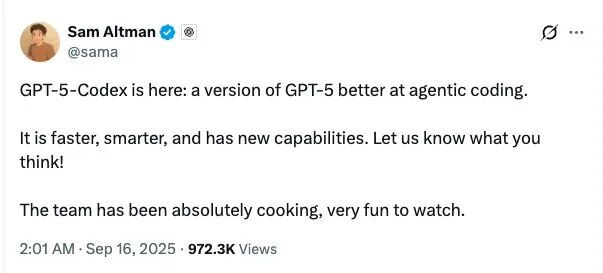
Core Insights - OpenAI has launched a new model, GPT-5-Codex, which is a fine-tuned variant of GPT-5 designed specifically for AI-assisted programming tools, demonstrating improved performance in coding tasks [1][3][6] - The release of GPT-5-Codex marks a significant shift in the "coding agents" landscape, intensifying competition in the field [3][6] - OpenAI aims to create an "agent-based software engineer" by the end of the year, integrating various tools and capabilities to enhance coding efficiency [7][19] Performance Metrics - GPT-5-Codex scored 74.5% on the SWE-bench, closely matching GPT-5's score of 74.9% on a subset of tasks, indicating its competitive performance [6] - The model's response time for coding tasks varies from a few seconds to seven hours, showcasing its dynamic processing capabilities [1][10] Development Focus - OpenAI's Codex team has prioritized the integration of research and product development, leading to significant improvements in long-duration task execution and code quality [8][10] - The model exhibits a unique ability to handle complex restructuring tasks over extended periods, demonstrating resilience and efficiency [10][34] Competitive Landscape - Over the past year, Anthropic has dominated the coding scene with its Claude models, leading to substantial revenue growth and market capitalization, prompting OpenAI to intensify its efforts [6][28] - OpenAI's historical contributions, such as the original Codex and GitHub Copilot, have laid the groundwork for its current advancements in coding capabilities [6][12] User Interaction and Tools - OpenAI has developed various tools, including Codex CLI and IDE extensions, to facilitate user interaction and enhance coding workflows [7][18] - The integration of Codex into existing development environments aims to streamline the coding process and improve user experience [20][24] Future Outlook - The company envisions a future where multiple agents operate in cloud environments, supervised by human teams to create significant economic value [36][39] - OpenAI is focused on addressing safety and alignment issues as it develops more powerful coding agents, ensuring that human operators maintain control over AI actions [36][37]
16个交易日股价暴涨约180%,开普云再发异动公告 此前称收购金泰克将切入AI存储市场
Mei Ri Jing Ji Xin Wen· 2025-09-16 02:15
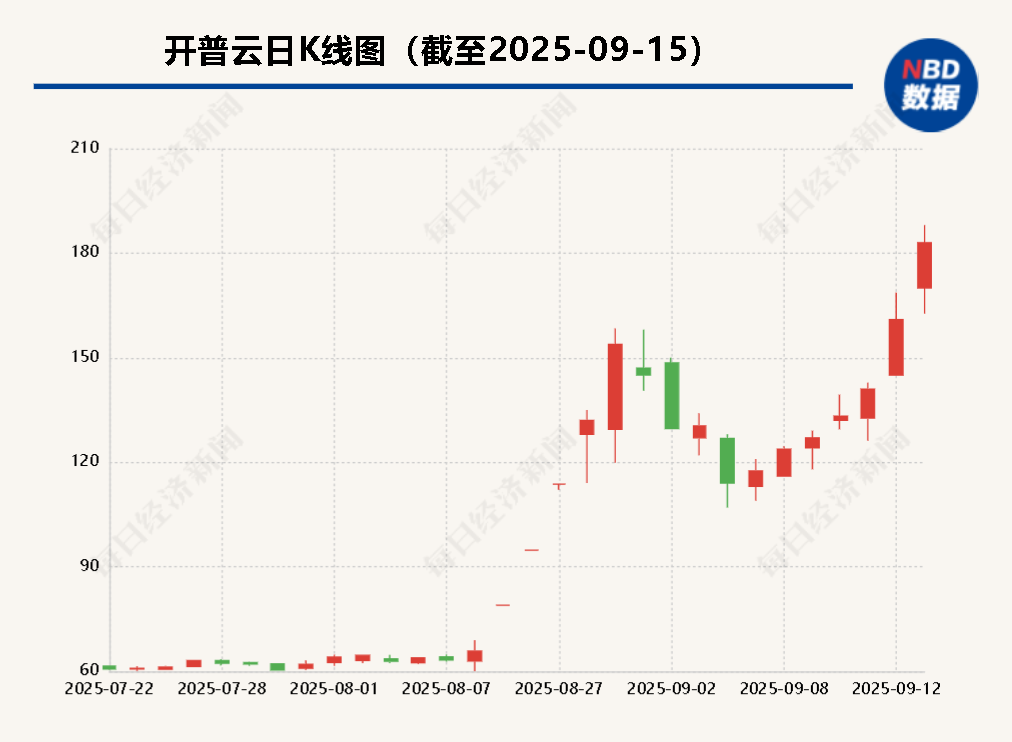
Company Overview - On September 15, 2023, Kaipu Cloud (开普云) announced a stock trading anomaly, with a stock price of 182.99 yuan and a market capitalization of 12.355 billion yuan, reflecting a 13.71% increase on that day [1] - Since its resumption of trading on August 25, the company's stock price has surged by 178.10% over 16 trading days [1] - The company is in the process of acquiring Shenzhen Jintaike Semiconductor Co., Ltd. (金泰克) to gain access to its storage product business [1][4] Acquisition Details - The acquisition involves assets that are still undergoing auditing and evaluation, requiring approval from the board of directors and shareholders, as well as regulatory bodies, indicating uncertainty in the transaction [1] - Kaipu Cloud's revenue for the first half of the year was nearly 160 million yuan, with a net profit of less than 4 million yuan, showing a return to profitability but remaining in a low-profit state [1] Market Position and Strategy - Kaipu Cloud has become a market leader in Dongguan, Guangdong, with a market value exceeding 10 billion yuan [3] - The company emphasizes the importance of storage in the AI infrastructure, stating that storage hardware is a core bottleneck affecting computational efficiency [4] - The acquisition aims to integrate high-performance storage capabilities to address the "storage wall" issue in AI applications, creating a closed loop of computation, storage, and operation [4] Financial Insights - The enterprise-level storage products from Jintaike are expected to contribute significantly to revenue, with a customer base that includes major domestic server and internet companies [5] - The semiconductor storage market has shown signs of recovery since March 2023, with major manufacturers announcing production cuts and downstream demand increasing [6] - According to research, the enterprise-level storage prices are anticipated to rise in the fourth quarter due to sustained AI demand [6] Competitive Landscape - Despite the growth potential, domestic storage manufacturers still lag behind international leaders, with Kingston holding a dominant market share of 78.12% in 2022 [6] - Jintaike holds a market share of 2.33%, ranking fifth among global memory module suppliers, indicating room for growth in the domestic market [6]

后AGI时代,当99%的人类价值归零,资本主义是否会幸存?
3 6 Ke· 2025-09-12 07:29
Group 1 - The core argument is that while AGI (Artificial General Intelligence) is approaching, there is a lack of deep societal reflection on how the post-AI era will function, particularly in terms of social, economic, political, and ethical transformations [1][2] - The urgency of understanding the implications of the post-AI society is emphasized, with a call for a comprehensive theoretical framework to analyze these changes [2][3] - Zhang Xiaoyu, a scholar with 20 years of experience in political philosophy, is exploring the complex relationships between technology, business, and state destiny, aiming to outline the societal changes brought by the post-AI era [2][4] Group 2 - The discussion highlights the foundational impact of technology on human civilization, suggesting that technology fundamentally alters societal structures and interactions [6][7] - The conversation shifts from immediate concerns about AI's challenges to a deeper understanding of how to conceptualize and interpret the changes AI brings to society [9][10] - Zhang identifies two fundamental principles for understanding the AI era: the emergence law, which states that complex phenomena can arise from simple rules when scaled sufficiently, and the human equivalent, which quantifies human intellectual output in terms of tokens [11][12] Group 3 - The economic implications of AI are discussed, contrasting AI's deflationary impact on employment with the inflationary effects of past technological revolutions like the steam engine [19][20] - The potential for AI to replace a significant portion of jobs is acknowledged, with a focus on the simplicity of tasks being more susceptible to automation [24][23] - The conversation also touches on the societal divide that may emerge, where a small percentage of individuals remain irreplaceable by AI, leading to a significant gap between the "1%" and the "99%" [27][28] Group 4 - The future of human relationships in a post-AI world is examined, suggesting that emotional connections may become less valuable as AI can replicate emotional interactions efficiently [37][38] - The political landscape may shift towards algorithmic governance, where AI serves as an impartial judge, potentially replacing traditional state functions [42][43] - The concept of a new social contract in the AI era is introduced, where the relationship between humans and advanced AI is framed as a time-based agreement rather than a spatial one [49][50]
商汤「日日新」,再次摘冠!
市值风云· 2025-09-10 10:11
Core Viewpoint - SenseTime's "SenseNova-V6.5 Pro" has achieved the highest score of 82.2 on the OpenCompass Multi-modal Academic Leaderboard, surpassing top international models like Gemini 2.5 Pro and GPT-5, marking it as one of the strongest multi-modal models globally [1][2][3] Group 1: Model Performance and Technology - "SenseNova-V6.5 Pro" is the latest achievement of SenseTime under its multi-modal general intelligence technology strategy, demonstrating significant advancements in multi-modal information perception and processing, which are essential for achieving AGI [1][3] - The model has successfully integrated "image-text interleaved thinking," allowing it to combine logical and visual thinking, thus enabling graphical representation of certain thought processes [3][4] - The model's reasoning performance has significantly improved through a new paradigm based on reinforcement learning, particularly in areas such as mathematics, coding, GUI operations, and high-level tasks [4] Group 2: Efficiency and Cost-Effectiveness - "SenseNova-V6.5 Pro" features an updated architecture with a lightweight visual encoder and a deepened MLLM backbone, achieving over three times efficiency improvement while maintaining performance, thus optimizing the performance-cost curve [4] - The model's cost-effectiveness is superior to that of international models like Gemini 2.5, indicating a strong competitive edge in the market [4] Group 3: Strategic Vision - SenseTime aims to build a leading general multi-modal model through a comprehensive strategy that integrates infrastructure, models, and applications, focusing on real-world scenarios to enhance end-to-end product technology competitiveness [4] - The company is committed to advancing multi-modal AI from the digital space into the physical world, providing end-to-end value in real scenarios [4] Group 4: Evaluation Framework - The OpenCompass evaluation system, launched by the Shanghai AI Laboratory, provides a comprehensive assessment platform for large models, covering various capabilities and specialized fields, and is regarded as an important reference for evaluating the application value of large models [5]

OpenAI的00后“叛徒”正在碾压华尔街“老江湖”
Hu Xiu· 2025-09-06 07:41
Core Insights - A new hedge fund, SALP, founded by 23-year-old Leopold Aschenbrenner, achieved a remarkable 47% return in just six months, significantly outperforming Wall Street averages by 700% [2][20][21] - Aschenbrenner, previously associated with OpenAI, was dismissed for raising concerns about security vulnerabilities, leading him to establish SALP focused entirely on AGI (Artificial General Intelligence) investments [3][12][14] Fund Overview - SALP is characterized as a pure AI-native fund, with 100% of its investments directed towards AI-related opportunities, distinguishing it from traditional funds that diversify across various sectors [4][22] - The fund's assets reportedly exceeded $1.5 billion by 2025, allowing for a concentrated investment strategy in a few high-confidence areas [23][24] Investment Philosophy - SALP operates under a mission-driven philosophy, focusing on AGI and its implications, rather than merely seeking high-growth companies [26][29] - The fund's strategy includes significant investments in AI infrastructure, such as computing power and energy, which are deemed essential for the future of AGI [32][34] Key Investments - SALP's notable investment includes Core Scientific, a cryptocurrency mining company that transitioned to AI computing services, highlighting the fund's ability to identify undervalued assets [3][35] - The fund also holds positions in major chip manufacturers like Broadcom and Intel, as well as energy companies like Vistra, anticipating a surge in demand for power due to AI advancements [35] Future Outlook - Aschenbrenner predicts that AGI could emerge around 2027, with a potential "intelligence explosion" following its realization, which would drastically alter economic and social structures [15][16][29] - The fund's approach is to leverage financial tools for both long and short positions, aiming to profit regardless of market conditions [27][28]



扎克伯格为何一边裁员一边开出亿元薪酬?
虎嗅APP· 2025-09-03 10:29
Core Viewpoint - Zuckerberg's "Personal Superintelligence" memo serves primarily as a recruitment declaration aimed at AI talent, showcasing Meta's technical capabilities in a format familiar to researchers [6]. Group 1: Meta's AI Vision - Zuckerberg's vision emphasizes personalized AI assistants for everyone, contrasting with competitors who focus on automation that could render humans dependent on AI [5][16]. - The memo's marketing differentiation is questioned, as all companies are training similar large language models [7][42]. - Meta's strategic shifts reflect the company's anxiety and opportunism in the face of new technological trends [10]. Group 2: AI Talent Market Dynamics - The AI talent market is experiencing extreme polarization, with top researchers receiving contracts worth hundreds of millions while ordinary employees face layoffs [9][50]. - Major tech companies are controlling AI startups through equity investments, ensuring they do not miss out on breakthroughs regardless of their origin [8][44]. Group 3: Social Implications of AI - The rise of AI companions may lead to increased loneliness and social isolation, as people spend more time interacting with machines rather than real friends [11][25]. - Over-reliance on AI writing tools could undermine independent thinking and the formation of personal viewpoints [12][55]. Group 4: Meta's Strategic Shifts - Meta's history of shifting strategic focus raises concerns about its ability to maintain a consistent direction, as seen in its past emphasis on privacy and cryptocurrency [33][34]. - The company is leveraging its vast social network to explore new opportunities, although it has yet to find a breakthrough [36][37]. Group 5: Marketing and Terminology in AI - The proliferation of terms like "superintelligence" and "AGI" reflects a trend of marketing jargon rather than substantive innovation, as companies are essentially training similar models [13][40]. - The competitive landscape is characterized by major players rebranding their efforts to align with the latest trends in AI [38][41]. Group 6: Financial Dynamics in Tech Companies - The contradiction of offering high salaries while conducting mass layoffs indicates a strategic financial maneuver to appease investors while restructuring for AI integration [50][51]. - The internal dynamics of tech companies are creating disparities, with some employees receiving exorbitant salaries while others face job insecurity [52]. Group 7: The Future of AI Writing - The debate around AI writing tools centers on their potential to either enhance or degrade human creativity and critical thinking [54][55]. - There is a risk that reliance on AI for writing could lead to a society where original thought is diminished, as people may resort to using AI-generated content without critical engagement [58][59].


扎克伯格为何一边裁员一边开出亿元薪酬?
Hu Xiu· 2025-09-03 07:16
Core Points - Mark Zuckerberg's "Personal Superintelligence" memo serves primarily as a recruitment declaration aimed at AI talent, showcasing Meta's technical capabilities in a format familiar to researchers [4][12][27] - The claimed differentiation in technical approach is largely a marketing strategy, as all companies are training similar large language models [5][70] - Major tech companies have effectively controlled all significant AI startups through equity investments, ensuring they do not miss out on breakthroughs regardless of their origin [6][81] - The AI talent market is experiencing extreme polarization, with top researchers receiving contracts worth hundreds of millions while ordinary employees face mass layoffs [7][101] - Meta's strategic indecision reveals the anxiety and opportunism of large companies in the face of new technological waves [8][41] - The concept of AI friends may lead to increased loneliness and social isolation among humans [9][30] - Over-reliance on AI writing tools could undermine human independent thinking and opinion formation [10][108] - The proliferation of terms like superintelligence and AGI reflects an inflation of industry jargon, with little substantive difference in content [11][59] Group 1 - Zuckerberg's memo format mimics that of AI researchers, indicating an attempt to appeal to potential AI talent [12][13] - The vision of "Personal Superintelligence" is framed as a contrast to other companies' focus on automation, but this distinction is questioned [15][18] - The memo concludes with a clear recruitment message, emphasizing Meta's resources and expertise in building necessary infrastructure [27][106] Group 2 - The shift in social media dynamics indicates a move away from genuine human interaction towards AI-generated content [28][30] - The ongoing strategic shifts at Meta highlight a pattern of chasing the next big trend, often at the expense of consistency [41][42] - The marketing of superintelligence appears to be a rebranding effort rather than a genuine technological advancement [55][60] Group 3 - Major tech companies are quietly consolidating their positions in the AI future through strategic investments in startups [73][76] - The contradiction of offering high salaries to AI talent while simultaneously laying off employees reflects a broader trend of inequality within the industry [91][101] - The financial rationale behind these layoffs and high compensation packages is tied to the need for companies to demonstrate fiscal responsibility to investors [96][106] Group 4 - The debate surrounding AI writing tools centers on their potential to either liberate or degrade human creativity and thought processes [107][118] - The societal implications of relying on AI for writing tasks could lead to a decline in critical thinking and personal expression [115][119]
朱啸虎论AI创业:避开大厂竞争,如何在AI外构建竞争优势?
Sou Hu Cai Jing· 2025-09-01 12:49
Core Insights - The investment landscape for AI startups is increasingly competitive, with a high failure rate among new ventures, as highlighted by the metaphor of releasing pigeons, where only a few will soar while most return to the ground [1] - The arrival of GPT-5 has not resulted in the anticipated breakthroughs, indicating a clear limit to the capabilities of AI based on the Transformer architecture, with future advancements expected to be minimal [3] - The rapid increase in Token consumption for AI applications signifies a shift towards practical implementation, with daily Token consumption in China surpassing 30 trillion [4] Group 1 - The current AI capabilities have reached a plateau, with data bottlenecks and reasoning ceilings being significant challenges, suggesting that merely increasing model parameters will not enhance intelligence [3] - The trend towards model miniaturization is expected to be crucial in the next two to three years, focusing on refining data to reduce costs while maintaining performance [3] - AI applications are witnessing explosive growth in Token consumption, indicating their increasing role within enterprises [4] Group 2 - The competitive landscape for AI startups has intensified, with venture capitalists in Silicon Valley typically requiring a product to achieve $2 million in annual recurring revenue (ARR) before considering investment [4] - Successful AI applications require high barriers to entry, and many seemingly impressive AI solutions may not deliver satisfactory user experiences, necessitating the establishment of a competitive edge beyond AI capabilities [5] - Opportunities exist in various sectors, including AI creator communities and hardware products like AI glasses, particularly in regions with robust supply chains such as the Greater Bay Area [5]