
半导体自主可控

Search documents
【国信电子胡剑团队|0914周观点】半导体自主可控再成焦点,继续推荐模拟、存储及算力ASIC
剑道电子· 2025-09-20 14:00
Core Viewpoint - The semiconductor industry's focus on self-sufficiency has re-emerged, with continued recommendations for analog, storage, and computing ASICs [3]. Market Performance - In the past week, the Shanghai Composite Index rose by 1.52%, while the electronics sector increased by 6.15%. Among sub-sectors, components surged by 11.33%, and optical electronics rose by 0.85% [3]. - The Hang Seng Tech Index, Philadelphia Semiconductor Index, and Taiwan Information Technology Index saw increases of 5.31%, 4.17%, and 6.05%, respectively [3]. Industry Trends - The rapid growth of the North American computing industry has catalyzed a bullish market trend, supported by TSMC's upward revision of annual performance guidance and optimistic outlooks from SMIC and Hua Hong Semiconductor regarding future orders and market conditions [3]. - The previously recommended sectors of analog (due to anti-dumping measures in the U.S.) and storage (price increases) have recently experienced significant market catalysts [3]. Focus Areas - The semiconductor industry's self-sufficiency has become a focal point once again, indicating a strategic shift in market dynamics [3].

北水成交净买入98.38亿 北水逢低抢筹山高控股超22亿港元
Zhi Tong Cai Jing· 2025-09-20 04:18
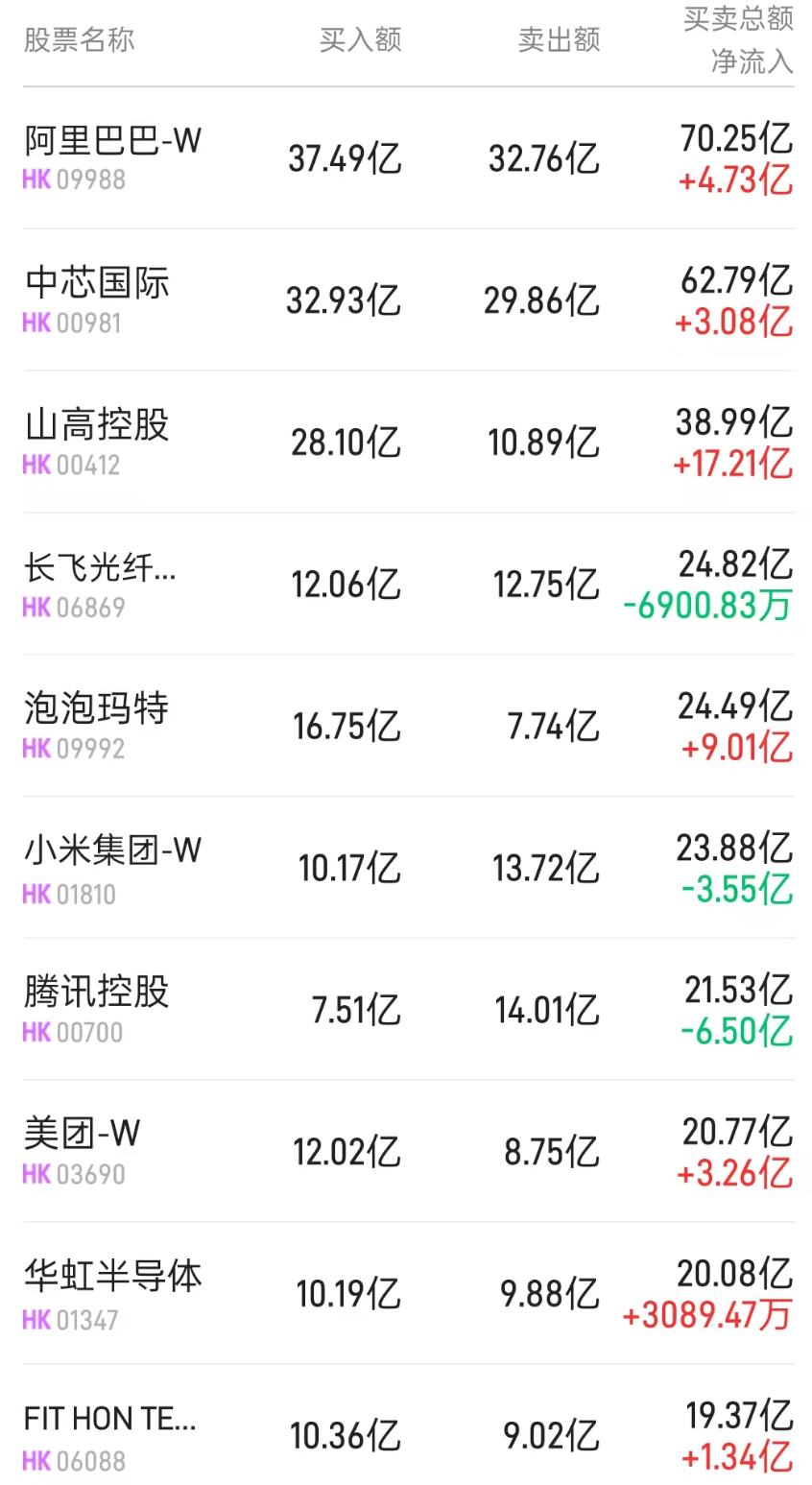
Group 1 - Northbound capital recorded a net purchase of 9.838 billion HKD on September 19, with 5.283 billion HKD from the Shanghai Stock Connect and 4.555 billion HKD from the Shenzhen Stock Connect [2] - The most net bought stocks included Shankai Holdings (00412), Alibaba-W (09988), and the Tracker Fund of Hong Kong (02800) [2] - The most net sold stocks were Tencent (00700), Xiaomi Group-W (01810), and Longi Green Energy (06869) [2] Group 2 - Alibaba-W had a net inflow of 4.73 billion HKD, with a buy amount of 37.49 billion HKD and a sell amount of 32.76 billion HKD [3] - Semiconductor stocks, including SMIC (00981) and Huahong Semiconductor (01347), saw net purchases of 3.08 billion HKD and 2.37 billion HKD respectively, driven by optimistic market sentiment [7] - Longi Green Energy (06869) experienced a net outflow of 690.83 million HKD, indicating market concerns regarding its performance [3][8] Group 3 - Shankai Holdings (00412) received a net purchase of 22.4 billion HKD, attributed to its compliance with public shareholding regulations [6] - The report highlighted that Alibaba's new AI chip development has surpassed Nvidia's A800, contributing to its positive market outlook [6] - Longi Green Energy's recent announcement indicated that its products related to data centers, particularly hollow-core fibers, are still in early stages of market adoption [8]




A股震荡整固 双节临近旅游股走强
Zheng Quan Shi Bao· 2025-09-19 18:04
Market Overview - A-shares experienced a pullback after reaching a 10-year high, with the Shanghai Composite Index adjusting quickly, while the Shenzhen Component, Sci-Tech 50, and ChiNext also saw fluctuations after multi-year highs. Weekly trading volume increased to 12.59 trillion yuan [1] - Margin trading saw a significant net buy of 50.8 billion yuan this week, marking the 13th consecutive week of net buying exceeding 10 billion yuan, with a total margin balance reaching 2.39 trillion yuan, a historical high [1] Sector Performance - The electronics sector attracted nearly 15 billion yuan in net margin buying over the week, leading the market, followed by non-bank financials with over 6.5 billion yuan. Other sectors like machinery, automotive, and power equipment also saw net buys exceeding 4 billion yuan [1] - The electronics sector recorded a net inflow of 41.6 billion yuan for the week, maintaining the top position, with net inflows of 104.5 billion yuan over the last 20 trading days and 380.7 billion yuan over the last 60 days, significantly outpacing other sectors [1] - Conversely, the non-ferrous metals sector saw a net outflow of over 13.1 billion yuan, with pharmaceuticals and banking also experiencing significant net outflows [1] Future Outlook - According to招商证券, the A-share market is expected to continue along low penetration rate tracks, focusing on eight key sectors including AI, humanoid robots, solid-state batteries, controllable nuclear fusion, military trade, commercial aerospace, semiconductor self-sufficiency, and innovative pharmaceuticals [2] - 中金公司 suggests that while A-shares are in a short-term adjustment phase, the downward risk is limited, and the upcoming 20th Central Committee's Fourth Plenary Session is likely to enhance investor focus on medium to long-term reform directions [2] Sector Highlights - The technology sector remains strong, particularly in the chip sector, with the photolithography machine segment performing best, achieving historical highs during market adjustments [2] - The tourism sector has shown resilience, with indices rising against market trends and reaching a 4.5-year high, driven by increased travel demand ahead of the Mid-Autumn and National Day holidays [3] - Data from 同程旅行 indicates a significant surge in travel searches and ticket sales for popular routes, with outbound tourism seeing a 130% increase compared to last year, particularly in Europe and North America [3]
【招商电子】国产算力芯片链深度跟踪:华为披露AI芯片3年规划,国内自主可控加速发展
招商电子· 2025-09-19 15:21
Core Viewpoint - Huawei's Full Connect 2025 Conference showcased the Lingqu Unified Interconnection Protocol, announcing the launch of Ascend 950/960/970 and Kunpeng 950/960 over the next three years, highlighting the gradual enhancement of domestic AI computing chip capabilities amid US-China tensions [9][58]. Group 1: AI Computing Chip Development - The Ascend NPU roadmap includes the release of Ascend 950 (PR and DT versions) in 2026, followed by 960 in 2027 and 970 in 2028, with significant performance improvements [15][20]. - The Kunpeng CPU will see the launch of Kunpeng 950 in late 2026 and Kunpeng 960 in early 2028, supporting advanced computing needs [20][34]. - Domestic chip manufacturers like Haiguang and Cambricon are projecting substantial revenue growth, with Haiguang targeting a CAGR of 44% over three years [3][58]. Group 2: Advanced Manufacturing and Semiconductor Industry - The domestic lithography machine industry is focusing on complete machines and related components, with expectations for advanced process expansion by 2026 [3][59]. - The domestic semiconductor industry is expected to benefit from the acceleration of independent and controllable demands, particularly in advanced logic and storage production lines [3][62]. Group 3: Storage and Edge Computing - The demand for inference and edge computing storage is increasing, with significant growth expected in AI PCs, smartphones, and wearable devices by 2026 [4][58]. - Domestic manufacturers are enhancing their enterprise storage product lines, with companies like Jiangbolong and Baiwei Storage launching new enterprise-level solutions [4][58]. Group 4: Investment Recommendations - Investment opportunities are suggested in AI computing chips, high-end chip manufacturing, packaging, storage, and related equipment and materials [5].

北水动向|北水成交净买入98.38亿 北水逢低抢筹山高控股(00412)超22亿港元
智通财经网· 2025-09-19 09:59
Core Insights - The Hong Kong stock market saw a net inflow of 98.38 billion HKD from Northbound trading on September 19, with the Shanghai Stock Connect contributing 52.83 billion HKD and the Shenzhen Stock Connect contributing 45.55 billion HKD [1] Group 1: Stock Performance - The most bought stocks included Shankai Holdings (00412), Alibaba-W (09988), and the Tracker Fund of Hong Kong (02800) [1] - The most sold stocks included Tencent (00700), Xiaomi Group-W (01810), and Yangtze Optical Fibre and Cable (06869) [1] Group 2: Individual Stock Details - Alibaba-W (09988) recorded a net inflow of 17.26 billion HKD, driven by positive news regarding its AI chip development [5] - Shankai Holdings (00412) received a net inflow of 22.4 billion HKD, with a focus on its public shareholding compliance [4] - Bubble Mart (09992) saw a net inflow of 9.01 billion HKD, with analysts suggesting that recent price adjustments do not indicate a decline in IP popularity [5] - Semiconductor stocks like Huahong Semiconductor (01347) and SMIC (00981) received net inflows of 2.37 billion HKD and 930.1 million HKD respectively, amid optimistic market outlooks [5] Group 3: Market Trends - The semiconductor sector is experiencing a rapid increase in interest, with companies like TSMC and SMIC providing positive forecasts [5] - The demand for AI-related products is expected to drive significant revenue growth for companies involved in AI server production, such as Hongteng Precision (06088) [6]
资管一线 | 弘毅远方基金王哲宇:半导体与国产算力产业已进入爆发窗口期
Xin Hua Cai Jing· 2025-09-19 09:02
Core Viewpoint - The A-share technology sector is experiencing significant volatility, characterized by "high-low switching" and "rapid rotation," raising questions about its ability to break out of this pattern and continue structural opportunities [1] Group 1: Market Trends - The technology sector's recent performance has been marked by fluctuations, with a focus on the automotive industry's semiconductor and domestic computing sectors as key areas for future growth [1][4] - The current market environment has led to a net value increase of over 48% for the automotive industry upgrade fund managed by Wang Zheyu as of September 16 [1] Group 2: Investment Strategy - Wang Zheyu emphasizes a "core + satellite" investment strategy, focusing on sectors with clear industrial logic and strong growth certainty while exploring potential opportunities in niche markets [2] - The adjustment in investment focus from solely electric vehicles to include semiconductor autonomy and computing upgrades reflects a deep understanding of industry phases [3] Group 3: Sector Analysis - The semiconductor and domestic computing sectors are seen as entering a critical phase of potential explosive growth, moving beyond mere speculation to a more mature industrial logic [3][4] - The evolution of the domestic semiconductor industry is compared to the breakthrough logic of the new energy vehicle sector around 2015, indicating a shift towards advanced processes and high-end applications [4] Group 4: Policy Support - There is a clear policy direction supporting self-sufficiency in technology, with resources being allocated to the semiconductor and computing sectors, enhancing growth certainty as policies are implemented [4] Group 5: Market Outlook - The current market dynamics show a rotation among stocks, which may lay the groundwork for further upward movement in the technology sector [4] - Industry trends suggest that as the sector matures, there will be increased sensitivity to valuation, necessitating caution as the market approaches a supply-demand equilibrium [5][6]
半导体相关ETF涨幅领先丨ETF基金日报
2 1 Shi Ji Jing Ji Bao Dao· 2025-09-19 03:53
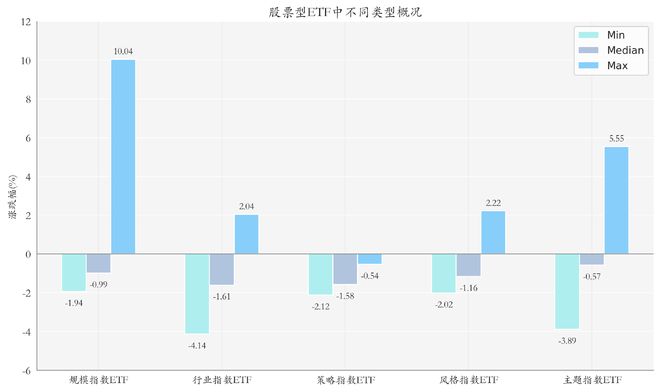
Market Overview - The Shanghai Composite Index fell by 1.15% to close at 3831.66 points, with a high of 3899.96 points during the day [1] - The Shenzhen Component Index decreased by 1.06% to 13075.66 points, reaching a peak of 13328.1 points [1] - The ChiNext Index dropped by 1.64% to 3095.85 points, with a maximum of 3168.68 points [1] ETF Market Performance - The median return of stock ETFs was -1.0% [2] - The highest performing scale index ETF was the China Merchants CSI A50 ETF with a return of 10.04% [2] - The highest performing industry index ETF was the Huaxia Shanghai Stock Exchange Sci-Tech Innovation Board New Generation Information Technology ETF with a return of 2.04% [2] - The highest performing strategy index ETF was the Huaxia CSI Dividend Quality ETF with a return of -0.54% [2] - The highest performing style index ETF was the Southern CSI Sci-Tech Innovation Board Growth ETF with a return of 2.22% [2] - The highest performing thematic index ETF was the GF CSI Semiconductor Materials and Equipment Thematic ETF with a return of 5.55% [2] ETF Performance Rankings - The top three ETFs by return were: - China Merchants CSI A50 ETF (10.04%) - GF CSI Semiconductor Materials and Equipment Thematic ETF (5.55%) - Huaxia CSI Semiconductor Materials and Equipment Thematic ETF (4.56%) [4] - The top three ETFs by decline were: - Wan Jia CSI Industrial Nonferrous Metals Thematic ETF (-4.14%) - Huaxia CSI Financial Technology Thematic ETF (-3.89%) - Huitianfu CSI Subdivided Nonferrous Metals Industry Thematic ETF (-3.89%) [4] ETF Fund Flows - The top three ETFs by fund inflow were: - GF CSI All-Index Securities Company ETF (26.4 billion) - Huabao CSI All-Index Securities Company ETF (1.262 billion) - Jiashi Shanghai Stock Exchange Sci-Tech Innovation Board Chip ETF (723 million) [6] - The top three ETFs by fund outflow were: - Huatai-PB CSI 300 ETF (828 million) - Southern CSI 1000 ETF (749 million) - Huaxia CSI Robot ETF (658 million) [6] ETF Margin Trading Overview - The top three ETFs by margin buying were: - Huaxia Shanghai Stock Exchange Sci-Tech Innovation Board 50 Component ETF (1.206 billion) - GF CSI All-Index Securities Company ETF (997 million) - Yi Fangda ChiNext ETF (885 million) [8] - The top three ETFs by margin selling were: - Southern CSI 500 ETF (53.32 million) - Huaxia Shanghai Stock Exchange 50 ETF (26.29 million) - Huatai-PB CSI 300 ETF (26.07 million) [8] Institutional Insights - First Shanghai Securities is optimistic about investment opportunities in domestic computing power for the second half of the year and next year, citing a sustained tight balance in domestic computing power [9] - Guosen Securities highlights the renewed focus on semiconductor self-sufficiency, particularly in analog chips, memory chips, and computing ASICs, with significant growth potential [10]
芯片股延续近期涨势 英伟达斥巨资入股英特尔 中美半导体行情实现共振
Zhi Tong Cai Jing· 2025-09-19 02:53
Core Viewpoint - Semiconductor stocks continue to rise, driven by significant investments and optimistic market outlooks in the industry [1] Group 1: Stock Performance - Huahong Semiconductor (01347) increased by 7.25%, reaching HKD 62.15 - SMIC (00981) rose by 3.96%, reaching HKD 72.25 - Jingmen Semiconductor (02878) gained 3.85%, reaching HKD 0.54 - Hongguang Semiconductor (06908) increased by 3.39%, reaching HKD 0.61 - ASMPT (00522) rose by 2.68%, reaching HKD 78.5 [1] Group 2: Major Investments - Nvidia plans to invest USD 5 billion in Intel at a price of USD 23.28 per share - Post-transaction, Nvidia will become one of Intel's largest shareholders, potentially holding 4% or more [1] Group 3: Strategic Collaborations - Intel will customize x86 CPUs for Nvidia in the data center sector - Nvidia will integrate these CPUs into its AI infrastructure platform for market deployment - In personal computing, Intel will produce x86 system-on-chip solutions that integrate Nvidia's RTX GPU chips [1] Group 4: Market Outlook - Guosen Securities reports a rapid increase in the semiconductor sector, following strong performance in North America's computing power industry - TSMC has raised its annual performance guidance, while SMIC and Huahong Semiconductor have optimistic forecasts for future orders [1] - The Ministry of Commerce has initiated anti-dumping investigations on US-produced analog chips, highlighting a focus on domestic chip production and wafer foundry sectors [1] - Alibaba and Baidu are developing their own computing power chips, indicating a gradual decoupling from overseas models for domestic training [1]


港股异动 | 芯片股延续近期涨势 英伟达斥巨资入股英特尔 中美半导体行情实现共振
智通财经网· 2025-09-19 02:41
Group 1 - Semiconductor stocks continue to rise, with notable increases in shares of Huahong Semiconductor (+7.25%), SMIC (+3.96%), and others [1] - Nvidia plans to invest $5 billion in Intel, potentially becoming one of its largest shareholders with a stake of 4% or more [1] - Intel will customize x86 CPUs for Nvidia in the data center sector and produce x86 system-on-chip solutions integrated with Nvidia's RTX GPUs for personal computing [1] Group 2 - Guosen Securities reports a rapid increase in the semiconductor sector, driven by TSMC's upward revision of annual performance guidance and optimistic outlooks from SMIC and Huahong Semiconductor [1] - The Ministry of Commerce has initiated anti-dumping investigations on US-made analog chips, highlighting a focus on domestic chip production and wafer foundry sectors [1] - Domestic companies like Alibaba and Baidu are developing their own computing chips, indicating a gradual decoupling from overseas technologies in model training [1]
【财经分析】科创板并购重组持续升温 从估值驱动转向产业驱动
Xin Hua Cai Jing· 2025-09-18 11:50
Core Viewpoint - The M&A market in the Sci-Tech Innovation Board is experiencing significant growth driven by policy incentives and industrial demand, with a notable shift from valuation-driven to industry-driven mergers and acquisitions [1][6]. Group 1: M&A Activity and Trends - As of September 18, 2025, over 70 new M&A transactions have been disclosed, with strategic emerging industries like electronics, new energy, and biomedicine becoming hotspots [2]. - In August 2025 alone, there were 7 major asset restructuring or capital increase acquisition cases, with the semiconductor sector being the dominant player, accounting for 5 of these cases [2]. - Major semiconductor companies like SMIC and Huahong are optimizing their capacity layout through acquisitions, focusing on technology complementarity and capacity synergy rather than mere scale expansion [2]. Group 2: Financial and Policy Environment - The revised M&A regulations by the China Securities Regulatory Commission in May 2025 have significantly shortened the review time for high-quality large-cap company acquisitions and relaxed financial and payment conditions [5]. - The introduction of DeepSeek AI in early 2025 has revitalized the high-tech sector and positively impacted the overall economic environment, facilitating M&A activities [3]. Group 3: Strategic Focus and Future Outlook - The current wave of M&A is characterized by a shift from "valuation-driven" to "industry-driven," with companies focusing on core business and enhancing competitive advantages through industrial chain integration [6]. - The Sci-Tech Innovation Board's M&A activity is positively correlated with the performance of the secondary market, as evidenced by the 41.04% increase in the Sci-Tech 50 Index this year [6]. - Future trends in M&A are expected to include an expansion of cross-border acquisitions and deeper vertical integration in sectors like AI chips and automotive semiconductors, driven by both policy and market incentives [6].