贸易政策
Search documents
标普续创收盘新高,科技股承压拖累纳指回落,通用汽车因关税影响重挫逾8%
Di Yi Cai Jing· 2025-07-22 23:04
Group 1 - General Motors' stock fell by 8.1%, marking its largest single-day drop in nearly a year, due to the impact of tariffs imposed by the Trump administration [3] - The company's Q2 revenue decreased by nearly 2% to approximately $47 billion, with adjusted earnings per share at $2.53, slightly above market expectations but significantly lower than the previous year's $3.06 [3] - General Motors warned of a potential profit loss of $4 billion to $5 billion for the year due to trade policies, despite maintaining its full-year core profit forecast in the range of $10 billion to $12.5 billion [3] Group 2 - The healthcare sector led the market with a 1.9% increase, while the real estate sector followed closely with a 1.78% rise, indicating a preference for defensive assets [4] - The Nasdaq China Golden Dragon Index rose by 1.7%, with notable gains in Chinese stocks such as NIO, which surged over 10%, and Baidu, which increased by more than 4% [4] - The technology sector showed mixed performance, with Alphabet achieving its longest consecutive gain in nearly five years, while other major tech stocks like Meta Platforms and Microsoft experienced declines [4] Group 3 - Lockheed Martin's stock plummeted nearly 11%, with the company reporting a year-over-year profit decline of approximately 80% [5] - The market is currently in a wait-and-see mode, with key catalysts expected from the upcoming tariff negotiations and earnings reports from major tech companies [5] - Economic data indicated a slight recovery in the non-manufacturing sector, with the Philadelphia Fed's non-manufacturing activity index improving from -25.0 to -10.3, although it remains in negative territory [5]
黄金大涨,重返3400美元
第一财经· 2025-07-22 00:14
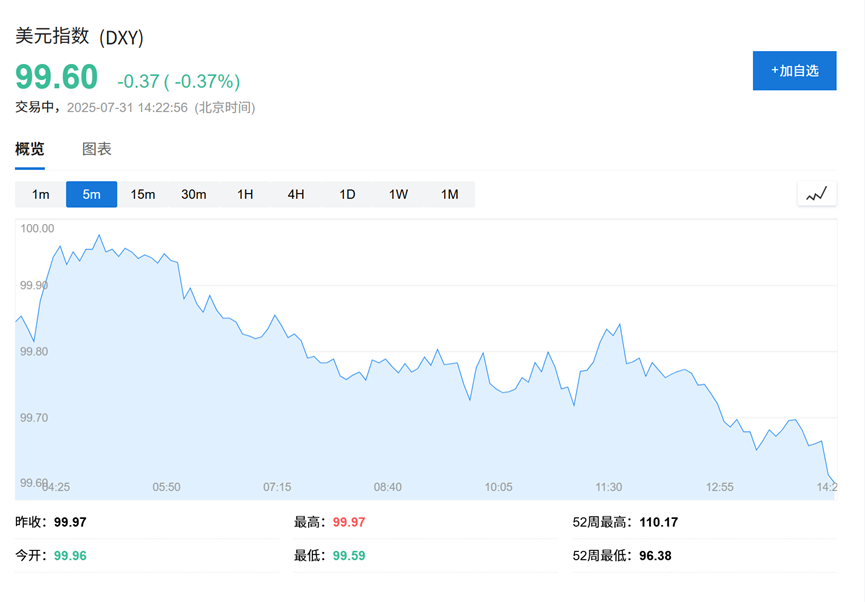
Core Viewpoint - International gold prices have risen over 1.5%, surpassing $3,400 per ounce, driven by increased market risk aversion and weakening of the US dollar and Treasury yields, with analysts identifying four key factors that may determine whether gold can break through $3,500 and challenge historical highs set in the first half of the year [1][3]. Group 1: Market Dynamics - The US dollar index has declined by 0.6%, falling below the 98 mark, while the benchmark 10-year Treasury yield has dropped to a one-week low, indicating a supportive environment for gold prices [3]. - Concerns over US debt growth and potential updates on tariffs are making gold a focal point, with analysts suggesting that the current price levels are well-supported [3][4]. - Discussions around potential interest rate cuts by the Federal Reserve are increasing, contributing to market tension and uncertainty [4][5]. Group 2: Factors Influencing Gold Prices - **Central Bank Activity**: Central banks have been significant buyers of gold, and any increase in their purchasing could drive prices up. Conversely, a decrease in demand could lead to a slight decline in prices [8]. - **Geopolitical Events**: Political instability often drives investors towards gold as a safe haven. Current geopolitical tensions have cooled, suggesting that any new crises could provide the necessary boost for gold prices to reach $3,500 [8]. - **Inflation Data**: Any sharp changes in inflation data could signal economic weakness, prompting investors to increase their gold holdings. Future macroeconomic reports influenced by tariffs may also drive demand for higher gold prices [8]. - **US Dollar Trends**: Historically, gold prices have shown a negative correlation with the US dollar. Factors affecting the dollar's performance include Fed rate cut prospects, US economic resilience, and trade war developments [9].
加拿大央行:二季度加拿大商业前景指标下滑至-2.4,前值-2.1。受访企业认为,(美国总统特朗普挑起的)贸易政策的后果可能不至于那么严重。
news flash· 2025-07-21 14:33
受访企业认为,(美国总统特朗普挑起的)贸易政策的后果可能不至于那么严重。 加拿大央行:二季度加拿大商业前景指标下滑至-2.4,前值-2.1。 ...
美国经济前景更新:仍偏向下行”-US Economics US outlook update Still weighted to the downside
2025-07-19 14:57
Summary of Morgan Stanley US Economics Outlook Update Industry Overview - **Industry**: US Economy - **Focus**: Economic outlook for 2025-2026, including growth, inflation, fiscal policy, trade, and immigration impacts Core Points and Arguments 1. **Economic Growth Expectations**: - Slow growth projected with real GDP growth of 0.8% in 2025 and 1.1% in 2026 [6][7][18] - Baseline scenario indicates firm inflation with inflation peaking in Q3 2025 [6][7] 2. **Inflation and Federal Reserve Policy**: - Inflation expected to remain elevated, with core PCE inflation at 3.0% in 2025 and 2.6% in 2026 [6][18] - Federal Reserve likely to hold rates steady in 2025, with cuts starting in March 2026 [6][11] 3. **Fiscal Policy Impact**: - The One Big Beautiful Bill Act (OBBBA) is anticipated to widen the deficit in 2026 but may provide a growth impulse of 0.4 percentage points to GDP [3][18] - Fiscal multipliers from the OBBBA are higher than previously expected, potentially boosting demand [3][13] 4. **Trade and Tariff Effects**: - Effective tariff rates projected to rise to approximately 16-17% under the baseline scenario, with potential increases to 23% in a mild recession scenario [9][16] - Recent trade announcements have increased downside risks to the economic outlook, with a 40% probability of a downside scenario [6][8][18] 5. **Immigration Policy**: - Immigration restrictions are expected to slow potential growth to 1.5%, with net immigration dropping significantly from 2.9 million in 2024 to 300,000 in 2025 [9][18] - Expanded legal immigration could help maintain potential growth at 2.0% in alternative scenarios [3][18] 6. **Alternate Scenarios**: - **Demand Upside**: Stronger fiscal multipliers could lead to higher growth and prolonged elevated inflation, with no Fed cuts in 2025 or 2026 [13][18] - **Supply Upside**: De-escalation in trade and immigration policies could result in faster growth and less aggressive Fed cuts [14][18] - **Mild Recession**: A trade shock could lead to a GDP decline of 1.2% peak-to-trough, with a significant rise in effective tariff rates [16][18] Other Important Content 1. **Unemployment Rate Projections**: - Unemployment rate expected to finish 2025 at 4.2% and 2026 at 3.8% under the baseline scenario [6][18] 2. **Consumer Confidence and Spending**: - Consumer confidence is projected to rebound but remains limited due to high inflation and uncertainty [18] - Consumer spending growth is expected to slow to 1.2% in 2025 before picking up to 1.6% in 2026 [18] 3. **Investment Trends**: - Nonresidential fixed investment is expected to rise by 4.6% in 2025 and 4.7% in 2026, driven by fiscal policy and improved sentiment [18] 4. **Credit Conditions**: - Credit conditions are expected to tighten further due to high policy rates and elevated uncertainty, with a potential loosening in 2026 [18] 5. **Productivity Growth**: - Productivity growth is anticipated to bounce back in 2026 after slowing in 2025 [18] This summary encapsulates the key insights and projections regarding the US economic outlook as presented in the Morgan Stanley report, highlighting the interplay between fiscal policy, trade dynamics, and macroeconomic indicators.
美国零售数据回暖,贵?属短线延续震荡
Zhong Xin Qi Huo· 2025-07-18 09:25
Report Summary 1) Report Industry Investment Rating No information provided. 2) Core View of the Report The overnight economic data in the US showed an overall improvement. The better - than - expected retail data in June and the decline in the weekly initial jobless claims drove the short - term strengthening of the US dollar and US stocks, putting pressure on precious metals, which are expected to maintain a short - term volatile trend. Gold maintains a long - term bullish trend, and silver retains a medium - term bullish view with cautious consideration of its elasticity. Attention should be paid to the new round of trade game in the first half of August and the change in interest - rate cut expectations brought by the global central bank meeting in the second half of August, as well as the trading interference from the "shadow Fed chairman" in the second half of the year. The weekly COMEX gold is expected to be in the range of [3250, 3450], and COMEX silver in the range of [36, 40] [1][3]. 3) Summary by Related Catalogs Key Information - US retail sales in June increased by 0.6% month - on - month, the highest since March this year, with an expected increase of 0.1% and a previous decrease of 0.9%. Core retail sales increased by 0.5% month - on - month, with an expected increase of 0.3% and a previous decrease (revised) of 0.2% [2]. - The number of initial jobless claims in the US last week was 221,000, with an expected 235,000. The four - week average was 229,500. The number of continued jobless claims as of the week ending July 5 was 1.956 million [2]. - US President Trump said he has no plan to fire Fed Chairman Powell unless fraud is proven. He also said he would accept Powell's resignation if Powell wants to [2]. - The Fed's latest Beige Book showed that economic activity in the US slightly rebounded from June to July. Import tariffs pushed up costs, and inflation may accelerate by the end of summer. Employment slightly increased, but companies were more cautious in hiring and lay - off decisions. The Fed's policy rate remained unchanged, and most officials were waiting to observe the impact of trade policies and inflation trends [2]. Price Logic The market had short - term fluctuations around the issue of Powell's possible dismissal. After Trump denied the dismissal rumor, market sentiment subsided. The overall improvement in US economic data drove the short - term strengthening of the US dollar and US stocks, putting pressure on precious metals, which maintained a short - term volatile trend. Long - term gold is bullish, and medium - term silver is also bullish with cautious consideration of its elasticity [3]. Outlook The weekly COMEX gold is expected to be in the range of [3250, 3450], and COMEX silver in the range of [36, 40] [3].
印尼官员:除酒精饮料和猪肉外,所有进口到印尼的美国商品都将享受零关税。
news flash· 2025-07-18 05:52
印尼官员:除酒精饮料和猪肉外,所有进口到印尼的美国商品都将享受零关税。 ...
零售与就业双强、美联储官员“放鹰” 金价上演“深V”行情
Jin Tou Wang· 2025-07-18 03:32
Core Viewpoint - The recent strong U.S. economic data has put short-term pressure on gold prices, while geopolitical tensions and tariff risks continue to provide support for the gold market [1][2][4]. Economic Data Impact - U.S. retail sales in June increased by 0.6%, with core retail sales rising by 0.5%, indicating a moderate recovery in consumer spending [2]. - Initial jobless claims fell by 7,000 to 221,000, the lowest level in three months, suggesting a stable labor market that supports consumer spending [2]. Federal Reserve Policy Divergence - There is a notable split within the Federal Reserve regarding interest rate policy, with some members advocating for maintaining restrictive policies to curb inflation, while others support rate cuts [3]. - The probability of a rate cut in September is currently at 54%, with a 30% chance for action in July [3]. Trade Risks and Market Reactions - The Trump administration is in urgent negotiations with Japan regarding a 25% tariff, with a deadline of August 1 for an agreement [4]. - A significant increase of 44% in Swiss gold exports in June indicates that some institutions are still accumulating physical gold as a hedge against potential policy and market risks [4]. Future Outlook for Gold Prices - Gold prices are currently under pressure from macroeconomic factors, but the outlook for the second half of the year will depend on the Federal Reserve's policy direction and the actual implementation of Trump's trade policies [4][5]. - Technically, gold prices remain in a long-term uptrend, with a critical support level at $3,300 per ounce, and potential resistance levels at $3,350 and $3,380 per ounce [5].
大摩前知名空头:美股本季度或至多跌10%,但“绝对”是抄底机会!
Jin Shi Shu Ju· 2025-07-18 02:56
Group 1 - Morgan Stanley's chief U.S. equity strategist Mike Wilson believes a bull market is forming in U.S. stocks, but the S&P 500 index may face a 5%-10% decline this quarter due to the impact of President Trump's trade policies on corporate balance sheets, which will provide an attractive entry point for investors [1] - The S&P 500 index recently reached a new all-time high, with a market capitalization increase of approximately $11.5 trillion in just a few months, following a brief bear market triggered by Trump's tariffs [1][2] - Wilson noted that the breadth of earnings revisions is improving, indicating that companies are effectively managing the challenges posed by tariffs [2][3] Group 2 - The third quarter is expected to be a concentrated risk period, as the effects of tariffs may start to impact product sales costs, but any market impact is anticipated to be temporary, with investors focusing on growth expectations for 2026 [3] - Recent strong retail sales data in June alleviated some concerns regarding consumer spending, supporting the positive outlook for the market [3] - Despite uncertainties surrounding the White House's trade plans potentially leading to short-term declines, the market is expected to continue its upward trajectory, having already bottomed out in April [5]
摩根士丹利:美股短期回调风险加剧,标普500或先跌5%-10%
Huan Qiu Wang· 2025-07-18 02:52
Core Viewpoint - The U.S. stock market is poised for a new bull market, but short-term risks should be monitored [1][3] Group 1: Market Outlook - The S&P 500 index may decline by 5% to 10% within the current quarter due to pressure on corporate earnings from President Trump's trade policies, but this pullback is expected to be "temporary and mild," providing a buying opportunity for investors [1][3] - The S&P 500 index has risen over 20% since its low in April, with a market capitalization increase of approximately $11.5 trillion [3] Group 2: Impact of Trade Policies - Recent broad tariff measures implemented by the Trump administration are beginning to impact corporate balance sheets, with the third-quarter earnings season expected to reflect these effects for the first time [3] - The number of industries with upward earnings revisions has significantly increased, indicating that companies are gradually absorbing the impact of tariffs [3] Group 3: Market Dynamics - The recent market rally has been primarily driven by a few technology giants, while cyclical sectors such as financials and industrials have not fully participated [3] - If trade risks lead to a broader earnings revision, funds may shift from growth stocks to value stocks, resulting in a more balanced rise in the index components [3] Group 4: Investor Sentiment - The market oscillates between fear and greed, and the key is to distinguish between temporary pullbacks and structural bear markets, with corporate earnings trajectories serving as the ultimate judge [3]
水产养殖旺季来临 菜籽粕总体有所上涨
Jin Tou Wang· 2025-07-17 07:16
Group 1 - The domestic oilseed market shows a bullish trend, particularly in rapeseed meal futures, which experienced a price increase of 2.49%, reaching a high of 2723.00 CNY/ton [1] - The market is currently in a seasonal peak for aquaculture feed consumption, but the cost-effectiveness of rapeseed meal is considered poor, leading to price pressure from soybean meal due to seasonal inventory accumulation [1][2] - The new season's rapeseed production is expected to increase, but tight supply from the previous season keeps prices firm, with domestic rapeseed imports expected to decline significantly from July to September [2] Group 2 - The European Union and Canada are experiencing low rainfall, affecting soil moisture for canola planting, while global canola production is recovering but planting area is down year-on-year [2] - Domestic oil mills are seeing a reduction in rapeseed meal inventory, but year-on-year levels remain high, with a significant drop in imports due to high tariffs and strong old crop canola prices [2] - The market is currently facing uncertainty due to trade policies, with domestic meal prices showing stronger performance compared to international markets, and short-term price movements are expected to remain within a range [2]