红利投资

Search documents
银行板块历史新高之际:写写红利与回报
天天基金网· 2025-07-11 11:22
Core Viewpoint - The A-share banking sector has been experiencing significant growth, with the China Securities Banking Index outperforming both gold and the Nasdaq 100 since the beginning of 2024, indicating its status as a high-yield asset globally [2]. Group 1: Reasons for Banking Sector Growth - The banking sector's rise is attributed to multiple factors, including high dividends, improved return on equity (ROE), and substantial inflows from passive index funds, particularly in the context of the Shanghai and Shenzhen 300 Index [6][10]. - The valuation recovery is a key driver, as the price-to-book (PB) ratio has decreased faster than ROE from 2021 to 2023, suggesting significant room for valuation correction [11]. - The introduction of policies to alleviate real estate financing pressures has reduced systemic risk concerns, thereby improving the asset quality outlook for banks [14]. Group 2: Institutional Investment Trends - By the end of 2024, core institutional investors, including active public funds, passive funds, insurance capital, and northbound funds, held 23.9% of the free-floating market value of bank stocks [18]. - Passive funds and northbound capital have been the primary contributors to the increased holdings in banking stocks, with active funds also showing a trend of rising positions [19]. Group 3: Evolution of Dividend Investment Logic - The past few years have seen a shift in investment logic towards high-dividend assets, which have provided a psychological safety net for investors amid declining interest rates [23]. - The performance of dividend assets has shown resilience, particularly during market downturns, with banking and non-banking sectors demonstrating relative stability [29]. - The relationship between dividend yield and stock price movements is expected to evolve, with a growing emphasis on the sustainability of dividends based on free cash flow rather than solely on historical yields [31][34]. Group 4: Free Cash Flow as a New Investment Strategy - Free cash flow is identified as a critical metric for assessing a company's ability to sustain dividends, with a focus on the stability and growth potential of earnings [35]. - The development of the National Free Cash Flow Index has provided a new tool for investors, emphasizing the importance of free cash flow in selecting high-quality stocks [41]. - Historical performance data indicates that the free cash flow index has outperformed traditional dividend indices, highlighting its effectiveness as an investment strategy [42][47].


红利大涨!怎么构建一个最完美的红利组合?
Sou Hu Cai Jing· 2025-07-11 02:50
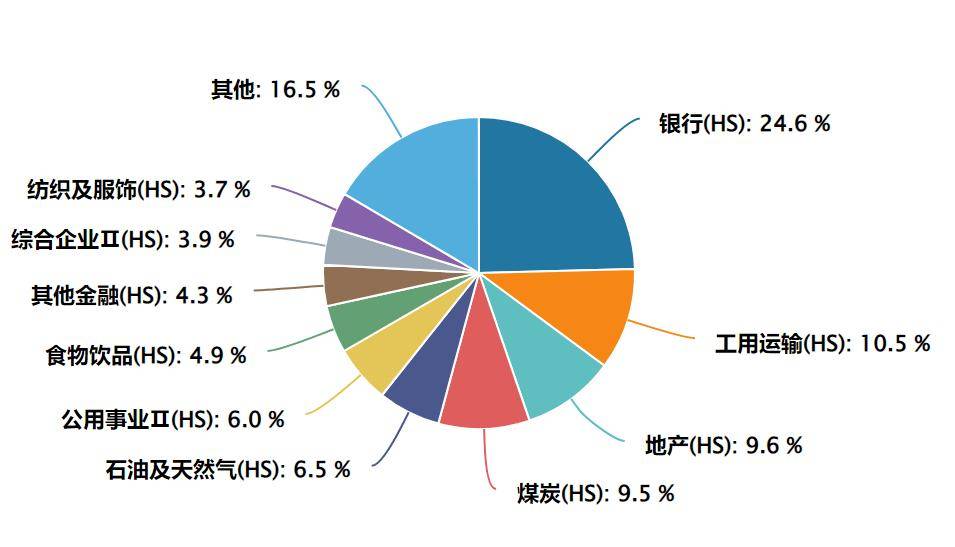
Core Viewpoint - The performance of dividend ETFs has been strong this year, with specific ETFs showing significant gains, indicating a shift in how dividend assets are perceived in investment strategies [1][3]. Group 1: Dividend ETF Performance - As of July 10, the Hong Kong Dividend Low Volatility ETF (520550) has achieved a year-to-date increase of 20.21%, outperforming all Shenwan first-level industry indices [1]. - Major banks contribute significantly to the performance of the Hong Kong Dividend Low Volatility ETF, with approximately 24.6% of its index composed of bank stocks, which have reached new highs [1]. - The China Securities Dividend Quality ETF (159209), established in March, has recently announced its first dividend distribution of 0.003 yuan per share, with a monthly dividend yield of 0.30% [5]. Group 2: Long-term Performance Comparison - Over a ten-year period, the performance of the Hang Seng Hong Kong Stock Connect High Dividend Low Volatility Index has not matched that of the China Securities Dividend Quality Total Return Index [3]. - The China Securities Dividend Quality Total Return Index has shown the best long-term performance, notably excluding bank stocks from its components [5]. Group 3: Diversification and Risk Management - The China Securities Dividend ETF (515080) has experienced the smallest drawdown this year at 6.68%, slightly outperforming the Dividend Quality ETF [9]. - A diversified dividend portfolio can be constructed using the Hong Kong Dividend Low Volatility ETF (520550), China Securities Dividend Quality ETF (159209), and China Securities Dividend ETF (515080), balancing short-term gains, long-term returns, and lower volatility [9].
A股上市银行总市值续创历史新高 经营稳健分红可持续吸引投资者
Jin Rong Shi Bao· 2025-07-11 01:41
Core Viewpoint - A-share listed banks have seen a significant increase in stock prices, with many reaching historical highs, driven by strong investor demand and improving fundamentals in the banking sector [1][2][3]. Group 1: Market Performance - On July 10, A-share indices closed higher, with the Shanghai Composite Index standing at 3509.68 points, up 0.48% [1]. - Among 42 listed banks, 34 saw their stock prices rise, contributing to a total market capitalization of 16.30 trillion yuan [1][2]. - The Industrial and Commercial Bank of China (ICBC) reached a market cap of approximately 2.88 trillion yuan, setting a new record [2]. Group 2: Dividend Distribution - A-share listed banks have entered a period of significant dividend distribution, with total cash dividends for 2024 expected to reach approximately 6209 million yuan [4]. - As of now, 31 banks have completed their 2024 annual dividend distributions, with a total of 3631.93 million yuan already announced [4]. Group 3: Investment Sentiment - Investor sentiment remains strong towards bank stocks, with a median dividend yield of around 4%, indicating potential for further capital inflow [1][3]. - Analysts suggest that the current high dividend yields and stable asset quality contribute to the attractiveness of bank stocks as a reliable investment [3][5]. Group 4: Global Context - The trend of rising bank stock prices is not limited to A-shares; global bank indices have also reached new highs, reflecting a broader macroeconomic environment favoring stable, dividend-paying assets [6]. - The global banking sector has seen significant increases in stock prices, with indices in various regions showing gains between 49% and 88% year-to-date [6]. Group 5: Future Outlook - Analysts predict that the positive performance of bank stocks may continue, supported by improved net interest margins and stable operating conditions [7]. - Factors such as the ongoing demand from various investment funds and the strategic adjustments by banks to enhance profitability are expected to sustain this trend [8].






[7月10日]指数估值数据(月薪宝继续创新高;红利指数什么时候会低迷;指数日报更新)
银行螺丝钉· 2025-07-10 13:52
Core Viewpoint - The article discusses the recent performance of the stock market, highlighting the strength of dividend and value stocks, and the potential for future investment opportunities in these areas. Group 1: Market Performance - The overall market saw an increase, with a closing rise that settled at 4.8 stars [1] - Major indices like the CSI 300 and other large-cap stocks experienced gains, while small-cap stocks showed slight increases [2] - Dividend and value indices have risen, indicating a strong performance in these investment styles [4][3] Group 2: Sector Performance - The pharmaceutical, biotechnology, and healthcare sectors have also seen recent gains [5] - In the Hong Kong market, the Hang Seng Index has risen, with technology and healthcare sectors leading the way, outperforming A-shares by approximately 20% since the Lunar New Year [6] Group 3: Investment Trends - The popularity of dividend-focused investments has increased over the past two years, contrasting with a period of low interest five years ago [8] - From May 2018 to 2021, A-shares rose by 80%, while growth stocks like the ChiNext increased by over 150%, with dividend stocks lagging behind [9][10] Group 4: Institutional Investment - Institutional investors, such as insurance companies and pension funds, are the primary drivers of dividend stock investments [15] - Insurance companies are attracted to dividend stocks due to the need for higher yield assets in a low-interest-rate environment [17][18] Group 5: Dividend Investment Strategy - The article suggests that investors should adopt a long-term strategy focused on undervalued dividend stocks with high yields, which are less affected by market fluctuations [29][30] - The long-term growth of company earnings is expected to enhance dividend payouts, making dividend stocks a suitable investment choice [33][34] Group 6: Valuation Metrics - The article provides a summary of various dividend indices and their performance metrics, including dividend yield and price-to-earnings ratios, to assist investors in making informed decisions [36][37]

行情不错,自己的持仓却不涨...
雪球· 2025-07-10 08:13
Core Viewpoint - The article emphasizes the importance of long-term value investing and the need for investors to remain patient and focused on their investment goals, even when market trends do not align with their current holdings [2][3]. Group 1: Market Trends and Investment Strategy - The current market is characterized by a focus on bank stocks and small-cap stocks, which the author's friend's portfolio lacks, leading to underperformance compared to market trends [2]. - A portfolio consisting of high ROE stocks can outperform the market over the long term, provided that investors are not overly focused on short-term gains [3]. - Investors should be cautious of high-risk investments, as most individuals lack the ability to manage such risks effectively, and high returns are not guaranteed [4]. Group 2: Valuation Metrics - The banking sector currently has a dividend yield of around 4%, but the high leverage involved poses significant risks, making it less attractive compared to lower-leverage consumer stocks with similar yields [4]. - The current PE ratio of the CSI 2000 index is 132, placing it in the 92.36th percentile historically, indicating limited upward potential [4]. - The PB ratio of the CSI 2000 index is 2.46, which is in the 94.98th percentile historically, suggesting that valuations are stretched and may not support further price increases [4][5]. Group 3: Investment Philosophy - The article advocates for a rational and detached approach to investing, where investors avoid chasing trends and instead focus on the long-term value of their holdings [5]. - The "Snowball Three-Point Method" is introduced as a strategy for long-term investment and asset allocation, emphasizing diversification across assets, markets, and timing to achieve risk mitigation and diversified returns [6].






银华基金焦巍,规模蒸发 150 亿背后的操盘逻辑
Sou Hu Cai Jing· 2025-07-10 01:14
Group 1 - The core viewpoint of the article highlights the challenges faced by Jiao Wei, a veteran fund manager at Yinhua Fund, whose flagship Yinhua Wealth Theme Fund has suffered significant losses over the past four years, with a total loss of 8 billion yuan and a reduction in scale by 15 billion yuan [2][3] - The Yinhua Wealth Theme Fund, established in November 2006, has seen a peak cumulative increase of 1653.50%, making it a prominent product for Yinhua Fund [3] - Jiao Wei's investment strategy initially focused on consumer and pharmaceutical sectors, particularly heavy investments in leading liquor stocks, which were considered cash cows [3][4] Group 2 - The fund's performance deteriorated due to misjudgments in the liquor market and aggressive trading strategies, leading to significant losses, particularly with stocks like Jiu Gui Jiu [4][6] - In response to the declining performance of liquor stocks, Jiao Wei shifted his investment focus to military and semiconductor sectors, but this transition also resulted in losses as the military index dropped sharply [7] - The fund's recent strategy has included investing in high-dividend stocks, which initially showed promise but ultimately led to underperformance compared to benchmarks [7][9] Group 3 - Jiao Wei acknowledged missing out on significant investment opportunities in emerging technologies like AI, which he identified as a major direction for the next decade [7][8] - The new consumption wave, characterized by companies like Pop Mart and others, has outperformed traditional consumer sectors, yet Jiao Wei's fund has remained largely absent from these opportunities [8][9] - The future of the Yinhua Wealth Theme Fund remains uncertain as it continues to focus on dividend stocks, raising questions about whether this strategy will yield better results than previous commitments to liquor stocks [9]

沪指重返3500点,红利还能买吗?
Sou Hu Cai Jing· 2025-07-09 05:32
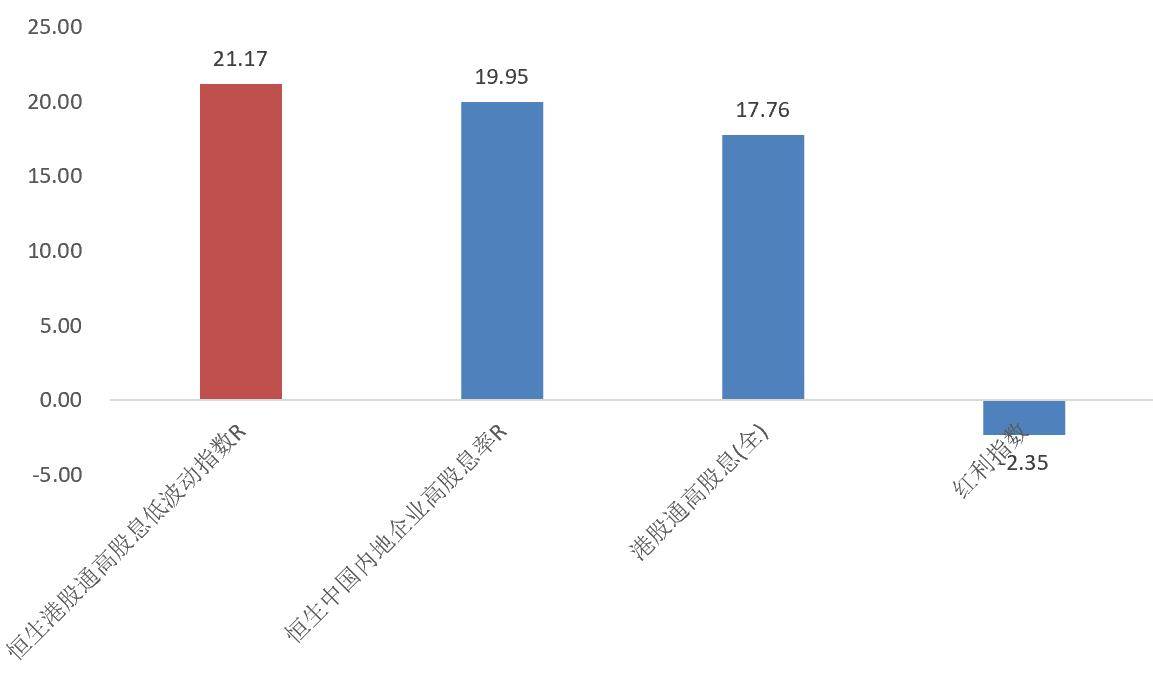
Core Viewpoint - The article discusses the performance of the Chinese stock market, particularly the Shanghai Composite Index, and the strong performance of dividend stocks, especially in the Hong Kong market, driven by significant inflows from institutional investors. Group 1: Market Performance - The Shanghai Composite Index has successfully reclaimed the 3500-point mark, indicating a potential continuation of upward momentum if trading volume remains robust [1] - The banking sector, particularly the four major banks, has reached historical highs, suggesting that the strong performance of dividend stocks is likely to persist [1] Group 2: Dividend Stocks Analysis - The Hang Seng High Dividend Low Volatility Index has shown the best performance among major dividend indices in both A-shares and Hong Kong, with a year-to-date increase of 21.17% and a current dividend yield of 6.4% [1] - The market capitalization of the Hang Seng High Dividend Low Volatility Index components held through the Stock Connect reached 1.58 trillion HKD, accounting for 17% of the total market capitalization, reflecting high investor interest [1] Group 3: Institutional Investment Trends - Institutional investments, particularly from insurance funds, have significantly boosted the performance of Hong Kong dividend assets, with net inflows exceeding 2.1 billion CNY into the Hong Kong Dividend Low Volatility ETF (520550) this year [2] - Projections indicate that insurance funds could see an incremental increase of 250 to 400 billion CNY in 2025, which would further support the strong performance of Hong Kong dividend stocks [5]
红利板块上扬,红利低波100ETF(159307)红盘震荡,活跃7连涨,最新规模突破新高
Xin Lang Cai Jing· 2025-07-09 02:37
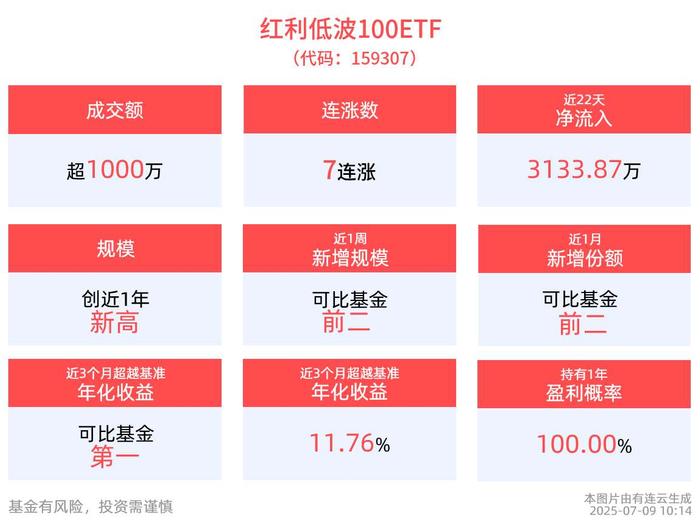
Group 1 - The core viewpoint of the news highlights the performance and growth of the Zhongzheng Dividend Low Volatility 100 Index and its corresponding ETF, indicating a positive trend in both price and liquidity [2][3][5] - As of July 8, 2025, the Zhongzheng Dividend Low Volatility 100 ETF has achieved a net value increase of 17.50% over the past year, ranking first among comparable funds [5] - The ETF has seen significant inflows, with a net inflow of 106.66 million yuan recently, and a total of 3.13 billion yuan over the past 22 trading days, indicating strong investor interest [3][5] Group 2 - The coal consumption demand has recently rebounded, leading to a slight increase in the price of thermal coal, with the Qinhuangdao 5500 kcal thermal coal price rising to 623 yuan/ton as of July 4 [3] - The top ten weighted stocks in the Zhongzheng Dividend Low Volatility 100 Index account for 20.14% of the index, with companies like Jizhong Energy and Shanxi Coking Coal among the leaders [7] - The ETF has a management fee rate of 0.15% and a custody fee rate of 0.05%, which are the lowest among comparable funds, indicating cost efficiency for investors [6]
成交、净流入、净值、规模同步新高!港股红利低波ETF(520550)多维度指标创纪录
Sou Hu Cai Jing· 2025-07-08 01:54
Group 1 - Southbound funds continue to increase their investment in the Hong Kong stock market, leading to a significant rise in trading activity of related investment targets [1] - On July 7, the Hong Kong Dividend Low Volatility ETF (520550) saw a net subscription amount close to 70 million yuan, with a total trading volume of 131 million yuan, and its net asset value rose to 1.1806 yuan, marking a total scale that surpassed 700 million yuan for the first time [1] - Market research institutions indicate that southbound funds have shown a systematic increase this year, with Cathay Pacific Securities stating that the investment logic for Hong Kong and A-share dividend assets remains fundamentally consistent, maintaining their defensive attributes [1] Group 2 - The Hong Kong Dividend Low Volatility ETF (520550) features a leading comprehensive fee rate structure of 0.2%, effectively reducing holding costs for investors [1] - The product offers a monthly dividend mechanism and T+0 trading advantages, significantly enhancing capital efficiency [1] - In portfolio construction, the ETF focuses on allocating to mature industries such as finance and energy, while implementing a strict individual stock weight limit of 5% and a dynamic exclusion mechanism to avoid "high dividend traps" [1]
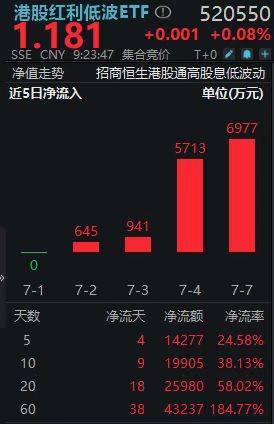
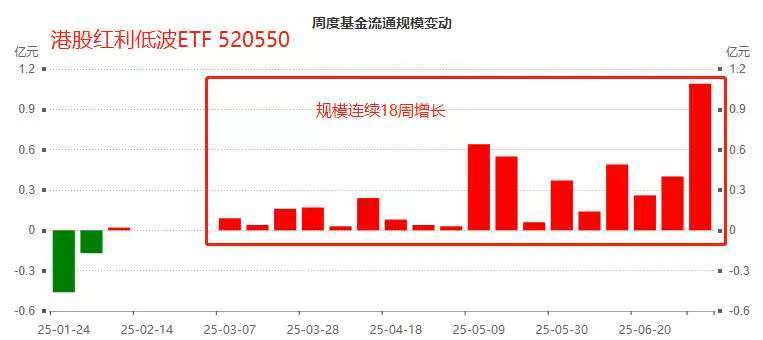
单日狂揽超5700万同类第一!港股红利低波ETF(520550)规模连增18周,迭创历史新高
Sou Hu Cai Jing· 2025-07-07 01:38
Group 1 - The core viewpoint of the article highlights the strong inflow of capital into Hong Kong dividend ETFs, particularly the low-fee, monthly dividend-paying ETF (520550), which saw a net inflow of over 57 million on July 4, and a cumulative net inflow of over 360 million since the beginning of the year, representing a growth of approximately 246.36% [1] - The investment logic for dividend assets in Hong Kong and A-shares remains consistent, emphasizing their defensive attributes. In weaker market conditions, the excess returns from dividend assets become more pronounced, although the probability of achieving positive absolute returns decreases [1] - The Hong Kong dividend low-volatility ETF (520550) features the lowest market fee rate (comprehensive fee rate of 0.2%), enhancing capital efficiency through its monthly dividend mechanism and T+0 trading characteristics. The portfolio structure includes mature sectors like finance and energy, providing a safety cushion while implementing a 5% weight cap on individual stocks to mitigate risks and avoid "dividend yield traps" [1]