
绿色消费

Search documents
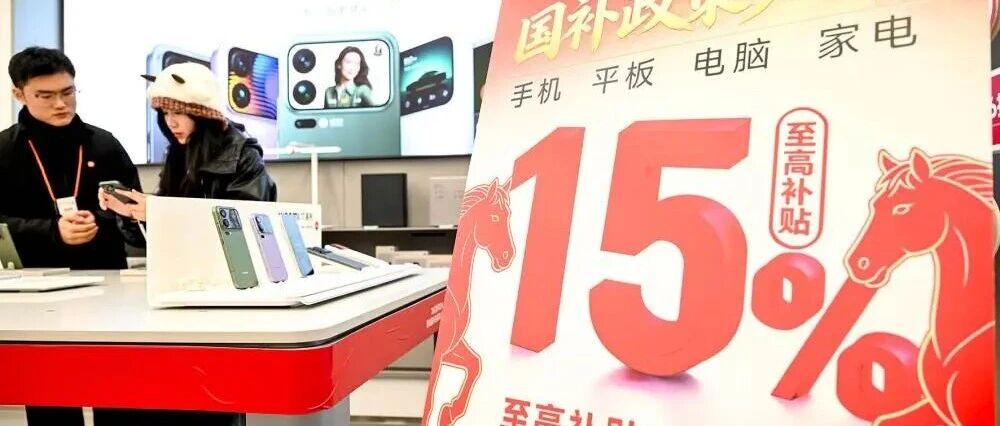
解码2026“国补”新政:撬动数码活力 赋能家电升级
Zheng Quan Ri Bao· 2026-01-13 17:05
Group 1: National Subsidy Policy Overview - The new round of "National Subsidy" policy has been implemented with an initial allocation of 62.5 billion yuan in special long-term government bonds to stimulate consumption and improve livelihoods [1] - The policy focuses on large-scale equipment updates and the replacement of old consumer goods, covering key areas such as automobiles, home appliances, and digital smart products, while also addressing public concerns like installing elevators in old residential areas and equipping elderly care facilities [1][6] - Compared to 2025, the subsidy rules for 2026 have been optimized, with specific subsidies for automobiles based on price and a 15% subsidy for energy-efficient home appliances, with a cap of 1,500 yuan per item [1][6] Group 2: Digital and Smart Products - The 2026 subsidy policy has expanded to include smart glasses, reflecting government support for the smart wearable industry and aligning with trends in consumption upgrades [2] - Smart glasses are transitioning from niche products to practical tools for various applications, including real-time translation for students and efficiency enhancement for professionals [3] - The inclusion of smart glasses in the subsidy program is expected to accelerate market growth and meet consumer demand for high-tech products [2][3] Group 3: Impact on Home Appliances - The 2026 subsidy policy emphasizes energy efficiency, with support limited to first-level energy-efficient or water-efficient products, thereby promoting green consumption [6][8] - The policy aims to increase the market share of energy-efficient products, with over 90% of home appliances updated to first-level efficiency during the previous years [7] - The adjustment in subsidy categories is expected to drive companies to enhance their R&D efforts towards high-end and green production [6][8] Group 4: Market Trends and Consumer Behavior - The smart wearable market, particularly AI glasses and smartwatches, has shown significant growth, with online retail sales increasing by 23.1% from January to October 2025 [8] - The subsidy adjustments are designed to align with current consumer preferences for high-quality and intelligent products, effectively stimulating new consumption potential [8] - The changes in subsidy policy are anticipated to create a positive cycle of hardware proliferation, ecosystem prosperity, and user growth in the digital consumption market [4][5]
商务部等9部门发文推广绿色消费 富岭股份已覆盖所有塑料替代产品应用场景
Sou Hu Cai Jing· 2026-01-13 12:15
Core Viewpoint - The recent policy announcement by the Ministry of Commerce and nine other departments aims to promote green consumption, focusing on biodegradable products and reducing single-use plastics, which provides clear policy direction and market opportunities for the plastic substitution industry [1] Group 1: Policy and Market Impact - The policy encourages the promotion of biodegradable products and the reduction of single-use plastic usage, creating a favorable environment for the plastic substitution industry [1] - Financial support measures are included to encourage collaboration between financial institutions and trade companies, facilitating funding for capacity expansion and technological research [1] Group 2: Company Overview - The company specializes in biodegradable materials and high-performance modifications of conventional plastics, having developed various modified biodegradable materials for multiple applications [2] - The company has invested 27.15 million yuan in R&D in the first half of 2025, leading the industry in the application of inorganic filled enhanced materials [2] - The company has established production bases in the U.S., Mexico, and Indonesia to adapt to changes in the international trade environment, with the Indonesian base partially operational [2] Group 3: Financial Performance - In Q3 2025, the company achieved a revenue of 1.509 billion yuan and a net profit of 77.69 million yuan, maintaining stable core business performance [3] - As of September 2025, the company's total assets reached 2.499 billion yuan, with net assets of 2.041 billion yuan, reflecting a 54.04% increase from the previous year [3] - The company is expected to continue expanding its market share and benefit from industry growth due to ongoing policy support and rapid demand growth [3]
上海发布28条新政促消费
第一财经· 2026-01-13 10:11
Core Viewpoint - The article discusses the recent measures introduced by Shanghai to enhance the quality of the service industry and stimulate consumption, emphasizing a strategic shift from short-term stimulus to long-term systemic development [3][5]. Group 1: Policy Measures - Shanghai has issued 28 policy measures aimed at optimizing supply and expanding consumption to foster new growth points in service supply and consumer demand [3][5]. - The focus of the new policies is on systemic linkage, emphasizing quality competition on the supply side to enhance service industry value and stimulate consumption [3][6]. Group 2: Economic Context - Since 2025, Shanghai's service industry has shown a positive growth trend, with a 5.9% increase in value added and a 5% rise in retail sales of consumer goods, both surpassing national averages [5][6]. - The measures aim to address challenges such as supply structure lagging behind consumption upgrades and the need for better integration of service and consumption sectors [5][6]. Group 3: Key Industries - The policies target six key sectors: finance, information services, transportation, cultural and entertainment services, life services, and inspection and certification, which together account for about 60% of Shanghai's service industry value added [7][8]. - The integration of these sectors is expected to create a closed-loop policy chain that enhances service consumption [7]. Group 4: Financial Innovation - The new policies emphasize the integration of consumption scenarios with consumer finance, supporting the development of financial products tailored to needs such as elderly care and wealth management [8]. - E-commerce platforms are encouraged to shift from price competition to quality competition, driving traffic to offline and quality consumption [8]. Group 5: Cultural and Entertainment Sector - The measures include initiatives to enhance the supply of cultural and entertainment services, such as supporting high-quality exhibitions and sports events, which have shown significant demand growth [9]. - For instance, a recent exhibition in Shanghai attracted over 2.77 million visitors and generated over 760 million yuan in revenue, significantly boosting overall city consumption [9]. Group 6: Institutional Support - The policies aim to strengthen institutional support by transitioning from policy support to a dual-driven approach of "institution + market," focusing on regulatory standards and credit systems to foster sustainable development [10]. - Key initiatives include enhancing brand certification, improving standard systems, and strengthening inspection and testing services to boost consumer confidence [10]. Group 7: Implementation and Coordination - The Shanghai government plans to ensure effective implementation of the measures by coordinating service supply with consumer demand and creating a conducive environment for policy support [12][13]. - Emphasis is placed on cross-departmental collaboration to avoid policy fragmentation and to establish a dynamic evaluation mechanism to monitor the effectiveness of the policies [13].

政策聚力活力涌,消费蓝海起新潮
Xin Lang Cai Jing· 2026-01-13 08:23
Group 1 - The core viewpoint of the articles emphasizes the transformative impact of the "National Subsidy" policy on consumer behavior and market dynamics, shifting from traditional consumption to a more experience-driven and value-oriented approach [1][2][3] - The "National Subsidy" policy targets major consumer sectors such as automobiles and home appliances, while also extending to new markets like smart wearables and products for the elderly, facilitating access to high-quality goods at more affordable prices [2] - The policy is designed to create a virtuous cycle where demand drives supply and vice versa, encouraging companies to innovate in green technology and smart products while making it easier for consumers to upgrade their goods [2][3] Group 2 - The integration of various sectors such as culture, tourism, sports, and technology is reshaping the consumer landscape, leading to a more immersive and comprehensive shopping experience [3] - The "National Subsidy" policy is seen as a catalyst for unlocking consumer potential, which in turn stimulates economic growth by enhancing the domestic circulation of goods and services [3] - The combination of policy incentives and market innovations is expected to ignite a significant surge in consumer activity, contributing to high-quality economic development in China [3]
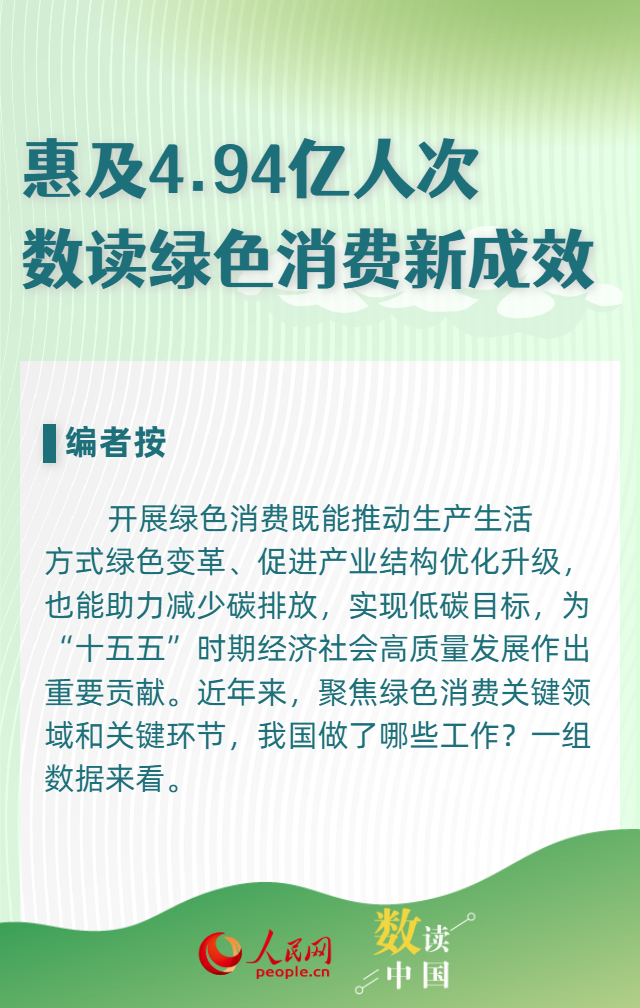
数读中国 惠及4.94亿人次 数读绿色消费新成效
Ren Min Wang· 2026-01-13 07:59
Group 1 - The core viewpoint of the article emphasizes the importance of promoting green consumption to drive green transformation in production and lifestyle, optimize industrial structure, reduce carbon emissions, and contribute to high-quality economic and social development during the 14th Five-Year Plan period [1] Group 2 - The "old-for-new" policy aims to replace 18.3 million cars by 2025, with nearly 60% being new energy vehicles, and to replace 192 million home appliances, achieving over 90% energy efficiency [4] - The "old-for-new" policy is projected to boost consumer goods sales by 3.92 trillion yuan, benefiting 494 million consumers [4] Group 3 - The construction of a green supply chain is highlighted, with pallet standardization reaching 37.8%, leading to an estimated saving of 250 million disposable pallets, equivalent to protecting 50 million trees and reducing carbon emissions by over 2 million tons [5] - There are currently 1,092 green warehouses in China, covering an area of approximately 65 million square meters [5] Group 4 - By 2025, the total amount of recycled resources in China is expected to reach approximately 380 million tons, with a cumulative government investment of 5 billion yuan for the treatment of waste electrical appliances [6] - The recycling efforts are projected to yield over 3 million tons of recycled resources from about 10 million units of waste electrical appliances [6] Group 5 - A total of 3,500 green hotels and 1,161 green shopping malls have been cultivated nationwide, showcasing the industry's commitment to green practices [8] Group 6 - E-commerce platforms are collaborating with upstream and downstream merchants to establish green cooperation alliances and promote low-carbon operational standards, encouraging small and medium-sized businesses to participate in green transformation [9] Group 7 - The promotion of green lifestyles is being facilitated through major exhibitions, which showcase green and intelligent products and services, aiming to cultivate consumer habits towards green consumption [10] - By 2025, the usage of organic product certification marks is expected to exceed 6.66 billion, positioning China as the third-largest organic consumer market globally [10] - The use of environmentally friendly alternatives is projected to increase by 26.31% in the first half of 2025 compared to the previous period [10]
2026/1/5-2026/1/9汽车周报:供应链涨价、购置税兜底驱缓,关注通胀环节投资机会-20260113
Shenwan Hongyuan Securities· 2026-01-13 06:50
Investment Rating - The report maintains a positive outlook on the automotive industry, particularly focusing on companies with strong supply-demand dynamics and pricing power, as well as those with technological cost-reduction capabilities [1][2]. Core Insights - The report highlights the impact of rising prices for memory, copper, aluminum, and key components, which are expected to lead to an upward trend in consumer vehicle prices. It suggests focusing on supply chain companies like Fuda, Bertley, Minshi, Top, and Jingu, as well as mid-to-high-end vehicle manufacturers such as Xiaopeng, NIO, Li Auto, BAIC, and Jianghuai [1]. - The report emphasizes the potential for profit recovery in the used car sector and improved profitability for dealers due to the industry's inflationary pricing cycle, recommending companies like Uxin [1][2]. - The report notes that the official implementation of new subsidies is expected to boost demand primarily in the mid-to-low-end market, with companies like BYD and Geely being highlighted for their performance potential [2]. Market Updates - According to the China Passenger Car Association, the average daily retail sales of passenger cars in the last week of December reached 123,000 units, a year-on-year increase of 17% [2]. - The automotive industry index rose by 2.53% this week, while the overall market index (CSI 300) increased by 2.79%, indicating that the automotive sector's performance was below the broader market [12]. - The report indicates that 201 automotive stocks rose while 68 fell, with the largest gainers being Siling Co., Jingu Co., and Kaizhong Co., which saw increases of 30.5%, 26.3%, and 23.3%, respectively [18]. Key Events - The Ministry of Industry and Information Technology announced the 403rd batch of new car approvals, which includes notable models such as Xiaomi SU7, NIO ES9, and BYD's new models [3][4][5]. - The report discusses the rising costs of memory impacting the automotive industry, with NIO's founder highlighting that memory prices are becoming a significant cost pressure compared to traditional materials like lithium [6][7]. - A joint initiative by nine government departments aims to promote green consumption, with a focus on supporting the purchase of new energy vehicles and enhancing the automotive supply chain [10][11][26]. Financial Analysis - The automotive industry currently has a price-to-earnings ratio of 30.20, ranking 18th among all primary industries, indicating a moderate valuation compared to the broader market [15]. - The report notes that there are no companies facing stock unlocks in the upcoming week, which may provide stability in the market [21]. Company Recommendations - The report recommends focusing on companies with strong positions in AI and robotics, such as Desay SV, Jingwei Hirain, and Kobot, which are expected to benefit from the industry's technological advancements [1][2]. - It also suggests monitoring component manufacturers with solid earnings support and relatively low valuations, including Yinlun, Fuda, Shuanghuan, Jifeng, Minshi, Xingyu, and Ningbo Huaxiang [2].

商务部部署八大重点,这些领域或将迎来消费爆发
21世纪经济报道· 2026-01-13 04:29
Group 1 - The core focus of the national business conference held on January 10-11 is to boost consumption, which is prioritized as the first key area of work for 2026 [4][5] - The conference emphasizes the need to accelerate the construction of a new development pattern, promoting high-quality development while balancing domestic economic work and international trade struggles [1][5] - The goal is to establish a strong domestic market, expand autonomous openness, and innovate trade development, indicating a proactive approach to high-quality development rather than a defensive contraction [1][5] Group 2 - The implementation of a consumption boost initiative includes creating the "Buy in China" brand and optimizing policies for replacing old products with new ones to enhance consumption [5][6] - The policy aims to support the purchase of energy-efficient appliances and vehicles, with projections of 18.3 million cars and 192 million home appliances being replaced under this initiative, generating significant sales and benefiting millions of consumers [5][6] - The green consumption market is expected to grow steadily, driven by the increasing availability of green products and innovative consumption models [6] Group 3 - The conference highlights the importance of stimulating consumption in rural and county areas, recognizing their potential for growth as rural retail sales have consistently outpaced urban areas [8][9] - Data shows that rural retail sales grew by 4.4% compared to 3.9% in urban areas, indicating a shift in focus towards enhancing county-level consumption and supporting rural economic development [8][9] - The initiative includes financial support for county-level consumption and promoting the sale of agricultural products, which is crucial for rural revitalization [9] Group 4 - The conference calls for greater efforts to build high-standard open platforms, particularly through the development of the Hainan Free Trade Port, which aims to align with international trade rules [10][11] - Hainan's practices are expected to serve as a testing ground for China's participation in high-level trade agreements like the CPTPP, enhancing China's influence in global trade rule-making [12] Group 5 - The conference emphasizes the integration of trade and investment, promoting the "Export China" and "Investment China" brands while enhancing the overall efficiency of the business system [14][15] - The focus is on creating a synergistic relationship between trade and investment, which is essential for stabilizing foreign trade and investment in a complex international environment [16] - The two integrations aim to improve the resilience and proactive nature of China's open economy, facilitating better resource sharing and market adaptability [16]
刚刚,上海宣布大利好
中国基金报· 2026-01-13 03:52
Core Viewpoint - Shanghai's government has released 28 measures to enhance the quality and efficiency of the service industry and stimulate consumption, focusing on optimizing supply and expanding demand to achieve mutual empowerment and progress [5][12]. Group 1: Background and Considerations - The measures are in response to the 20th National Congress's call to expand domestic demand and the Central Economic Work Conference's emphasis on boosting consumption and service industry capacity [5]. - In the first three quarters of 2025, the service industry's added value grew by 5.9%, and retail sales of consumer goods increased by 5%, both surpassing national averages [5]. - The measures aim to create new growth points in service supply and consumption demand, promoting high-quality development in the service sector [6]. Group 2: Key Measures - The focus is on six key sectors: finance, information services, transportation, cultural and entertainment services, life services, and inspection and certification, which together account for about 60% of the city's service industry value [7]. - Financial services will be enhanced to support diverse consumer needs, including the development of new financial products tailored to various consumption scenarios [7][13]. - E-commerce platforms will be encouraged to shift from price competition to quality competition, driving offline consumption and enhancing consumer experience [7][16]. Group 3: Transportation and Cultural Services - Transportation services will be improved to connect various consumption scenarios, enhancing the overall consumer experience and reducing travel costs [8][17]. - Cultural and entertainment offerings will be expanded, including support for high-quality exhibitions and events that drive significant economic impact [9][19]. - The gaming and esports industry will be developed further, with initiatives to support high-level competitions and foster a robust ecosystem [9][20]. Group 4: Life Services and Quality Improvement - Life services will be enhanced to improve quality and convenience, including initiatives for home care, elderly care, and healthcare services [10][22]. - The government will support the transformation of home service companies into employee-based models, enhancing service quality and providing insurance for service personnel [22][23]. - Medical services will be diversified, promoting high-end healthcare and encouraging the development of specialized insurance products [23][24]. Group 5: Brand and Standards Enhancement - The measures will strengthen brand certification and establish a robust standard system to enhance consumer trust and service quality [11][24]. - The inspection and certification industry will be supported to improve service capabilities, focusing on high-demand sectors such as food and cosmetics [11][25]. - A consumer credit system will be developed to promote transparency and trust in the marketplace [11][26]. Group 6: Support and Talent Development - The government will enhance financial support for service providers, ensuring effective use of fiscal resources to stimulate growth [27][28]. - Talent attraction initiatives will be implemented to draw skilled professionals to the service and consumption sectors, fostering innovation and development [28][29]. - Statistical monitoring will be improved to assess the effectiveness of policies and optimize measures for service industry growth [28].
商务部部署八大重点 消费或在这些领域爆发
2 1 Shi Ji Jing Ji Bao Dao· 2026-01-12 23:12
Group 1: Core Insights - The national business conference emphasizes boosting consumption as the top priority for 2026, aiming to create a strong domestic market and enhance high-quality development [1][2] - The conference outlines eight key areas of focus, including trade innovation, foreign investment expansion, and the integration of domestic and international markets [1][10] - The approach reflects a shift towards a consumption-driven economy, with a clear recognition of external uncertainties and the need for a balanced development strategy [1][11] Group 2: Consumption and Green Initiatives - The implementation of a consumption upgrade policy, including a "trade-in" program for energy-efficient appliances and vehicles, is expected to significantly boost green consumption [3][4] - The projected outcomes for 2024-2025 include 18.3 million vehicles being traded in, with nearly 60% being new energy vehicles, and 192 million appliances, with 90% meeting high-efficiency standards [3] - The green consumption initiative aims to enhance consumer safety and promote sustainable practices through incentives like green product points and trade-in benefits [5][4] Group 3: Downstream Market Potential - The conference identifies stimulating consumption in rural and county markets as a key focus, highlighting the growth potential in these areas compared to urban markets [6][7] - Data shows that rural retail sales growth outpaces urban areas, indicating significant untapped consumer potential [6] - The strategy includes financial support for county-level consumption initiatives and enhancing the sales of agricultural products [6][7] Group 4: Open Economy and Trade Integration - The conference calls for advancing the construction of high-standard open economic zones, particularly focusing on the Hainan Free Trade Port [8][9] - The integration of trade and investment is emphasized, with initiatives to enhance service trade and optimize import and export structures [10][11] - The dual focus on "internal and external trade integration" aims to improve the overall efficiency of the business system and strengthen resilience against external shocks [11]
商务部部署八大重点,消费或在这些领域爆发
Xin Lang Cai Jing· 2026-01-12 23:09
Group 1: Core Objectives of the National Business Work Conference - The conference emphasized the importance of boosting consumption as the top priority for 2026, aiming to create a strong domestic market and enhance high-quality development [1][2] - The focus on "self-initiated openness," "trade innovation," and "two-way investment" indicates a strategic shift towards a more selective and higher-level openness rather than a defensive contraction [1] - The overall direction set by the conference aims to stabilize expectations and strengthen confidence for high-quality business development during the 14th Five-Year Plan period [1] Group 2: Green Consumption Initiatives - The implementation of a consumption upgrade policy, including subsidies for energy-efficient appliances and new energy vehicles, is expected to significantly boost green consumption [3][4] - The "old-for-new" policy is projected to lead to the replacement of 1.83 million vehicles and 192 million home appliances, generating a sales volume of 3.92 trillion yuan and benefiting approximately 494 million consumers [3] - The introduction of a green consumption points system aims to incentivize consumers to choose green products, linking points to public service benefits [4][5] Group 3: Activation of Downstream Market Consumption - The conference identified the activation of consumption in rural and county areas as a key focus for 2026, recognizing the significant potential in these markets [6][7] - Data shows that rural retail sales growth outpaces urban areas, indicating a shift towards quality and service-oriented consumption in these markets [7][8] - The emphasis on enhancing rural consumption and supporting local products aligns with broader strategies to improve the rural economy and increase consumer spending [7][8] Group 4: Promotion of Free Trade Zones and Open High Grounds - The conference called for greater efforts to align with international high-standard trade rules and enhance the construction of free trade zones, particularly in Hainan [9][10] - Hainan's free trade port is set to serve as a testing ground for high-level openness, potentially influencing China's participation in global trade rule restructuring [9][10] - The focus on trade and investment integration aims to create synergies between trade and investment, enhancing the overall efficiency of the business system [11]