AI芯片

Search documents
2025年超1万家银行网点关闭,净减少超2000家|首席资讯日报
首席商业评论· 2026-01-14 04:34
Group 1 - In 2025, over 11,000 bank branches will be approved for closure, resulting in a net decrease of more than 2,000 branches, indicating an acceleration in digital transformation and optimization of physical banking channels [2] - SK Hynix announced an investment of 19 trillion KRW in its advanced packaging factory in Cheongju, South Korea, aiming to enhance production efficiency, with construction expected to start in April 2026 and completion by the end of 2027 [3] - The Ministry of Industry and Information Technology will focus on promoting the large-scale application of humanoid robots and health monitoring devices in various settings, emphasizing technological empowerment in the elderly care sector [4] Group 2 - Citigroup plans to lay off approximately 1,000 employees as part of a broader strategy to reduce 20,000 jobs by the end of 2026, reflecting adjustments to align workforce and skills with current business needs and technological advancements [5] - Ctrip clarified that a recent message about a mass layoff was a mistake, confirming that there is no plan for a full staff departure [6] - The U.S. Defense Secretary announced that Elon Musk's AI chatbot "Grok" will be integrated into the Pentagon's systems, alongside Google's generative AI, to enhance military operations [7] Group 3 - The launch of a 4,199 RMB bottle of Moutai sold out immediately on the iMoutai app, indicating strong demand for premium products [8] - Shanghai has introduced measures to optimize auto loan processes, including relaxing application conditions and determining reasonable loan issuance ratios, terms, and interest rates to stimulate consumption [9] - Apple responded to rumors regarding Google taking over iPhone control, clarifying that there has been no transfer of control over Siri or Apple Intelligence to Google [10] Group 4 - Lianchuang Electronics has begun supplying optical products to the robotics sector, although the industry is still in its early stages with relatively low sales [11] - DeepSeek published a new paper on conditional memory for large language models, co-authored with Peking University, contributing to advancements in AI research [12]

科创综指ETF鹏华(589680)涨超3.5%,半导体设备与AI应用走强共振
Xin Lang Cai Jing· 2026-01-14 03:52
Group 1 - Semiconductor equipment stocks showed strong gains in early trading, driven by a recovery in domestic wafer fab capacity utilization and a strong willingness to expand production, indicating a "super cycle" phase in the global memory chip industry driven by AI [1] - The AI application sector is gaining strength again, with companies like Alibaba expected to release new generations of large models, indicating continuous catalysis in the AI industry and broad commercial development potential [1] - The STAR Market Index and its constituent stocks saw significant increases, likely driven by accelerated domestic semiconductor equipment production and multiple benefits from the AI industry chain [1] Group 2 - The STAR Market is clearly positioned to primarily serve innovative enterprises in key areas such as semiconductors, biomedicine, and high-end equipment, representing an investment in China's technological breakthroughs and domestic substitution frontiers [2] - In the context of changing external environments, technological self-sufficiency has become a top priority for national development, particularly in AI chips and semiconductor equipment, accelerating the domestic production process and providing significant growth opportunities for STAR Market companies [2] Group 3 - Related products include the STAR Market Index ETF Penghua (589680) and linked funds (Class A 023757, Class C 023758, Class I 024141) [3] - Related individual stocks include Cambricon-U (688256), Haiguang Information (688041), SMIC (688981), Zhongwei Company (688012), Kingsoft Office (688111), Lanke Technology (688008), Baile Tianheng (688506), United Imaging Healthcare (688271), Yingshi Innovation (688775), and Tuojing Technology (688072) [3]
估值预期500亿美元!李彦宏第二个IPO,终于要来了
Xin Lang Cai Jing· 2026-01-13 09:54
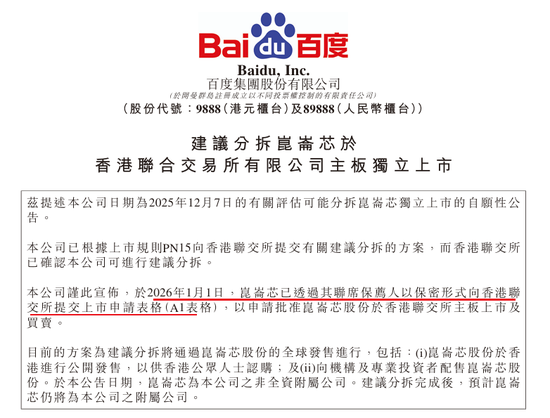
Core Viewpoint - Baidu has announced that Kunlun Core has submitted a confidential application for listing on the Hong Kong Stock Exchange, marking it as the first major internet company to spin off its chip business for independent listing [1][20]. Group 1: Company Developments - The rumors about Baidu's spin-off of Kunlun Core have been confirmed, representing one of Baidu's largest moves in recent years [3][20]. - Kunlun Core's first round of financing after its spin-off in 2021 was valued at 13 billion, and the latest round in July 2022 reached a valuation of 21 billion [3][20]. - Following the announcement of the listing, several institutions, including CICC and Haitong International, have projected a valuation exceeding 50 billion USD for Kunlun Core [3][20]. Group 2: Market Context - The listing of Kunlun Core comes amid a surge of domestic GPU companies going public, which has ignited market enthusiasm [3][20]. - The recent IPOs of companies like Moore Threads and Muxi have significantly boosted market sentiment towards domestic chip manufacturers [13][32]. - Baidu's stock price has risen significantly since the rumors of Kunlun Core's listing began circulating, increasing from a low of 105.3 HKD to a high of 148 HKD, representing a maximum increase of 40% [35]. Group 3: Financial Projections - Goldman Sachs estimates that Kunlun Core's sales will reach approximately 3.5 billion in 2025 and 6.5 billion in 2026, driven by strong growth in new products and orders [7][24]. - The valuation of Kunlun Core has reached 21 billion, with potential estimates from various institutions suggesting it could rise to as high as 50 billion to 180 billion USD [10][29]. - Baidu's stake in Kunlun Core, which is 59%, could be valued at 22 billion USD, indicating that the value of Kunlun Core is approaching half of Baidu's total market capitalization of 52.34 billion USD [10][29].
2025科技观察:AI赶超、芯片“突围”、结构性重塑
Jing Ji Guan Cha Wang· 2026-01-13 07:49
Group 1: Global Innovation Index and China's Position - China has entered the global top ten in the Global Innovation Index for the first time, with the Shenzhen-Hong Kong-Guangzhou cluster ranking first globally, reflecting a significant enhancement in China's position within the global innovation system [1] - The new landscape of emerging industries in China is characterized by breakthroughs in core areas, optimized innovation ecosystems, and market-driven applications, particularly in fields like artificial intelligence, AI chips, quantum information, and biopharmaceuticals [1] Group 2: Advancements in Artificial Intelligence - In 2025, the Chinese AI company DeepSeek launched the open-source model DeepSeek-R1, achieving low training costs and performance on par with international leaders in tasks like mathematical reasoning and code generation, marking a significant development in global AI [1] - The year saw a surge in various AI applications, including AI assistants, search engines, and hardware like AI PCs and smartphones, driven by advancements in large models in natural language processing and multimodal capabilities [1] Group 3: Breakthroughs in Fusion Energy and Quantum Computing - China made substantial progress in fusion energy with the EAST device achieving a world record of 1 million degrees Celsius for 1000 seconds, indicating a shift from basic research to engineering practice [2] - The "Zu Chongzhi No. 3" superconducting quantum computing prototype set a new world record, outperforming the fastest supercomputers by a factor of trillions, showcasing China's leading position in quantum computing [2] Group 4: Robotics and Commercial Space - The commercial space sector witnessed reduced rocket launch costs and increased launch frequency, with satellite internet constellations entering a phase of dense networking and the low-altitude economy beginning to take shape [3] - The robotics industry is poised for significant growth, with numerous companies filing for IPOs, indicating a vibrant market and capital potential in the sector [3] Group 5: Policy and Competitive Landscape - The 20th Central Committee of the Communist Party of China emphasized technological innovation in its five-year plan, highlighting its importance for high-quality development in the tech industry [4] - The intensifying global tech competition is pushing Chinese companies to accelerate independent innovation and increase R&D investments, fostering a new wave of internationally competitive tech firms [5] Group 6: AI Chip Industry Developments - The demand for computing power in China has shifted from a focus on parameter competition to application implementation, leading to a breakthrough for domestic AI chip companies in the capital market [5] - 2025 marked a significant year for IPOs in the AI chip sector, with several companies successfully listing, indicating a transition of China's chip industry from a supplementary role to a core player [5]
集成电路ETF(159546)回调超2.7%,市场关注AI芯片成本下探与行业复苏,回调或可布局
Mei Ri Jing Ji Xin Wen· 2026-01-13 06:12
Core Viewpoint - The electronic and semiconductor industry is currently performing outstandingly in the dual mainline market of technology and cycles, with the global semiconductor cycle showing over nine consecutive quarters of year-on-year positive growth since Q1 2023, demonstrating unprecedented structural depth and resilience in capital expenditure [1] Industry Summary - The current semiconductor cycle, driven by GPU and generative AI, surpasses previous cycles led by consumer electronics in both duration and intensity [1] - Communication equipment, such as optical communication, benefits from the expansion of AI computing power, data center growth, and the electronic upgrade of smart vehicles, showing a structural increase in demand similar to the 5G base station construction period of 2019-2020 [1] - The core driving factor in the industry is ΔG (marginal change in profit growth), with no significant turning point observed, indicating that the AI hardware sector is likely to maintain its strength in a favorable valuation environment [1] - The commercialization of AI applications is accelerating under the resonance of policy, demand, ecology, and capital, with improvements in domestic large model capabilities driving scenario realization, although caution is advised regarding the risk of growth rate shifts due to high base effects [1] Company Summary - The Integrated Circuit ETF (159546) tracks the Integrated Circuit Index (932087), which selects listed companies involved in integrated circuit design, manufacturing, packaging, testing, and related materials and equipment to reflect the overall performance of the integrated circuit industry [1] - This index features high technical content and growth characteristics, effectively representing the development status of China's integrated circuit industry [1]
寒武纪跌2.18%,成交额38.50亿元,主力资金净流入299.48万元
Xin Lang Cai Jing· 2026-01-13 03:42
Group 1 - The core stock price of Cambrian has decreased by 2.18% to 1477.01 CNY per share, with a total market capitalization of 622.83 billion CNY as of January 13 [1] - Cambrian's stock has increased by 8.96% year-to-date, with a 6.79% rise over the last five trading days, 9.90% over the last twenty days, and 18.38% over the last sixty days [2] - The company primarily focuses on the research, design, and sales of AI core chips for various cloud servers, edge computing devices, and terminal devices, with 99.62% of its revenue coming from cloud products [2] Group 2 - As of September 30, 2025, Cambrian's revenue reached 4.607 billion CNY, representing a year-on-year growth of 2386.38%, while the net profit attributable to shareholders was 1.605 billion CNY, up 321.49% [2] - The number of shareholders increased by 52.13% to 62,000, while the average circulating shares per person decreased by 34.13% to 6,748 shares [2] - Major shareholders include Hong Kong Central Clearing Limited, which holds 12.0035 million shares, and several ETFs that have reduced their holdings [3]

首日市值破1370亿港元 国产半导体巨头豪威集团赴港上市
Zhong Guo Jing Ying Bao· 2026-01-13 03:13
Core Viewpoint - The successful listing of OmniVision Technologies (豪威集团) on the Hong Kong Stock Exchange marks a significant milestone for Chinese semiconductor companies, reflecting a broader trend of domestic firms pursuing dual listings in both A-shares and H-shares to enhance their global presence and attract international capital [1][5][7]. Company Overview - OmniVision Technologies, founded in 1995, is a leading Fabless semiconductor design company, primarily focused on image sensors and related solutions [2][3]. - The company was acquired by Weir Group (韦尔股份) in 2019 for approximately 15 billion RMB, facilitating its transformation into a high-end semiconductor design firm [2]. - As of 2024, OmniVision is the third-largest supplier of digital image sensors globally and holds a 32.9% market share in the automotive CIS market [2][3]. Financial Performance - OmniVision's revenue increased from 20.04 billion RMB in 2022 to 25.71 billion RMB in 2024, with a significant rise in net profit from 544 million RMB in 2023 to 3.279 billion RMB in 2024 [3]. - For the first three quarters of 2025, the company reported revenue of 21.783 billion RMB, a year-on-year growth of 15.20%, and a net profit of 3.210 billion RMB, up 35.15% [3]. Market Trends - The listing of OmniVision is part of a broader trend of semiconductor companies in China accelerating their capital market activities, particularly in Hong Kong [5][6]. - The semiconductor sector has become a focal point for IPOs in Hong Kong, with several companies, including GPU leader Biren Technology, successfully listing and attracting significant investment [6][7]. - The rise of AI and smart automotive technologies is driving demand for semiconductors, prompting domestic firms to seek financing through public listings to expand capacity and accelerate technological advancements [7]. Strategic Direction - OmniVision aims to leverage its dual listing to enhance its global strategy, focusing on technological innovation and collaboration with global partners [4].

英伟达,筑起新高墙
3 6 Ke· 2026-01-13 02:39
Core Insights - Nvidia's recent licensing agreement with Groq, a startup specializing in inference chips, signifies a strategic move to absorb potential competition and enhance its technological capabilities in the AI chip market [1][2][3] - The shift in focus from training to inference in AI chip competition highlights the urgency for Nvidia to secure its position against emerging threats from AMD and custom ASICs [2][5] - Groq's unique architecture emphasizes deterministic design and low latency, which aligns with the evolving demands of AI applications, making it a valuable asset for Nvidia [4][5][6] Group 1: Strategic Moves - Nvidia's acquisition of Groq's technology and key personnel represents a "hire-to-acquire" strategy, allowing it to integrate critical expertise without triggering regulatory concerns [1][2] - The deal occurs at a pivotal moment as the AI chip landscape transitions towards inference, where Groq's LPU architecture offers significant advantages [2][3] - Nvidia's historical pattern of acquisitions, such as Mellanox and Bright Computing, indicates a focus on building a robust defense against competitive threats rather than merely expanding its market presence [2][3] Group 2: Technological Implications - Groq's LPU architecture, which prioritizes predictable execution and low latency, contrasts with the dynamic scheduling typical of Nvidia's GPUs, highlighting a shift in system philosophy [3][4] - The transition of Groq towards inference-as-a-service reflects a growing market demand for low-latency solutions in sectors like finance and military applications [5][6] - Nvidia's strategy to control not just hardware but also the software and system layers, including workload management through acquisitions like SchedMD, positions it to dominate the AI ecosystem [7][8][19] Group 3: Market Dynamics - The competitive landscape is evolving, with a focus on system-level efficiency and cost-effectiveness, prompting Nvidia to adapt its offerings beyond just powerful GPUs [5][6][19] - Nvidia's integration of cluster management tools and workload schedulers into its AI Enterprise stack signifies a shift towards providing comprehensive system solutions rather than standalone products [8][19] - The emphasis on reducing migration costs and enhancing ecosystem stickiness suggests that Nvidia is not only selling hardware but also creating a tightly integrated AI infrastructure [19][20]

英伟达,筑起新高墙
半导体行业观察· 2026-01-13 01:34
Core Viewpoint - The article discusses NVIDIA's strategic acquisition of Groq, highlighting its implications for the AI chip market and NVIDIA's competitive positioning in the evolving landscape of AI inference technology [1][2][4]. Group 1: NVIDIA's Acquisition of Groq - NVIDIA's acquisition of Groq is characterized as a "recruitment-style acquisition," where key personnel and technology are absorbed without a formal takeover, allowing NVIDIA to mitigate potential competition [1][2]. - The timing of this acquisition is critical as the AI chip competition shifts from training to inference, with Groq's technology being particularly relevant for low-latency and performance certainty in inference tasks [2][4]. - Groq's founder, Jonathan Ross, is recognized for his pivotal role in developing Google's TPU, making Groq a significant player in the AI chip space [5]. Group 2: Shift in AI Focus - The focus of the AI industry is transitioning from sheer computational power (FLOPS) to efficiency and predictability in delivering inference results, which Groq's architecture emphasizes [4][7]. - Groq's LPU architecture, which utilizes deterministic design principles, contrasts with the dynamic scheduling typical in GPU architectures, highlighting a shift in system philosophy [5][6]. Group 3: Broader Strategic Implications - NVIDIA's acquisition strategy reflects a broader goal of consolidating control over the AI computing ecosystem, moving beyond hardware to encompass system-level capabilities [23][24]. - The integration of Groq, along with previous acquisitions like Bright Computing and SchedMD, illustrates NVIDIA's intent to dominate the entire AI computing stack, from resource scheduling to workload management [23][24]. - By controlling the execution paths and system complexity, NVIDIA aims to create a high barrier to entry for competitors, making it difficult for customers to switch to alternative solutions [24][25].
李彦宏要IPO敲钟了
盐财经· 2026-01-12 10:22
Core Viewpoint - Baidu's Kunlun Chip is preparing for an IPO in Hong Kong, marking a significant move in the Chinese semiconductor industry as it aims to capitalize on the rising demand for computing power [4][9][10]. Group 1: Company Background and Development - Kunlun Chip, originally part of Baidu's AI chip division, was spun off in 2021 with an initial valuation of 13 billion RMB [4][12]. - The chip development began in 2011, with significant milestones including the launch of the first Kunlun chip in 2018, which achieved a computing power of 260 Tops [7][8]. - By 2024, the third generation of Kunlun chips is expected to be mass-produced, targeting various industries such as finance, energy, and education [8]. Group 2: Financial Performance and Market Position - Kunlun Chip has attracted a diverse range of investors, including major firms like BYD and various state-owned enterprises, indicating strong market confidence [12][13]. - Projections suggest that Kunlun Chip's sales could reach 3.5 billion RMB in 2025 and 6.5 billion RMB in 2026, highlighting its growth potential [13]. - Baidu anticipates that the IPO will enhance Kunlun Chip's market image and allow for independent capital market access, optimizing financial resource allocation [13]. Group 3: Competitive Landscape and Strategic Importance - The IPO comes at a time when other Chinese semiconductor companies, such as Wallen Technology and Moore Threads, have recently achieved significant market valuations, creating a competitive environment [16][17]. - Baidu's Kunlun Chip is positioned to replicate the success of its competitors, with a current shipment volume of 69,000 units, placing it among the top domestic chip manufacturers [17]. - Analysts suggest that if Kunlun Chip receives a valuation similar to that of Cambricon, Baidu's stake could be valued at 22 billion USD, representing 45% of its total market capitalization [17].