
自动驾驶技术

Search documents
传禾赛科技-W以每股212.8港元定价 公开发售部分超额认购170倍
Zhi Tong Cai Jing· 2025-09-11 09:19
Company Overview - Hesai Technology, the first global lidar company to go public in Hong Kong, priced its shares at HKD 212.8, raising at least HKD 3.62 billion [1] - The public offering was oversubscribed by 170 times, with total funds involved reaching HKD 66.9 billion [1] - The company aims to raise up to HKD 3.88 billion from the public offering, with a total issuance of 17 million Class B ordinary shares [1] Financial Performance - In Q2 2023, Hesai achieved revenue of RMB 710 million, a year-on-year increase of 53.9%, and net profit exceeding RMB 40 million [2] - The total delivery of Hesai's lidar units reached 352,095, marking a year-on-year growth of 306.9% [2] - The company has secured a new model from a joint venture under Toyota, with plans for mass production by 2026 [2] Market Position - Hesai is recognized as the largest lidar supplier globally by revenue for 2022, 2023, and 2024, and is projected to be the first to exceed 100,000 units shipped in a single month by 2024 [3] - The global lidar market is expected to grow from USD 300 million in 2020 to USD 1.6 billion by 2024, with a compound annual growth rate (CAGR) of 57.8% [3] - The Chinese lidar market is significantly outpacing other regions in terms of market size and growth rate [3] Stock Performance - Since its listing on the US stock market in February 2023, Hesai's stock price has doubled, closing at USD 27.74, with a market capitalization exceeding USD 3.7 billion [3]

新股消息 | 传禾赛科技-W(02525)以每股212.8港元定价 公开发售部分超额认购170倍
智通财经网· 2025-09-11 09:12
Company Overview - Hesai Technology, the first global lidar company to go public in Hong Kong, priced its shares at HKD 212.8, aiming to raise at least HKD 3.62 billion [1] - The public offering was oversubscribed by 170 times, with total funds involved reaching HKD 66.9 billion [1] - The company plans to issue 17 million Class B ordinary shares, with 10% allocated for public offering, and the maximum fundraising target is HKD 3.88 billion [1][2] Financial Performance - In Q2 2023, Hesai achieved revenue of RMB 710 million, a year-on-year increase of 53.9%, and net profit exceeded RMB 40 million, surpassing GAAP profitability targets [2] - Total lidar deliveries reached 352,095 units in Q2, marking a year-on-year growth of 306.9%, with ADAS product deliveries at 303,564 units, up 275.8% [2] - For the first six months of 2025, total lidar deliveries reached 547,913 units, a year-on-year increase of 276.2% [2] Market Position - Hesai is recognized as the largest lidar supplier globally by revenue for 2022, 2023, and 2024, and is projected to be the first company to exceed 100,000 units shipped in a single month by December 2024 [3] - The global lidar market is expected to grow from USD 300 million in 2020 to USD 1.6 billion by 2024, with a compound annual growth rate (CAGR) of 57.8%, and projected to reach USD 17.3 billion by 2029, with a CAGR of 61.7% [3] - The Chinese lidar market is significantly outpacing other regions in terms of market size and growth rate [3] Stock Performance - Since its U.S. listing, Hesai's stock has doubled, closing at USD 27.74, with a market capitalization exceeding USD 3.7 billion [3]
奇瑞汽车通过港交所上市聆讯;上汽通用五菱与华为深化合作丨汽车早参
Mei Ri Jing Ji Xin Wen· 2025-09-07 23:06
Group 1 - SAIC-GM-Wuling announced a comprehensive upgrade of its strategic partnership with Huawei, focusing on advanced driving assistance, smart cockpit, and smart manufacturing to promote high-quality development in the automotive industry [1] - The first product to feature the jointly developed technology will be the Baojun Huajing S, a new flagship six-seat SUV, enhancing product competitiveness in the smart vehicle sector [1] - Huawei's technology solutions will further solidify its influence in the smart automotive solutions ecosystem [1] Group 2 - Changan Automobile launched the "Tianshu Intelligent" brand, focusing on driving assistance, cockpit, and chassis to provide consumers with "extreme safety" smart travel solutions [2] - The company plans to explore applications in industrial and service robots, aiming to produce humanoid automotive robots by 2028 and expand into household service robots after 2030 [2] - This strategic move highlights Changan's commitment to smart technology and cross-domain integration, potentially enhancing its brand image and long-term competitiveness [2] Group 3 - Chery Automobile has passed the listing hearing at the Hong Kong Stock Exchange, marking a significant step in its international capital strategy [3] - This move is expected to enhance Chery's brand international influence and financing capabilities, providing a model for domestic brands to accelerate development in overseas markets [3] - The listing may boost the valuation recovery expectations for the automotive sector, attracting international funds interested in China's smart electric vehicle growth [3] Group 4 - Pony.ai announced a partnership with Qatar National Transport Company to advance autonomous driving technology and vehicles in Qatar, initiating Robotaxi road tests in Doha [4] - The collaboration aims to adapt autonomous driving technology to Qatar's complex environment, enhancing the company's international commercialization image and technical validation capabilities [4] - This initiative is likely to increase attention on the smart driving industry chain, particularly for companies in sensors, high-precision mapping, and vehicle-road collaboration [4]

东吴证券给予曹操出行(02643)“买入”评级,预计9月8日正式纳入港股通
Zhi Tong Cai Jing· 2025-09-06 09:48
Group 1 - Dongwu Securities has initiated coverage on Cao Cao Mobility (02643) with a "Buy" rating, highlighting its integrated platform for Robotaxi services, which combines vehicle manufacturing, operational capabilities, and technology [1] - The Chinese ride-hailing market is transitioning from "wild growth" to "compliant intelligence," with a focus on autonomous driving technology and the restructuring of human-vehicle relationships [1] - Cao Cao Mobility aims to replicate the success of ride-hailing by leveraging its partnership with Geely Group to create an optimal Robotaxi system [1] Group 2 - Revenue projections for Cao Cao Mobility from 2025 to 2027 are estimated at 20.67 billion, 26.24 billion, and 32.37 billion yuan, with year-on-year growth rates of 41.0%, 26.9%, and 23.4% respectively [2] - The company is expected to achieve a net profit of -1.1 billion, -270 million, and 890 million yuan from 2025 to 2027, with a potential return to profitability by 2027 [2] - Cao Cao Mobility is set to be listed on the Hong Kong Stock Exchange on June 25, 2025, and is anticipated to be included in the Hang Seng Composite Index on September 8, attracting additional mainland capital [2]

东吴证券给予曹操出行“买入”评级,预计9月8日正式纳入港股通
Zhi Tong Cai Jing· 2025-09-06 09:38
Group 1 - The core viewpoint of the report is that Cao Cao Mobility is positioned as a unique integrated platform for Robotaxi services in China, leveraging Geely's manufacturing capabilities, advanced autonomous driving technology, and operational experience to achieve competitive advantages [1] - The Chinese ride-hailing market is undergoing a significant transformation from "wild growth" to "compliance and intelligence," with the focus shifting from capital subsidies to the restructuring of autonomous driving technology and human-vehicle relationships [1] - The report highlights that with L4-level autonomous driving technology, decreasing hardware costs, and an improving policy framework, the commercialization of Robotaxi services is accelerating [1] Group 2 - The analyst projects that Cao Cao Mobility's revenue will reach 20.67 billion, 26.24 billion, and 32.37 billion yuan from 2025 to 2027, with year-on-year growth rates of 41.0%, 26.9%, and 23.4% respectively [2] - The company is expected to achieve a net profit of -1.1 billion, -270 million, and 890 million yuan for the same period, with a potential turnaround to profitability by 2027 [2] - Cao Cao Mobility is set to be listed on the Hong Kong Stock Exchange on June 25, 2025, and is anticipated to be included in the Hang Seng Composite Index, which is expected to attract additional capital from mainland investors [2]
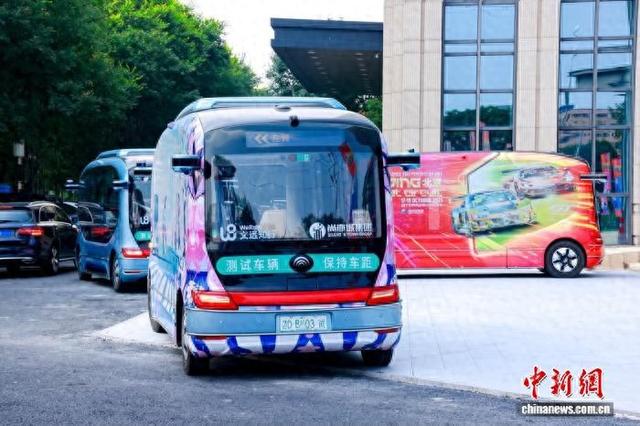
自动驾驶小巴“驶入”多元场景 成北京亦庄“科技名片”
Zhong Guo Xin Wen Wang· 2025-09-05 14:09
Core Insights - Beijing Yizhuang is exploring market-oriented operations for L4 level autonomous minibuses, expanding their application scenarios beyond industrial tourism and education to include commuter services and event support [1][4]. Group 1: Autonomous Minibus Operations - Eight L4 autonomous minibuses have been deployed in various application scenarios, including commuter services and customized travel [1]. - The autonomous minibus service has opened six commuter routes, operating over 400 trips and accumulating more than 5,000 kilometers in travel distance [2]. - The service has become a significant feature at large events, attracting over 1,000 experience participants [2]. Group 2: Educational Integration - A mobile classroom initiative has been launched in collaboration with Beijing Economic Development Zone Party School, featuring two dedicated routes and courses that integrate technology with education [4]. - The initiative aims to create a "smart party building" environment, enhancing the educational experience through technology [4]. Group 3: Market Potential and Future Plans - The operational data indicates the feasibility of the business model for autonomous minibuses, particularly in dynamic response transportation services [5]. - Future plans include enhancing the information system for full digital management to contribute to urban smart travel solutions [7].

小马智行与卡塔尔国家运输公司达成合作,在多哈开展Robotaxi道路测试
Xin Lang Cai Jing· 2025-09-05 10:29
9月5日,小马智行宣布与卡塔尔国家运输公司(Mowasalat)达成合作,共同推进自动驾驶技术和车辆 在卡塔尔落地。双方目前已在卡塔尔首都多哈开展Robotaxi道路测试。 ...
筹备了很久,下周和大家线上聊一聊~
自动驾驶之心· 2025-09-05 07:50
Core Viewpoint - The article emphasizes the establishment of an online community focused on autonomous driving technology, aiming to facilitate knowledge sharing and networking among industry professionals and enthusiasts [5][12]. Group 1: Community and Activities - The community has over 4,000 members and aims to grow to nearly 10,000 in the next two years, providing a platform for technical exchange and sharing [5][11]. - An online event is planned to engage community members, allowing them to ask questions and interact with industry experts [1][3]. - The community includes members from leading autonomous driving companies and top academic institutions, fostering a collaborative environment [12][20]. Group 2: Technical Focus Areas - The community covers nearly 40 technical directions in autonomous driving, including multi-modal large models, closed-loop simulation, and sensor fusion, suitable for both beginners and advanced learners [3][5]. - A comprehensive learning path is provided for various topics, such as end-to-end autonomous driving, multi-sensor fusion, and world models, to assist members in their studies [12][26]. - The community has compiled resources on open-source projects, datasets, and industry trends, making it easier for members to access relevant information [24][25]. Group 3: Job Opportunities and Networking - The community has established a job referral mechanism with several autonomous driving companies, facilitating connections between job seekers and potential employers [8][54]. - Members can freely ask questions regarding career choices and research directions, receiving guidance from experienced professionals [54][57]. - Regular discussions with industry leaders are held to share insights on the development trends and challenges in autonomous driving [57][59].

海外Robotaxi支付意愿或较强,国内关注To-B RoboX放量 | 投研报告
Zhong Guo Neng Yuan Wang· 2025-09-03 07:08
Core Insights - The report highlights the convergence of Robotaxi technology with passenger vehicles, indicating that Waymo is developing its VLA/world model based on Gemini, while Tesla's FSDV13 shows a significant gap in performance compared to Waymo [1][2] - In high purchasing power markets, the willingness to pay for Robotaxi services is stronger than for traditional ride-hailing services, with Waymo users prioritizing safety and showing lower price sensitivity [2] - Domestic markets may still view Robotaxi as a substitute for traditional taxis, while in regions like the Middle East, Europe, and North America, there is potential for high-end demand for Robotaxi services [2] Investment Highlights - The report suggests that the domestic To-B solutions, such as RoboTruck, RoboVan, RoboBus, and Robosweeper, may see faster commercialization compared to To-C Robotaxi due to the clear cost-reduction needs of businesses [2] - Companies that could benefit from the overseas Robotaxi market and the acceleration of domestic To-B solutions include WeRide, Pony.ai, Horizon Robotics, Black Sesame Technologies, Jingwei Hirain, and Desay SV [3] Technical Developments - The report emphasizes the need to monitor Tesla's V14 version experience and the performance of Robotaxi operations after removing safety drivers and opening to the public, as this could significantly impact the competitive landscape [1][2]

理想汽车-W(02015):8月销量承压,期待i6上市
Guosen International· 2025-09-02 11:03
Investment Rating - The report maintains a "Buy" rating for the company, with a target price adjusted from 140 HKD to 125 HKD, corresponding to a projected P/E ratio of 22.9 times for 2026 [1][3][6]. Core Insights - The company's August sales were 29,000 units, representing a year-on-year decline of 39.7% and a month-on-month decrease of 7.2%. Cumulatively, sales for the first eight months reached 263,000 units, down 8.6% year-on-year. The management expects third-quarter deliveries to be between 90,000 and 95,000 units, with September sales projected at 31,000 to 36,000 units, driven by the new i8 model [2][3]. - The second-quarter performance met expectations, with revenue of 30.2 billion RMB, a year-on-year decrease of 5% but a quarter-on-quarter increase of 17%. The gross margin was 20.1%, with automotive sales gross margin at 19.4%, showing a year-on-year increase of 0.7 percentage points [2][3]. - The company is set to launch the i6 model, with several strategic adjustments aimed at boosting sales, including optimizing product SKUs, adjusting channel strategies, and increasing investment in AI technology, with an expected expenditure of over 6 billion RMB in 2025 [3][4]. Summary by Sections Sales Performance - August sales were 29,000 units, down 39.7% year-on-year and 7.2% month-on-month. Cumulative sales for the first eight months were 263,000 units, down 8.6% year-on-year. The management anticipates third-quarter deliveries of 90,000 to 95,000 units, with September sales expected to be between 31,000 and 36,000 units, primarily driven by the i8 model [2][3]. Financial Performance - The second-quarter revenue was 30.2 billion RMB, a 5% decline year-on-year but a 17% increase quarter-on-quarter. The gross margin was 20.1%, with automotive sales gross margin at 19.4%, reflecting a year-on-year increase of 0.7 percentage points [2][3]. Strategic Initiatives - The company plans to launch the i6 model and has made several strategic adjustments to enhance sales, including optimizing product SKUs, adjusting channel strategies, and increasing AI investment, with a projected expenditure of over 6 billion RMB in 2025 [3][4].
