
资产证券化

Search documents
利好来了,证监会大动作,就重要新规征求意见
2 1 Shi Ji Jing Ji Bao Dao· 2025-11-29 02:21
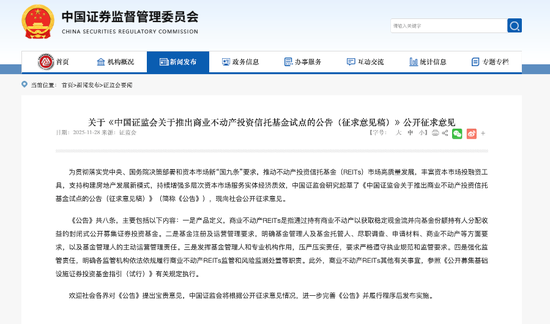
Core Viewpoint - The announcement of the pilot program for Commercial Real Estate Investment Trusts (REITs) marks a significant innovation in China's capital market, aiming to connect commercial real estate with the capital market and provide standardized solutions for revitalizing trillions of yuan in existing assets [3][4]. Group 1: Pilot Program Overview - The pilot program is a key transition from infrastructure REITs to commercial real estate, aligning with the new "National Nine Articles" to promote high-quality development of the REITs market [3]. - The program aims to provide a new equity financing channel for the commercial real estate sector and transform the operational model of real estate development [3][6]. Group 2: Institutional Design - The pilot program features a comprehensive institutional design that establishes a market-oriented and standardized operational system, emphasizing the active management of REITs [4][5]. - The definition of commercial real estate REITs highlights their equity nature and the requirement for professional management to create value through operations [4]. - The program sets clear asset quality standards, ensuring that only properties with stable cash flows and clear ownership can be included [4]. Group 3: Market Impact - The introduction of commercial real estate REITs is expected to unlock dormant assets in prime urban areas, providing a new financing avenue for companies holding substantial commercial properties [6][7]. - REITs will shift the operational logic of commercial real estate from a focus on sales to a focus on management, enhancing property value through improved operational capabilities [7]. - The REITs model is anticipated to inject new vitality into the capital market, appealing to long-term investors such as insurance funds and pension funds due to its stable returns [7][8]. Group 4: Future Development and Opportunities - The development of commercial real estate REITs is based on five years of experience with infrastructure REITs, following a path from infrastructure to commercial real estate [8]. - The market is prepared for implementation, with exchanges revising rules and fund companies forming specialized teams [8]. - Successful implementation of the pilot program will require supportive policies, including tax and state-owned asset transfer regulations, to create a conducive environment for REITs [9].

利好来了,证监会大动作,就重要新规征求意见
21世纪经济报道· 2025-11-29 02:19
Core Viewpoint - The introduction of the commercial real estate REITs pilot program marks a significant breakthrough in China's capital market, aiming to connect commercial real estate with the capital market and provide standardized solutions for revitalizing trillions of yuan in existing assets [1] Group 1: Institutional Design - The pilot program establishes a market-oriented and standardized operational system, defining commercial real estate REITs as public funds that invest in commercial real estate asset-backed securities to obtain ownership or operational rights [2][3] - The announcement emphasizes the importance of clear asset ownership and stable cash flow for the assets held by the REITs, ensuring quality through a "safety filter" for investors [2] - A multi-layered responsibility system is constructed, involving the CSRC for regulation, exchanges and industry associations for self-regulation, and fund managers for operational management, ensuring market vitality while maintaining risk control [3] Group 2: Revitalizing Existing Assets - The pilot program coincides with a critical turning point in China's commercial real estate development, providing a new financing channel for companies holding substantial commercial properties [4] - REITs allow developers to achieve asset securitization without losing operational rights, effectively converting large amounts of capital tied in real estate into liquid capital, thus improving cash flow [4] - The introduction of REITs is expected to transform the operational logic of commercial real estate, pushing managers to enhance operational capabilities and property value through refined management practices [5] Group 3: Future Development and Market Opportunities - The development of commercial real estate REITs is based on five years of experience from infrastructure REITs, following a path from infrastructure to commercial real estate [6] - Market participants are prepared for implementation, with exchanges revising supporting rules and fund companies forming specialized teams [7] - The complementary relationship between commercial real estate REITs and infrastructure REITs will enhance the overall REITs market ecosystem in China [7] - The potential for new asset classes, such as logistics and data centers, to be listed through REITs presents additional investment opportunities [7] - Successful pilot implementation will require coordinated support from related policies, including tax and state-owned asset transfer regulations, to create a favorable environment for REITs market development [8]

白云山(00874)向兴证资管出售第五次新增基础资产
智通财经网· 2025-11-28 08:57
智通财经APP讯,白云山(00874)发布公告,于2025年11月28日,广州医药与兴证资管根据基础资产买卖 协议(第四期)签订《新增基础资产交割确认函》,确认向兴证资管出售第五次新增基础资产(其为账面值 人民币4.42亿元的应收账款),并收到购买价款人民币4.4亿元。 广州医药通过该等交易项下的交易利用应收账款进行资产证券化,可以将应收账款转变为流动性较高的 现金资产,达到盘活资产存量的目的。鉴于上述原因及本公告所披露的该等交易的条款,董事会认为该 等交易的条款属公平合理,符合本集团及本公司股东的整体权益。 ...
白云山向兴证资管出售第五次新增基础资产
Zhi Tong Cai Jing· 2025-11-28 08:55
Core Viewpoint - The announcement highlights the sale of receivables by Guangzhou Pharmaceutical to Xingzheng Asset Management, which is part of an asset securitization strategy aimed at enhancing liquidity and optimizing asset utilization [1] Group 1: Transaction Details - Guangzhou Pharmaceutical confirmed the sale of receivables with a book value of RMB 442 million to Xingzheng Asset Management, receiving a purchase price of RMB 440 million [1] - This transaction is part of the fourth phase of a foundational asset sale agreement, indicating a structured approach to asset management [1] Group 2: Strategic Implications - The transaction allows Guangzhou Pharmaceutical to convert receivables into cash, thereby improving liquidity and enabling better asset management [1] - The board of directors considers the terms of the transaction to be fair and reasonable, aligning with the overall interests of the company and its shareholders [1]
白云山(00874.HK)附属广州医药拟4.4亿元出售应收账款
Ge Long Hui· 2025-11-28 08:47
Core Viewpoint - The company, Baiyunshan (00874.HK), has announced a transaction involving the sale of additional underlying assets to Xingzheng Asset Management for a total purchase price of RMB 440,280,622.20, aimed at enhancing liquidity through asset securitization [1] Group 1: Transaction Details - Baiyunshan's non-wholly owned subsidiary, Guangzhou Pharmaceutical, signed a "New Underlying Asset Delivery Confirmation" with Xingzheng Asset Management based on the asset sale agreement (Phase IV) [1] - The transaction involves the sale of the fifth batch of additional underlying assets, confirming the financial terms and conditions of the deal [1] Group 2: Financial Implications - The transaction allows Guangzhou Pharmaceutical to utilize accounts receivable for asset securitization, converting receivables into more liquid cash assets [1] - The board of directors considers the terms of the transaction to be fair and reasonable, aligning with the overall interests of the group and its shareholders [1]
企业资产支持证券产品报告(2025年10月):发行规模环比收缩,融资成本下行态势趋缓,二级市场活跃度环比走低但同比仍呈提升趋势
Zhong Cheng Xin Guo Ji· 2025-11-28 06:01
Group 1: Report Summary - The report focuses on the enterprise asset-backed securities (ABS) products in October 2025, covering issuance, filing, secondary market trading, and maturity situations [4]. Group 2: Industry Investment Rating - There is no information about the industry investment rating provided in the report. Group 3: Core Viewpoints - In October 2025, the issuance scale of enterprise ABS shrank month - on - month, the downward trend of financing cost slowed, the secondary market activity decreased month - on - month but still showed an upward trend year - on - year [4]. Group 4: Issuance Situation - In October 2025, 105 enterprise ABS were issued, with a total scale of 95.087 billion yuan. The number decreased by 85 and the scale dropped by 42.19% month - on - month, while the number increased by 10 and the scale rose by 21.47% year - on - year [4][5]. - The top five original equity holders in terms of issuance scale were China Pacific Life Insurance Co., Ltd., Huaneng Guocheng Trust Co., Ltd., China CITIC Financial Asset Management Co., Ltd., Shenzhen Zhongrong Micro - loan Co., Ltd., and China Foreign Economic and Trade Trust Co., Ltd., with a total scale of 25.375 billion yuan, accounting for 26.69% [6]. - The top five managers in terms of new management scale were CITIC Securities Co., Ltd., CITIC Construction Investment Securities Co., Ltd., Huatai Securities (Shanghai) Asset Management Co., Ltd., Ping An Securities Co., Ltd., and Shanghai Guotai Haitong Securities Asset Management Co., Ltd., with a total scale of 56.361 billion yuan, accounting for 59.27% [6]. - The underlying asset types mainly included personal consumer finance, enterprise financial leasing, accounts receivable, micro - loans, and policy - pledged loans [4]. - The interest rate center of AAAsf - rated securities with a maturity of about one year was approximately between 1.80% - 2.00%, with the median unchanged month - on - month and a year - on - year decrease of about 47BP [4]. Group 5: Filing Situation - In October 2025, 130 enterprise ABS were filed with the Asset Management Association of China, with a total scale of 135.031 billion yuan [4][22]. Group 6: Secondary Market Trading Situation - In October 2025, there were 3,463 transactions of enterprise ABS in the exchange market, with a total turnover of 81.889 billion yuan. The number of transactions decreased by 549 month - on - month and increased by 659 year - on - year, and the turnover decreased by 23.47% month - on - month and increased by 34.63% year - on - year [4][23]. - The more active underlying asset types in the secondary market were REIT - like products, accounts receivable, CMBS, personal consumer finance, and enterprise financial leasing, with turnover accounting for 29.56%, 12.71%, 11.51%, 11.13%, and 8.52% respectively [23]. Group 7: Maturity Situation - In November 2025, 387 outstanding enterprise ABS were due, with a total scale of 91.943 billion yuan [4][25]. - The main underlying asset types of the due ABS were accounts receivable, supply chain, personal consumer finance, and policy - pledged loans, with due scales accounting for 44.48%, 22.92%, 9.45%, and 4.89% respectively [25]. - The top three original equity holders in terms of due scale were China Railway Capital Co., Ltd., China Railway Construction Commercial Factoring Co., Ltd., and Shenzhen Qianhai Lianyirong Commercial Factoring Co., Ltd., with due scales accounting for 15.37%, 7.53%, and 5.57% respectively [25].
重庆:深化企业上市“千里马”行动,推动上市公司并购重组和再融资
Ge Long Hui· 2025-11-28 05:27
格隆汇11月28日|重庆市人民政府印发《重庆市要素市场化配置综合改革试点行动方案》,其中提出, 加快发展资本市场。深化企业上市"千里马"行动,开展"认股权+"业务模式创新,推动上市公司并购重 组和再融资。强化投资和融资相结合的资本市场功能,以市场化方式有序推进资产证券化。优化基础设 施不动产投资信托基金(REITs)项目全链条服务,通过信用承诺、容缺受理、后置核验等方式开辟绿色 服务通道。 ...
山东高速股份有限公司2025年第三季度业绩说明会纪要
Shang Hai Zheng Quan Bao· 2025-11-27 19:20
Core Viewpoint - The company held a Q3 2025 earnings briefing to address investor concerns regarding its financial performance and future projects, highlighting both challenges and strategic responses in its operations [1][3]. Group 1: Financial Impact and Revenue - The revenue from the Weilai Expressway is expected to decrease by 345 million yuan in 2025 due to the cessation of tolls after its completion in October 2024 [3]. - The Jihe Expressway saw a significant revenue increase of 178.59% year-on-year due to the restoration of two-way traffic, while the Jingtai Expressway experienced a revenue decline of 7.94% primarily due to the expiration of tolls on a connecting line [3]. Group 2: Project Progress and Challenges - The Jingtai Expressway project is progressing normally, with 97.5% of the roadbed completed, although building and electromechanical works lag behind at 57% and 50% respectively, which will not affect the planned opening [3]. - The company is exploring measures such as "highway + cultural tourism" and customized services to enhance overall road network utilization [3]. Group 3: Innovation and R&D - The company is focusing on "smart highways" and "green low-carbon" technologies, although its R&D expense ratio is currently at 1.76% [4]. - Innovations in infrastructure digital transformation and all-weather traffic are already contributing to cost reduction and efficiency improvements [4]. Group 4: Capital Structure and Shareholder Returns - The company has experienced high capital expenditures and rising debt levels due to extensive infrastructure projects since 2016, but plans to gradually reduce its debt ratio as projects are completed and operational [4]. - Future strategies may include asset securitization or attracting strategic investors to optimize the capital structure [4]. Group 5: Profitability and Margin Management - The gross profit margin increased by 4.8 percentage points to 31.09% year-on-year, mainly due to a reduction in low-margin PPP construction revenue [5]. - The company aims to maintain profitability by focusing on core operations and exploring new profit growth points within the industry [5].

百亿并购重组,国家电投整合煤电铝资产,旗下“煤炭航母”浮出水面
3 6 Ke· 2025-11-27 04:00
Core Viewpoint - The asset restructuring valued at 11.149 billion yuan is part of State Power Investment Corporation's strategy to build a coal-electricity-aluminum empire in Inner Mongolia, enhancing its operational efficiency and market position [1][2]. Group 1: Asset Restructuring Details - State Power Investment Corporation plans to acquire 100% equity of Baiyinhu Coal Power Co., Ltd. from its controlling shareholder, Inner Mongolia Energy Co., Ltd., for a total price of 11.149 billion yuan [1]. - The acquisition will be financed through a combination of share issuance and cash payment, along with a fundraising plan of up to 4.5 billion yuan for ongoing projects and working capital [1][2]. - Post-acquisition, the coal production capacity will increase to 63 million tons per year, and aluminum production capacity will exceed 1.26 million tons [2]. Group 2: Strategic Implications - The restructuring is part of a broader strategic adjustment by State Power Investment Corporation, focusing on specialized operations across its listed platforms [2]. - Other subsidiaries are also undergoing transformations, such as Yuanda Environmental Protection acquiring hydropower assets and shifting focus to nuclear power [2]. - The integration aims to create a closed-loop system where coal is converted to aluminum on-site, significantly reducing production costs by 2,300 yuan per ton compared to market prices [2][3]. Group 3: Financial Impact - The acquisition is expected to increase the total assets of State Power Investment Corporation from 54.979 billion yuan to 80.079 billion yuan, with projected revenue growth from 14.464 billion yuan to 19.942 billion yuan by mid-2025 [4]. - Analysts estimate that the transaction could enhance the annual net profit attributable to shareholders by approximately 1.867 billion yuan [5]. - However, Baiyinhu Coal Power Co., Ltd. has a high debt level, with total liabilities reaching 16.9 billion yuan and a debt ratio of 67% as of mid-2025, raising concerns about financial stability [5][6]. Group 4: Industry Trends - The merger reflects an accelerating trend of asset securitization in the power industry, with state-owned enterprises increasingly optimizing their asset structures [7]. - The focus has shifted from merely filling funding gaps to strategically enhancing asset structures, particularly in the renewable energy sector [7]. - The restructuring also indicates a renewed recognition of the value of traditional energy sources, as coal prices stabilize and the role of coal in the new power system is reassessed [7].

广东发布金融支持产业链整合兼并方案 探索将并购重组、资产盘活等纳入国企考核体系
Shang Hai Zheng Quan Bao· 2025-11-26 18:28
Core Viewpoint - The Guangdong Provincial Financial Management Bureau has launched an "Action Plan" to support enterprises in optimizing their industrial chain layout through mergers and acquisitions, aiming to enhance the competitiveness and quality of the industrial chain [1][2]. Group 1: Financial Support for Industrial Chain Integration - The "Action Plan" emphasizes the importance of financial empowerment for the collaborative development of upstream and downstream enterprises in the industrial chain, focusing on directing financial resources to key areas of integration and mergers [2][3]. - The plan aims to create a world-class industrial cluster by 2027, enhancing the advantages of the Guangdong-Hong Kong-Macao Greater Bay Area and improving the efficiency of integration services [2]. Group 2: Encouragement of Mergers and Acquisitions - The plan encourages listed companies to utilize various payment tools, such as shares and convertible bonds, to facilitate mergers and acquisitions, thereby attracting more social capital and enhancing sustainable development capabilities [3][4]. - It supports the establishment of industrial merger funds by listed companies, focusing on critical upstream and downstream segments of the industrial chain [3]. Group 3: Capital Market Development - The "Action Plan" promotes the improvement of comprehensive service platforms for enterprise listings and encourages technology-driven companies to list on the Growth Enterprise Market and Science and Technology Innovation Board [4]. - Guangdong's capital market has seen significant activity in mergers and acquisitions, with over 100 transactions completed in the past year, amounting to nearly 1,000 billion [4]. Group 4: State-Owned Enterprise Resource Integration - The plan includes measures to integrate quality resources within state-owned enterprises, exploring the inclusion of mergers and asset revitalization in their performance evaluation systems [5][6]. - It highlights the importance of using existing financing platforms for asset restructuring and equity swaps to enhance asset securitization levels [6]. Group 5: Recent Mergers and Acquisitions Examples - Notable recent mergers include Guangdong Hongda's acquisition of Xinjiang-listed company Xuefeng Technology for 2.2 billion, enhancing its production capacity [6]. - Another example is the acquisition of Hong Kong-listed company Yuefeng Environmental by Hanlan Environment for 11.1 billion HKD, expanding its operations across 54 cities [6].