
云业务

Search documents
瑞银:内地电讯商增值税调高 料中国移动、中国电信及中国联通盈利受9%、18%及逾18%影响
Zhi Tong Cai Jing· 2026-02-03 03:58
Core Viewpoint - UBS reports that the recent VAT adjustment by China's three major telecom operators will have a significant negative impact on their profitability, as the affected services account for 45% to 60% of their projected service revenue for 2025 [1] Group 1: VAT Adjustment Impact - The VAT rate for mobile data, SMS/MMS, and internet broadband services will increase from 6% to 9% starting January 1 of this year [1] - The service revenue of telecom operators is expected to be impacted by approximately 1.5% to 2% due to this VAT adjustment [1] Group 2: Profitability Forecast - Assuming a corporate income tax rate of 25% and not considering other costs or tax deductions, the net profit impact for China Mobile, China Telecom, and China Unicom is estimated to be around 9%, 17.9%, and 18.2% respectively for 2025 [1] Group 3: Strategic Response - The three major telecom operators will continue to enhance operational efficiency, focus on high-quality development, and accelerate their transformation towards emerging fields such as artificial intelligence and cloud services to mitigate the impact of the tax rate increase [1]




瑞银:内地电讯商增值税调高 料中国移动(00941)、中国电信(00728)及中国联通(00762)盈利受9%、18%及逾18%影响
智通财经网· 2026-02-03 03:49
Core Viewpoint - UBS reports that the recent VAT adjustment announced by China's three major telecom operators will have a significant negative impact on their profitability, as the affected services account for 45% to 60% of their projected service revenue for 2025 [1] Group 1: VAT Adjustment Impact - The VAT rate for mobile data, SMS/MMS, and internet broadband services will increase from 6% to 9% starting January 1 of this year [1] - The adjustment is expected to reduce service revenue for telecom operators by approximately 1.5% to 2% [1] Group 2: Profitability Forecast - Assuming a corporate income tax rate of 25% and not considering other costs or tax deductions, the net profit impact for the three major telecom operators by 2025 is estimated to be around 9% for China Mobile, 17.9% for China Telecom, and 18.2% for China Unicom [1] Group 3: Strategic Response - The three major telecom operators plan to enhance operational efficiency, focus on high-quality development, and accelerate transformation into emerging fields such as artificial intelligence and cloud services to mitigate the impact of the tax rate increase [1]
瑞银:内地电讯商增值税调高,预计中国移动、中国电信及联通盈利受9%、18%及逾18%影响
Ge Long Hui A P P· 2026-02-02 07:23
Core Viewpoint - UBS reports that the recent VAT adjustment by China's three major telecom operators will have a significant negative impact on their profitability, as the affected services account for 45% to 60% of their projected service revenue for 2025 [1] Group 1: VAT Adjustment Impact - The VAT rate for mobile data, SMS/MMS, and internet broadband services will increase from 6% to 9% starting January 1, 2023 [1] - The adjustment is expected to reduce service revenue for telecom operators by approximately 1.5% to 2% [1] Group 2: Profitability Forecast - Assuming a corporate income tax rate of 25% and not considering other costs or tax deductions, the net profit impact for China Mobile, China Telecom, and China Unicom is estimated to be around 9%, 17.9%, and 18.2% respectively for 2025 [1] Group 3: Strategic Response - The three major telecom operators plan to enhance operational efficiency, focus on high-quality development, and accelerate transformation into emerging fields such as artificial intelligence and cloud services to mitigate the impact of the tax rate increase [1]
甲骨文计划年内筹资至高500亿美元加码云业务投资
Xin Lang Cai Jing· 2026-02-01 23:57
Core Viewpoint - Oracle plans to raise between $45 billion to $50 billion by 2026 through a combination of debt and equity financing to expand its cloud infrastructure capacity [1] Group 1: Financing Strategy - The company aims to raise half of the target amount through equity-linked instruments and common stock issuance, including mandatory convertible preferred stock and an ATM stock issuance plan of up to $20 billion [1] - The remaining funds will be raised through a single bond issuance planned for early 2026 [1] Group 2: Client Demand - Oracle is raising funds to meet the contractual demands of its largest cloud infrastructure clients, which include AMD, Meta, NVIDIA, OpenAI, TikTok, and xAI [1]

微软(MSFT.US)FY26Q2电话会:云业务收入首次突破500亿美元 Q3资本支出预计环比下降
Zhi Tong Cai Jing· 2026-01-30 01:22
Core Insights - Microsoft reported Q2 FY26 revenue of $81.3 billion, a 17% year-over-year increase, with operating income up 21% and adjusted EPS at $4.14, reflecting a 24% increase [1] - Cloud revenue surpassed $50 billion for the first time, reaching $51.5 billion, a 26% increase year-over-year [1] - The company’s commercial order volume grew by 230% year-over-year, driven by significant long-term commitments from clients like OpenAI [1] Financial Performance - Q2 revenue: $81.3 billion, up 17% YoY (15% at constant currency) [1] - Operating income: up 21% YoY (19% at constant currency) [1] - Adjusted EPS: $4.14, up 24% YoY (21% at constant currency) [1] - Cloud revenue: $51.5 billion, up 26% YoY (24% at constant currency) [1] - Gross margin: 67% [1] Business Outlook - Q3 revenue forecast: $80.65 billion to $81.75 billion, a 15%-17% YoY increase [1] - Expected cost of revenue: $26.65 billion to $26.85 billion, a 22% YoY increase [1] - Anticipated operating expenses: $17.8 billion to $17.9 billion, a 10%-11% YoY increase [1] - Capital expenditures expected to decrease quarter-over-quarter due to normal fluctuations in cloud infrastructure construction [1] Strategic Focus - The company’s strategy emphasizes three layers of technology stack: cloud and token factory, agent platform, and superior agent experience [2] - The impact of AI on GDP and Total Addressable Market (TAM) growth is just beginning [2] - The agent platform is seen as the next generation of application platforms, requiring various services for deployment and management [2] Capital Expenditure and ROI - CapEx growth is driven by long-term demand, with investments aimed at supporting applications like M365 Copilot and GitHub Copilot [3] - Azure's growth guidance is linked to capacity allocation rather than immediate revenue [3] - The average contract duration for RPO has increased from 2 years to 2.5 years, indicating a more stable revenue outlook [3] OpenAI Partnership - Approximately 45% of the unfulfilled orders (RPO) are related to OpenAI, with the remaining 55% reflecting a diverse business portfolio [4][5] - The partnership with OpenAI is viewed positively, contributing to Microsoft's leadership in technology and application innovation [5] Capacity Expansion - The company is focused on increasing capacity globally, with significant projects in Atlanta and Wisconsin [6] - Long-term infrastructure development is prioritized to ensure efficient deployment of GPU and CPU resources [6] Chip Development - The Maia 200 accelerator shows significant performance improvements, enhancing Microsoft's competitive edge in AI workloads [6] - Continuous innovation in chip design and system optimization is crucial for maintaining cost advantages [7] Client Transformation - Clients adopting Microsoft’s AI technology stack are experiencing transformative benefits, with potential for increased spending as they become "frontier firms" [8] - The deployment of agents is changing how companies coordinate work, leading to greater impact [8] Cloud Migration Trends - Ongoing cloud migration is evident, with services like SQL Server on Azure showing growth [9] - The need for a balanced approach between commercial cloud and AI cloud is emphasized as clients migrate workloads [9]

微软资本支出创历史新高
Shang Hai Zheng Quan Bao· 2026-01-29 08:56
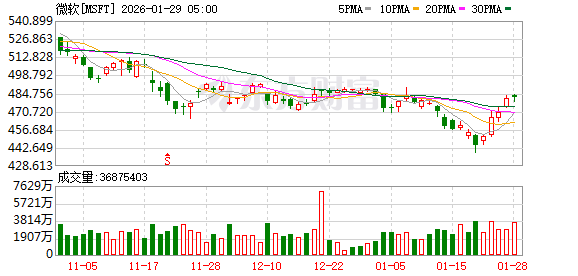
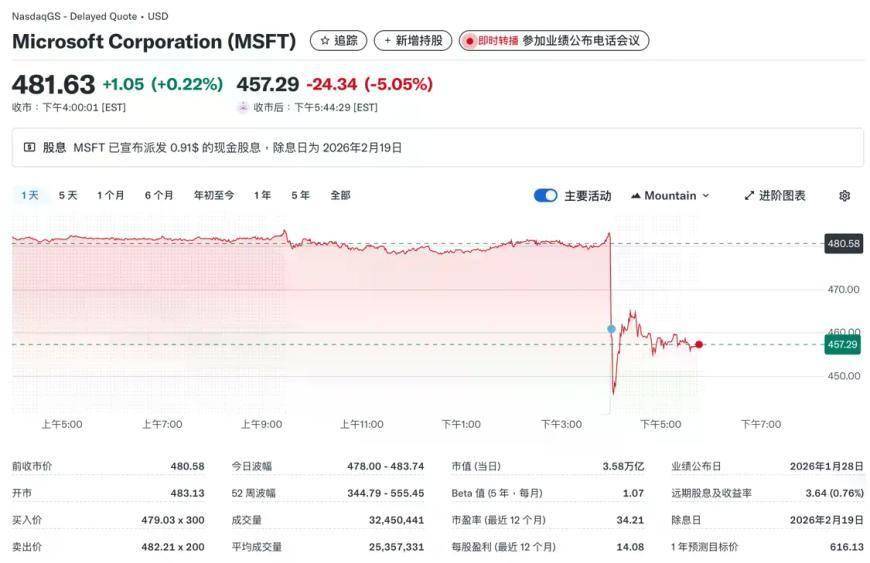
Core Insights - Microsoft reported strong financial results for Q2 of FY2026, with revenue of $81.3 billion, a 17% year-over-year increase, and net income of $38.5 billion, reflecting a 60% increase [2] - The cloud business revenue surpassed $50 billion, indicating robust demand for Microsoft's service offerings [2][4] - Despite exceeding expectations, Microsoft's stock price fell approximately 7% post-earnings release [2] Financial Performance - Revenue: $81.3 billion, up 17% year-over-year [2] - Operating Income: $38.3 billion, up 21% year-over-year [2] - GAAP Net Income: $38.5 billion, up 60% year-over-year [2] - Non-GAAP Net Income: $30.9 billion, up 23% year-over-year [2] - Earnings per Share: $5.16, with $1.02 attributed to OpenAI-related earnings [6] Cloud Business Insights - Cloud revenue reached $51.5 billion, a 26% year-over-year increase, with Azure and other cloud services growing by 39% [4][6] - The backlog of cloud contracts doubled year-over-year to $625 billion, with 45% of this attributed to OpenAI [7] - The growth rate of cloud business has slightly slowed, down about 1% from the previous quarter [4] AI and OpenAI Impact - Microsoft's performance is significantly influenced by its partnership with OpenAI, with $7.6 billion of net income derived from OpenAI-related earnings [6] - The company is integrating AI tools powered by OpenAI into its products, aiming to enhance productivity software and cloud service sales [6] - The future sales potential is bolstered by a new $250 billion agreement with OpenAI, reflecting a strong reliance on AI for growth [7]

微软第二财季净利润384.58亿美元,同比增长60%
Sou Hu Cai Jing· 2026-01-29 01:57
Core Viewpoint - Microsoft reported strong financial results for Q2 of FY2026, with significant revenue and profit growth, but faced a decline in stock price due to slowing cloud business growth [1][2]. Financial Performance - Total revenue for Q2 was $81.273 billion, a 17% increase from $69.632 billion year-over-year, with a 15% increase when adjusted for constant currency [1][5]. - Net profit reached $38.458 billion, up 60% from $24.108 billion year-over-year, with a 57% increase on a constant currency basis [1][5]. - Diluted earnings per share were $5.16, a 60% increase from $3.23 year-over-year, with a 58% increase when adjusted for constant currency [5]. Segment Performance - Cloud revenue amounted to $51.5 billion, a 26% year-over-year increase, with a 24% increase on a constant currency basis [5]. - Productivity and Business Processes revenue was $34.1 billion, up 16% year-over-year, with LinkedIn revenue growing 11% [5]. - Intelligent Cloud revenue reached $32.9 billion, a 29% increase year-over-year, with Azure and other cloud services growing 39% [5]. - More Personal Computing revenue was $14.3 billion, a 3% decline year-over-year, although Windows OEM and devices revenue grew by 1% [5]. Shareholder Returns - Microsoft returned $12.7 billion to shareholders through dividends and stock buybacks, a 32% increase year-over-year [5].
独家|马化腾点评豆包手机和阿里千问,称自家游戏“强得可怕”
Di Yi Cai Jing· 2026-01-26 11:48
Core Insights - Tencent's gaming business is described as "strong to a terrifying degree," indicating robust performance and growth potential [10] - The cloud business has achieved scale profitability, marking a significant turnaround from previous challenges [10] - AI remains a key focus for Tencent, with ongoing investments and strategic integration across its platforms [6][7] Group 1: Business Performance - Tencent's cloud business has turned around and is now profitable, with CSIG revenue exceeding 37 billion yuan and a gross margin above 30% [10] - The gaming segment, previously criticized for complacency, has shown remarkable growth, with over 30% of IEG's revenue coming from overseas, totaling over $10 billion [10] - Tencent Music Entertainment's market value fluctuated, briefly surpassing Baidu's, but has since declined to around $20 billion, highlighting the need for caution in navigating market cycles [11] Group 2: Strategic Focus - Tencent is prioritizing AI integration across its services, with a focus on decentralized AI applications within WeChat to enhance user experience while maintaining privacy [7][8] - The company is adopting a collaborative approach to product development, emphasizing co-design and integration of AI capabilities [6] - Tencent's strategy includes a commitment to high-quality content in its video and news segments, aiming to improve user engagement and efficiency [10]


阿里巴巴-W再涨超4% 淘宝闪购声明坚决维护行业公平有序竞争
Zhi Tong Cai Jing· 2026-01-12 04:04
Core Viewpoint - Alibaba-W (09988) saw a rise of over 4%, closing at HKD 152.8 with a trading volume of HKD 12.93 billion, indicating positive market sentiment towards the company amid ongoing regulatory developments in the industry [1] Group 1: Regulatory Environment - On January 9, the State Council's Anti-Monopoly and Anti-Unfair Competition Committee announced an investigation into the market competition status of the food delivery platform service industry [1] - Taobao Flash Purchase announced its commitment to cooperate with the industry market competition investigation and to strictly implement compliance responsibilities [1] Group 2: Company Performance and Outlook - CITIC Securities maintained a "Buy" rating for Alibaba, highlighting the company's increased investment in "consumption + AI" and accelerated development of its cloud business [1] - The company is focusing on AI and international expansion, with a significant investment of HKD 380 billion in infrastructure to enhance its global competitiveness [1] - While the e-commerce segment remains stable, growth is slowing; however, losses in Flash Purchase are narrowing, and it holds the top market share [1] - The long-term dual-core driving logic for Alibaba is clear, with controllable investment pace, indicating strong long-term value potential [1]

阿里巴巴-W(09988):更新报告:阿里千问破局,云业务利润率提升可期
ZHESHANG SECURITIES· 2026-01-05 09:37
Investment Rating - The investment rating for Alibaba is "Buy" [5] Core Insights - Alibaba's cloud business is expected to see a significant improvement in profitability as it scales, with a long-term certainty of margin enhancement [2][39] - The company is currently in a high capital expenditure phase, with Q3 2025 capital expenditures reaching 31.428 billion RMB, a year-on-year increase of 85.12% [2][32] - Despite two consecutive quarters of declining free cash flow, Alibaba maintains a strong cash position with 292.3 billion RMB in net cash and liquid investments [2][34] Summary by Relevant Sections Cloud Business and AI Development - Alibaba's cloud business, while currently lagging behind competitors like AWS and Microsoft in EBITA margin, has the potential for significant margin improvement as it grows [2][37] - The launch of the "Qianwen" AI application has seen rapid user growth, with over 30 million monthly active users within 23 days of its public testing [15][16] - The integration of AI capabilities into Alibaba's ecosystem is expected to enhance user experience and operational efficiency across various platforms [21][23] Financial Forecast and Valuation - Revenue projections for FY2026-2028 are estimated at 1,068.23 billion, 1,177.88 billion, and 1,298.12 billion RMB, with year-on-year growth rates of 7.2%, 10.3%, and 10.2% respectively [3][40] - Adjusted net profit for the same period is forecasted to be 119.85 billion, 160.11 billion, and 213.63 billion RMB, with growth rates of -24.1%, 33.6%, and 33.4% [3][40] - The target price is set at HKD 189.09 per share, based on a 12x PE ratio for FY2027 adjusted net profit and a 7x PS ratio for FY2027 cloud revenue [3][40] Capital Expenditure and Cash Flow - The company is committed to high capital expenditures to ensure competitive supply, with plans to invest 380 billion RMB in cloud and AI infrastructure over the next three years [32] - The recent decline in free cash flow, reported at -21.84 billion RMB for Q3 2025, has raised market concerns, but the company’s cash reserves provide a buffer for new business investments [34][34] Competitive Landscape - The competition in the AI and cloud sectors is intensifying, with Alibaba's Qianwen positioned as a strong contender against other AI applications like Doubao [16][18] - The strategic integration of AI into Alibaba's e-commerce and travel services is expected to redefine user interactions and operational efficiencies [21][26]