计算机

Search documents
中游出口强劲增长——1-2月经济数据前瞻
一瑜中的· 2026-03-03 14:14
Core Viewpoint - The economic performance at the beginning of the year is expected to be strong, particularly in the midstream export sector, benefiting from the global manufacturing upturn, increased AI investment, and higher overseas gross margins compared to domestic ones, leading to stronger export momentum [2] Group 1: External Demand - External demand is resilient, supporting exports, with midstream manufacturing expected to be significantly strong. Exports are projected to grow by around 7% year-on-year in dollar terms for January-February, while imports are expected to increase by around 9% [4] - Key indicators include: - January's JPMorgan Global Manufacturing PMI at 50.9%, up from 50.4% in December [4] - February's average manufacturing PMI for the US, EU, UK, and Japan at 52.08%, higher than January's 51.3% and December's 50.3% [4] - Combined export growth for Japan, South Korea, Vietnam, and Malaysia reaching 27.7% in January, up from 13.8% in December [4] - Container throughput at Chinese ports increasing by 12.4% year-on-year in the first nine weeks of the year [4] Group 2: Midstream Manufacturing - AI investment demand is expected to significantly boost electronic exports, with South Korea's export growth reaching 31.4% in January, driven by strong demand from AI investments and a surge in storage chip prices, leading to a 115.2% increase in semiconductor and electronic product exports [5] - Machinery and equipment exports are also showing strong performance, with a combined export growth of 45% for Japan, South Korea, Vietnam, and Malaysia in January, significantly up from 16.9% in December [5] Group 3: Domestic Demand - Fixed asset investment (FAI) is expected to slightly rebound to around 2% growth in January-February, primarily driven by increased investment from central and state-owned enterprises [6] - Retail sales are projected to grow at around 2.4%, with essential consumption (excluding six subsidized items and price changes) growing at 5.0%, while subsidized items are expected to decline by 8.0% [6] - Industrial production growth is estimated at around 5.5%, supported by strong freight activity, with highway freight truck traffic showing a year-on-year increase of 5.6% [6] Group 4: Price Trends - February's Consumer Price Index (CPI) is expected to rise by approximately 0.5% month-on-month, with a year-on-year increase from 0.2% to around 0.9% [8] - Producer Price Index (PPI) is projected to show a month-on-month increase of about 0.1%, with a year-on-year improvement from -1.4% to around -1.2% [8] Group 5: Financial Sector - New social financing is expected to reach approximately 1.2 trillion yuan in February, a decrease of 880 billion yuan compared to the same period last year, with the stock growth rate expected to fall to around 7.9% [9] - M2 is projected to grow by around 8.8% year-on-year, while new M1 is expected to grow by around 4% [9]


1-2月经济数据前瞻:中游出口强劲增长
Huachuang Securities· 2026-03-03 07:07
External Demand - Export growth is expected to be around 7% year-on-year in USD terms for January-February, while imports are projected to grow by 9%[2] - The global manufacturing PMI for January was 50.9%, up from 50.4% in December, indicating a slight recovery in manufacturing activity[11] - Container throughput at Chinese ports increased by 12.4% year-on-year in the first nine weeks of the year, compared to 10.7% in the same period last year[11] Midstream Manufacturing - AI investment is expected to significantly boost electronic exports, with South Korea's export growth reaching 31.4% in January, up from 13.4% in December[3] - Semiconductor and electronic product exports surged by 115.2% in January, compared to 17.5% in December[12] - Mechanical and electrical equipment exports from Japan, South Korea, Vietnam, and Malaysia grew by 45% in January, a substantial increase from 16.9% in December[3] Domestic Demand - Fixed asset investment (FAI) growth is projected to recover to around 2% for January-February, driven by increased investment from central enterprises[4] - Retail sales growth is expected to be around 2.4%, with essential consumption (excluding subsidies) growing at 5% and subsidized items declining by 8%[4] - Industrial production growth is estimated at 5.5%, supported by strong freight activity, although automotive production may weaken due to subsidy policy adjustments[4] Price Trends - CPI is expected to rise to approximately 0.9% year-on-year in February, up from 0.2% in January, influenced by the timing of the Spring Festival and rising oil prices[5] - PPI is projected to improve slightly to -1.2% year-on-year, compared to -1.4% in January, with the non-ferrous sector stabilizing[5] Financial Indicators - New social financing is expected to be around 1.2 trillion yuan in February, a decrease of 880 billion yuan year-on-year, with the stock growth rate falling to approximately 7.9%[6] - M2 growth is projected at 8.8% year-on-year, while new M1 is expected to be around 4%[6]
地缘局势不稳,恒指恐受压
Guodu Securities Hongkong· 2026-03-02 03:05
Group 1: Market Overview - The Hang Seng Index experienced fluctuations, closing at 26,630.54, up 0.95% on the last trading day of February, but down 2.76% for the month [3] - The index has fallen below key moving averages, indicating potential pressure due to geopolitical tensions, particularly with the U.S.-Iran situation [3] - The trading volume for the day was 288.4 billion HKD, reflecting active market participation despite the overall monthly decline [3] Group 2: Company Performance - China Everbright Water reported a 17.37% decline in annual profit to 842 million HKD, with revenue decreasing by 21.85% to 5.355 billion HKD [11] - The company aims to leverage opportunities in the environmental sector and focus on high-quality development amid China's 14th Five-Year Plan [11] - Baidu's adjusted profit fell by 42%, with its stock price showing volatility, while other tech stocks like Tencent and JD.com had mixed performances [4] Group 3: Industry Dynamics - IDC forecasts a 12.9% decline in global smartphone shipments for the year, marking the largest drop in history, driven by memory chip shortages [9] - The report anticipates that smartphone sales will decrease by 0.5% this year, with a slight recovery expected in 2024 [9] - The ongoing challenges in chip supply are expected to persist, affecting pricing and availability in the second half of the year [9] Group 4: Financial Developments - Bank of China Hong Kong successfully assisted the Indonesian government in issuing offshore RMB and Euro-denominated bonds, totaling approximately 31.1 billion RMB [12][13] - The bond issuance attracted significant interest, with order values reaching 170.4 billion RMB and 94.8 billion Euro, indicating strong market confidence [13] - This issuance is part of a broader strategy to enhance Hong Kong's offshore bond market and facilitate international financing for Indonesia [13]
打造“普罗米修斯”计划:传贝索斯拟募资数百亿美元入局AI工业革命
智通财经网· 2026-02-27 07:04
Core Insights - Jeff Bezos' AI lab is raising hundreds of billions of dollars to acquire industrial companies impacted by AI technology, aiming to capitalize on the transformative potential of this technology [1] - The valuation of the fundraising effort is approximately $30 billion, excluding new investments from this round [1] - Bezos is taking on an operational management role for the first time since stepping down as CEO of Amazon in July 2021, as co-CEO of a startup called "Project Prometheus," which focuses on AI development in engineering, manufacturing, computing, automotive, and aerospace sectors [1] Funding and Partnerships - Project Prometheus is in preliminary discussions with several large sovereign wealth funds, including the Abu Dhabi Investment Authority, for equity investment in its holding company [1] - Bezos is also in talks with Jamie Dimon, CEO of JPMorgan Chase, regarding investment opportunities, potentially utilizing funds from the bank's $10 billion Security and Resiliency Initiative Fund, aimed at strengthening the supply chain of critical U.S. industries [2]

1月份越南贸易逆差近18亿美元
Shang Wu Bu Wang Zhan· 2026-02-13 17:10
Core Insights - In January 2026, Vietnam experienced a trade deficit of nearly $1.8 billion despite a significant increase in exports and imports [1][2] Export Summary - Vietnam's total exports reached $43.19 billion in January 2026, marking a year-on-year increase of 30.13% [1] - Key export categories included computers, electronic products, and components, as well as machinery and tools, both exceeding $1 billion in exports, with growth rates of 57.92% and 40.52% respectively [1] - Foreign Direct Investment (FDI) enterprises accounted for nearly 78% of total exports, amounting to $33.64 billion, which is a 43.32% increase year-on-year [1] - In the electronics, computers, and mobile phone sectors, FDI enterprises contributed to 99% of the export value [1] Import Summary - Vietnam's total imports in January 2026 reached $44.97 billion, reflecting a year-on-year increase of 49.61% [1] - Major import categories included computers, electronic products, and components, with imports growing by 70.82%, and machinery and tools, which increased by 47.11% [1] - FDI enterprises dominated the import structure, accounting for approximately 71.3% of total imports, totaling $32.06 billion, a year-on-year increase of 67.27% [1] - The current value chain structure in Vietnam indicates that domestic companies primarily engage in low-value-added activities such as processing and assembly [1] Trade Balance Summary - In the first half of January, Vietnam faced a significant trade deficit, but a recovery in exports in the latter half led to a surplus of $1.58 billion, resulting in an overall trade deficit of $1.78 billion for the month [2] - The trade balance pressure is attributed to a substantial increase in imports of raw materials and components necessary for manufacturing [2]
1月广州CPI环比上涨0.1%
Guang Zhou Ri Bao· 2026-02-13 07:34
Core Insights - In January, Guangzhou's Consumer Price Index (CPI) increased by 0.1% month-on-month and remained flat year-on-year, indicating stable consumer prices in the region [1] Group 1: Price Changes - Food prices decreased by 0.8%, with 9 out of 14 food categories showing a decline, influenced by favorable weather conditions leading to a 7.7% drop in fresh vegetable prices and a 1.1% decrease in pork prices [1] - Prices in the category of other goods and services rose by 2.4%, driven by fluctuations in international precious metal prices, with jewelry and watches increasing by 13.0%, and specific items like gold jewelry rising by 7.7% [1] - The education, culture, and entertainment category saw a price increase of 0.4%, attributed to a rise in online audio-visual services by 4.6% and increased travel demand leading to a 2.8% rise in other travel prices [1] Group 2: Minor Price Influences - Prices for daily necessities and services increased by 0.6%, while healthcare prices rose by 0.3% and transportation and communication prices went up by 0.2% [2] - Housing prices remained stable, and clothing prices experienced a slight decrease of 0.1% [2]
英伟达(NVDA.US)16年长租协议助推数据中心债券发行,AI基础设施借贷热潮转向“垃圾债”市场
Zhi Tong Cai Jing· 2026-02-12 23:27
Group 1 - Nvidia (NVDA.US) plans to lease a data center funded by $3.8 billion in junk bonds, intensifying the borrowing frenzy around AI infrastructure [1] - A Tract Capital-backed entity will issue bonds to finance part of a 200 MW data center and substation in Story County, Nevada [1] - The bond offering was increased by $150 million, indicating strong market demand, with expected yields around 6% [1] Group 2 - Data center developers have been leveraging the high-yield bond market to fund new facilities, with recent examples including cryptocurrency miners Cipher Mining Inc. and TeraWulf Inc. [1] - Nvidia's initial lease is approximately 16 years, with two options to renew for 10 years each [1] - Tract Capital, managing about $6 billion in assets, launched the "Fleet" strategy to build new data centers for large enterprises, with Fleet I being the first fund [2] Group 3 - The bond proceeds will reduce equity contributions initially estimated at $620 million for the project [2] - The transaction is expected to be priced on Friday, with JPMorgan serving as the lead underwriter and Morgan Stanley as the co-manager [2] - Nvidia operates its own data centers while also leasing space from cloud service providers like Amazon AWS and Microsoft Azure to meet increasing computational demands for AI [2]

2026年1月物价数据点评:“反内卷”与新质生产力发展并进
BOHAI SECURITIES· 2026-02-12 10:11
Group 1: CPI Analysis - In January 2026, the CPI increased by 0.2% year-on-year, a decrease from the previous value of 0.8%[11] - Core CPI's month-on-month growth reached its highest level in six months, driven by increased travel demand and rising international gold prices[4] - Food prices remained stable month-on-month, with fresh vegetable prices decreasing by 4.8%[14] Group 2: PPI Analysis - In January 2026, the PPI's year-on-year decline narrowed, while the month-on-month increase expanded[5] - Prices in the upstream raw materials sector turned from decline to increase due to the "anti-involution" effect, with basic chemical raw materials rising by 0.7%[25] - The month-on-month increase in production materials prices expanded, while living materials prices shifted from stable to rising[25] Group 3: Future Outlook - The CPI is expected to increase in February 2026, influenced by sufficient pig supply and potential price rises in fresh vegetables before the Spring Festival[16] - The PPI is projected to maintain a similar month-on-month increase in February, with a further narrowing of the year-on-year decline to around -1.0%[5] - Input inflation may rise in February, driven by ongoing "anti-involution" and the rapid development of new productive forces[26]
CPI与PPI走势趋于收敛——2026年1月通胀数据解读【陈兴团队·华福宏观】
陈兴宏观研究· 2026-02-12 04:51
Group 1 - Energy and raw material prices are experiencing a phase of decline, with January PPI decreasing by 1.4% month-on-month, a reduction of 5 percentage points compared to the previous month. The prices in the oil and gas extraction industry fell by 16.7%, while the prices in the oil, coal, and other fuel processing industries dropped by 11.5% [2][11] - The overall energy-related industries are in a deep negative growth zone, significantly dragging down the PPI. Although some non-energy sectors, such as non-ferrous metals and electronics manufacturing, are seeing price recoveries, the high weight and large declines in the energy sector continue to be a major factor in the year-on-year negative PPI for January [2][11] - The January CPI year-on-year growth rate decreased to 0.2%, down by 0.6 percentage points from the previous month, influenced by a high base from last year's Spring Festival and current weak food prices. The core CPI year-on-year growth rate recorded 0.8%, a decrease of 0.4 percentage points from the previous month [3][4] Group 2 - The CPI year-on-year growth rate fell to 0.2%, with food prices turning from growth to a decline of -0.7%, impacting the CPI by approximately 0.11 percentage points. The prices of fresh vegetables and fruits increased by 6.9% and 3.2%, respectively, while pork and egg prices decreased by 13.7% and 10.6% [4][7] - Non-food prices saw a year-on-year growth rate decrease of 0.4 percentage points to 0.4%. Energy prices fell by 5% year-on-year, contributing approximately 0.34 percentage points to the CPI decline, with gasoline prices down by 11.4% [4][7] - The January PPI year-on-year decline narrowed to 1.4%, a reduction of 0.5 percentage points from the previous month, marking the second consecutive month of narrowing. The prices of production materials recorded a year-on-year growth rate of -1.3%, while living materials saw a decline of -1.7% [11][14]

招商宏观:春节错月导致CPI显著回落
Sou Hu Cai Jing· 2026-02-12 03:50
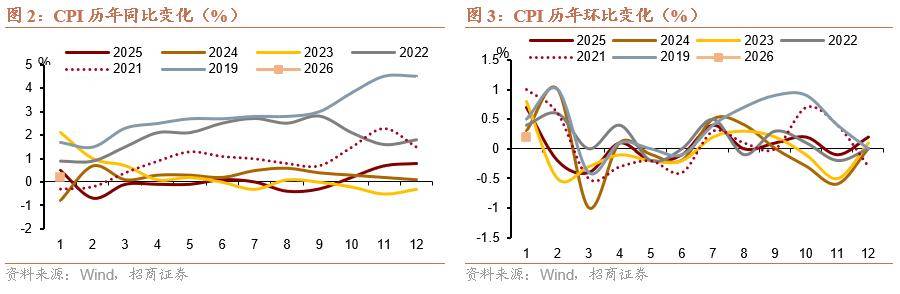
Group 1: CPI Analysis - In January, the CPI increased by 0.2% month-on-month and 0.2% year-on-year, with a significant drop in year-on-year growth due to the timing of the Spring Festival [1] - The food item saw a year-on-year decline of 0.7%, down 1.8 percentage points, while pork prices continued to be under pressure with a year-on-year drop of 13.7% [1] - Core CPI, excluding food and energy, recorded a year-on-year increase of 0.8%, down 0.4 percentage points from the previous month, but month-on-month, it reached a six-month high of 0.3% [1] Group 2: PPI Analysis - In January, the PPI decreased by 1.4% year-on-year, but the decline narrowed by 0.5 percentage points from the previous month, with a month-on-month increase of 0.4%, marking four consecutive months of growth [2] - Key industries such as cement and photovoltaic equipment saw price increases, with cement rising by 0.1% and photovoltaic equipment by 1.9% month-on-month [2] - The prices in the non-ferrous metal industry surged, with mining and processing prices increasing by 5.7% and 5.2% respectively [2] Group 3: Future Expectations - The CPI for February is expected to rise by 1.3% year-on-year, potentially reaching a new high since February 2023, driven by the Spring Festival demand [3] - The PPI is anticipated to turn positive in the second quarter of this year, reflecting improvements in industrial price environments and the gradual recovery of economic momentum [3] - Current policies are focused on expanding domestic demand and promoting reasonable price recovery, which is expected to support the overall economic environment [3]