
人才自主培养

Search documents
习近平总书记给中国农业大学全体师生的回信激励广大学子和教育、农业工作者矢志强农报国
Xin Hua She· 2025-10-16 12:36
Core Points - Xi Jinping's letter to China Agricultural University (CAU) encourages students and educators to commit to strengthening agriculture and serving the nation [1][2][3] - The letter highlights the importance of agricultural education and innovation in achieving national food security and rural prosperity [1][4] Group 1: Educational Commitment - CAU emphasizes the need to cultivate a strong sense of agricultural responsibility among students, aligning with the school motto of nurturing talent for the benefit of society [2][3] - Faculty members express their dedication to integrating research with practical applications to address food security challenges, particularly in extreme climate conditions [2][4] Group 2: Agricultural Innovation - The letter calls for enhanced agricultural technology innovation and the application of research outcomes to improve productivity and sustainability in agriculture [3][4] - Agricultural experts and students are motivated to focus on breeding high-quality crop varieties and applying scientific knowledge to real-world agricultural issues [4]
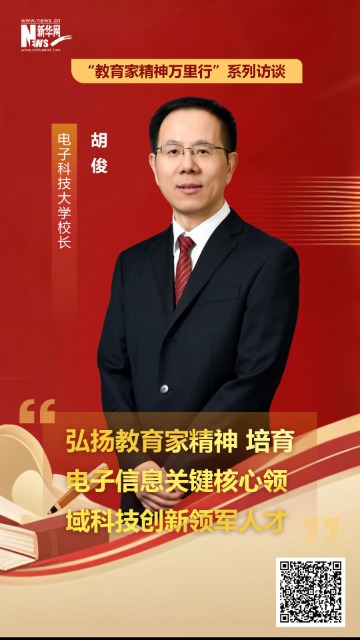
电子科技大学校长胡俊:弘扬教育家精神 培育电子信息关键核心领域科技创新领军人才
Xin Hua Wang· 2025-09-24 08:04
Core Viewpoint - The article discusses the initiatives taken by the Ministry of Education and various educational institutions to integrate the spirit of educators into the teaching profession, emphasizing the importance of teacher development and the role of education in achieving the goal of building a strong educational nation by 2035 [1][3]. Group 1: Implementation of Educator Spirit - The implementation of the educator spirit aims to enhance the foundational and leading role of teacher development in higher education institutions [4]. - Key requirements include prioritizing teacher ethics, continuous improvement of teachers' moral and educational capabilities, and creating a supportive teaching environment [4]. - Electronic Science and Technology University has established a high-level talent team of over 400 individuals and implemented a long-term mechanism for teacher ethics education [4]. Group 2: Interaction between Technology and Talent Development - The university emphasizes the integration of education, technology innovation, and talent cultivation as a direction for higher education reform [5]. - The "ECE Leading Plan" aims to cultivate top innovative talents in the fields of electronics and computer science, featuring a robust curriculum and practical research projects [5][6]. - The plan encourages collaboration between students and faculty in research projects, enhancing hands-on experience from the first year of study [5]. Group 3: Digital Empowerment of Teacher Development - The university has launched several initiatives to digitally empower teacher development, including the deployment of local AI models and high-performance computing resources [7][8]. - A four-dimensional AI curriculum has been developed, promoting a collaborative teaching model between teachers and AI [8]. - The institution has implemented a data-driven talent quality assessment system to support teacher evaluations and enhance their capabilities [8]. Group 4: Vision for Higher Education by 2035 - The vision for higher education by 2035 includes producing groundbreaking scientific research, cultivating innovative talents, and building a high-level teaching workforce [9]. - The educator spirit is seen as a guiding principle for teachers' professional development and a standard for evaluating their conduct [9]. - The article emphasizes the need for a talent cultivation system that reflects Chinese characteristics and promotes the educator spirit across all aspects of teaching and research [9].

“十四五”期间高等教育累计向社会输送5500万人才——办好人民满意的教育
Ren Min Ri Bao· 2025-09-24 04:12
Core Insights - The "14th Five-Year Plan" period has seen significant progress in building a strong education system in China, focusing on moral education and integrating various educational approaches [1][2][3] Group 1: Education Quality and Accessibility - China has established the largest and high-quality education system, ensuring equal access to education for children [2] - By the end of 2024, 246 districts and counties are expected to achieve quality balanced education, with 2895 county-level administrative units already reaching basic balanced education [2] - The proportion of migrant children attending public and government-subsidized schools has increased to over 97%, up by 11.2 percentage points since the end of the 13th Five-Year Plan [2] Group 2: High School and Higher Education Development - The revitalization of county-level high schools is a key focus for ensuring equitable and quality basic education [3] - The gross enrollment rate for higher education has increased from 30% in 2012 to 60.8%, marking a significant advancement towards universal access [3] - A total of 123.5 million students from rural and impoverished areas have been admitted to key universities through targeted enrollment plans [3] Group 3: Contribution to Economic Development - During the "14th Five-Year Plan," higher education institutions have trained 55 million talents to support national innovation and modernization [4] - Over 75% of national natural science awards and more than 50% of national technological advancement awards have been attributed to universities [4] - A new ecosystem for technology transfer from universities has been established, with 28 public transformation platforms created, facilitating the transfer of over 4800 research outcomes [4] Group 4: Vocational Education and Skills Development - Vocational education contributes over 70% of the newly added high-quality skilled talents in modern industries [5] - China has built the world's largest vocational education system, with 9302 secondary vocational schools and 3400 million students enrolled [5] - In the past five years, 12,000 new vocational programs have been added, with 50% focused on engineering and technology [5] Group 5: Comprehensive Educational Reform - The "14th Five-Year Plan" coincides with the second round of "Double First-Class" construction, enhancing the development of universities and disciplines [6] - Significant reforms in graduate evaluation methods have been implemented, allowing for innovation achievements to be considered for degree applications [6] - The national digital education strategy has been fully implemented, with a smart education public service platform covering over 200 countries and regions [7]
75%以上的国家自然科学奖和技术发明奖来自高校
Zhong Guo Jing Ji Wang· 2025-09-23 15:03
Core Viewpoint - During the "14th Five-Year Plan" period, Chinese universities have significantly contributed to enhancing the national innovation system, integrating education, technology, and talent development to support modernization efforts [1][2]. Group 1: Achievements in Basic Research - Universities have played a crucial role in basic research, with over 75% of the National Natural Science Awards and Technology Invention Awards coming from universities, and more than 50% of the National Science and Technology Progress Awards also attributed to them [1]. - Major national projects, such as the "Xihe" solar exploration mission and the "Crust-1" deep Earth exploration, have seen significant contributions from universities [1]. Group 2: Technology Transfer and Transformation - A new ecosystem for technology transfer and transformation has been established, with the Jiangsu Regional Technology Transfer Center achieving substantial progress, including the creation of 28 public transformation platforms and the connection of over 4,800 university research outcomes, with nearly 180 successfully transformed [1]. - The Guangdong-Hong Kong-Macao Greater Bay Area Center is leveraging industrial, international, and financial advantages to accelerate the establishment of an international transfer and transformation center [1]. Group 3: Talent Development and Innovation - Initiatives have been launched to promote a positive interaction between independent technological innovation and talent cultivation, focusing on breakthroughs in fundamental and interdisciplinary subjects [1]. - The education sector aims to cultivate high-end talent through innovative research, thereby achieving further innovation through the development of skilled professionals [1][2].
中金公司迎新任总裁:二十七年“投行老将”王曙光接棒
2 1 Shi Ji Jing Ji Bao Dao· 2025-09-01 22:56
Core Viewpoint - Wang Shuguang has been appointed as the new president of CICC, marking a significant leadership transition within the company, emphasizing internal talent development and strategic continuity [1][4][10] Group 1: Leadership Transition - Wang Shuguang has been with CICC since graduating from Tsinghua University in 1998, showcasing a 27-year career within the company [1][2] - His promotion to president and executive director candidate reflects CICC's strategy of nurturing talent from within, as most past presidents have similar backgrounds [3][10] - The new leadership duo of Wang Shuguang and Chairman Chen Liang is expected to enhance CICC's core strengths in technology IPOs, cross-border mergers, and investment banking [4][10] Group 2: Career Progression - Wang Shuguang's career can be divided into four stages: starting from the investment banking department in 1998, becoming a managing director in 2010, leading the investment banking division in 2022, and now assuming the presidency in 2025 [6][8] - His extensive experience includes leading significant projects in A-share IPOs, refinancing, and mergers and acquisitions, demonstrating his comprehensive capabilities in investment banking [8][9] Group 3: Financial Performance - CICC reported a significant increase in performance for the first half of 2025, with operating income and net profit attributable to shareholders rising by 44% and 94% year-on-year, respectively [7] - The investment banking sector showed remarkable growth, with revenues reaching 1.445 billion yuan, a year-on-year increase of 149.7% [7][8]

中金换帅,70后总裁上任
2 1 Shi Ji Jing Ji Bao Dao· 2025-08-30 00:44
Core Viewpoint - Wang Shuguang has been appointed as the new president of CICC, marking a significant internal promotion that reflects the company's strategy of nurturing talent from within [1][10]. Group 1: Career Path of Wang Shuguang - Wang Shuguang joined CICC in 1998 after graduating from Tsinghua University and has spent 27 years with the company, progressing through four key career stages [1][8]. - His career stages include starting in the investment banking department, becoming a managing director in 2010, leading the investment banking division in 2022, and now being appointed as president [8][11]. - Wang is recognized as a representative figure of CICC's internal talent development strategy, having risen through the ranks without leaving the company [7][10]. Group 2: Leadership Changes and Market Implications - The appointment of Wang Shuguang comes at a time when CICC is experiencing frequent executive exchanges with Galaxy Securities, leading to speculation about a potential merger between the two institutions [4][10]. - Wang's leadership is expected to strengthen CICC's core advantages in technology company IPOs, cross-border mergers and acquisitions, and international investment banking [4][11]. - The new leadership team, consisting of Wang and Chairman Chen Liang, is anticipated to guide CICC through its next phase of development [3][11]. Group 3: Historical Context of CICC's Leadership - CICC has a history of promoting presidents from within, particularly since 2002, with most having substantial investment banking backgrounds [2][10]. - The company has seen over ten presidents in its 30-year history, with a shift towards internal promotions since the early 2000s [10][11]. - Wang's promotion aligns with CICC's ongoing strategy to enhance professional talent development within the organization [11].
推动科技自主创新和人才自主培养良性互动(专题深思)
Ren Min Ri Bao· 2025-07-09 22:32
Group 1 - Education, technology, and talent are foundational and strategic supports for China's modernization, emphasizing the need for a virtuous cycle among education, technology, and talent [1] - Higher education institutions are crucial for developing technology and nurturing talent, which are essential for driving innovation and supporting China's modernization efforts [1] Group 2 - Talent is recognized as the primary resource for innovation, and higher education institutions must integrate moral education with talent cultivation to produce innovative talents [2] - The reform of ideological and political courses is highlighted as a means to instill values and enhance students' capabilities, ensuring a comprehensive talent development system [2] - The role of artificial intelligence in personalizing and optimizing talent training is emphasized, alongside the need for a global perspective in nurturing innovative talents [2] Group 3 - There is a call for collaboration between basic and interdisciplinary sciences to cultivate composite talents needed for economic and social development [3] - Higher education must innovate its discipline systems to activate innovation potential and support high-level technological self-reliance [3] - The focus is on long-term support strategies for foundational disciplines and the establishment of interdisciplinary collaborative entities to drive technological innovation [3] Group 4 - Deep integration of industry, academia, and research is essential for accelerating the cultivation of innovative talents and leading technological innovation [4] - Higher education institutions are urged to enhance their talent cultivation systems and collaborate with industries to address technological challenges [4] - The establishment of specialized technology transfer institutions and a differentiated talent cultivation model is necessary to align talent supply with regional industrial upgrades [4]
树立报国之志 锐意创新进取——习近平总书记致复旦大学的贺信激发挺膺担当的奋进力量
Xin Hua Wang· 2025-05-26 15:23
Core Viewpoint - The congratulatory letter from General Secretary Xi Jinping to Fudan University emphasizes the importance of patriotism, innovation, and the cultivation of talent to support national development and modernization efforts [1][2]. Group 1: Innovation and Talent Development - The letter highlights the need for continuous improvement in serving national strategies and regional economic development [2][3]. - Fudan University is encouraged to uphold its educational mission and contribute to the cultivation of high-quality talent that meets national needs [1][4]. - The emphasis on "self-innovation" and "talent cultivation" indicates a strategic direction for educational institutions to align with national priorities [3][4]. Group 2: Educational Reform and Responsibilities - The educational sector is urged to implement reforms that focus on practical problem-solving and high-quality research outcomes [4]. - There is a call for universities to leverage their resources to produce more high-level talent and impactful research [4]. - The letter expresses expectations for the younger generation to take on new responsibilities and contribute to the modernization of China [4].
提高人才自主培养质效
Jing Ji Ri Bao· 2025-05-22 22:08
Group 1 - The core argument emphasizes that innovation is fundamentally driven by talent, highlighting the urgent need to understand the new demands of Chinese modernization on education, technology, and talent [1][2] - The rapid advancement in technology and industrial iteration presents new challenges for innovation, with a significant talent gap of 19 million in fields like intelligent manufacturing and industrial internet, while traditional industries face a surplus of over 35% [1][2] - The global competition for talent has intensified, with developed countries attracting top talent and limiting cooperation with China, leading to a 27% increase in the concentration of top talent in regions with robust innovation ecosystems [2] Group 2 - There is a need to strengthen the autonomous talent cultivation in universities by aligning academic programs with national strategies and industry demands, promoting interdisciplinary studies, and enhancing the quality of engineering education [3] - A new talent development system is proposed, focusing on integrating education and industry, establishing collaborative platforms, and reforming talent evaluation systems to prioritize innovation and practical contributions [4] - A mechanism for a virtuous cycle among education, technology, and talent is essential, emphasizing the need for coordinated policies and resource allocation to achieve high-quality development and technological self-reliance [5]