
人机共创

Search documents
八强高校选手角逐AI电竞锦标赛
Nan Fang Du Shi Bao· 2025-10-19 23:15
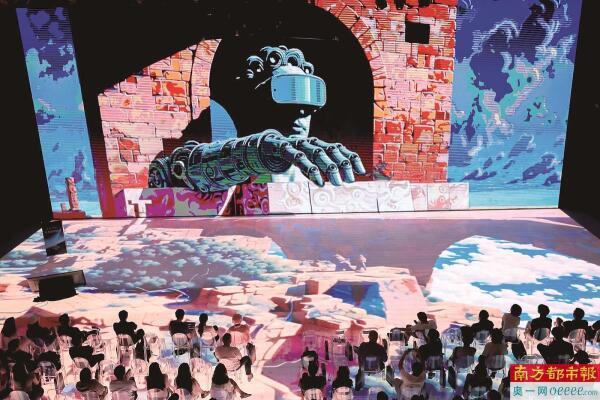
Core Insights - The second AI Visual Creative Competition (VACAT) was held from October 17 to 19 in Longgang District, Shenzhen, showcasing the latest breakthroughs in AI visual technology and aiming to establish itself as the "Oscar" of the AI visual creative field [2][4]. Group 1: Competition Overview - The competition received over 4,600 submissions globally, marking a 36.8% increase from the previous year, with 235 entries making it to the final round [3]. - The event featured various categories including AI art posters, AI visual art films, AI commercial creative films, AI animation narrative films, and AI real narrative films, with awards announced on the opening day [3]. - The participation of prestigious institutions like Beijing Film Academy and the International Student Media Arts Festival highlights the event's professional recognition [3]. Group 2: Quality and Scope of Participation - The competition demonstrated significant improvements in three areas: stronger ecological links, higher quality of submissions, and broader participation [4]. - The quality of entries was noted for its production precision, artistic completion, and visual expression, standing out among similar national events [4]. - The event attracted a diverse range of creators and teams, enhancing its global appeal [4]. Group 3: AI Visual Technology Workshop - An AI Visual Technology Workshop was held during the competition, featuring 22 experts from leading global fields to discuss the latest advancements in AI visual technology [5]. - The workshop aimed to explore innovative applications of AI in artistic creation, showcasing a high level of international collaboration [5]. Group 4: AI Competition Day - The "AI Competition Day" on October 19 served as the climax of the event, testing participants' creativity, technical skills, and adaptability through intensive competitions [6]. - The day included a global AI video vendor team competition and a dual-track event focusing on university and professional teams, highlighting the capabilities of AI video tools [6]. Group 5: Industry Collaboration Opportunities - The event provided a platform for companies in the AI visual creative industry to seek collaborations, with various AI application products showcased [6][7]. - Companies like Yedu Culture Media and Lian Dan Technology expressed interest in transitioning to AI and VR technologies, aiming to find technical partners for content production [7]. Group 6: Publication of the Blue Book - The first "Blue Book on AI Visual Creative Applications" was released during the competition, aiming to fill the gap in systematic research and provide industry guidelines [8]. - The Blue Book outlines the current state, core issues, and future trends of AI in the visual creative field, serving as a comprehensive industry guide [9]. Group 7: Challenges in the AI Visual Industry - Despite rapid development, the AI visual industry faces challenges such as high cognitive costs for creators, who need a blend of industry knowledge and systematic methods [9]. - The Blue Book includes practical content from real-world applications, providing creators with actionable references to enhance their creative efficiency [9].

三个视角厘清“人机共创”(纵横)
Ren Min Ri Bao· 2025-09-28 22:28
Core Viewpoint - The article discusses the legal implications of AI-generated content, emphasizing that under current Chinese law, AI is not recognized as a creator and thus cannot bear legal responsibility for infringement. All consequences of AI creations fall on human creators [1][2]. Group 1: Legal Framework - The first truth revealed by the courts is that AI has never been granted "creator" status within the existing legal framework in China, meaning it is merely an extension of human tools. Therefore, AI lacks "autonomous responsibility," and humans must bear the consequences of AI-generated content [1]. - The courts have established clear boundaries: if AI is used to commit fraud, it is treated as "human fraud"; if AI is used for innovation, it is protected as "human innovation." The core standard for this distinction is whether there is "original expression" by a human [1]. Group 2: Human-AI Collaboration - The second truth is that while AI can create a framework for creativity, it cannot fill it with the essence of thought. A designer's experience illustrates that AI struggles to capture nuanced cultural concepts, such as the balance of softness and strength in traditional Chinese furniture design [2]. - The third truth highlights that AI-generated content relies on human-created "ingredients," which are rooted in human original rights. This emphasizes the need for AI training to be more regulated to protect original creators [2]. Group 3: Technological Solutions - To protect original works, companies are exploring technological solutions such as digital watermarking to embed invisible markers in original content and blockchain technology to document creation details, which can help clarify the source of content even when used for AI training [2]. - The concept of "human-AI co-creation" is framed not as a struggle for dominance but as a means for humans to expand creative boundaries with AI assistance. Embracing AI's benefits while ensuring legal, institutional, and technological protections for original content is essential for sustainable development in the creative industry [2].
智联招聘发布《报告》:“数字同事”正深度融入职场
Zhong Guo Jing Ji Wang· 2025-09-24 03:57
Group 1 - The widespread application of AI tools is transforming traditional work methods, leading to a shift from "human-machine collaboration" to "human-machine symbiosis" in the workplace [1] - 78.2% of employees utilize AI in their work weekly, indicating that AI has become an indispensable tool in the workplace [1] - General-purpose AI tools dominate the market, accounting for 47.4%, while vertical AI applications like DingTalk and Feishu represent 28.1% [1] Group 2 - 71.7% of employees recognize the efficiency improvements brought by AI tools, which automate low-value tasks and streamline information processing [2] - 33.6% of employees have learned to actively collaborate with AI, marking a transition to a higher level of "human-machine co-creation" [2] - 64.9% of employees feel empowered to complete tasks that previously required human colleagues' assistance with AI support [2] Group 3 - 63.3% of employees prefer to make independent judgments when AI suggestions differ from human colleagues, indicating a balanced approach to AI reliance [3] - 31.7% of companies in first-tier cities provide AI-related training, highlighting a disparity in digital economy development between urban areas [3] - The report suggests that companies need to reassess their AI investment strategies to foster a more inclusive and adaptable work environment [3]
AI视频的落地浪潮:三次技术进化如何重构全球创意生态?|101 Weekly
硅谷101· 2025-09-03 02:01
AI Video Technology Evolution - AI video technology has undergone three major evolutions: understanding physical laws, achieving continuous narrative, and significantly reducing costs [1] - AI video applications are experiencing unprecedented growth in 2025 due to the rapid development of multimodal technology [1] - The industry is exploring how to make AI-generated content emotionally resonant and whether data and algorithm iterations can truly stimulate human imagination [1] Industry Applications and Impact - AI video is being implemented in industries such as advertising, film and television, and e-commerce, potentially restructuring the global supply chain ecosystem [1] - The commercialization of AI video is accelerating, with technology and imagination colliding to ignite a new era [1] - The industry is focusing on the potential of AI to empower creators and shape the next story revolution in the age of human-machine co-creation [1] Key Technological Advancements - AI video models have evolved from "digital puppets" to possessing "director consciousness" [1] - The first evolution involves moving from "recognizing objects" to "understanding physical laws" [1] - The second evolution involves moving from "single-frame illustrations" to "series-level storytelling" [1] - The third evolution involves moving from "high cost" to "controllable cost" [1] Global Competition and Future Outlook - A global competition is emerging in the AI video supply chain ecosystem [1] - The industry is considering future scenarios of human-machine co-creation and how AI can empower creators [1]

机器人产业全球化图景:区域市场特点与趋势分析
机器人圈· 2025-08-29 10:48
Core Viewpoint - The global robotics industry is experiencing both inevitable trends and multiple challenges, with regional characteristics and global trends intertwining to shape its future [3][4]. Part 01: Asia - Asia is characterized by a "China-led, multi-polar collaboration" model, with China increasing its industrial robot installation by 5% in 2024, raising its global market share from 51% to 54% [8][9]. - The growth in China's robotics sector is driven by the electronics industry and the metal machinery sector, with industrial robot production rising from 33,000 units in 2015 to 556,000 units in 2024 [8][9]. - Regional disparities in robotics development are evident, with the Beijing-Tianjin-Hebei region focusing on humanoid robots and intelligent technology, while the Yangtze River Delta is seeing significant growth in industrial and service robots [13][14]. Part 02: Europe and North America - Europe saw a 6% decline in industrial robot installations in 2024, yet maintained a historical high, with growth driven by sectors like plastics and food rather than automotive [20][21]. - North America experienced a 9% drop in industrial robot installations, but diversification into non-automotive sectors is evident, with companies focusing on practical solutions rather than humanoid robots [22][24]. Part 03: Middle East and Emerging Markets - The Middle East is leveraging national strategies to rapidly develop its robotics industry, with the UAE planning to deploy 200,000 robots by 2032 [25][28]. - Emerging markets like ASEAN are witnessing significant growth, with the region's robot market expected to reach $1.48 billion by 2025, driven by diverse applications in agriculture and logistics [19]. Part 04: China's Robotics Industry - China's robotics industry is transitioning from a participant to a leader, with a full-chain innovation capability that includes basic research, application transformation, and industrial landing [34][35]. - The country is focusing on "scene innovation" to drive industry iteration, with companies like Qianlong Robotics achieving significant global sales and application in various sectors [35][36]. Part 05: Global Trends - The global robotics industry is at a critical point of scaling applications, with three major trends reshaping the landscape: technology democratization, scene integration, and governance collaboration [38]. - The emphasis on sustainable development and ethical considerations is becoming a global consensus, with international organizations and companies working together to establish standards and frameworks [37][38].

【WRC专家观点】中国科学院外籍院士、日本工程院院士福田敏男:《日本具身智能的发展》
机器人圈· 2025-08-25 12:00
Core Viewpoint - The article discusses the advancements and future potential of robotics and embodied intelligence, emphasizing the importance of collaboration between humans and machines to enhance various sectors, including healthcare and disaster response [1][10]. Group 1: Event Overview - The 2025 World Robot Conference will be held from August 8 to 12 in Beijing, featuring a main forum and 31 series of activities with 416 experts and representatives sharing insights on new technologies and applications [1]. Group 2: Embodied Intelligence - Embodied intelligence is defined as the ability of robots to not only perform tasks but also to perceive and understand their environment, marking a shift from traditional AI definitions [8]. - The development of embodied intelligence emphasizes the need for robots to adapt to complex environments and possess cognitive abilities [8][9]. Group 3: Technological Advancements - Significant progress has been made in nanorobotics over the past 40 to 50 years, with ongoing research aimed at making robots more intelligent and capable [4][5]. - The integration of bionic elements into robotic systems is highlighted, with a focus on developing distributed autonomous robotic systems that can operate within the human body [6][7]. Group 4: Human-Robot Collaboration - The article stresses the importance of human-robot collaboration, suggesting that robots should not only assist in repetitive tasks but also provide solutions in critical situations [9][10]. - A vision for 2050 is presented, where robots will possess the ability to autonomously identify and solve problems, significantly enhancing their role in society [10][11]. Group 5: Future Prospects - The potential for companion and caregiving robots is discussed, with the expectation that they will be able to support humans throughout their lives, including during emergencies [10][12]. - The concept of "soft robots" is introduced, which combines flexibility and adaptability with traditional robotic capabilities, aiming for a balanced design approach [11][12].
“慢公司”的豪赌:Notion押注AI的内外进化史
混沌学园· 2025-08-15 12:07
Core Insights - Notion has successfully transitioned from a traditional productivity tool to an AI-enhanced platform, marking a significant shift in its operational and strategic approach [3][10][39] - The introduction of Notion AI has transformed user interaction, allowing the software to act as a proactive assistant rather than a passive tool, thereby enhancing user experience and productivity [10][12][39] Product Evolution - Initially known for its flexibility as a document and database tool, Notion has evolved into a "second brain" by integrating AI functionalities that assist users in content creation and data management [4][6] - Key AI features include: - AI writing assistant launched in November 2022, which helps users draft content and provides writing suggestions [6] - AI content summarization and extraction capabilities introduced in 2023, allowing users to condense lengthy notes into actionable insights [6][10] - AI database autofill feature, enabling automatic data entry based on user-defined prompts [6][10] - AI Q&A functionality, allowing users to query the system in natural language for quick information retrieval [7][10] Market Strategy and Performance - Notion's subscription model for AI features has successfully converted free users into paying customers, with a standard pricing of $10 per user per month [20][22] - The company has seen significant growth in user base, expanding from 1 million monthly active users in 2019 to nearly 100 million by 2023-2024 [23] - Over 50% of Fortune 500 companies are now using Notion, indicating strong penetration into the enterprise market [24] Organizational Culture and Transformation - Notion's unique culture, characterized by a blend of aesthetic and engineering principles, has enabled it to respond quickly to the AI trend while maintaining product quality [29][31] - The company emphasizes a flat organizational structure, allowing for agile decision-making and rapid development cycles [31][39] - Notion has strategically integrated external AI models while maintaining control over user data and experience, ensuring a tailored approach to AI implementation [36][39]

博纳影业业绩发布:率先开辟“AI+影视”战略布局全新赛道
Cai Fu Zai Xian· 2025-04-29 02:31
Core Insights - BONA Film Group is adapting to a challenging Chinese film market in 2024, with a 22.7% decline in box office revenue and a 23.1% drop in audience numbers, while focusing on its core business and exploring new growth areas [1] Group 1: AI Integration and Technological Advancements - BONA Film Group has launched an "AI + Film" strategy, establishing the AIGMS (AI Generated Movie/Series) production center to integrate generative AI with the film production process, covering all stages from script development to post-production [1] - The company emphasizes a "human-machine co-creation" approach, enhancing content quality and production efficiency through AI assistance in script development, character creation, and visual design [1][3] Group 2: Successful Projects and Recognition - The company produced the first AIGC-generated sci-fi short series "Sanxingdui: Future Revelation," which garnered 160 million views on Douyin and received multiple awards, including the American Film Arts Festival's Gold Award [2] - BONA Film Group's fantasy action film "Legend" is noted as the world's first feature film starring a "digital human," utilizing Deepfake technology to recreate a 27-year-old Jackie Chan, achieving significant global sales across over 100 countries [2] Group 3: Future Developments and Industry Impact - The second season of "Sanxingdui: Future Revelation" is set to continue its narrative of "decoding history for the future," showcasing an industrial-level standard for human-AI co-created sci-fi works [3] - BONA Film Group is driving the industrial upgrade of the film sector in China, creating a new avenue for collaborative creation between humans and AI as technology evolves [3]