
企业投资

Search documents
伊利股份在内蒙古成立两家投资公司
Zheng Quan Shi Bao Wang· 2025-12-19 03:09
Group 1 - Inner Mongolia Longzhuo Investment Co., Ltd. and Inner Mongolia Yonghao Investment Co., Ltd. have recently been established, both with the same legal representative, Uyun Dalai [1] - The business scope of both companies includes enterprise management, management consulting, and investment activities using their own funds [1] - Both companies are wholly owned by Yili Group (stock code: 600887) according to the equity penetration analysis [1]

兰西城市群建设提速 “十四五”期间企业投资累计破千亿
Zhong Guo Xin Wen Wang· 2025-12-02 13:57
Group 1 - The core viewpoint of the articles highlights the collaborative development and investment growth within the Lanzhi urban agglomeration, which has seen mutual investments exceed 100 billion yuan and over 600 projects implemented during the 14th Five-Year Plan period [1][2] - The Lanzhi urban agglomeration, established in 2018, is a significant economic corridor in China, encompassing 22 cities and serving as an ecological barrier in the upper reaches of the Yellow River [1] - According to statistics, the GDP of the Lanzhi urban agglomeration is projected to reach 796.95 billion yuan in 2024, reflecting an increase of 226.48 billion yuan from 2020, with an average annual growth rate of 5.42% during the 14th Five-Year Plan [1] Group 2 - The focus on manufacturing and energy collaboration between Qinghai and Gansu provinces has led to the signing of 4 strategic cooperation agreements and the achievement of 1.1 billion yuan in upstream and downstream business connections [2] - The two provinces are enhancing their trade cooperation, particularly through the China-Nepal land trade corridor, and are working on resource sharing and complementary advantages between their respective comprehensive bonded zones [2]
报告显示经济逆风下德国仍是中企重要投资地
Xin Hua She· 2025-11-19 06:02
Core Viewpoint - Despite facing challenges such as high labor costs, Germany remains a key investment destination for Chinese enterprises in Europe, with potential for increased cooperation through improved business environment [1] Group 1 - The report titled "2025 Business Environment Survey for Chinese Enterprises in Germany" was jointly released by the German Chinese Chamber of Commerce and KPMG [1] - The findings suggest that optimizing the business environment in Germany could attract more Chinese investments [1] - The report highlights the importance of Germany as a strategic location for Chinese companies looking to expand in Europe [1]
【环球财经】法国企业将向本土新增投资92亿欧元
Xin Hua She· 2025-11-18 15:29
Core Insights - The French Ministry of Economy and Finance announced an investment of €9.2 billion by French companies during the first "French version" of the "Choose France" summit, focusing on data centers and other sectors [1] Group 1: Investment Overview - The "Choose France" summit has been held annually since 2018 to attract investment and create jobs, with this year's summit recognizing companies that produce, innovate, and create jobs in France [1] - Approximately 200 French companies, industry associations, unions, and employer organizations participated in the summit, covering sectors such as energy, agriculture, healthcare, chemicals, and aerospace [1] - Including the new investment of €9.2 billion, the total number of investments by these companies in France this year will reach 151, amounting to €30.4 billion [1] Group 2: Sector Focus - The newly announced investments are primarily directed towards sectors such as energy and environment, digital technology, healthcare, and chemicals and new materials [1] - The largest investment comes from French telecom operator Opticore, which plans to invest nearly €4 billion to build a data center on the site of a former power plant in Seine-et-Marne [1]
英国三季度GDP意外放缓 贸易逆差收窄难抵生产端萎缩
Xin Hua Cai Jing· 2025-11-13 08:04
Economic Performance - The UK's GDP for Q3 2025 shows a quarter-on-quarter growth of 0.1%, a slowdown from 0.3% in Q2 and below the market expectation of 0.2% [1] - Year-on-year growth stands at 1.3%, slightly below the anticipated 1.4% [1] - The services sector grew by 0.2%, while construction saw a marginal increase of 0.1%, but the production sector contracted by 0.5% [1] Industrial Output - Industrial output experienced a significant decline of 2.0% in September, reversing the previous month's growth of 0.3%, marking the largest monthly drop since January 2021 [1] - Manufacturing output fell by 1.7%, with a notable decrease of 28.6% in the production of motor vehicles, trailers, and semi-trailers [1] - Year-on-year industrial output decreased by 2.5%, exceeding market expectations of a 1.2% decline [1] Trade Dynamics - The trade deficit narrowed to £1.09 billion in September, the smallest level since January, with the previous value revised to £1.28 billion [2] - Exports fell by 0.9% to £77.21 billion, the lowest in three months, while imports decreased by 1.1% to £78.3 billion, reaching an eight-month low [2] - Exports to the EU dropped by 2.7%, primarily due to reduced fuel exports, and exports to non-EU countries fell by 8.0%, with a significant 11.4% decline in exports to the US [2] Business Investment - Business investment declined by 0.3% in the three months to September, better than the expected 0.7% drop, marking the second consecutive quarter of decline [2] - Year-on-year growth in business investment slowed to 0.7%, significantly lower than the previous quarter's 3.0% [2] - However, gross fixed capital formation increased by 1.8%, supported by investments in information and communication technology, machinery, housing, and intellectual property products [2] Construction Sector - The construction sector showed a notable rebound, with orders increasing by 29.3% year-on-year in Q3, the fastest growth since Q4 2021, reversing the previous quarter's decline of 11.7% [3] - Seasonally adjusted, construction orders grew by 9.8% [3] - Public housing orders surged by 72.9%, new housing orders rose by 17.0%, and private housing orders increased by 9.2% [3] Overall Economic Outlook - Despite positive contributions from net trade and a strong rebound in construction activity, the deep contraction in industrial production and ongoing weakness in business investment indicate structural pressures on the UK economy amid high interest rates and weakened external demand [3]
员工降薪参股公司变“老赖” 福建富豪许景南的匹克麻烦不断
Sou Hu Cai Jing· 2025-10-20 07:59
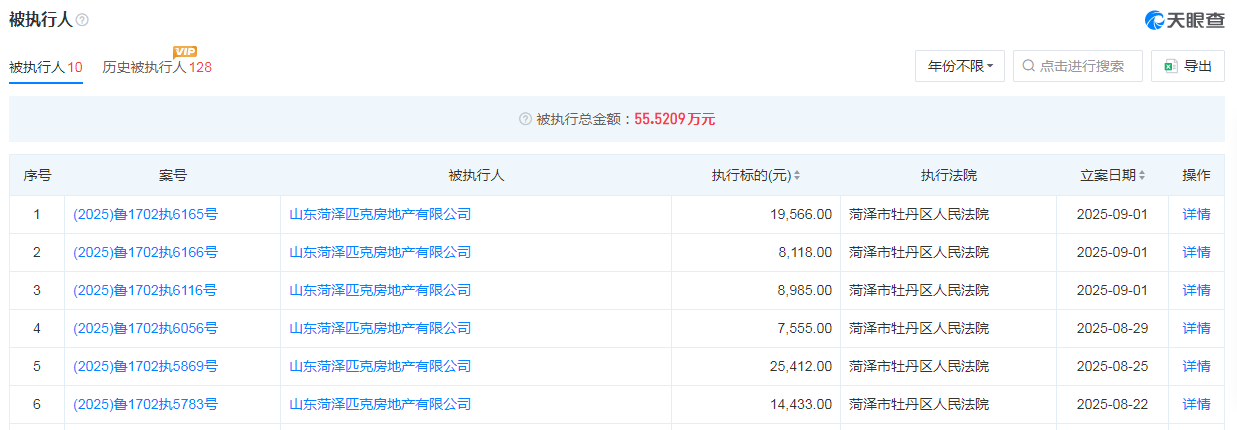
Core Viewpoint - The news highlights the financial struggles of Peak Group and its actual controller Xu Jingnan, who has faced scrutiny due to multiple companies being listed as "dishonest debtors" while simultaneously making significant charitable donations [1][2][8]. Group 1: Financial Issues - Shandong Heze Peak Real Estate Co., Ltd. was listed as a debtor with a total amount of less than 40,000 yuan (36,669 yuan) [1]. - Peak Group's actual controller Xu Jingnan's wealth has nearly doubled from 7 billion yuan in 2022 to 13.5 billion yuan in 2024, according to the Hurun Global Rich List [1]. - As of September 1, 2025, Heze Peak has appeared on the debtor list 10 times, with a cumulative amount of 55,500 yuan [2][4]. Group 2: Business Operations - Xu Jingnan has diversified investments across various sectors, including aerospace, real estate, and finance, with Peak Group being a significant player in these areas [1][7]. - Peak Group's main investment platform, Peak Investment, has stakes in several financial companies, indicating a deep involvement in the financial sector beyond its core business of sports goods [7]. Group 3: Salary Cuts and Employee Reactions - In mid-September 2025, Peak Group announced significant salary cuts for employees, with reductions ranging from 10% to 50% depending on salary brackets, citing a loss of over 13 million yuan in the direct sales sector [8]. - Employees expressed dissatisfaction with the salary cuts, and the company required those who refused to comply to submit reflections, which has been deemed illegal by labor rights authorities [8]. Group 4: Charitable Contributions - Despite financial difficulties, Peak Group has made substantial charitable donations, including a 10 million yuan donation to the Quanzhou Charity Association and an additional 20 million yuan commitment shortly after the salary cuts were announced [8][17]. - On September 5, 2025, Peak Group was recognized as a "charitable family" during a charity event, where it contributed significantly more than other companies [8][17].

美国政府停摆:长期经济增长的“杀手”
Jin Shi Shu Ju· 2025-10-15 05:45
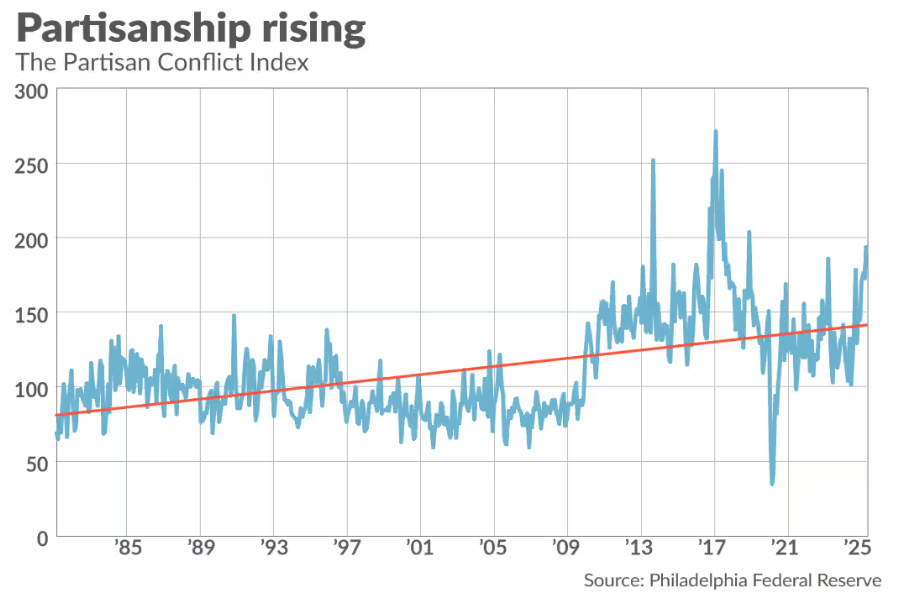
Group 1 - The core argument is that political polarization in the U.S. is leading to a significant reduction in corporate investment, which will adversely affect long-term economic growth [1][2] - A study by Marina Azzimonti found a negative correlation between the partisan conflict index (PCI) and domestic private investment, indicating a causal relationship [2][5] - Azzimonti's research highlights that 27% of the decline in corporate investment from 2007 to 2009 can be attributed to increased partisan conflict [2] Group 2 - The long-term trend of the PCI is steadily increasing, currently more than double the levels seen during the 2007-2009 period, suggesting that corporate investment would be higher without government dysfunction [5] - Political polarization creates greater economic uncertainty, which diminishes the likelihood of returns on capital investments, leading to delays in investment decisions [5] - Political polarization also reduces the likelihood of timely legislative responses to economic crises, negatively impacting expected returns and suppressing corporate investment [5][6] Group 3 - Azzimonti's findings contradict the belief that corporate America prefers political gridlock, as it actually leads to poorer stock market performance [6] - Research indicates that stock market returns are better under unified government control, with annualized returns being 8.7 percentage points higher from 1927 to 2020 during unified government periods [8] - The impact of government dysfunction may not be immediately visible in economic data, but historical trends suggest that future U.S. economic growth rates are likely to be significantly lower [8]
又一报告拉响警报:美国经济恐陷“高GDP、低就业”怪圈!
Jin Shi Shu Ju· 2025-10-13 10:02
Economic Outlook - The NABE survey indicates a surge in business investment is expected to offset weak consumer spending and global trade growth, keeping the US economic growth near trend levels [2] - Economists predict a 1.8% growth for the US economy in 2025, an increase from the previous forecast of 1.3% [2] - Inflation, measured by the PCE price index, is expected to reach 3% by the end of this year, slightly lower than the previous estimate of 3.1% [2] Employment and Unemployment - The unemployment rate is projected to rise to 4.5% next year, a decrease from the earlier forecast of 4.7% [3] - Average monthly job growth is expected to be only 29,000 for the remainder of this year, with a gradual recovery to about 75,000 next year, lower than the previous estimate of 97,000 [3] Business Investment - Business investment is anticipated to grow significantly, with a forecasted increase of 3.8% this year, up from the previous estimate of 1.6% [3] - Investment growth is expected to continue at a rate of 1.7% next year, higher than the earlier prediction of 0.9% [3] Real Estate Market - The real estate market remains sluggish, with residential investment expected to decline by 1.6% this year, contrasting with the earlier forecast of a 0.5% growth [3] - Next year's residential investment growth is projected to be less than 1% [3]
Brazil's Petrobras to invest $486 mln in naval sector, fertilizer plant in Bahia state
Reuters· 2025-10-08 19:43
Core Insights - Petrobras, the Brazilian state-run oil company, is set to invest approximately 2.6 billion reais, equivalent to $486 million, in the northeastern state of Bahia [1] Company Summary - The investment by Petrobras indicates a strategic focus on expanding operations in the northeastern region of Brazil [1] - The CEO of Petrobras announced the investment plans, highlighting the company's commitment to regional development [1]


【财经分析】英国经济增长动能持续疲弱:私人消费不足 企业投资积极性受挫
Xin Hua Cai Jing· 2025-10-02 07:20
Economic Growth Trends - The UK economy's growth momentum is showing signs of continued weakness, with a quarterly growth rate of 0.7% in Q1 slowing to 0.3% in Q2 [1] - Current data indicates that the growth rate is further declining in Q3, with July showing zero growth and PMI data suggesting a continued slowdown in August and September [1] Manufacturing Sector Challenges - The manufacturing PMI for September dropped to 46.2, marking a five-month low, indicating significant challenges for UK manufacturers due to low market sentiment and rising costs [1] - Manufacturers' confidence for the next 12 months remains low, reflecting ongoing difficulties in the sector [1] Retail Sector Performance - Retail sales in the UK fell by 0.1% from June to August, with a 0.6% decline from May to July, indicating a prolonged downturn in retail traffic [2] - The increase in household savings, which rose by 0.2 percentage points to 10.7%, suggests that consumers are prioritizing savings over spending [2] Inflation Impact - The UK's CPI remained at 3.8% year-on-year in July and August, contributing to weakened consumer confidence, particularly in food prices which rose by 4.2% [3] - Rising energy bills and concerns over potential tax increases are adding to consumer pressure [3] Business Investment Decline - Private sector investment fell by 1.1% in Q2, contrasting with a 3% increase in the same period last year, primarily due to reduced investment in equipment [4] - Government investment was the main contributor to the 0.3% growth in Q2, but overall fixed asset investment remains significantly lower compared to previous years [4] Recommendations for Economic Stability - To stabilize economic growth, it is crucial to enhance private consumption and business investment, with a focus on controlling inflation and stabilizing policy expectations [5] - The government is urged to utilize policy tools to lower costs for businesses and stimulate investment, particularly in the upcoming autumn budget [5]