
偿二代二期

Search documents
2025保险大盘点,14家增资200亿,19家发债900亿,总额过千亿!
Xin Lang Cai Jing· 2025-12-15 13:39
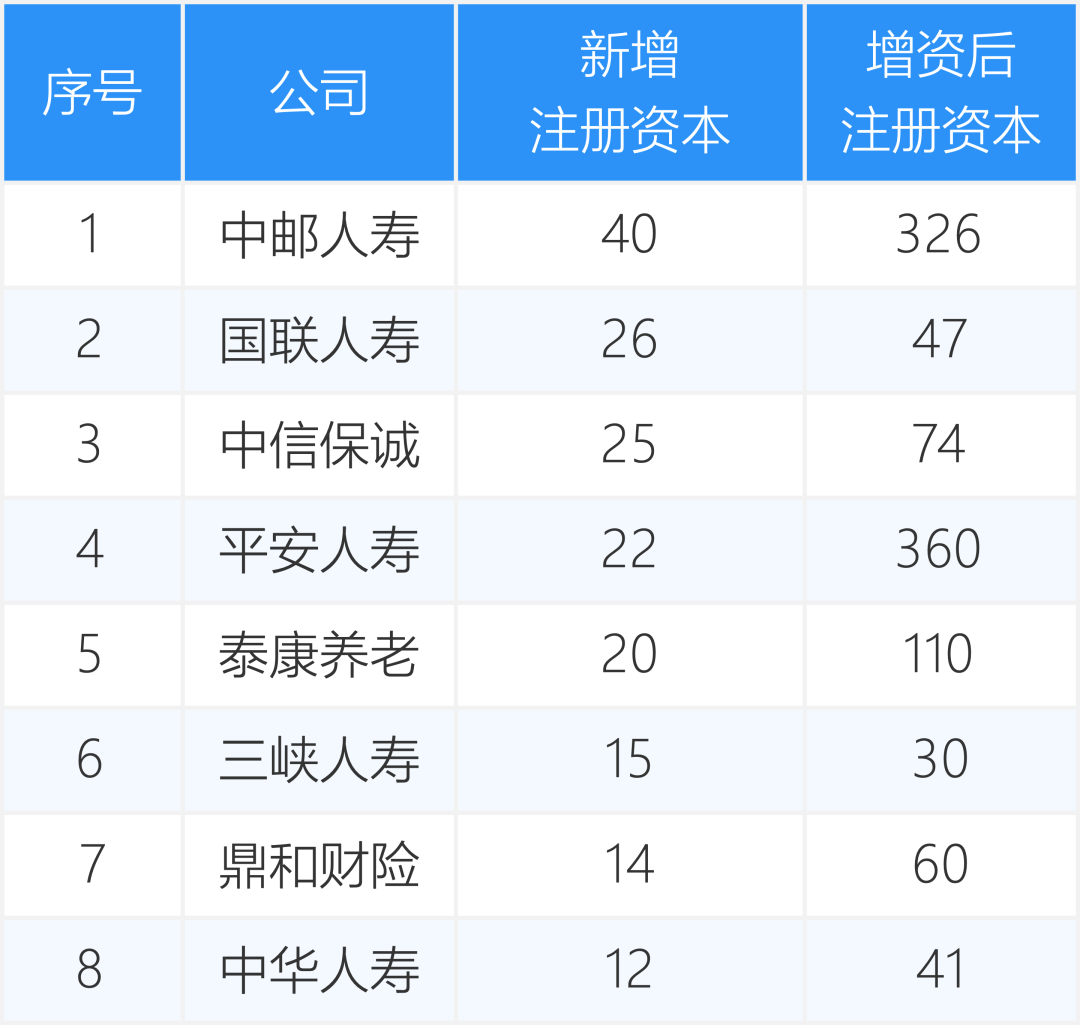
Core Viewpoint - The solvency of many life insurance companies is under pressure due to the extended transition period until the end of 2025, prompting a significant capital replenishment effort to meet new regulatory requirements [1][7]. Capital Increase and Bond Issuance - In 2025, 14 insurance companies were approved for capital increases totaling 19.7 billion, with the majority being life insurance companies (11 companies, 17.2 billion) and property insurance companies (3 companies, 2.6 billion) [1][7]. - At least three additional companies have plans for capital increases [1]. - A total of 19 insurance companies have issued supplementary bonds amounting to over 90 billion, with life insurance companies accounting for 79.2 billion and property insurance companies for 15 billion [1][7]. - The amount of bond issuance is nearly five times that of capital increases, reflecting a trend where companies prefer bond issuance for its flexibility and non-dilutive nature [1][7]. Notable Capital Increases - Eight companies have capital increases exceeding 1 billion, with the smallest being 200 million [1][7]. - Notable increases include: - Zhongyi Life: Increased by 4 billion, new capital 32.6 billion [2][8]. - Guolian Life: Increased by 2.6 billion, new capital 4.66 billion, a 122% increase [2][8]. - Ping An Life: Increased by approximately 19.999 billion, new capital 36 billion, marking its first increase in 13 years [2][8]. - Taikang Pension: Increased by 2 billion, new capital 11 billion [2][8]. Bond Issuance Details - The largest bond issuance this year was by Ping An Life, totaling 20 billion with a 10-year maturity [9]. - Ping An Life also issued a 13 billion perpetual bond earlier this year, bringing its total capital replenishment through bonds to 33 billion [9]. - Other significant issuances include: - Taiping Life: 9 billion perpetual bond [9]. - Various companies have issued bonds ranging from 5 billion to 20 billion [9][11]. Summary of Capital Increase and Bond Issuance by Company - A detailed table of capital increases and bond issuances shows the following: - Zhongyi Life: New capital 4 billion, total 32.6 billion [10]. - Guolian Life: New capital 2.6 billion, total 4.66 billion [10]. - Ping An Life: New capital 19.999 billion, total 36 billion [10]. - Taikang Pension: New capital 2 billion, total 11 billion [10]. - The bond issuance table indicates various companies with significant bond amounts, including Ping An Life and Taiping Life [11].

【光大金融】股票风险因子差异化下调,推动险资强化耐心资本属性
Xin Lang Cai Jing· 2025-12-08 01:32
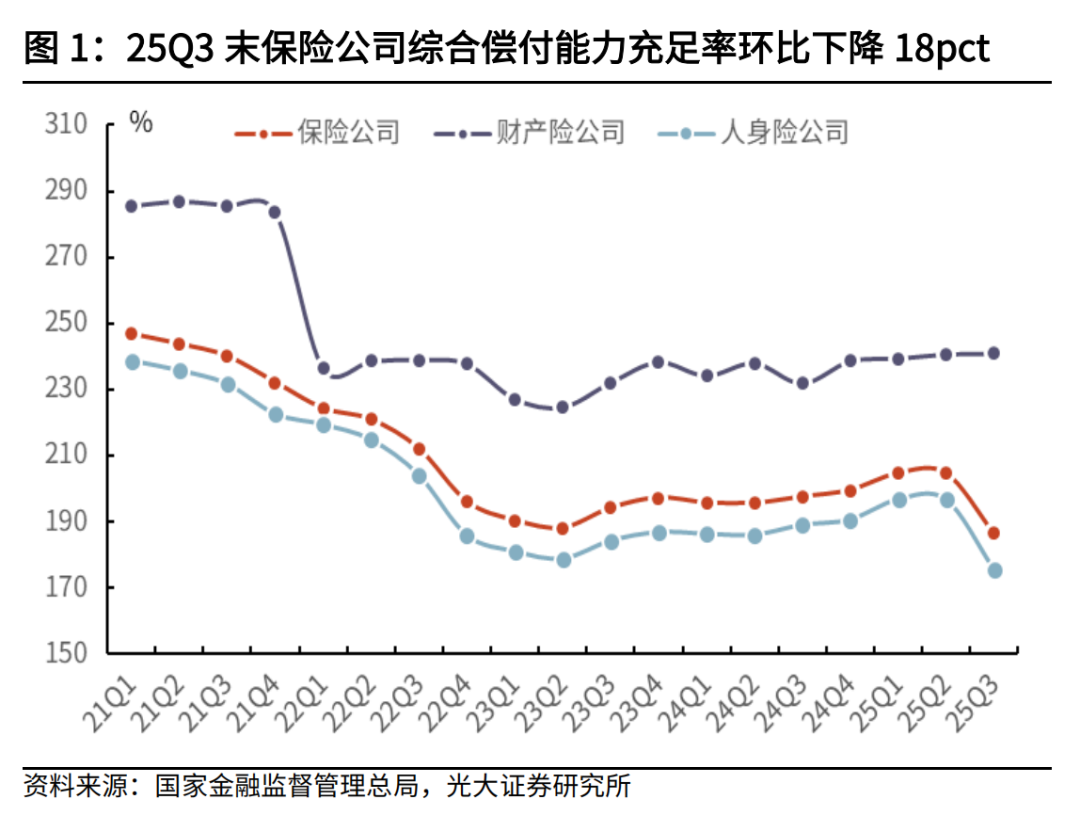
Core Viewpoint - The adjustment of risk factors for insurance companies aims to enhance their capital management and encourage long-term investments, particularly in the stock market and support for foreign trade enterprises [1][16]. Group 1: Background - The implementation of the second phase of solvency regulations has put pressure on insurance companies' solvency ratios, with the overall solvency adequacy ratio declining since the rules were enacted in 2022 [2][17]. - Despite regulatory optimizations in September 2023, the solvency adequacy ratio remains below levels prior to the second phase implementation [17]. - As of Q3 2025, the stock allocation ratio for the insurance industry reached 10%, an increase of 1.2 percentage points from the previous quarter and 2.5 percentage points from the beginning of the year [2][17]. Group 2: Content of the Notification - The notification includes differentiated adjustments to risk factors based on holding periods for stocks, encouraging long-term investments [4][18]. - For stocks in the CSI 300 index and the CSI Low Volatility 100 index held for over three years, the risk factor is reduced from 0.3 to 0.27 [4][18]. - For stocks listed on the Sci-Tech Innovation Board held for over two years, the risk factor is reduced from 0.4 to 0.36 [4][18]. - The risk factor for export credit insurance and overseas investment insurance premiums is reduced from 0.467 to 0.42, and the reserve risk factor is reduced from 0.605 to 0.545 [4][18]. Group 3: Internal Control and Solvency Management - Insurance companies are required to enhance internal controls and accurately measure stock holding periods to improve long-term investment management capabilities [5][19]. - There is an emphasis on strengthening solvency management to ensure that solvency data is accurate and complete [5][19]. Group 4: Impact - The adjustments are expected to promote long-term investments by insurance capital, alleviating pressure on solvency ratios and enhancing investment flexibility [14][28]. - In a low-interest-rate environment, increasing equity investment ratios can help insurance companies improve investment yield elasticity and mitigate potential interest spread losses [14][28].
险企发债“补血”:永续债成热门,规模与节奏藏玄机
Huan Qiu Wang· 2025-12-05 07:27
【环球网财经报道 记者 冯超男】Choice数据显示,截至12月4日,年内已有19家险企成功发行资本补充债券或永续债共20笔,规模合计741.7亿元。与去年 同期相比,险企发行资本补充债或永续债的规模有所缩减,彼时该规模已突破千亿元大关。 值得一提的是,2024年底,国家金融监督管理总局发布通知,将原定2024年底结束的《保险公司偿付能力监管规则(Ⅱ)》(下称"偿二代"二期)过渡期延 长至2025年底。如今,距离过渡期结束不到一个月时间,险企偿付能力将面临更严格要求,尤其是核心偿付能力受到的影响较大。 "'偿二代'二期过渡期临近收尾,年底又是偿付能力指标考核关键节点,险企集中发债以提升核心与综合偿付能力充足率 。银行间市场发行与资金到位流程 存在时滞,11月集中发行可确保年内完成资金募集,避免跨年度审批与市场不确定性。"中国城市专家智库委员会常务副秘书长、浙大城市学院副教授林先 平在接受环球网记者采访时称。不仅如此,在他看来,当前市场利率处于低位,叠加年末资金面相对宽松,利于降低发债成本、提升融资效率。 而根据国家金融监督管理总局披露数据,截至2025年三季度末,保险公司综合偿付能力充足率约为186.3%,较 ...

“偿二代”二期大考将至,险企加快增资步伐“输血”
Bei Jing Shang Bao· 2025-12-01 13:51
同样在11月27日,北京商报记者注意到,北京产权交易所披露了华安保险的增资扩股项目。该公司此次增资扩股拟募集资金不低于10亿元。此 外,11月26日晚间,福建高速公告,拟以1.8亿元参与海峡保险2025年度增资扩股项目,增资后持有其18%股权。 这些只是行业密集增资"补血"的冰山一角,据北京商报记者不完全统计,年内已有19家险企在中国保险行业协会披露增资计划或发布增资相关公 告。 临近年末,险企增资步伐明显加快。12月1日,北京商报记者注意到,近期已有三家险企释放了增资信号,分别是在北京产权交易所披露增资项目 的华安保险、公布增资计划的德华安顾人寿以及将获得股东增资的海峡保险。 在当前经济环境下,保险公司面临着市场竞争加剧、监管规则变化等多重挑战,特别是随着"偿二代"二期监管规则的过渡期将结束,部分保险公 司的偿付能力受到考验,亟须补充资本金以维持运营和满足监管要求。 密集增资 11月27日,德华安顾人寿公告,公司注册资本金拟从22.40亿元增至37.85亿元。公告显示,德华安顾人寿三家股东按比例增资,无新增股东,山东 省国有资产投资控股有限公司出资5.4075亿元,德国安顾集团股份公司出资5.4075亿元, ...

海峡金桥、德华安顾人寿接连拟增资 年内已有约20家保险公司寻求增资“补血”
Mei Ri Jing Ji Xin Wen· 2025-12-01 13:07
业内人士在受访时表示,今年险企增资呈现明显分化,"马太效应"明显。对于股东实力较弱的中小公司 而言,无论是增资还是发债补充资本都普遍困难,生存压力加大。 近期,又有两家保险公司拟增资"补血"。11月26日晚,福建高速公告透露海峡金桥2025年增资项目,3 家股东拟合计增资10亿元。11月27日,德华安顾人寿发布注册资本变更公告,公司股东拟按比例增资 15.45亿元。 据《每日经济新闻》记者不完全统计,2025年以来,约有20家保险公司在中国保险行业协会披露增资计 划,截至目前,已有12家公司获批增资,有外资股东增资的数量占比约半数,包括国民养老、中信保诚 人寿、中意财险、汇丰人寿、复星联合健康、太平养老等。此外,国联人寿、三峡人寿、鼎和财险等国 资背景股东增资规模较大。 又有两家险企拟增资 11月26日晚,福建高速公告,公司拟以1.8亿元参与海峡金桥2025年度增资扩股项目,增资后持股比例 为18%不变。 海峡金桥由福建省投资开发集团有限责任公司、福建高速、福州市投资管理公司、厦门象屿集团有限公 司等7家股东共同发起。包括福建高速在内,此次有3家股东拟参与增资,其中原第一大股东福建省投资 开发集团有限责任公司 ...
发新还旧、资本承压 险企忙发债
经济观察报· 2025-11-29 07:30
Core Viewpoint - The insurance industry is experiencing a wave of bond issuance, driven by the need for capital supplementation and the replacement of high-interest bonds, with 20 insurance companies issuing financial bonds totaling 74.1 billion yuan since 2025, although this is lower than the 100 billion yuan levels of 2023 and 2024 [1][5]. Group 1: Bond Issuance Trends - Since November 2025, China Merchants Renhe Life Insurance Co., Ltd. issued capital supplementary bonds with a coupon rate of 2.4%, while redeeming an 8 million yuan bond with a 4.95% coupon rate, saving 20 million yuan in interest annually [2][3]. - The bond issuance trend includes 19 insurance companies issuing subordinated bonds in 2025, an increase from 2024, but the total issuance remains lower than previous years, with 74.1 billion yuan issued [7][8]. - The continuous decline in medium to long-term risk-free interest rates and narrowing credit spreads provide a favorable window for insurance companies to issue bonds and refinance existing debt [8]. Group 2: Types of Bonds and Their Impact - The issued bonds are primarily categorized into capital supplementary bonds and perpetual bonds, with the latter being favored by larger insurance companies due to their ability to enhance core capital ratios [11][12]. - Since 2023, there have been 23 issuances of perpetual bonds totaling 121.64 billion yuan, accounting for nearly 30% of the total bond balance of insurance companies, with a significant increase in issuance by life insurance companies [12][13]. Group 3: Capital Adequacy Challenges - The insurance industry faces increasing capital adequacy pressures, with 50 out of 72 companies reporting a year-on-year decline in core solvency ratios as of Q3 2025 [16]. - Smaller insurance companies are particularly affected, relying heavily on interest spreads for stability, which poses sustainability risks [16]. - The issuance costs for smaller insurance companies are higher, as evidenced by the differing coupon rates for similar bond issuances, highlighting the challenges they face in the current market [16].

降价近7900万再挂牌!中银三星人寿24%股权寻买家,三季度净利大反转
Xin Lang Cai Jing· 2025-11-14 07:43
Core Viewpoint - In 2025, China Bank Samsung Life Insurance will celebrate its 20th anniversary, but it faces significant changes, including a 24% equity stake being put up for sale by China Aviation Group at a base price of approximately 1.736 billion yuan, reflecting a decrease of nearly 79 million yuan from the previous listing price [1][3]. Group 1: Equity Transfer and Financial Performance - China Aviation Group's stake in China Bank Samsung Life was first listed for sale in December 2024 at a base price of 1.815 billion yuan, with a requirement for one-time payment and a deposit of approximately 544 million yuan [1]. - The company experienced a significant turnaround in profitability, moving from a loss of 543 million yuan in the first half of 2025 to a profit of 694 million yuan in the third quarter, primarily due to changes in accounting standards [1][6]. - Despite the profit increase, challenges remain, including declining solvency, changes in shareholders, and reliance on a single product through the bancassurance channel [1][9]. Group 2: Shareholder Dynamics and Strategic Adjustments - China Bank Samsung Life was established in 2015 and is a national life insurance company under China Bank, with a current shareholder structure including China Bank Investment Asset Management (51%), Samsung Life Insurance (25%), and China Aviation Group (24%) [2]. - The recent equity transfer is closely related to regulatory guidance and strategic adjustments within China Aviation Group, which is focusing on its core business and optimizing its asset structure [3]. Group 3: Challenges in the Insurance Sector - The insurance sector has faced difficulties in equity transfers, with few successful transactions due to increased supply from state-owned enterprises and financial constraints faced by real estate companies [4]. - The implementation of "Solvency II Phase II" has raised capital requirements for insurance companies, leading to increased pressure on operations [4]. Group 4: Capital Management and Debt Issuance - China Bank Samsung Life previously attempted to raise capital in 2022, with existing shareholders contributing based on their shareholding ratios, but the planned capital increase faced uncertainty due to the exit of China Aviation Group [5]. - To alleviate capital pressure, the company issued bonds, successfully raising 1.8 billion yuan in 2024 and 3 billion yuan in perpetual bonds in September 2025 [5]. Group 5: Management Changes and Operational Pressure - The company is undergoing management changes, with the retirement of Chairman Ma Chaolong and General Manager Qiu Zhikun taking over, focusing on sustainable growth [6]. - Despite a significant profit turnaround in the third quarter, the company reported a net cash flow deficit in its universal account business of 2.788 billion yuan and 768 million yuan in its dividend account business [6][8]. Group 6: Product Structure and Dependency on Bancassurance - The company heavily relies on the bancassurance channel, with the "China Bank Enjoy Life" policy generating premium income of 18.9 billion yuan, accounting for over 60% of total premiums in 2024 [7]. - This reliance on bancassurance has led to a product structure skewed towards short-term, simple, and quick-return financial products [7]. Group 7: Solvency and Cash Flow Management - As of the end of the third quarter of 2025, the core solvency adequacy ratio was 166.92%, and the comprehensive solvency adequacy ratio was 225.37%, with a forecasted decline in the core solvency ratio to 116.24% in the next quarter [8]. - Balancing cash flow, solvency, and scale is a critical issue for China Bank Samsung Life amid ongoing equity changes [9].
太保平安接连发行境外可转债 险企“发H债、赎A股”新逻辑
2 1 Shi Ji Jing Ji Bao Dao· 2025-09-15 23:40
Core Viewpoint - China Pacific Insurance (Group) Co., Ltd. successfully issued HKD-denominated zero-coupon convertible bonds, raising HKD 15.556 billion, marking several records in the market [1][3][7] Group 1: Issuance Details - The issuance of convertible bonds by China Pacific Insurance is the first overseas convertible bond for a state-owned financial enterprise listed both domestically and internationally [1] - The bonds have a conversion price of HKD 39.04 per share, representing a premium of approximately 21.24% over the closing price on September 10 [2] - The total number of shares that can be converted from the bonds is approximately 398 million, accounting for 14.36% of the existing H-shares [2] Group 2: Strategic Use of Funds - The funds raised will primarily support the core insurance business and the company's three strategic developments: "Great Health and Wellness," "Artificial Intelligence+," and "Internationalization" [3][7] - China Ping An also announced similar plans for its bond issuance, focusing on capital needs for medical and elderly care strategies [3] Group 3: Market Sentiment and Investor Confidence - The issuance of zero-coupon bonds indicates a near "free" long-term financing option, as investors forgo regular interest income in favor of potential capital gains from future stock conversions [3][4] - Over 70% of the bonds were subscribed by long-term investors, reflecting strong market confidence in the fundamentals and long-term prospects of China Pacific Insurance [3] Group 4: Comparative Analysis with Peers - China Ping An's strategy involved issuing H-shares while simultaneously repurchasing A-shares, balancing interests across different markets [4][5] - The issuance of convertible bonds and share repurchases is seen as a way to attract foreign investment while managing stock dilution and enhancing share price [5] Group 5: Regulatory and Market Context - The issuance aligns with the implementation of the second phase of the solvency regulatory framework, which raises capital requirements for insurance companies [7] - The low-cost financing through convertible bonds is a strategic response to the global low-interest-rate environment, allowing insurance companies to secure long-term funding [6][8] Group 6: Future Trends - The trend of issuing H-share convertible bonds may become more common among listed financial enterprises due to favorable market conditions and regulatory flexibility in Hong Kong [8] - The focus on emerging business areas like health and artificial intelligence is expected to yield long-term returns, although these sectors typically require patience for profitability [8]


东吴人寿30亿元发债获股东无偿担保,慷慨背后暗藏增长隐忧
Sou Hu Cai Jing· 2025-08-20 12:06
Group 1 - Dongwu Life Insurance plans to issue up to 3 billion yuan in capital supplement bonds with a 10-year term, backed by a full irrevocable guarantee from its largest shareholder, Suzhou International Development Group [2][3] - The guarantee provided by Suzhou Guofa is expected to lower Dongwu Life's financing costs and enhance its credit rating, reflecting a strong alignment of interests between the shareholder and the company [2][3] - The arrangement highlights the capital challenges faced by regional life insurance companies, as Dongwu Life's solvency ratios have been declining for two consecutive quarters, indicating a need for capital replenishment [5][9] Group 2 - Despite achieving profitability in 2024 and maintaining earnings in the first half of 2025, Dongwu Life's profit growth is not keeping pace with its asset expansion, raising concerns about its reliance on capital consumption for growth [5][9] - The company is facing pressures from stricter capital recognition standards and various risks, including interest margin losses and asset yield fluctuations, which complicate its business expansion [5][6] - Dongwu Life aims to enhance its asset-liability management and investment capabilities while focusing on internal business contributions to stabilize its solvency indicators [6][9] Group 3 - The competitive landscape for Dongwu Life is challenging, as it operates in a region with strong insurance demand but faces significant competition from larger national players [7][8] - The company is pursuing a differentiated strategy by engaging in local insurance projects and accelerating digital transformation to build a competitive edge [7][8] - Dongwu Life plans to prioritize resource allocation in the Yangtze River Delta region while selectively expanding into other provinces, aiming for efficient resource distribution and localized innovation [8][9]

险资密集举牌 长钱加速入市
Cai Jing Wang· 2025-08-20 08:28
Core Insights - Insurance capital has made over 30 equity stakes this year, marking the second-highest number since 2015, with a significant focus on bank stocks [1][2][3] - The main motivations for this trend include the need for high-dividend, low-volatility equity assets to lock in interest rate spreads, the impact of new financial instrument standards, and regulatory encouragement [1][5][10] Group 1: Insurance Capital Activity - Insurance companies have engaged in over 30 equity stakes this year, primarily in the banking sector, with 14 instances specifically targeting bank stocks [2][4] - Notable actions include Ping An Life's significant increase in holdings of Agricultural Bank of China H-shares, raising its stake to 14.08% [2][4] - The trend of insurance capital acquiring stakes in peer insurance companies has re-emerged after six years, with Ping An Life increasing its holdings in China Pacific Insurance and China Life [5][6] Group 2: Motivations Behind Equity Stakes - The shift to longer-duration liabilities and the need for stable returns in a low-interest-rate environment are driving insurance companies to seek high-dividend equities [1][5] - Regulatory policies encouraging insurance capital to allocate more to equity assets have also played a significant role in this trend [1][10] - The new accounting standards have increased the volatility of insurance companies' profit and loss statements, prompting a shift towards high-dividend equity assets to stabilize financial performance [7][8] Group 3: Characteristics of Targeted Stocks - Bank stocks are particularly attractive due to their high dividend yields (approximately 3.98%) and low valuations (0.60 times PB), making them suitable for insurance capital's risk management needs [5][6] - The characteristics of bank stocks align with insurance capital's investment strategy, which seeks stable returns and low volatility [5][6] - The insurance sector also exhibits similar traits, with low valuations and high dividend yields, making it a target for insurance capital [6][9] Group 4: Future Outlook - The demand for equity asset allocation among insurance companies is expected to continue, with potential for increased investment in high-dividend stocks [9][10] - The ongoing low-interest-rate environment and new accounting standards are likely to further influence insurance companies' investment strategies [9][10] - Regulatory support for insurance capital to enter the equity market is anticipated to enhance the allocation of funds to equity assets [10]