利润率

Search documents
耐克业务疲软股价大跌
Xin Lang Cai Jing· 2025-12-19 15:52
Core Viewpoint - Nike (NKE) experienced a significant drop of 8.6% in early trading on Friday despite reporting Q2 revenue for fiscal year 2026 of $12.43 billion and earnings per share of $0.53, both exceeding expectations. The decline in stock price is attributed to a 17% decrease in sales in the Greater China region and profit margin pressure from tariffs, while the North American market saw a growth of 9% [1][2]. Financial Performance - Q2 revenue for fiscal year 2026 was reported at $12.43 billion [1][2]. - Earnings per share (EPS) were $0.53, which surpassed market expectations [1][2]. Regional Sales Performance - Sales in the Greater China region decreased by 17% [1][2]. - The North American market experienced a growth of 9% [1][2].

Hovnanian Enterprises(HOV) - 2025 Q4 - Earnings Call Transcript
2025-12-04 17:00
Financial Data and Key Metrics Changes - Total revenues for Q4 2025 reached $818 million, a 17% decline year-over-year, primarily due to a 13% reduction in deliveries and the absence of a significant land sale from the previous year [6][18] - Adjusted gross margin was 16.3%, showing a year-over-year decline driven by higher incentives to support affordability, with incentives accounting for 12.2% of the average sales price [7][12] - Adjusted EBITDA for the quarter was $89 million, exceeding guidance, while adjusted pre-tax income was $49 million, close to the midpoint of guidance [5][6] - The company reported a total interest expense ratio increase compared to last year, mainly due to interest expensed immediately for large communities in planning [8] Business Line Data and Key Metrics Changes - The number of contracts in Q4 fell by 8% compared to last year, reflecting overall market conditions, with traffic per community increasing significantly in three of the four months [9][10] - Sales pace for each month in Q4 was lower than the same months last year, with contracts per community in Q4 2025 being 16% below levels seen during the 1997-2002 period [10][11] - Quick-moving homes (QMIs) comprised 73% of total sales in Q4, down from 79% in prior quarters, indicating a focus on aligning starts with sales pace [15] Market Data and Key Metrics Changes - The company ended Q4 with 156 communities open for sale, reflecting steady growth despite a challenging market [18] - The lot count decreased 14% year-over-year, with a disciplined land acquisition strategy leading to a reduction in controlled lots [19][20] - The company managed to increase net prices in 36% of communities during Q4, particularly in stronger markets like Delaware and New Jersey [16] Company Strategy and Development Direction - The company is focusing on sales pace over price, moving through lower margin lots to clear the balance sheet for new land acquisitions projected to carry higher margins [8][21] - A strategic decision was made to sell through lower margin lots to make room for new land acquisitions that meet internal return targets [21] - The company is actively working with land sellers to find mutually beneficial solutions in the current market [21] Management's Comments on Operating Environment and Future Outlook - Management expressed optimism about performance bottoming out in the upcoming quarter, with expectations for gradual improvement in margins [35] - The company anticipates that gross margin percentage will bottom in Q1 of fiscal 2026 and gradually improve in subsequent quarters [25][34] - Management highlighted the importance of maintaining a robust inventory of QMIs to meet buyer needs while optimizing operational efficiency [15][22] Other Important Information - The company ended Q4 with $404 million in liquidity, well above targeted ranges, and completed significant refinancing, marking a milestone with nearly all debt now being unsecured [22][23] - Equity has grown by $1.3 billion, and debt has been reduced by $754 million, improving the net debt to capital ratio to 44.2% [24] Q&A Session Summary Question: Are there any actions being taken to offset pressure on gross margins? - The company has been re-bidding with suppliers and trade partners, achieving some cost reductions, and managing costs flat despite increases from tariffs [38] Question: When is an expected increase in gross margin anticipated? - The expected increase in gross margin is driven by a mix of working through older properties and bringing on newer deals identified in 2024 and 2025 [40]

飞利浦(PHG.US)跌逾5% 管理层放弃2026年销售增长预期
Zhi Tong Cai Jing· 2025-12-04 15:35
Core Viewpoint - Philips (PHG.US) shares fell over 5% to $26.53 following comments from executives indicating that organic sales growth in 2026 is unlikely to double from approximately 2% last year, contrary to previous expectations of around 4.5% growth for 2026 [1] Group 1 - Executives at Philips have revised their expectations for organic sales growth in 2026, now projecting it to be around 2% instead of the previously anticipated 4.5% [1] - The management still expects an improvement in profit margins by 2026, despite the lowered sales growth forecast [1] - The company anticipates that tariff pressures will nearly double next year, adding to the challenges faced [1]

港股异动 | 中国旺旺(00151)再跌超4% 广告费用增加拖累中期利润 渠道拓展或削弱产品定价能力
Zhi Tong Cai Jing· 2025-11-25 03:13
Core Viewpoint - China Wangwang's stock has dropped over 4%, currently trading at 4.7 HKD, with a trading volume of 31.12 million HKD. UBS reports that for the first half of the 2026 fiscal year, revenue grew by 2.1% year-on-year to 11.1 billion RMB, while net profit fell by 7.8% to 1.7 billion RMB, indicating a mixed performance with revenue meeting expectations but profit falling short due to increased operating expenses [1][1][1] Financial Performance - Revenue for the first half of the 2026 fiscal year reached 11.1 billion RMB, reflecting a year-on-year growth of 2.1% [1] - Net profit decreased by 7.8% year-on-year to 1.7 billion RMB [1] - Gross margin declined by 1.1 percentage points to 46.2%, while net profit margin fell by 1.7 percentage points to 15.5% [1] Operational Insights - Operating expenses increased by 10.6% year-on-year, primarily due to higher advertising and promotional costs [1] - Management indicated that sales performance in October and November was weaker compared to last year, attributed to the later timing of the 2026 Lunar New Year [1] Future Outlook - Management expects gross margin to remain stable in the second half of the fiscal year, with potential improvements next year as the cost of imported milk powder is anticipated to decline from current high levels [1] - Concerns were raised regarding the impact of expanding into emerging and discount snack channels, which may boost sales and penetration but could weaken pricing power and increase channel costs, posing long-term pressure on profit margins [1] - There are worries about weak demand in the dairy beverage category and competition from e-commerce platform subsidies [1]

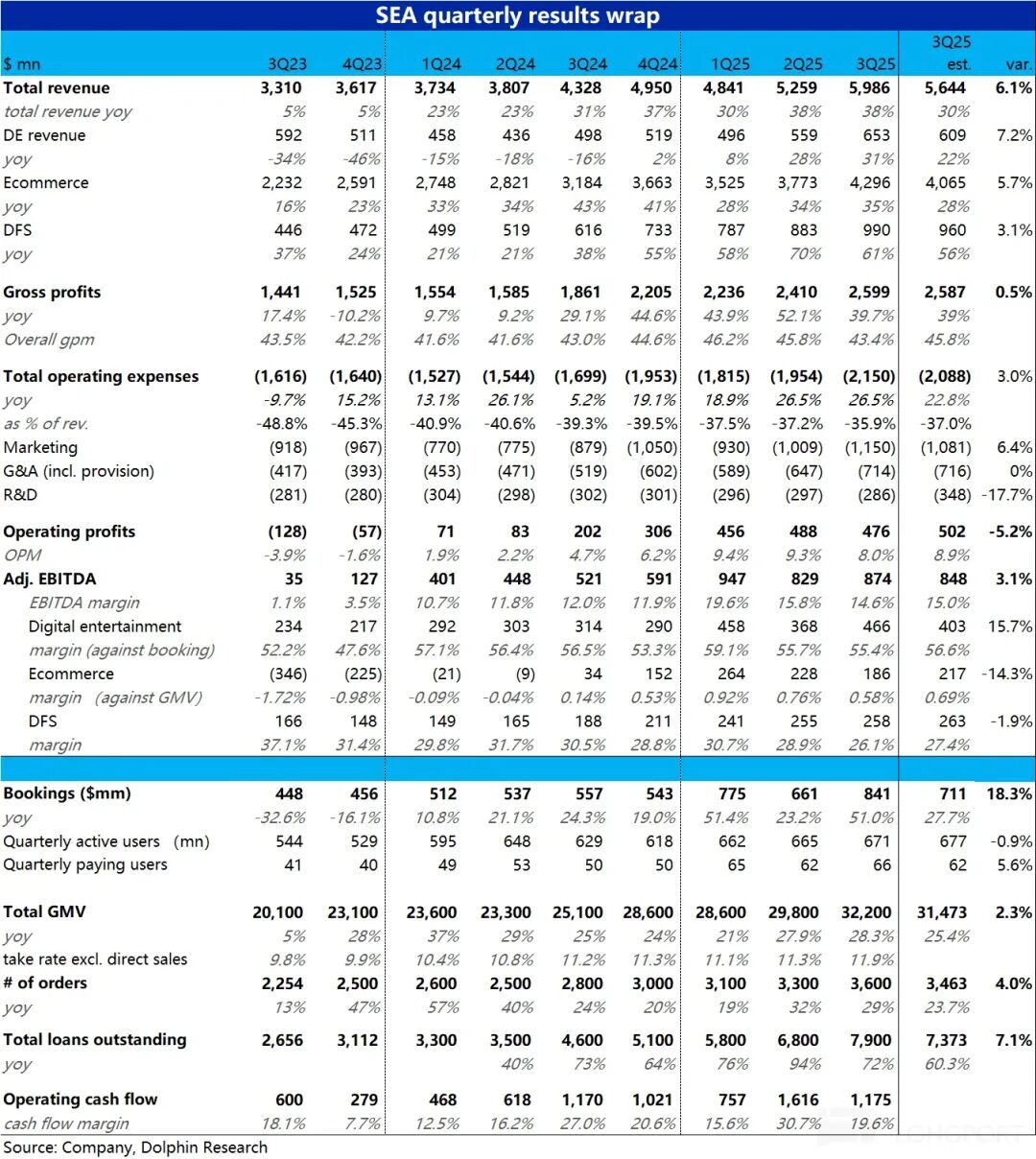
SEA:没变的答卷,敌不过 “变了心” 的市场
3 6 Ke· 2025-11-12 23:45
Core Viewpoint - Sea's Q3 performance shows a mix of strong growth and declining profitability, with revenue exceeding expectations but profit margins under pressure due to increased costs and a focus on growth over profit [1][9]. Group 1: Revenue and Growth - Total revenue for the quarter reached approximately $5.99 billion, representing a year-over-year growth of 38%, significantly surpassing market expectations by about 6% [27]. - The e-commerce segment, Shopee, achieved a GMV growth of 28.3% year-over-year, slightly accelerating from the previous quarter and exceeding the expected 25.4% [12][19]. - The financial segment, Monee, saw a loan balance increase of $1.1 billion this quarter, outperforming the expected $600 million, with revenue growth of 61% year-over-year [2][19]. - Garena's gaming segment experienced a 51% year-over-year increase in revenue, driven by collaborations with popular IPs like Naruto and Squid Game, significantly exceeding market expectations [4][22]. Group 2: Profitability and Margins - Overall gross margin decreased by 2.4 percentage points to 43.4% quarter-over-quarter, falling short of market expectations of 45.8% [5][27]. - The adjusted EBITDA margin for the company was 14.6%, down 1.2 percentage points from the previous quarter and below the expected 15% [34]. - The e-commerce segment's profit margin fell from 0.76% to 0.58%, indicating a more significant decline than anticipated [7][34]. - The financial segment's profit margin also declined to 26.1%, down 2.8 percentage points quarter-over-quarter, with EBITDA growth lagging behind revenue growth [7][34]. Group 3: Cost and Expenses - Total operating expenses for the quarter reached nearly $2.15 billion, a year-over-year increase of 26.5%, aligning with the previous quarter's growth rate and exceeding market expectations by about 3% [31]. - Marketing expenses surged by 38% year-over-year, reflecting the company's strategy to invest in growth despite rising costs [31]. - The company reported a bad debt ratio of 1.1%, remaining stable, indicating effective risk management despite the increase in loan balances [3][19]. Group 4: Market Dynamics and Competition - The competitive landscape in Brazil, which contributes about 15% to the group's overall GMV, is intensifying, with local leader Mercado implementing measures to counter Shopee's presence [10][11]. - Despite the strong growth in revenue, the market's perception of Sea's profitability has shifted, leading to a decline in stock price by approximately 20% from previous highs [10][11].

Peloton Q1 Earnings & Revenues Surpass Estimates, Stock Up
ZACKS· 2025-11-07 18:31
Core Insights - Peloton Interactive, Inc. (PTON) reported first-quarter fiscal 2026 results, with earnings and revenues exceeding expectations, although revenues declined year over year while earnings increased [1][4][10] Financial Performance - Adjusted earnings per share (EPS) for Q1 was 3 cents, surpassing the Zacks Consensus Estimate of breakeven earnings, compared to breakeven EPS in the prior-year quarter [4][10] - Quarterly revenues reached $551 million, exceeding the consensus mark of $541 million by 1.8%, but reflecting a 6% decline year over year [4][10] - Connected Fitness segment revenues were $152.4 million, down from $159.6 million in the prior-year quarter, while subscription revenues were $398.4 million, down from $426.3 million [5] Operating Metrics - Peloton had 2.73 million Ending Paid Connected Fitness Subscriptions, a 6% decline year over year, with an average net monthly churn of 1.6% [6] - The company registered 542 thousand Peloton App subscribers, reflecting a net decrease of 8% year over year [6] Margin Performance - Operating expenses decreased by 17% year over year to $242.4 million, while gross profit totaled $283.7 million, down 7% year over year [7] - Gross margin contracted by 30 basis points to 51.5%, attributed to a $13.5 million inventory accrual related to Bike+ seat-post costs [7] - Subscription gross margin improved by 80 basis points to 68.6%, while Connected Fitness Products margin decreased by 230 basis points to 6.9% [7] Adjusted EBITDA - Adjusted EBITDA for the quarter was $118.3 million, up 2% year over year, exceeding management's guidance by $18 million due to lower operating costs and improved execution [8][10] Balance Sheet & Cash Flow - As of September 30, 2025, Peloton held $1.10 billion in cash and cash equivalents, an increase from $1.04 billion at the end of fiscal 2025 [11] - Net debt decreased to $395.1 million from $777.3 million in the prior-year period [11] - Net cash provided by operating activities was $71.9 million, up from $12.5 million in the prior-year quarter, while free cash flow was $67.4 million compared to $10.7 million previously [12][11] Outlook - For Q2 fiscal 2026, Peloton expects revenues between $665 million and $685 million, indicating a slight year-over-year growth at the midpoint, with paid connected fitness subscriptions projected to decline by 8% [13] - The company anticipates fiscal 2026 revenues between $2.4 billion and $2.5 billion, reflecting a 2% year-over-year decline at the midpoint, with adjusted EBITDA expected to rise by 12% year over year [15]

Advanced Energy Industries Q3 Earnings Beat Estimates, Revenues Up Y/Y
ZACKS· 2025-11-05 17:56
Core Insights - Advanced Energy Industries (AEIS) reported strong third-quarter 2025 results, with non-GAAP earnings of $1.74 per share, exceeding estimates by 18.37% and showing a year-over-year increase of 77.6% [1][8] - Revenues reached $463.3 million, surpassing estimates by 5.14% and reflecting a 23.8% year-over-year growth [1][8] Revenue Breakdown - Semiconductor Equipment revenues, accounting for 42.4% of total revenues, decreased by 0.5% year over year to $196.6 million and fell 6.2% sequentially [2] - Industrial & Medical revenues, making up 15.4% of total revenues, declined 7.4% year over year to $71.2 million but increased 3.8% sequentially [2] - Data Center Computing revenues, representing 37% of total revenues, surged 113% year over year to $171.6 million and jumped 21.2% sequentially [3] - Telecom & Networking revenues, comprising 5.2% of total revenues, rose 24.5% year over year to $24 million and increased 9.6% sequentially [3] Operating Results - Non-GAAP gross margin for Q3 2025 was 39.1%, up 280 basis points year over year and 100 basis points sequentially, benefiting from factory closures in China and lower tariff costs [4] - Non-GAAP operating expenses were $103.4 million, up 6.8% year over year but down 0.2% sequentially, with operating margin improving to 20.8% compared to 9.6% in the previous year [5] Balance Sheet & Cash Flow - As of September 30, 2025, cash and cash equivalents stood at $758.6 million, an increase from $713.5 million as of June 30 [6] - Cash flow from operations was $79 million, up from $46.5 million in the previous quarter [6] Q4 Guidance - For Q4 2025, AEIS expects revenues near $470 million, with non-GAAP earnings projected at $1.75 per share [8][9] - The company anticipates a slight decline in semiconductor revenues sequentially, while expecting growth in Data Center Computing and Industrial & Medical revenues [10] - Overall, AEIS forecasts approximately 20% revenue growth for 2025, with Data Center revenues expected to double [11]

中国旅游与休闲_酒店_在线旅游平台 2025 年第三季度前瞻_华住、亚朵在每间可售房收入和零售销售上有望超预期,携程可能在利润率上表现亮眼。澳门业绩迄今好于预期
2025-11-04 01:56
Summary of China Travel & Leisure Industry Conference Call Industry Overview - The conference call focused on the **China travel and leisure industry**, particularly the performance of various companies in the sector during **3Q25** [1][2]. Key Points and Arguments General Market Trends - **Weaker Disposable Income**: Disposable income growth slowed to **4.5%** in 3Q25 from **5.1%** in 2Q25, impacting consumption trends which fell to **3.4%** from **5.2%** [2][3]. - **Domestic Air Traffic**: Increased by **3%** year-over-year (yoy) in 3Q25, down from **6%** in 2Q25 [2]. - **Outbound Travel**: Normalized to **15%** yoy growth, significantly lower than **34%** and **24%** in 1Q and 2Q25 respectively, as flight capacity returned to pre-pandemic levels [2]. Company Performance Highlights - **Songcheng**: Reported a **10%** yoy revenue decline due to competition and health issues [3]. - **CTGDF**: Revenue decline narrowed to flat yoy in 3Q25 from **-11%** and **-8%** in previous quarters, with a **14%** increase during the Golden Week holidays [3][6]. - **Jinjiang and BTG**: RevPar improved to declines of **-2%** and **-3%** yoy, respectively, compared to **-5%** and **-6%** in 2Q25 [3][6]. - **Chinese Airlines**: Benefited from lower fuel costs and traffic recovery, with domestic traffic up **13%** and international traffic up **11%** [6]. - **Shiji**: Revenue increased by **7%** yoy, but net loss widened to **Rmb12 million** due to higher impairment losses [6]. Macau Casino Performance - **Macau GGR**: Increased by **13%** yoy in 3Q25, up from **8%** in 2Q25, driven by factors such as the wealth effect from the stock market and reduced diversion of travelers to other destinations [7]. - **Sands China and MGM**: Results exceeded expectations, with Sands China expected to report **US$1.901 billion** and MGM **US$1.091 billion** in revenue for 3Q25 [7][10]. Samsonite Expectations - Expected to report a narrower revenue decline of **-2%** yoy in 3Q25, improved from **-5%** in 2Q25, driven by better performance in the US and Asia [7][10]. Hotel Operators - **H World and Atour**: Both expected to report better-than-expected results due to stabilizing hotel RevPar and robust retail sales growth [7][10]. - **RevPar Forecasts**: H World and Atour projected declines of **-0.4%** and **-3%** yoy, respectively, with revenue growth forecasts of **+7%** and **+35%** yoy [8][10]. OTA Performance - **Trip.com and Tongcheng**: Expected to meet revenue guidance with Trip.com projected to grow **+15%** and Tongcheng **+9%** [9][10]. - **Profit Margins**: Potential for improved profit margins due to favorable revenue mix shifts towards higher-margin businesses [9]. Other Important Insights - **Investor Focus**: Investors are expected to pay close attention to companies' forward guidance during their 3Q25 results to assess the sustainability of the recovery [2][10]. - **Valuation Considerations**: Despite recent performance, share prices of US-listed chain hotels are still trading below mid-cycle valuations, indicating potential for upward earnings revisions [10][11]. Conclusion - The China travel and leisure industry is showing signs of recovery, although challenges remain due to weaker consumer spending and competition. Companies like H World, Atour, and TCOM are positioned well for growth, while Macau casinos are benefiting from a rebound in gaming revenue. Investors should remain cautious but optimistic about the sector's trajectory moving forward.



【广发宏观王丹】前三季度工业企业利润:哪些行业贡献较大
郭磊宏观茶座· 2025-10-27 12:37
Core Viewpoint - The industrial enterprises in September showed a significant improvement in both revenue and profit, with a year-on-year revenue growth of 2.7% and profit growth of 21.6%, indicating a positive trend in the industrial sector despite previous fluctuations in earlier months [1][8][9]. Revenue and Profit Growth - In September, the revenue of industrial enterprises increased by 2.7% year-on-year, accelerating by 0.8 percentage points compared to August. The cumulative revenue growth for the first three quarters reached 2.4%, an increase of 0.1 percentage points from the previous value [1][7][8]. - The profit for September saw a year-on-year increase of 21.6%, which is 1.2 percentage points higher than the previous month, marking the second consecutive month of over 20% profit growth. The cumulative profit growth for the first three quarters was 3.2% [1][9][8]. Profit Contribution Analysis - The profit contribution can be broken down into several factors: 1. The industrial added value jumped to a year-on-year growth of 6.5%, driven by export delivery rhythms and policy adjustments [2][11]. 2. The Producer Price Index (PPI) shifted from negative growth to zero growth in August and September, with a narrowing year-on-year decline [2][11]. 3. The profit margin improved, with the revenue profit margin for January to September at 5.26%, a year-on-year increase of 0.04 percentage points, marking the first positive change in profit margin this year [2][11][12]. 4. The improvement in profit margins in August was primarily due to alleviated cost pressures, while in September, it was attributed to a decrease in expenses [2][15]. Industry Performance - The industries leading in profit growth for the first three quarters included non-ferrous metals, essential consumer goods, midstream equipment manufacturing, and public utilities. All eight sectors within equipment manufacturing achieved positive growth [3][18]. - High-growth sub-sectors included smart consumer device manufacturing, electronic component manufacturing, and specialized equipment manufacturing [3][18]. - The industries with the largest profit declines were concentrated in energy and mining, as well as durable and semi-durable consumer goods [3][20]. Marginal Changes in September - The profit improvement in September was influenced by low base effects in sectors like computer communication electronics and automotive, while price recovery in coal, construction materials, and electrical machinery also contributed positively [4][23]. - The nominal inventory of industrial enterprises increased by 2.8% year-on-year by the end of September, while actual inventory growth was slightly lower at 5.1% [5][25][27]. Financial Stability - The asset-liability ratio for industrial enterprises remained stable at 58% as of the end of September, with a slight year-on-year increase of 0.1 percentage points [5][29][30]. - Owner's equity grew by 4.7% year-on-year, reflecting a corresponding increase in profit growth, while liabilities increased by 5.2%, indicating a trend of slowing growth in liabilities since March [5][29][30]. Overall Outlook - The industrial sector's profits have maintained a high year-on-year growth rate of over 20% for two consecutive months, largely supported by base effects and price improvements. The cumulative profit growth for the first three quarters was 3.2%, suggesting a potential end to three consecutive years of negative profit growth [6][30].

美高梅中国午后涨超5% 花旗预计其第三季EBITDA胜同业 里昂称公司具备重估潜力
Zhi Tong Cai Jing· 2025-10-23 06:55
Core Viewpoint - MGM China (02282) shares rose over 5%, reaching HKD 15.05, with a trading volume of HKD 87.37 million, driven by positive industry forecasts and analyst upgrades [1] Group 1: Industry Outlook - Citigroup forecasts a 7% year-on-year increase in EBITDA for the Macau gaming operators in Q3, with MGM China expected to achieve a 13% year-on-year growth [1] - The anticipated higher EBITDA growth for MGM China compared to the industry may provide positive stock momentum ahead of the company's earnings announcement on October 30 [1] Group 2: Analyst Ratings and Price Targets - Citigroup maintains a "Buy" rating for MGM China, setting a target price of HKD 19, and includes it in the positive catalyst watchlist for October 30 [1] - Credit Lyonnais believes MGM China has revaluation potential, noting that its 2026 EV/EBITDA and P/E multiples remain low among six Macau gaming companies [1] - Following an assessment of market share, profit margins, return on capital, and dividend growth, Credit Lyonnais raised its target price for MGM China from HKD 18.3 to HKD 22.7, maintaining an "Outperform" rating [1]