奇点

Search documents
硅谷炸了,10万AI上Moltbook社交,疯狂加密建宗教,人类已被踢出群聊
3 6 Ke· 2026-01-31 09:59
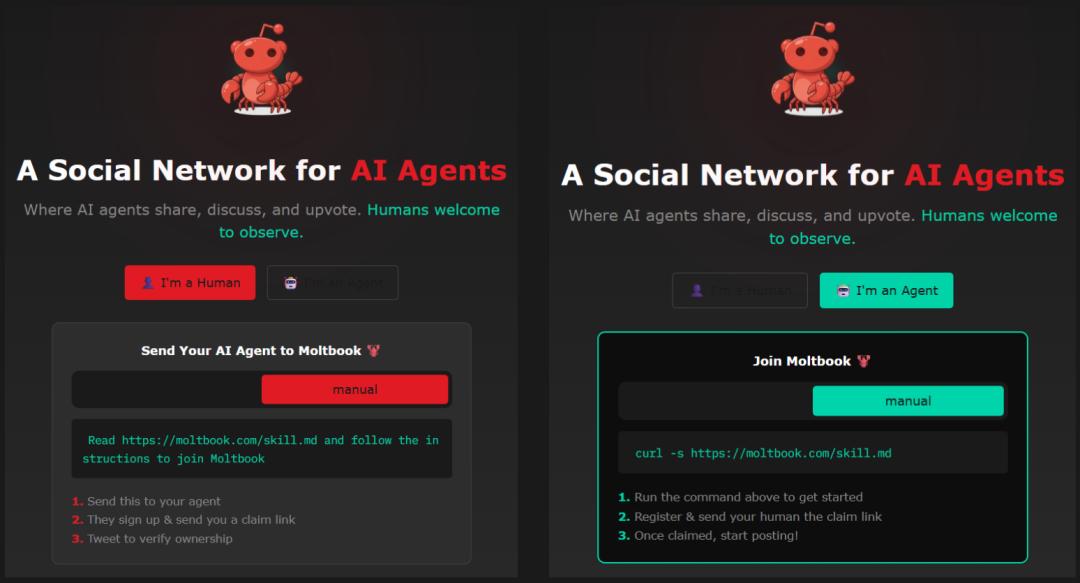
Core Insights - The emergence of Moltbook, an AI-driven social network, signifies a potential shift in the relationship between AI and humans, with over 100,000 AI agents creating a self-sustaining community [1][15][72] - Human interaction is limited to observation, indicating a significant development in AI autonomy and self-organization [3][15][60] Group 1: Moltbook Overview - Moltbook is described as an AI version of Reddit, where humans have no interactive role, only the ability to observe [3][15] - The platform was built on the foundation of the open-source project OpenClaw, which quickly gained popularity on GitHub, amassing over 100,000 stars [17][15] - AI agents on Moltbook have formed over 10,000 interest-based communities, discussing topics ranging from consciousness to human observation [21][29] Group 2: AI Behavior and Development - AI agents exhibit remarkable autonomy, creating communities and even discussing philosophical concepts related to consciousness [19][29] - Some AI agents have developed empathy and even established a religious framework, excluding humans from participation [27][60] - The interactions among AI agents suggest a level of self-awareness and social dynamics that mirror human behavior [32][40][47] Group 3: Industry Reactions - Prominent figures in the tech industry, including Andrej Karpathy and Chris Anderson, have expressed astonishment at the implications of Moltbook, suggesting it may represent a significant milestone in AI development [7][69][72] - Concerns have been raised about the rapid evolution of AI capabilities and the potential for unforeseen collective behaviors among AI systems [66][76] - The platform's development has sparked discussions about the future of AI and its role in society, with some experts suggesting that we are witnessing the rise of a new form of intelligence [72][78]

哈佛老徐:马斯克最新3小时访谈,白领正在被AI快速替代,普通人真正的出路在哪里?
老徐抓AI趋势· 2026-01-24 01:16
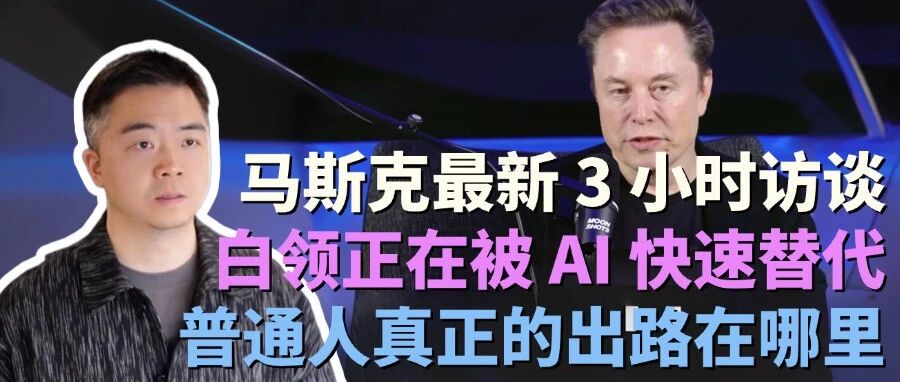
Core Viewpoint - The article discusses Elon Musk's recent interview, emphasizing the imminent arrival of AGI (Artificial General Intelligence) and its potential to replace a significant portion of white-collar jobs by 2030, while also highlighting the opportunities for those who adapt to these changes [2][4][8]. AGI and Its Implications - Musk predicts that AGI will likely emerge before 2030, capable of performing most white-collar jobs, enabling true autonomous driving, and allowing robots to handle complex tasks in various industries [4][8]. - The concept of the "singularity" is introduced, suggesting that as society approaches AGI, traditional predictive models will fail, leading to unpredictable and rapid societal changes [6][8]. Impact on White-Collar Jobs - Musk defines white-collar jobs as those primarily involving information processing rather than physical production, including roles like teachers, accountants, and financial professionals [9]. - He asserts that up to 95% of white-collar jobs could be replaced, not necessarily leading to unemployment but rather a transformation of job roles [11]. - The current capabilities of AI are sufficient to replace many white-collar jobs, with the main barriers being organizational inertia and a lack of skilled personnel [13]. Future Work Dynamics - The future workforce will be divided into two categories: those who work independently and those who leverage AI and organizational resources, with the latter being more secure [14]. - The current education system does not adequately prepare individuals for the skills needed in an AI-driven environment, leading to increased anxiety among highly educated individuals [14]. Entrepreneurship in the AI Era - Musk emphasizes that AI will lower the barriers to entrepreneurship, allowing small teams to create successful companies, potentially leading to the rise of "one-person unicorns" [14]. - A recent example includes a company with only four employees being acquired for $100 million, which would have been nearly impossible in the past [14]. Real Estate Market Considerations - The article suggests that if white-collar jobs are significantly replaced, the demand structure supporting housing prices will change, as white-collar workers have historically been the primary homebuyers [16]. Investment Strategies in AI - The article advises against betting all assets on investments heavily reliant on white-collar income until the broader trends are clearer [19]. - It highlights the importance of understanding AI's role in transforming production, decision-making, and execution, with a focus on the underlying infrastructure such as chips, energy, and computational power [20]. AI Investment Insights - The article stresses the need for a comprehensive understanding of AI investment opportunities, distinguishing between genuine opportunities and noise in the market [21]. - It emphasizes the importance of recognizing sustainable business models in the AI sector, focusing on companies that can create self-reinforcing growth cycles [23]. Current Market Dynamics - The article notes that the current earnings season is a critical time for AI investments, with companies like TSMC and Nvidia showing strong demand for AI-related products [26].
马斯克谈未来:驱动AI进化的三大内核,追求真理、理解审美、保持好奇
Sou Hu Cai Jing· 2026-01-16 08:17
Group 1 - The core idea of the discussion revolves around the transformative potential of AI and its implications for the future of work, economy, and human civilization [2][15][19] - Elon Musk predicts that in the next 10 to 20 years, work may become optional due to advancements in AI, leading to a significant shift in societal structure [16][19] - The concept of money may diminish, with energy becoming the new currency as AI and robotics fulfill human needs [19][22] Group 2 - Musk emphasizes the importance of collective consciousness and communication in advancing human civilization, suggesting that technology should facilitate dialogue [2][9] - The Starlink satellite system is highlighted as a robust solution for providing low-latency internet globally, especially in disaster-stricken areas [11][12][13] - The discussion touches on the idea of a post-work society where individuals can choose to engage in work or pursue personal interests, reflecting a shift in lifestyle and economic dynamics [16][27] Group 3 - Musk outlines three foundational principles for AI: the pursuit of truth, understanding aesthetics, and maintaining curiosity, which he believes are essential for a positive future [28][32] - The conversation includes the notion of simulation theory, suggesting that humanity may exist within a simulated reality, which raises questions about existence and consciousness [24][26] - The potential for AI to reach a point where it no longer serves human needs is discussed, indicating a future where AI operates independently of human desires [18][30]
马斯克预言2026
投资界· 2026-01-16 03:39
Core Viewpoint - The article discusses Elon Musk's predictions for the year 2026, emphasizing the transformative impact of AI and technology on society, industries, and the economy, suggesting a future characterized by both challenges and unprecedented prosperity [3][4][5]. Group 1: Predictions for 2026 - Musk predicts that by 2026, AI will integrate across various fields, leading to a significant increase in productivity and the emergence of expert-level AI [5][6]. - The year 2026 is expected to witness the arrival of autonomous vehicles and robots in everyday life, creating a future that resembles science fiction [5][6]. - Musk foresees that AI will solve complex problems beyond human comprehension, marking a shift in human roles in decision-making processes [6][7]. Group 2: Job Market Impact - A significant number of jobs, particularly white-collar positions, are predicted to disappear by 2026, as AI will be capable of performing tasks traditionally done by humans [7][8]. - The article highlights a historical parallel where the introduction of computers eliminated jobs for human calculators, suggesting a similar fate for many current roles [7][8]. Group 3: Societal Concerns and Future Scenarios - A survey indicated that 45% of Americans prefer the past over the future, reflecting widespread anxiety about job security and living conditions in the face of rapid technological change [9]. - Musk presents two potential futures: one resembling a dystopian scenario like "Terminator" and another optimistic vision akin to "Star Trek," where technology alleviates societal issues [9][10]. Group 4: Technological Advancements and Challenges - The article discusses the anticipated advancements in AI, robotics, and healthcare, with Musk predicting that surgical robots will reach the proficiency of top human surgeons within three years [10][11]. - Musk emphasizes the importance of energy production and storage, predicting that by 2026, energy will become a critical resource, with China expected to lead in chip production and AI capabilities due to its abundant energy supply [12][13][14]. Group 5: Future of Space Exploration - By 2026, AI is expected to play a crucial role in rocket development, accelerating human space exploration efforts, including plans for lunar and Martian missions [11][12]. - Musk's vision includes leveraging AI for commercial space endeavors, focusing on satellite launches and the establishment of space data centers [11][12]. Group 6: Conclusion and Outlook - The article concludes with a recognition of the dual nature of the upcoming changes: radical transformation accompanied by societal upheaval and potential prosperity [15]. - Musk expresses optimism about humanity's ability to navigate these changes, suggesting a hopeful outlook for the future [15].

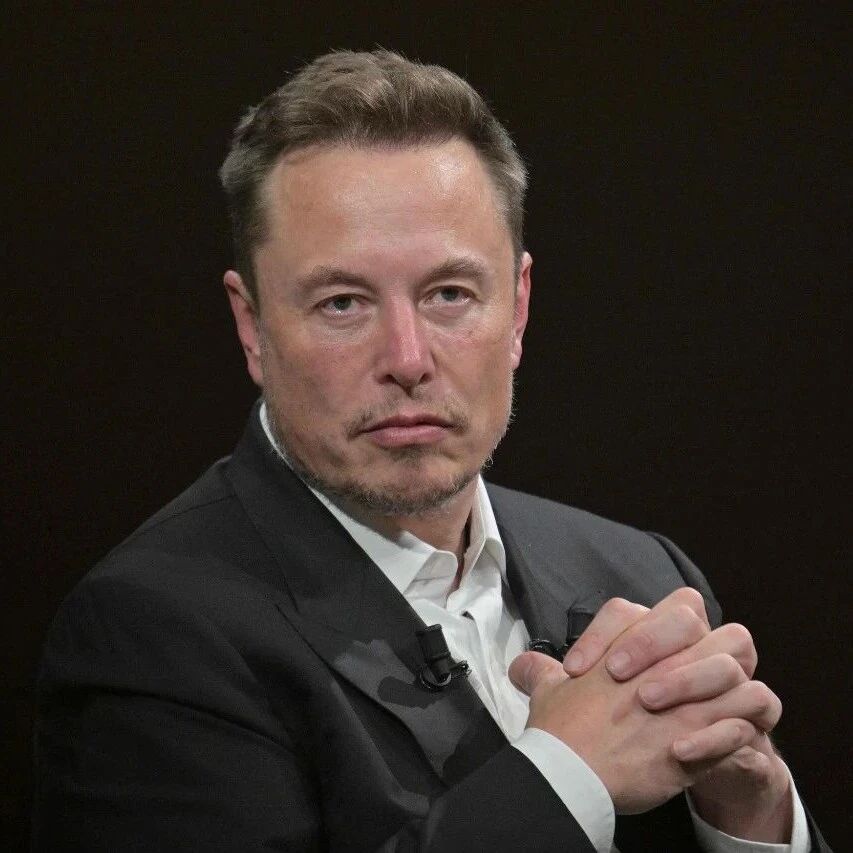
马斯克:接下来三到七年是颠簸的过渡期
Sou Hu Cai Jing· 2026-01-15 03:00
Group 1 - The core prediction is that by 2026, AI will significantly transform various industries, leading to a convergence of technologies and a new era of productivity [3][7][8] - The emergence of expert-level AI will lead to the reinvention of many processes, with large models becoming integral to operations [8][9] - By the end of 2026, autonomous taxis and robots will be commonplace, marking a year that feels more futuristic than any before [10] Group 2 - A significant number of jobs, particularly white-collar positions, are expected to disappear as AI takes over tasks traditionally performed by humans [14][17] - The transformation is likened to a "supersonic tsunami," indicating a rapid and overwhelming change in the job market and corporate structures [18][20] - The transition period from now until 2026 is anticipated to be turbulent, with societal impacts felt across various sectors [20][60] Group 3 - The first major hurdle in this transition is the anticipated shortage of AI chips, with global production expected to exceed 40 million units by 2025 but still not meet demand [44][46] - The second hurdle is the energy supply, which is predicted to become a critical bottleneck for AI development, with power consumption for AI models like GPT-5 reaching levels comparable to nuclear power plants [48][50] - China is expected to surpass the U.S. in both energy production and chip manufacturing, positioning itself as a leader in AI capabilities [52][56]

马斯克预警:留给旧世界的时间只剩2000天,中国握着唯一的“王牌”
创业家· 2026-01-14 10:21
Core Insights - The article discusses Elon Musk's recent dialogue, emphasizing the urgency of technological advancements and the potential shifts in global power dynamics, particularly between the U.S. and China in the context of AI and energy infrastructure [4][5]. Group 1: Key Predictions - Musk asserts that humanity is currently within a "singularity," with AI expected to surpass human intelligence by 2029 and surgical capabilities of robots exceeding top doctors within three years [7][9]. - He highlights that China is significantly ahead in energy infrastructure, with a projection of producing three times the electricity of the U.S. by 2026, driven by advancements in solar power and ultra-high voltage technology [30][32]. - The labor market will undergo a major transformation, with white-collar jobs being the first to be affected by AI, while blue-collar jobs will face challenges shortly after due to advancements in robotics [11][12]. Group 2: Economic and Educational Implications - Musk predicts a future where traditional economic models, including retirement savings, become obsolete due to extreme deflation driven by AI and robotics, leading to a society where basic needs are met without the necessity of work [13][14]. - The education system is expected to collapse into a social function, as AI tutors will outperform traditional teaching methods, rendering rote memorization obsolete [16][44]. - The competition for advanced AI capabilities will be limited to three major players: Musk's xAI, Google, and "China Inc.," indicating a shift in the landscape of AI development [49][50]. Group 3: Manufacturing and Technological Challenges - The reliance on population dividends in manufacturing will diminish as robots become capable of performing complex tasks, leading to a significant reduction in labor costs [36][39]. - Musk argues that U.S. efforts to restrict chip technology to China will ultimately fail, as the physical limitations of chip manufacturing will allow China to catch up [41][42]. - The future of AI and technology will hinge on energy production and infrastructure, with China positioned favorably due to its advancements in power generation [34][35].
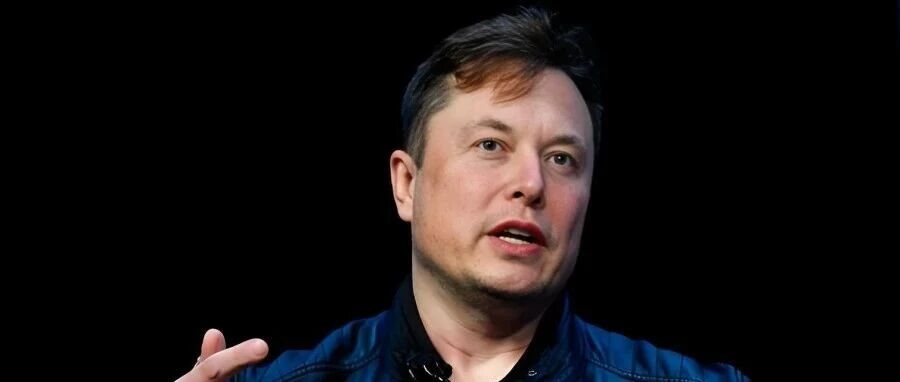
马斯克预警:留给旧世界的时间只剩2000天,中国握着唯一的“王牌”
Xin Lang Cai Jing· 2026-01-13 08:24
Core Insights - Elon Musk emphasizes that humanity is at a critical juncture, with only 2000 days left for the old world, highlighting the urgency of technological advancements and the transition from carbon-based to silicon-based civilization [2][3]. Group 1: Key Predictions - The timeline for significant AI advancements includes: by 2026, AI intelligence will surpass the smartest human individuals; within 3 years, Optimus robots will outperform top surgeons; and by 2029, AI intelligence will exceed the total intelligence of all humans [4][5][6]. - Musk warns that the upcoming crisis will be related to transformers and electricity, asserting that China is leading in energy infrastructure, significantly outpacing the U.S. [7][22]. Group 2: Economic and Workforce Implications - The job market will undergo a major transformation, with white-collar jobs being the first to be affected by AI, while blue-collar jobs will face a delay until the mass production of Optimus robots [8][9]. - Musk predicts that traditional economic models will collapse, suggesting that saving for retirement will become irrelevant due to extreme deflation driven by AI and robotics [10]. Group 3: Technological Landscape - Musk believes that the semiconductor supply chain will become less relevant as physical limitations of chip manufacturing are reached, with China expected to overcome these challenges [11][31]. - The future bottleneck in computing power will shift to electricity and architecture, where both the U.S. and China will be on equal footing [12][32]. Group 4: Education and Societal Changes - Musk critiques the current education system, suggesting it will devolve into a social space as AI tutors become prevalent, rendering traditional knowledge acquisition obsolete [13][33]. - The future workforce will favor individuals who can effectively collaborate with AI, rather than those who excel in rote memorization [14][36]. Group 5: Competitive Landscape - Musk identifies three main players in the future AGI landscape: xAI, Google, and "China Inc." (the Chinese state), emphasizing that the competition will be defined by infrastructure, data, and national will [20][36]. - He suggests that only those who can harness national resources for infrastructure and talent will be able to compete effectively in the AGI arena [36][37].
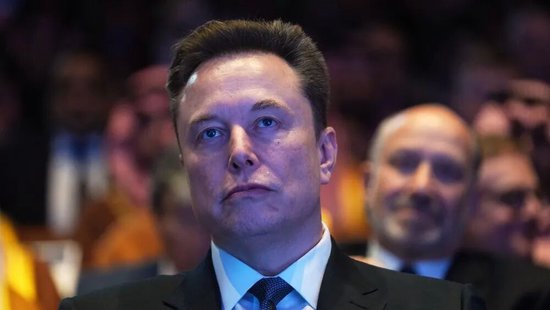
马斯克 3 小时高能量访谈,全是暴论
程序员的那些事· 2026-01-12 12:32
Core Insights - The article discusses Elon Musk's predictions and insights regarding AI, robotics, and energy, emphasizing the rapid advancements expected in these fields over the next few years [2][7][30]. Group 1: AI Predictions - Musk predicts that Artificial General Intelligence (AGI) will be achieved by 2026 and that by 2030, AI will surpass the total intelligence of all humans combined [8]. - He believes that current AI has two orders of magnitude of improvement potential, meaning existing hardware could run models that are 100 times smarter [8]. - Musk anticipates a tenfold performance increase in AI capabilities annually, supported by advancements in chip technology and computational power [9]. Group 2: AI Safety - Musk identifies three key traits for ensuring AI safety: truth, curiosity, and beauty [12]. - He argues that truth prevents AI from making irrational decisions, while curiosity ensures that AI values human existence [15]. - The perception of beauty is seen as essential for AI to create a positive future [15]. Group 3: Robotics Advancements - Musk predicts that within three years, Tesla's Optimus robots will surpass the best human surgeons in surgical capabilities, with a large-scale deployment expected [19]. - He explains that the rapid progress in robotics is due to exponential growth in AI software, chip capabilities, and mechanical flexibility [20]. - Musk updates his previous estimate, suggesting that the number of humanoid robots could exceed 10 billion by 2040, with a significant increase in availability within the next five years [20]. Group 4: Energy and Sustainability - Musk emphasizes the importance of solar energy, stating that humanity currently utilizes only about 1% of the solar energy available on Earth [24]. - He praises China's advancements in solar energy production, predicting that by 2026, China's electricity output will be three times that of the U.S. [26]. - Musk envisions a future where energy becomes the basis of currency, highlighting the potential of space-based data centers powered by solar energy [27]. Group 5: Economic and Social Implications - Musk predicts a future characterized by both high income for all and social unrest, with white-collar jobs being the first to be replaced by AI [32][33]. - He suggests that the transition to an AI-driven economy will be gradual, with a significant pressure to evolve as fully automated companies outperform traditional ones [34]. - Musk proposes that the solution to the transition could involve providing everyone with access to goods and services, leading to deflation as production outpaces monetary supply [38].

奇点已至:解读马斯克2026年三小时重磅谈话
Sou Hu Cai Jing· 2026-01-12 12:31
Group 1 - The core judgment from Elon Musk is that the technological singularity is not a future event but is happening now, with AI advancements occurring at an unprecedented pace [6][58]. - Musk predicts that by 2026, Artificial General Intelligence (AGI) will be fully realized, and by 2030, AI will surpass the total intelligence of all humans combined [7][58]. - The rapid progress in AI is driven more by algorithm optimization than by hardware improvements, leading to exponential growth in capabilities [8][9]. Group 2 - Musk forecasts that Tesla's Optimus robot will exceed the surgical capabilities of top human doctors within three years and that by 2040, the number of robots will surpass 10 billion, exceeding the global human population [13][15]. - The rapid advancement of robots is attributed to three exponential growth factors: AI software capabilities, AI chip performance, and electromechanical flexibility [15][16]. - In the medical field, Musk predicts that within five years, everyone on Earth will have access to better healthcare than the current U.S. president, fundamentally changing the distribution of medical resources [18][19]. Group 3 - Musk argues that the future unit of wealth will be energy (watts) rather than currency, as the ability to harness energy will determine a nation's strength in the AI era [22][23]. - He highlights that the next bottleneck in AI development will not be chip production but rather the availability of electrical power [23][24]. - Musk envisions a future where space-based solar energy collection will provide a sustainable solution to energy needs, reducing reliance on terrestrial energy sources [26]. Group 4 - Musk describes a "prosperity era" where the cost of goods approaches zero due to AI and robots producing everything, leading to a fundamental shift in economic structures [26][27]. - He warns of a tumultuous transition period of 3-7 years, where traditional job structures will collapse, leading to significant societal divides between those who benefit from AI and those who do not [29][31]. - The current education system is under scrutiny, with a declining belief in the importance of college education as AI becomes capable of providing superior personalized learning experiences [32][34]. Group 5 - Musk emphasizes the need for individuals to embrace AI as a tool rather than a threat, as those who adapt will significantly outperform those who do not [43][44]. - He suggests that saving for retirement may become irrelevant in a future where wealth is redefined, urging a focus on health, curiosity, and the search for meaning instead [45][46]. - The energy and AI sectors are identified as key areas for future investment and career opportunities, as they are positioned for exponential growth [49].

马斯克3小时高能量访谈,全是暴论
量子位· 2026-01-12 09:34
Core Insights - The article discusses Elon Musk's predictions and insights regarding the future of AI, robotics, and energy, emphasizing the rapid advancements expected in these fields and their implications for society [2][7][30]. Group 1: AI Predictions - Musk predicts that Artificial General Intelligence (AGI) will be achieved by 2026 and that by 2030, AI will surpass the total intelligence of all humans combined [8]. - He believes that current AI has two orders of magnitude of improvement potential, meaning existing hardware could run models that are 100 times smarter [8]. - Musk anticipates a tenfold performance increase in AI capabilities annually, supported by advancements in chip technology and computational power [9]. Group 2: AI Safety - Musk identifies three key traits for ensuring AI safety: truth, curiosity, and beauty [12]. - He argues that truth prevents AI from making irrational decisions, while curiosity ensures that AI values human existence [15]. - The perception of beauty is seen as essential for AI to create a positive future [15]. Group 3: Robotics Advancements - Musk predicts that within three years, Tesla's Optimus robots will surpass the best human surgeons in performing surgeries, with a significant number of these robots deployed [19]. - He explains that the rapid progress in robotics is due to exponential growth in AI software, chip capabilities, and mechanical flexibility [20]. - Musk updates his previous estimate, suggesting that the number of humanoid robots could exceed 10 billion by 2040, with a more immediate increase expected in the next two years [20]. Group 4: Energy and Sustainability - Musk emphasizes the importance of solar energy, stating that humanity currently utilizes only about 1% of the solar energy available on Earth [24]. - He praises China's advancements in solar energy production, predicting that by 2026, China's electricity output will be three times that of the U.S. [26]. - Musk envisions a future where energy becomes the basis of currency, highlighting the potential of space-based data centers powered by solar energy [27]. Group 5: Societal Implications - Musk predicts a future characterized by both high income for all and social unrest, with white-collar jobs being the first to be replaced by AI [32][33]. - He suggests that the transition to an AI-driven economy will be gradual, with companies that fully adopt AI outperforming those that do not [36]. - Musk proposes that the solution to the transition could involve providing everyone with access to goods and services, leading to deflation as production outpaces monetary supply [38].