
宏观经济不确定性

Search documents
These Analysts Revise Their Forecasts On Lowe's Following Q3 Earnings
Benzinga· 2025-11-20 16:56
Core Insights - Lowe's Companies, Inc. reported strong third-quarter earnings with adjusted EPS of $3.06, a 5.9% increase year over year, surpassing analyst expectations of $2.97, but sales of $20.813 billion fell short of the anticipated $20.823 billion [1] Financial Performance - The company updated its fiscal 2025 outlook, reducing comparable-sales expectations to 0% from a previous range of 0%–1%, while projecting capital spending of up to $2.5 billion [2] - Lowe's narrowed its fiscal 2025 adjusted EPS guidance to $12.25 from a prior range of $12.20 to $12.45, slightly below the analyst estimate of $12.29, but raised its sales outlook to $86.0 billion from $84.5 billion to $85.5 billion, exceeding expectations of $85.415 billion [3] Stock Performance and Analyst Ratings - Following the earnings announcement, Lowe's shares experienced a slight decline of 0.1%, trading at $228.16 [3] - Analysts have made various adjustments to their price targets for Lowe's, with Bernstein maintaining an Outperform rating and raising the target from $282 to $284, while Telsey Advisory Group lowered its target from $305 to $285, among other adjustments from different analysts [5]



机构调查显示英国消费者信心显著下滑
Zhong Guo Xin Wen Wang· 2025-11-20 13:29
Group 1 - The UK consumer confidence index has significantly declined in November, marking the largest monthly drop since April this year [1] - Consumer expectations regarding the economy for the next three months fell from -35% in October to -44% in November, while personal financial expectations dropped from -11% to -16%, both reaching their lowest levels since April [1] - The decline in consumer confidence is attributed to macroeconomic uncertainties, including previous government hints at potential income tax increases, which have impacted consumer spending willingness [1] Group 2 - Helen Dickinson, CEO of the British Retail Consortium, noted a decrease in public expectations for non-food retail goods and various consumer products as Christmas approaches [2] - Although UK inflation has decreased from its peak, core inflation remains above the 2% policy target, limiting consumer purchasing power and willingness due to stagnant wage growth compared to rising prices [2] - The upcoming annual budget announcement by Chancellor of the Exchequer, on November 26, is anticipated to include measures aimed at boosting consumer confidence and alleviating cost-of-living pressures to support economic growth [2]
Lowe's beats on quarterly sales, but lowers full-year profit forecast amid economic uncertainty
CNBC· 2025-11-19 11:22
Core Insights - Lowe's reported a year-over-year sales increase for the quarter but slightly lowered its full-year profit outlook due to a challenging economic environment [1][3] - The company expects full-year total sales to reach $86 billion, an increase from previous expectations of $84.5 to $85.5 billion, attributed to a recent acquisition [2] - Comparable sales are expected to be flat compared to the previous year, down from an earlier forecast of flat to up 1% [2] Financial Performance - For the fiscal third quarter, Lowe's net income decreased to $1.62 billion, or $2.88 per share, compared to $1.7 billion, or $2.99 per share in the same period last year [3] - Revenue for the quarter increased from $20.17 billion in the year-ago quarter to $20.81 billion, slightly below the expected $20.82 billion [3][9] - The adjusted earnings per share for the full year is now expected to be approximately $12.25, at the lower end of the previous range of $12.20 to $12.45 [3] Strategic Moves - Lowe's is focusing on attracting more business from contractors and home professionals to counteract weaker do-it-yourself sales [4][5] - The company recently acquired Foundation Building Materials for about $8.8 billion, which is expected to enhance its offerings to large residential and commercial professionals [5] - Earlier in the year, Lowe's announced the acquisition of Artisan Design Group for nearly $1.33 billion, further emphasizing its strategy to cater to professional markets [6] Market Context - The home improvement market is anticipated to remain roughly flat, as indicated by Lowe's CFO, who noted that the company's strategy, rather than an improving industry backdrop, will drive sales [7] - Competitor Home Depot has also lowered its full-year profit forecast, citing similar challenges such as a tough housing market and consumer uncertainty [4]
科技股、币圈、黄金“三杀”,美股跌破关键支撑位,美国市场遭遇“全面抛售”
Hua Er Jie Jian Wen· 2025-11-18 00:21
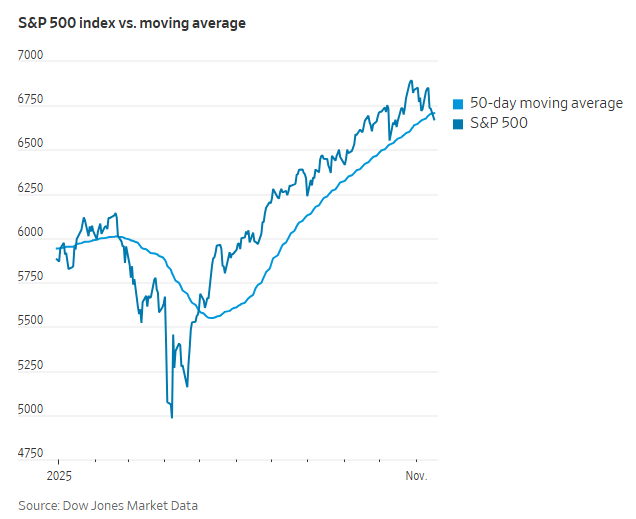
Market Overview - A significant sell-off swept through the U.S. financial markets on November 17, affecting nearly all asset classes, including tech stocks, cryptocurrencies, and gold, amid growing concerns over the sustainability of the AI boom and economic outlook [1][2] - The S&P 500 and Nasdaq Composite indices closed below their 50-day moving averages for the first time in 138 trading days, breaking the longest consecutive rise since May [1][5] - The Dow Jones Industrial Average experienced its worst three-day performance since April, closing down 1.2% or 557 points [1] Technology Sector Impact - The tech sector was particularly hard hit, with major stocks like Nvidia, Meta, and Amazon declining, despite Berkshire Hathaway increasing its stake in Alphabet, which saw a 3.1% rise [7] - The index tracking large tech stocks fell to its lowest closing point in nearly a month, indicating a weakening market sentiment [8][10] Credit Market Concerns - The sell-off in equities coincided with increasing pressure in the credit market, as credit spreads for investment-grade and high-yield corporate bonds widened, indicating rising concerns over corporate default risks [15][17] - Amazon's $15 billion bond issuance faced scrutiny, with the final pricing reflecting higher risk premiums, highlighting investor caution regarding tech giants' heavy borrowing for AI infrastructure [17][18] Cryptocurrency and Gold Performance - The cryptocurrency market was also severely impacted, with Bitcoin dropping below $92,000, erasing its gains for the year and forming a "death cross" technical pattern [3][22] - Gold prices fell to around $4,000 per ounce, losing its status as a safe-haven asset, while silver also dropped below the critical $50 mark [1][27] Economic Indicators and Investor Sentiment - Investor sentiment is clouded by macroeconomic uncertainties, with the Federal Reserve's policy path remaining unclear, leading to reduced expectations for a rate cut in December [26][30] - Mixed economic data, including a decline in non-residential construction spending and better-than-expected manufacturing surveys, have contributed to the cautious market outlook [28]
Robinhood, Coinbase Lead Crypto Stock Plunge as Investors Fret Over Macro Concerns
Yahoo Finance· 2025-11-06 18:33
Market Overview - The crypto market is experiencing a downturn due to macroeconomic uncertainties, including U.S. jobs data, trade tensions, and a prolonged government shutdown [1][3]. - Major crypto stocks have plummeted, with Robinhood shares falling over 7% and Coinbase down more than 6% [2][4]. Company Performance - Robinhood's shares dropped to $131, marking a decline of over 9% at one point, despite surpassing analysts' revenue and earnings estimates for Q3 [2]. - Other companies like Galaxy Digital and major miners such as MARA Holdings, CleanSpark, and Riot Blockchain also saw significant declines, with drops ranging from 3.6% to over 6% [2][4]. Economic Indicators - U.S. employers cut 153,074 jobs in October, nearly tripling the total from the same period last year, indicating a significant economic slowdown [3]. - The ongoing trade wars with China and other partners are contributing to economic strain, further impacting the crypto market [4]. Legislative Impact - The government shutdown has delayed the passage of important crypto legislation, such as the Clarity Act and the RFIA, which could have provided positive market catalysts [5]. - The uncertainty surrounding the timing of this legislation is contributing to a lack of upward price movement in the crypto market [5].
Avient (AVNT) - 2025 Q3 - Earnings Call Transcript
2025-11-05 14:00
Financial Data and Key Metrics Changes - The company reported third quarter adjusted EPS of $0.70, consistent with guidance, despite weaker than anticipated sales, resulting in a year-over-year adjusted EPS growth of 7.7% [4][5] - Adjusted EBITDA margins expanded by 60 basis points to 16.5%, offsetting lower sales compared to the prior year [4][6] - Year-to-date adjusted EPS growth stands at 4.1% on flat year-over-year sales, attributed to favorable mix and ongoing productivity initiatives [5][6] Business Line Data and Key Metrics Changes - The Color Additives and Inks segment experienced a 4% decline in organic sales due to demand conditions in consumer packaging and building and construction [12] - Specialty Engineered Materials segment saw a 1% decline in organic sales, with strong growth in defense and healthcare offsetting lower sales in consumer energy and industrial markets [12][13] - Healthcare and defense markets showed high single-digit growth, while consumer sales were down high single digits globally, particularly in Asia [7][9] Market Data and Key Metrics Changes - Consumer and packaging markets remained subdued, with packaging demand lower than anticipated, especially in EMEA [7][8] - Industrial and building construction markets are in negative demand territory, with no significant recovery expected in Q4 [8] - Energy market demand was significantly lower than anticipated, impacted by delays in infrastructure projects and geopolitical factors [8][9] Company Strategy and Development Direction - The company is focusing on productivity, cost containment, and portfolio prioritization to navigate the current low demand environment [5][6] - Plans are in place for additional productivity actions and organizational complexity reduction to maintain margins and earnings [10] - The company is optimistic about growth in healthcare and defense markets, while preparing for potential challenges in other segments [10][15] Management's Comments on Operating Environment and Future Outlook - Management noted that the macro environment remains uncertain, with trade wars and geopolitical issues affecting demand [6][18] - There is cautious optimism for improved consumer sales performance in Q4, although overall market conditions are expected to remain challenging [7][10] - The company is preparing for various scenarios, including a potential prolonged period of slow growth [10][24] Other Important Information - The updated adjusted EBITDA range for the year is now $540 million to $550 million, with adjusted EPS guidance maintained at $2.77 to $2.87 [16][17] - The company expects to reduce debt by $150 million this year, having already repaid $100 million year-to-date [16][17] Q&A Session Summary Question: What is the growth outlook for 2026 given the current conditions? - Management indicated that uncertainty persists, but they are preparing for various scenarios, including potential headwinds in the CAI business while expecting growth in SEM due to new product launches [22][23] Question: How much momentum is there from innovation heading into 2026? - Growth vectors are expected to continue driving growth, particularly in healthcare and defense, although the rest of the portfolio requires market tailwinds for consistent growth [25][26] Question: Are there any changes in defense order patterns due to the government shutdown? - Currently, defense orders remain robust, but prolonged shutdowns could impact product delivery due to inspection requirements [34][35] Question: What is the status of customer inventory levels? - Customers are ordering smaller lots more frequently, indicating healthy inventory levels, particularly in the SEM business [42][44] Question: What is the outlook for packaging demand? - Packaging demand has been weak, particularly in the U.S. and EMEA, but there are signs of potential growth in Asia driven by semiconductor trends [58][59] Question: Are there any signs of market share loss in packaging? - Management believes they are not losing market share and may even be gaining share in certain areas despite the overall slowdown [66][67]

机构:股市下跌受多种因素驱动
Ge Long Hui A P P· 2025-11-05 03:37
Core Viewpoint - The decline in the stock market is driven by a cautious sentiment among investors, influenced by multiple macroeconomic uncertainties rather than a single clear catalyst [1] Group 1: Macroeconomic Uncertainties - Concerns regarding economic growth prospects are contributing to investor caution [1] - Ongoing negotiations in the U.S. government regarding a potential shutdown are adding to the uncertainty [1] - There is a careful review of capital expenditures in key industries, further impacting investor sentiment [1]
速看!5家大行展望2026年投资
Wind万得· 2025-10-25 22:30
Group 1: Goldman Sachs Insights - Goldman Sachs reports a "slow bull" market trend in the Chinese stock market, predicting a 30% increase in major stock indices by the end of 2027, driven by a 12% trend in earnings growth and a 5%-10% valuation adjustment [4] - The report highlights a significant drop in international gold prices, with a record single-day decline of 6.3%, but maintains a bullish outlook on gold, forecasting a price of $4,900 per ounce by the end of 2026 [4] Group 2: Bank of America Concerns - Bank of America expresses concerns about the S&P 500 index, identifying five emerging risks that could impact the market, including signs of a bear market with 60% of warning signals already present [6][7] - The rise of artificial intelligence may lead to job cuts in white-collar sectors, affecting consumer spending, prompting a downgrade in the non-essential consumer sector [6] - Macroeconomic uncertainties and the "Gordion knot" between large companies, private enterprises, and the U.S. government are highlighted as significant risks [6][7] Group 3: UBS and Market Trends - UBS notes a shift in A-share market style from technology growth to value dividends, influenced by geopolitical factors and profit-taking demands, while maintaining that overall market leverage levels are manageable [9] Group 4: Citigroup's Copper Price Forecast - Citigroup is bullish on copper prices, predicting an average price of $12,000 per ton by Q2 2026, driven by U.S. fiscal and monetary policy easing despite mixed signals in global manufacturing confidence [11] Group 5: CITIC Securities on RMB Exchange Rate - CITIC Securities forecasts a moderate appreciation of the RMB exchange rate, supported by a favorable external environment and domestic fundamentals, with the central bank having sufficient tools to manage exchange rate expectations [13]

FirstService(FSV) - 2025 Q3 - Earnings Call Transcript
2025-10-23 16:02
Financial Data and Key Metrics Changes - Total revenues increased by 4% year-over-year to $1.45 billion, driven by tuck-under acquisitions, while organic growth was flat overall [3][12] - EBITDA rose by 3% to $165 million, with a consolidated margin of 11.4%, slightly down from 11.5% in the previous year [3][12] - Earnings per share (EPS) increased by 8% to $1.76 [3][12] - Year-to-date revenues reached $4.1 billion, up 7% from $3.85 billion in the prior year, with adjusted EBITDA at $425 million, a 13% increase [12][13] Business Line Data and Key Metrics Changes - **FirstService Residential**: Revenues grew by 8% with organic growth at 5%, supported by solid net contract wins [4][13] - **FirstService Brands**: Revenues were up 1%, but organic declines of 4% were noted, particularly in restoration brands [4][14] - **Roofing Segment**: Revenues increased mid-single digits due to acquisitions, but organic revenues declined by 8% [7][9] - **Century Fire Protection**: Revenues rose over 10%, driven by strong repair, service, and inspection revenues [9][10] Market Data and Key Metrics Changes - Industry-wide claim activity and weather-related damage were modest across North America, leading to a decline in restoration revenues compared to the previous year [5][6] - The company anticipates a 20% decline in restoration revenues for Q4 compared to the prior year due to minimal storm-related revenues [6][7] - The roofing segment is experiencing delays in large commercial projects and a general reduction in new construction, impacting organic growth [8][9] Company Strategy and Development Direction - The company remains focused on long-term growth opportunities in restoration and roofing despite current macroeconomic challenges [30][40] - Recent acquisitions in roofing are aimed at expanding presence in key markets, with a commitment to investing in the roofing segment [9][16] - The company is actively pursuing tuck-under acquisitions, although competition remains high, particularly in fire protection and residential property management [35][36] Management's Comments on Operating Environment and Future Outlook - Management noted that macroeconomic stability is needed for improvement in commercial construction and to release deferred work [30][40] - The outlook for Q4 indicates revenues roughly in line with the prior year, with expectations of mid-single-digit growth in consolidated annual revenues for the full year [17][30] - Management expressed confidence in the long-term demand prospects for roofing and restoration, citing aging building stock and increased weather events as key drivers [40][41] Other Important Information - The company generated over $125 million in cash flow from operations during Q3, totaling $330 million year-to-date, a significant increase of approximately 65% year-over-year [15][16] - The balance sheet showed net debt of $985 million, with a leverage ratio of 1.7 times net debt to trailing 12 months EBITDA [16] Q&A Session Summary Question: Divergence in performance between Century Fire Protection and roofing business - Management explained that Century Fire Protection's service, repair, and inspection business is more recurring and has been resilient, benefiting from growth in data centers [19][20] Question: Margins in the Brands division - Management highlighted strong profitability in home improvement and Century Fire, attributing it to operational efficiencies and client relationships [21][22] Question: Market share gains in restoration - Management noted that efforts in positioning with national accounts and increased activity across the branch network contributed to market share gains [25][26] Question: Outlook for FirstService Residential margins - Management indicated that while margin improvements have been significant, some tapering is expected in Q4 due to seasonal factors [27][28] Question: Roofing project delays and future growth - Management acknowledged the uncertainty in the market but expressed confidence in the long-term demand prospects for roofing [30][40] Question: Competition for tuck-under deals - Management confirmed that the M&A environment remains competitive, particularly in roofing, but they continue to seek opportunities [35][36] Question: Backlog status in restoration - Management reported that the backlog is stable but slightly off from last year, with some impact from previous storm-related work [48] Question: Performance in Florida - Management stated that Florida's performance is in line with expectations, with some budgetary pressures alleviated due to stabilization in the insurance market [50]

FirstService(FSV) - 2025 Q3 - Earnings Call Transcript
2025-10-23 16:02
Financial Data and Key Metrics Changes - Total revenues increased by 4% year-over-year to $1.45 billion, driven by tuck-under acquisitions, while organic growth was flat overall [3][12] - EBITDA rose by 3% to $165 million, with a consolidated margin of 11.4%, slightly down from 11.5% in the previous year [3][12] - Earnings per share (EPS) increased by 8% to $1.76 [3][12] - Year-to-date revenues reached $4.1 billion, up 7% from $3.85 billion in the prior year, with adjusted EBITDA at $425 million, a 13% increase [12][13] Business Line Data and Key Metrics Changes - **FirstService Residential**: Revenues increased by 8% to $605 million, with organic growth at 5% [4][13] - **FirstService Brands**: Revenues were up 1% to $842 million, but organic declines of 4% were noted [4][14] - **Restoration Brands**: Revenues were down 7% year-over-year, despite sequential growth relative to Q2 [4][5] - **Roofing Segment**: Revenues increased mid-single digits due to acquisitions, but organic revenues declined by 8% [7][8] - **Century Fire Protection**: Revenues grew over 10% year-over-year, supported by strong repair, service, and inspection revenues [9][12] Market Data and Key Metrics Changes - Industry-wide claim activity and weather-related damage were modest across North America, leading to lower revenues from named storms compared to the previous year [5][6] - The company anticipates a 20% decline in revenues for Q4 compared to the prior year due to minimal storm-related revenues [6][7] - The roofing segment is experiencing delays in large commercial projects and a general reduction in new construction [8][39] Company Strategy and Development Direction - The company remains focused on long-term growth opportunities in restoration and roofing, despite current macroeconomic challenges [30][31] - Recent acquisitions in roofing are aimed at expanding presence in key markets [8][9] - The company is committed to maintaining a strong balance sheet and generating consistent free cash flows [16] Management's Comments on Operating Environment and Future Outlook - Management noted that macroeconomic stability is needed for improvement in commercial construction and to release deferred work [30][39] - The outlook for Q4 indicates revenues roughly in line with the prior year, culminating in mid-single-digit growth for the full year [17] - Management expressed confidence in the long-term demand prospects for roofing and restoration, driven by aging infrastructure and increased weather events [39] Other Important Information - Cash flow from operations for Q3 was over $125 million, totaling $330 million year-to-date, a significant increase of approximately 65% year-over-year [15] - The company has a net debt of $985 million, with a leverage ratio of 1.7x net debt to trailing 12 months EBITDA [16] Q&A Session Summary Question: Divergence in performance between Century Fire and roofing business - Management explained that Century Fire's service, repair, and inspection business is more resilient due to its recurring nature and focus on data centers, while roofing is facing delays [19][20] Question: Margins in the Brands division - Management highlighted strong profitability in home improvement and Century Fire, despite challenges in restoration and roofing [21][22] Question: Market share gains in restoration - Management attributed market share gains to solidifying relationships with national accounts and increased activity across the branch network [25][26] Question: Margins and seasonal weakness in FirstService Residential - Management indicated that while margins may taper, ongoing initiatives are in place to maintain efficiency [27][28] Question: Impact of macroeconomic factors on roofing - Management noted that macroeconomic stability is essential for the release of deferred work and that the long-term demand prospects remain strong [30][39] Question: Competition for tuck-under deals - Management acknowledged a competitive environment for acquisitions, particularly in fire protection and residential property management [34][35] Question: Backlog status in restoration - Management reported that the backlog is stable but slightly down from last year due to previous strong performance in Canada [47] Question: Florida's performance in FirstService Residential - Management stated that Florida's performance is in line with expectations, with some budgetary pressures alleviated [49] Question: Pricing power and cost pressures - Management expressed confidence in maintaining pricing power across various segments, with a focus on efficiency [52][56] Question: Acquisition strategy in roofing - Management confirmed ongoing interest in acquisitions, focusing on cultural fit and strategic alignment [46]