
定价策略

Search documents
优衣库预计连续6年创利润新高,将继续在美涨价
3 6 Ke· 2025-10-10 12:58
Core Viewpoint - Fast Retailing, the operator of Uniqlo, expects a slight increase in consolidated net profit for the fiscal year 2026, reaching 435 billion yen, while shifting growth focus from the Chinese market to other regions, particularly the U.S. market, which is becoming increasingly important [2][4]. Group 1: Financial Projections - The company forecasts a 10% increase in sales revenue for the fiscal year 2026, reaching 3.75 trillion yen [3]. - For the fiscal year 2025, the North American business reported operating income of 271.1 billion yen, a 25% year-on-year increase [3]. - The consolidated net profit for the fiscal year 2025 was 433 billion yen, marking a 16% year-on-year growth [5]. Group 2: Market Strategy and Pricing - Fast Retailing plans to raise prices to offset the impact of tariffs, although this poses a risk of declining consumer demand in the U.S. market [2][3]. - The company has already implemented price adjustments on certain products to manage the cost increases due to tariffs [3]. - The CEO of Fast Retailing expressed strong dissatisfaction with the U.S. tariff policy, emphasizing the need for a free and open market [3]. Group 3: Regional Performance - Sales in the Greater China region, including Hong Kong and mainland China, decreased by 4% to 650.2 billion yen, marking the first decline in five years [4]. - In contrast, North America saw a 25% increase in sales, reaching 271.1 billion yen, while Europe experienced a 34% growth, totaling 369.5 billion yen [4]. Group 4: Competitive Landscape - Other apparel companies, such as H&M and Inditex, are also raising prices in the U.S. market due to similar tariff impacts, indicating a broader trend in the industry [5].


Darden Restaurants(DRI) - 2026 Q1 - Earnings Call Transcript
2025-09-18 13:32
Financial Data and Key Metrics Changes - The company reported total sales of $3 billion, which is 10% higher than last year, driven by same restaurant sales growth of 4.7% and the acquisition of 103 Chuy's restaurants [16][17] - Adjusted diluted net earnings per share from continuing operations were $1.97, a 12.6% increase compared to last year [17] - Adjusted EBITDA reached $439 million, with a return of $358 million to shareholders through dividends and share repurchases [17][18] Business Line Data and Key Metrics Changes - Olive Garden's same restaurant sales grew by 5.9%, supported by culinary innovations and effective marketing strategies [6][20] - LongHorn Steakhouse achieved same restaurant sales growth of 5.5%, maintaining a strong focus on quality and operational consistency [9][21] - The fine dining segment experienced slightly negative same restaurant sales, but Ruth's Chris Steak House's limited-time offer drove positive comps [12][21] Market Data and Key Metrics Changes - The average same restaurant sales for the casual dining industry grew by 5%, with guest counts increasing by 2.6% [5] - Darden's same restaurant sales were in the top quartile of the industry, outperforming the industry benchmark by 90 basis points [16][20] Company Strategy and Development Direction - The company continues to leverage its competitive advantages, including significant scale and extensive data insights, to drive long-term growth [6][14] - A focus on affordability and menu innovation is evident, with Olive Garden testing lighter portion sizes to attract more guests [9][41] - The company plans to open approximately 65 new restaurants, reflecting confidence in its development pipeline [23][70] Management's Comments on Operating Environment and Future Outlook - Management expressed optimism about the consumer spending environment, noting that casual dining is gaining traction due to perceived value [56][41] - The company anticipates total sales growth for the year to be between 7.5% and 8.5%, with same restaurant sales growth of 2.5% to 3.5% [23][72] - Management acknowledged challenges with beef costs but remains confident in navigating through these pressures while maintaining pricing discipline [27][58] Other Important Information - The company is actively involved in philanthropic efforts, including supporting Feeding America with refrigerated trucks to meet food assistance demands [15] - The acquisition of Chuy's restaurants is expected to enhance the company's growth trajectory and market presence [16][22] Q&A Session Summary Question: Can you discuss the visibility on food cost outcomes? - Management indicated that coverage for beef is currently at 25% for the next six months, with significant price increases observed, particularly in tenders and ribeyes [27] Question: What are the early indications of the new portion sizes at Olive Garden? - Management believes the new portion sizes may dilute checks slightly but could drive traffic in the long run, with early indications showing increased frequency [29] Question: How did the affordability pivot and UberDirect impact costs? - Management noted that the segment profit margin at Olive Garden was only down 10 basis points, indicating strong business model resilience despite cost pressures [32] Question: What is the outlook for casual dining performance? - Management believes the strong performance in casual dining is due to lower pricing compared to other segments, with guests valuing the dining experience [40] Question: How is the company addressing the beef cost situation? - Management is monitoring beef prices closely and does not believe current high prices are sustainable, indicating a potential for price adjustments if necessary [27][90]

七年来首次温和涨价?大摩:下周的苹果发布会,所有目光聚焦iPhone 17定价
美股IPO· 2025-09-05 06:16
Core Viewpoint - Morgan Stanley predicts that Apple may implement a "moderate price increase" for the first time in seven years by eliminating the 128GB entry-level configuration for the Pro model and introducing a higher-priced ultra-thin model, which could lead to a 5% increase in the average selling price (ASP) of iPhones, significantly exceeding the market expectation of 1% [1][3][5]. Pricing Strategy - The anticipated pricing strategy focuses on two main adjustments: the removal of the 128GB entry-level storage option for the iPhone 17 Pro, raising its starting price to $1,099 from $999, and the introduction of the new ultra-thin iPhone 17 Air starting at $999 for the 256GB model, which is $100 higher than the iPhone 16 Plus [3][5]. - The pricing expectations for various iPhone 17 models indicate that the iPhone 17 Air will have a starting price of $999 for 256GB, while the iPhone 17 Pro will start at $1,099 for 256GB, reflecting a strategic shift in storage configurations to encourage higher-priced model purchases [4][10]. Revenue and Profit Potential - The price increase is primarily aimed at offsetting cost pressures from import tariffs and rising component prices, with Morgan Stanley forecasting a 5% increase in iPhone ASP to $939 by fiscal year 2026, compared to a market expectation of only 1% growth to $910 [5][11]. - The report suggests that the current market consensus on iPhone sales and price growth is relatively subdued, which could turn the upcoming product launch into a positive catalyst for Apple's stock performance [5][13]. Sales Volume Expectations - Despite the anticipated price increases, both Morgan Stanley and the market maintain a conservative outlook on iPhone 17 sales, projecting flat shipment volumes of approximately 236 million units for fiscal year 2026 [11]. - However, there is potential for upward revision in sales forecasts, as a survey indicated that 51% of U.S. iPhone users are likely to upgrade within the next 12 months, marking a historical high [11]. Market Sentiment and Stock Performance - Historically, Apple's product launches have led to "sell the news" scenarios, where stock prices decline post-announcement due to overly optimistic pre-event pricing [13]. - This year, however, the market's low expectations for iPhone revenue growth (4% for fiscal year 2026) compared to the historical average (9% from 2011-2020) suggests that a successful pricing strategy could lead to positive stock performance and potentially break the trend of post-launch declines [13].


蔚来重返千亿市值:以后不“烧钱”了
Di Yi Cai Jing Zi Xun· 2025-08-25 05:12
Core Viewpoint - NIO has launched the new ES8, which has led to significant stock price increases, with a total market value of approximately $14.1 billion (around 100.9 billion RMB) as of the latest report, marking a return to a market cap of over 100 billion RMB since last October [2] Group 1: Product Launch and Market Response - The new ES8 is priced nearly 100,000 RMB lower than the previous generation, yet CEO Li Bin claims that the gross margin will not be lower than that of the second-generation ES8 [2][3] - Following the product launch, NIO's stock surged by 9.27% on August 21, 11.12% on August 22 in Hong Kong, and an additional 14.44% in the U.S. [2] Group 2: Cost Management Strategies - Li Bin outlined three methods for cost reduction: supply chain optimization, economies of scale, and R&D cost reduction [3] - The company is focusing on R&D cost savings, highlighting the cost efficiency of the Shenji chip and the 900V rear electric drive system, which can be utilized across multiple models [3][4] Group 3: Pricing Strategy Reflection - Li Bin acknowledged past pricing mistakes with the second-generation ES8, indicating that the cost structure and product definition were flawed, leading to a lack of competitive products in the high-end market [4] - He emphasized that the pricing strategy is not solely about current market competition but is also based on a sustainable cost structure [3][4] Group 4: Financial Performance and Future Outlook - In Q1, NIO reported revenues of 12.035 billion RMB, a year-on-year increase of 21.46%, but a net loss of 6.891 billion RMB, which widened by 31.06% year-on-year [5] - The company has implemented a comprehensive cost control initiative since Q1, referred to as an "organizational transformation focused on user value creation" [5] - NIO has provided optimistic guidance for Q2, expecting total deliveries between 72,000 and 75,000 units, representing a year-on-year growth of 25.5% to 30.7% [5] Group 5: Market Perception and Communication - Since the release of the Q1 report, NIO's stock price has increased by 80% as of August 22 [6] - The company is shifting its narrative from "losses" and "burning cash" to emphasizing "controllable costs," "healthy gross margins," and "R&D returns," aligning more closely with traditional automotive financial language [6]


关税风险消退+定价潜力,大摩看好苹果(AAPL.US):iPhone销量预测上调至5400万部
智通财经网· 2025-08-15 13:23
Group 1 - Morgan Stanley raised its forecast for Apple's iPhone sales in the September quarter from 50 million units (a 7% year-over-year decline) to 54 million units (flat year-over-year) due to multiple positive factors [1] - Key factors supporting this optimistic outlook include extended iPhone replacement cycles, upcoming new model designs, and structural gross margin improvements [1] - Concerns regarding peak tariff risks have largely dissipated, and regulatory impacts on short-term performance are weaker than market expectations, although they remain a long-term risk [1] Group 2 - The production adjustment primarily targets the iPhone 16 and Pro Max models, with an additional 2 million units of capacity [1] - Analysts expect the iPhone 17 series production to remain between 80 million and 85 million units in the second half of 2025, reflecting a year-over-year decline of 5% to 1% [2] - Current market estimates for iPhone sales are trending upward, and historically, Apple's stock price tends to expand in valuation during estimate revision periods [2]
Forward Air(FWRD) - 2025 Q2 - Earnings Call Transcript
2025-08-11 21:30
Financial Data and Key Metrics Changes - Consolidated revenue for Q2 2025 was reported at $619 million, a decrease of 3.9% from $644 million in the prior year, primarily due to a decline in the Expedited Freight segment [18][19] - Adjusted EBITDA for Q2 2025 was $74 million, reflecting an increase from $73 million in the same quarter last year, with an 11.9% margin compared to 11.3% a year ago [20][10] - Consolidated EBITDA was $74 million for Q2 2025, down from $89 million in the same quarter last year, resulting in a margin decrease from 13.8% [20][10] Business Line Data and Key Metrics Changes - Revenue in the Expedited Freight segment decreased by $34 million or 11.5% to $258 million, driven by a 12.7% decrease in tonnage per day [19][20] - The OmniLogistics segment saw revenue growth of $16 million to $328 million, attributed to increased demand in contract logistics [19][14] - The Intermodal segment's revenue remained flat at $59 million, with a 4.4% increase in revenue per shipment offset by a 4% decrease in the number of drayage shipments [20][14] Market Data and Key Metrics Changes - The logistics industry is currently experiencing a freight recession, with overall transportation volumes remaining muted due to macroeconomic uncertainties [15][28] - The company is focused on maintaining high service quality despite the soft market conditions, believing that this will drive future growth and profitability [12][24] Company Strategy and Development Direction - The company aims to transform into a world-class logistics organization by streamlining its global structure and focusing on customer service and operational excellence [15][28] - Management is committed to optimizing pricing and managing discretionary expenses to improve margins, particularly in the Expedited Freight segment [11][12] - The strategic alternative review is ongoing, with no immediate updates expected, but the company remains focused on delivering award-winning services [26][45] Management's Comments on Operating Environment and Future Outlook - Management expressed confidence in the company's ability to drive sustainable growth despite the uncertain macroeconomic landscape [28] - The company believes it is well-positioned to outgrow the market once the freight environment normalizes [15][16] - Management highlighted the importance of maintaining service quality as a key driver for future pricing and profitability [12][24] Other Important Information - The company reported $13 million in cash used by operations for Q2 2025, an improvement from $45 million used in the same quarter last year [21] - Total liquidity at the end of Q2 2025 was $368 million, down from $393 million in the previous quarter due to a semiannual interest payment [21] Q&A Session Summary Question: Update on Omni's commercial synergy efforts - Management noted the hiring of a new Chief Commercial Officer and emphasized the focus on synergy selling across product value streams [30][31] Question: Increased activity in strategic review - Management indicated ongoing interest in the company's assets but emphasized the value of the collective whole over individual parts [32][33] Question: Long-term earnings contribution and margin aspirations - Management discussed the potential for margin improvement in the truckload business and the importance of cost management [38][39] Question: Volume trends and GRI considerations - Management refrained from providing intra-quarter guidance but noted no significant changes as they entered Q3 [46][47] Question: Update on poorly priced freight - Management confirmed that pricing corrections have largely been completed, leading to improved segment profitability [71][73] Question: Portfolio reshaping and strategic focus - Management stated that while integration is complete, there may be one non-core asset considered for divestiture, but overall focus remains on the combined entity [78]

Pro Max Ultra...苹果的定价刀法,害了理想?
Hu Xiu· 2025-08-05 12:00
Core Viewpoint - The article discusses how Li Auto, which initially adopted Apple's naming convention for its i8 model, has decided to abandon this approach due to poor order numbers and market confusion regarding the vehicle's classification as an SUV rather than an MPV [1]. Group 1: Company Actions - Li Auto has re-released the i8 model with a price reduction and enhanced features in response to disappointing order numbers, reportedly only 6,000 units [1]. - The decision to drop Apple's naming convention indicates a shift in strategy to better align with market expectations and consumer preferences [1]. Group 2: Market Context - The article raises questions about whether the i8's design, which resembles an MPV, contributed to its classification issues and subsequent sales challenges [1]. - It also suggests that Apple's pricing strategy may have negatively influenced consumer perceptions of Li Auto's pricing and product positioning [1].

Simpson(SSD) - 2025 Q2 - Earnings Call Transcript
2025-07-28 22:02
Financial Data and Key Metrics Changes - The company's net sales for Q2 2025 were $631.1 million, reflecting a 5.7% increase year-over-year despite a challenging residential housing market [5][16] - North American net sales increased by 6.4% to $492.7 million, while European net sales rose by 2.7% to $133.4 million [5][16] - Consolidated gross margin remained stable at 46.7%, with operating margin at 22.2%, consistent with the prior year [11][20] Business Line Data and Key Metrics Changes - The OEM business experienced double-digit volume growth year-over-year, while the commercial business saw mid-single-digit volume improvement [6][7] - The national retail business had flat shipment growth, but point-of-sale performance improved with mid-single-digit gains [9] - The residential business volumes declined slightly due to challenging market conditions [10] Market Data and Key Metrics Changes - North American volumes were flat year-over-year, down approximately 1% year-to-date [50] - European business outperformed local markets despite lower volumes, driven by new application launches [10][17] - Global wood construction product sales increased by 5%, while concrete construction product sales rose by 9.2% [18] Company Strategy and Development Direction - The company aims to maintain an operating income margin at or above 20% and continues to focus on above-market growth relative to U.S. housing starts [14][27] - The company is investing in domestic production to reduce tariff exposure and improve responsiveness to customer demand [25][26] - The company is evaluating potential M&A opportunities aligned with strategic objectives [26] Management's Comments on Operating Environment and Future Outlook - Management expressed caution regarding the second half of the year due to market uncertainties and potential tariff impacts [36][72] - The company remains committed to disciplined cost management and targeted pricing strategies to maintain gross margins [12][28] - The outlook for U.S. housing starts is revised to be down in the low single digits compared to 2024 levels [27] Other Important Information - The company generated strong cash flow from operations of $124.7 million for Q2 2025, enabling investments in capital expenditures and stock repurchases [23] - The effective tax rate for the second quarter was 25.8%, slightly lower than the prior year [21] Q&A Session Summary Question: Contribution from acquisitions and revenue growth - The $9 million contribution from acquisitions was confirmed, with pricing being the primary driver of revenue growth while volumes remained flat [34] Question: Margins and outlook for the second half - Management acknowledged uncertainty in the market and potential gross margin headwinds from tariffs, leading to a cautious outlook for the second half [36] Question: Reclassification of expenses - The reclassification was a housekeeping change with no real impact on overall spending or investment levels [37] Question: Working capital and stock repurchase plans - The company remains focused on returning free cash flow to shareholders and is open to opportunistic stock repurchases [40] Question: Order progression and market conditions - Management did not observe substantial pre-buying and noted that the second half is expected to be softer in line with market forecasts [72]
老铺黄金高点回落30%!华尔街:上半年业绩营收增速“慢了”,下半年定价策略是关键
Hua Er Jie Jian Wen· 2025-07-28 12:49
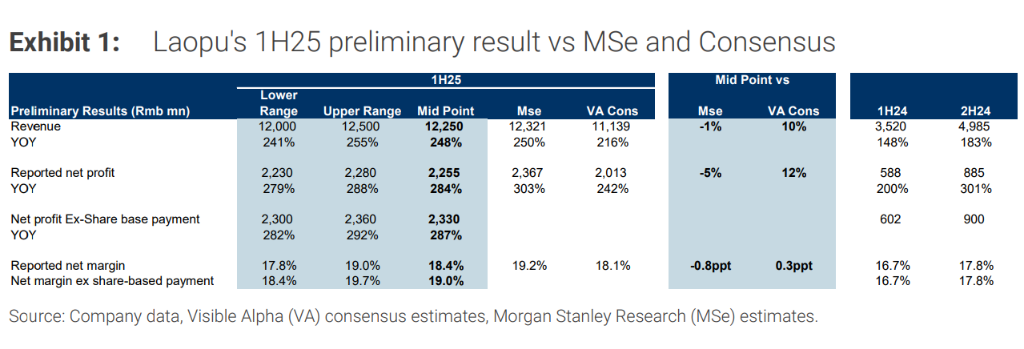
Core Viewpoint - The company achieved strong year-on-year growth in the first half of the year, but performance was slightly below analysts' high expectations, raising concerns about profitability due to limited price adjustments amid rising gold prices [1][4]. Financial Performance - Revenue for the first half is projected to be between 120-125 billion RMB, which is 3-7% lower than UBS's forecast [2]. - Net profit guidance is set at 22.3-22.8 billion RMB, aligning closely with UBS's estimate of 22.58 billion RMB [2]. - Adjusted net profit (excluding share-based payments) is expected to reach 23.0-23.6 billion RMB, which is 1-3% lower than UBS's prediction [2]. - Year-on-year revenue growth is reported at 241%-255%, while net profit growth is between 279%-288% [3]. Margin and Pricing Strategy - Rising gold prices have negatively impacted the company's gross margin, with a noted increase of approximately 24% in gold prices during the first half [5][4]. - The company only raised retail prices once in February by 10%, which was insufficient to offset the margin pressure from rising gold prices [5][6]. - Analysts emphasize that the pricing strategy for the second half of the year will be crucial for balancing profitability and demand elasticity [6][7]. Market Sentiment and Stock Performance - The company's stock price has declined by 29% since early July, reflecting investor concerns over profit pressures due to rising gold prices [8]. - Analysts observe a strong correlation between gold prices, demand growth, and the company's stock price, indicating that the stock has not yet faced a stable or declining gold price environment [8]. Analyst Ratings and Future Outlook - Nomura raised the target price for the company from 1023 HKD to 1148 HKD, maintaining a "Buy" rating, citing improved valuation attractiveness [11]. - UBS maintains a "Neutral" rating with a target price of 980 HKD, while Morgan Stanley keeps a weight rating with a target price of 1055 HKD [11]. - Analysts remain optimistic about the company's long-term prospects but highlight the impact of gold price volatility on valuation [11].
阿克苏诺贝尔第二季度利润率提升60个基点至15%
Jin Tou Wang· 2025-07-23 05:22
Core Insights - AkzoNobel reported stable organic sales in Q2 2025 compared to Q2 2024, with a 2% increase in pricing but a 6% decline in sales due to adverse currency effects [1] - Adjusted EBITDA for Q2 2025 was €393 million, including a €24 million negative currency impact, compared to €400 million in 2024 [1] - The adjusted EBITDA margin improved to 15.0%, an increase of 60 basis points from 2024 [1] - Cash generated from operating activities was €234 million, significantly higher than €151 million in the same period of 2024 [1] Financial Performance - For the first half of 2025, organic sales remained flat, with a 3% decline in sales due to adverse currency effects [1] - Adjusted EBITDA for H1 2025 was €750 million, including a €31 million negative currency impact, compared to €763 million in 2024 [1] - The adjusted EBITDA margin for H1 2025 was 14.3% [1] - Cash generated from operating activities for H1 2025 was €122 million, reversing the negative €19 million from the same period in 2024 [1] Strategic Developments - CEO Greg Poux-Guillaume highlighted improved profitability in Q2 due to strict pricing strategies and operational efficiency initiatives [2] - The company is facing significant currency pressure from a strong euro and weak overall market demand but has demonstrated strong business performance [2] - AkzoNobel has signed a binding agreement to sell its Indian subsidiary to JSW Group, marking a significant step in its portfolio strategy assessment [2] - The transaction is expected to be completed in Q4 2025 [2]