
小核酸药物研发

Search documents
前沿生物(688221.SH)与葛兰素史克签署授权许可协议
智通财经网· 2026-02-23 09:09
根据协议,公司将获得4,000万美元首付款及1,300万美元近期里程碑付款;公司还将额外在两个项目中累 计获得最高9.5亿美元的基于成功开发、监管及商业化里程碑的付款,同时享有两款产品全球净销售额 的分级特许权使用费。根据协议,公司将负责两款在研产品的早期开发工作,具体包括:负责其中一款 产品在中国的I期临床试验推进,并完成另一款产品的IND支持性研究。葛兰素史克将负责两款产品之 后所有的全球临床开发、监管申报及商业化活动。 公司与葛兰素史克达成的授权合作,将为公司带来首付款及后续里程碑付款,有助于改善现金流、优化 财务结构,为核心管线研发投入、技术平台优化升级提供坚实的资金保障,助力公司进一步实现研发资 源的高效配置与战略聚焦。协议中基于净销售额的分级特许权使用费安排,使公司得以持续分享合作产 品未来在全球范围内可能实现的商业成果,形成潜在长期收入来源,持续为全体股东创造价值。本次与 全球领先的生物制药企业GSK达成此项协议,体现了公司在小核酸药物研发领域的技术实力与平台价值 正获得国际市场认可。此次合作将借助GSK在全球临床开发与商业化方面的资源与经验,加速公司管线 的国际化价值转化,并为后续推进产品商业 ...

前沿生物2025年业绩预告:营收增速放缓,亏损扩大,研发转向小核酸药物
Jing Ji Guan Cha Wang· 2026-02-13 03:58
机构观点 营收增长主要依赖核心产品艾可宁及新业务,但增速已降至个位数。净利润亏损同比增亏,主要因2024 年处置子公司收益缺失;研发费用投入1.38亿元至1.45亿元,同比微增,聚焦小核酸药物管线。公司坦 言新药研发周期长、风险高。 股票近期走势 近期股价波动明显,近5日下跌0.82%,反映市场对公司业绩及研发风险的谨慎情绪。 经济观察网前沿生物发布2025年业绩预告,预计营收1.4亿元至1.45亿元,同比增长8.13%至11.99%,增 速持续下滑;归属净利润亏损扩大至2.55亿元至2.9亿元。公司研发重心转向小核酸药物,多款产品处于 早期阶段。 财报分析 分析指出,公司核心产品放量受行业免费药物格局制约,小核酸药物虽为长期增长点,但均处临床前或 早期阶段,未来面临审批、竞争等多重风险。公司需突破盈利瓶颈。 以上内容基于公开资料整理,不构成投资建议。 ...
未知机构:瑞博生物电话会小结与Madrigal达成BD6千万美元首付款43亿-20260213
未知机构· 2026-02-13 02:25
【瑞博生物】电话会小结 – 与Madrigal达成BD,6千万美元首付款+43亿美元里程碑【东吴医药朱国广团队】 与MDGL的互补合作:MASH适应症大市场,双方互赢,①肝病非常适合小核酸去做,MDGL对未来临床需要达到 的效果有很好的刻画,瑞博具备临床前到临床的转化经验和数据,因此可以倒算出临床前的数据要求,完全符合 要求,因此达成了合作。 ②MDRL已经是MASH领域先行者,MDRL拥有Rezdi ④对瑞博来说,MASH临床前数据优秀,但是并不是公司临床聚焦的方向,临床也很难做,最优解就是合作授 权。 ⑤达成合作的6个管线,并不相同,具有互补机制。 #未来2年内至少达到一个mash的IND,或有数kw美元的收入。 与BI的合作:BI与MDGl的靶点、适应症领域均有区别,BI更注重晚期肝病和并发症,聚焦FIC的科学突破性创新 靶点。 目前进展符合预期,已经拿到2个里程碑,预计与MDGL的合作管线同期会进入IND。 创新技术:肾靶向领先全球 + 其他的肝外递送早期资产 + 双靶点。 与MDGL的互补合作:MASH适应症大市场,双方互赢,①肝病非常适合小核酸去做,MDGL对未来临床需要达到 的效果有很好的刻画, ...

开年就爆,全球创新药企争抢中国小核酸
3 6 Ke· 2026-02-10 00:42
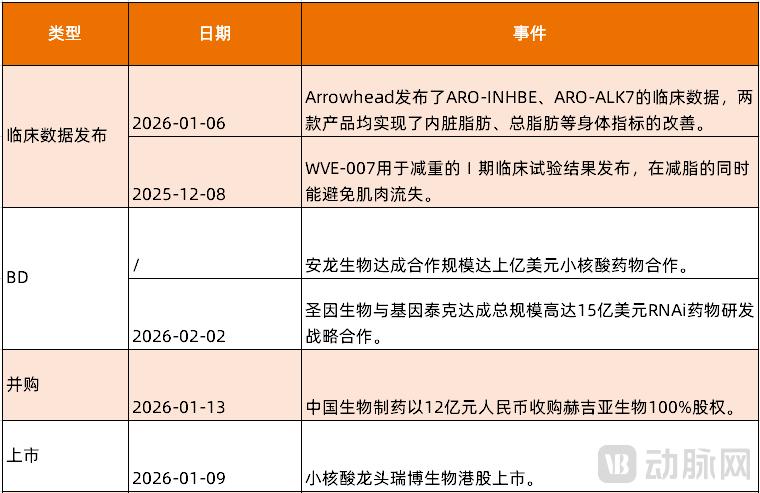
Core Insights - The small nucleic acid sector is experiencing a significant commercialization phase, driven by technological breakthroughs and successful clinical data releases in the weight loss domain [1][3][6] - Major transactions, including a billion-level acquisition by China Biologic and the Hong Kong listing of Rebio, indicate that capital exit channels are now open [1][5][6] Group 1: Clinical Data Releases - Arrowhead Pharmaceuticals announced clinical data for two siRNA obesity candidates, ARO-INHBE and ARO-ALK7, showing improvements in visceral fat and total fat in obese patients with type 2 diabetes, leading to a 10.9% stock price increase [3] - Wave Life Sciences reported that its siRNA drug WVE-007 achieved a 4.0% weight reduction and a 0.9% muscle gain in a Phase I trial, resulting in a 147.3% stock price surge [4] - The clinical data from these small nucleic acid drugs suggest potential for use either alone or in combination with GLP-1 drugs to reduce fat while preserving muscle [4][7] Group 2: Business Development Transactions - In early 2026, Anlong Bio secured an international strategic cooperation agreement in the small nucleic acid drug field worth over $100 million, marking a significant breakthrough in international business development [5] - China Biologic announced a 1.2 billion RMB acquisition of Hejiya Bio, enhancing its small nucleic acid portfolio and leveraging Hejiya's unique long-acting delivery platform [5][6] - Saintin Bio has engaged in multiple business development deals, including a strategic collaboration with Genentech worth up to $15 billion for RNAi drug development [17] Group 3: Market Trends and Future Outlook - The small nucleic acid sector is increasingly recognized as a core area for innovative drug development, with expectations for more significant events in the future [2][6] - The weight loss market is identified as a potential area for major transactions, driven by the large market size and the growing recognition of clinical efficacy for small nucleic acid drugs [7][19] - Major pharmaceutical companies are actively exploring collaborations in the small nucleic acid space, particularly in conjunction with GLP-1 drugs to enhance therapeutic outcomes [18][20]



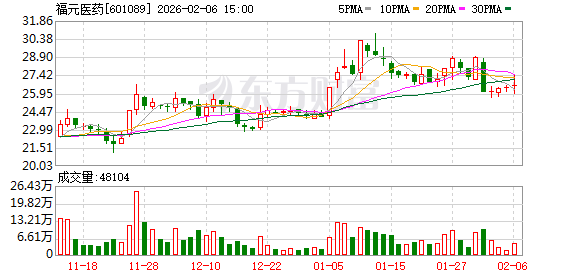
福元医药:公司的N-ER平台是以福元医药自主研发为技术基础的创新核酸药物发现及递送系统的研发平台
Zheng Quan Ri Bao· 2026-02-06 12:13
证券日报网2月6日讯 ,福元医药在接受调研者提问时表示,公司创新药的研发立项思路是以市场价值 为导向,聚焦尚未满足的临床需求,进行差异化立项,并切合公司管线及成熟的销售优势。小核酸是继 小分子和抗体后的第三大类药物,福元医药创新药主要聚焦小核酸及小核酸递送系统的研发。公司的 N-ER平台是以福元医药自主研发为技术基础的创新核酸药物发现及递送系统的研发平台。公司已搭建 创新核酸药物设计、合成、修饰、生物学评价、药学研究一体化研发平台。截至目前进展最快的管线在 进行I期临床实验。 (文章来源:证券日报) ...

CXO行业系列专题报告(3):小核酸突围,大服务赋能
Guoxin Securities· 2026-02-01 07:44
Investment Rating - The report maintains an "Outperform" rating for the industry [1] Core Insights - The small nucleic acid drug market is experiencing robust growth, transitioning from technology validation to accelerated commercialization, with a global market size increasing from $2.7 billion in 2019 to $4.6 billion in 2023, and projected to reach $45.7 billion by 2033, reflecting a CAGR of 26.08% [2][39] - The small nucleic acid CXO sector is benefiting from technological breakthroughs and commercialization acceleration, establishing a comprehensive CRDMO service system [2] - Key players in the small nucleic acid field include CROs with core technologies and rich project experience, such as Chengdu XianDai and Kanglong Chemical, and CDMOs with leading production capabilities like WuXi AppTec and Kailai Ying [2] Summary by Sections 1. Small Nucleic Acid Drugs - Small nucleic acid drugs encompass various types, including ASO, siRNA, and aptamers, which target gene expression for disease treatment [11][12] - These drugs offer advantages such as shorter development cycles, broad therapeutic areas, sustained efficacy, and higher success rates compared to traditional drugs [15][16] 2. Market Expansion and BD Activity - The small nucleic acid market is expanding, with significant BD transactions occurring, including a $9 billion collaboration between Wobang Pharmaceutical and Novartis, and a $2 billion platform authorization between Rebio and Boehringer Ingelheim [48] - Domestic companies are actively developing drugs targeting hyperlipidemia, hypertension, and hepatitis B, with notable progress in clinical stages [45][47] 3. CXO Empowerment in Small Nucleic Acid R&D - The CXO industry is crucial for supporting the R&D and production of small nucleic acid drugs, with a focus on enhancing delivery technologies and chemical modifications to improve drug stability and efficacy [22][26]



中国生物制药12亿收购赫吉亚,中外大药企缘何“独宠”小核酸?
2 1 Shi Ji Jing Ji Bao Dao· 2026-01-13 13:36
Core Viewpoint - The acquisition of Hegia Biotech by China National Pharmaceutical Group for 1.2 billion RMB is seen as a strategic move to strengthen its position in the rapidly growing small RNA drug sector, which is becoming a new frontier in innovative pharmaceuticals [1][2]. Company Summary - China National Pharmaceutical Group has expanded its portfolio by acquiring Hegia Biotech, a company specializing in siRNA innovation, which has developed six delivery platforms and has four drugs in clinical stages [1][2]. - Hegia Biotech, founded in 2018, has a strong R&D team with over 20 years of experience and has secured more than 50 core patents, establishing a comprehensive drug development system from target discovery to clinical proof of concept [2][3]. - The acquisition is expected to enhance China National Pharmaceutical Group's capabilities in the large chronic disease market, providing a complete closed loop from technology development to clinical transformation [3][10]. Industry Summary - The small RNA drug sector is emerging as a significant area of innovation, following PD-1 and ADC, with global pharmaceutical companies actively investing in this space [2][4]. - The global small RNA drug market is projected to grow from $5.7 billion in 2024 to $20.6 billion by 2029, with a compound annual growth rate (CAGR) of 29.4% [7]. - In China, the RNAi therapy market is expected to expand from approximately $4 million in 2022 to over $30 million by 2030, indicating a CAGR exceeding 300% [7]. - The successful listing of Suzhou Rebio Biotech on the Hong Kong Stock Exchange signifies growing recognition of China's independent R&D capabilities in the small RNA drug field [6][5]. - The industry is witnessing significant advancements, including the successful overcoming of delivery patent barriers and the establishment of a mature industrial chain ecosystem [5][6]. Competitive Landscape - The competition in the small RNA drug market will focus on three dimensions: technological platform advantages, depth and differentiation of pipelines, and globalization capabilities [10]. - Companies are expected to pursue mergers and acquisitions to quickly acquire technology and teams, as the high technical barriers in the small RNA sector may hinder independent research and development [10].
睿智医药加码小核酸药物研发领域
Zheng Quan Ri Bao Wang· 2026-01-13 12:49
Core Insights - Ruizhi Pharmaceutical Technology Co., Ltd. has developed two automated integrated micro-flow synthesis systems based on its "Super Limit Intelligent Manufacturing" platform, which are currently applied internally to enhance R&D in ADC and small nucleic acid drug fields [1][2] Group 1: Technology and Innovation - The internal application of the Super Limit Intelligent Manufacturing platform focuses on two main areas: enhancing the coupling process for antibody-drug conjugates (ADCs) and synthesizing nucleoside monomers for oligonucleotide drugs, significantly improving development efficiency and overall yield [1] - The ADC drug process development time can be reduced by 70%, while the cost of synthesizing nucleoside monomers can be lowered by over 40% [2] Group 2: Strategic Partnerships and Market Positioning - The drug manufacturing system was jointly released by Ruizhi Pharmaceutical and East China Normal University, emphasizing the establishment of a joint laboratory to improve the transition from laboratory R&D to industrial production [2] - The company is positioning its business around "new modalities (including small nucleic acids)" and "ecological investment," aiming to create more opportunities in the small nucleic acid sector through strategic partnerships with multiple companies [2]

瑞博生物-B(6938.HK)上市:揭秘小核酸龙头的“价值炼金术”
Ge Long Hui· 2026-01-12 01:45
Core Viewpoint - The listing of Rebio Biotech (6938.HK) on the Hong Kong Stock Exchange marks a significant milestone for China's small nucleic acid drug development, transitioning from "technical accumulation" to "value realization" [1] Group 1: Market Reaction and Financial Performance - The market reacted positively, with Rebio's stock price rising over 29% in pre-listing trading and closing at 82.1 HKD per share on its first day, reflecting strong investor confidence in Chinese innovative pharmaceuticals [1] - Rebio's financial performance shows a strong revenue growth of 56.57% year-on-year, reaching 1.04 million RMB in the first half of 2025, while losses narrowed by 30.94% during the same period [4][5] - The revenue growth is primarily driven by licensing and collaboration agreements with major players like Boehringer Ingelheim and Qilu Pharmaceutical, indicating recognition of its underlying platform technology [4] Group 2: Strategic Development and R&D - Rebio's platform-based R&D approach is transforming the traditional investment model in biotechnology, moving from betting on single molecules to a modular and scalable development strategy [6] - The company aims to advance 2-4 assets to clinical trials annually, leveraging its platform's efficiency and confidence in its development capabilities [6] - Rebio has established a strong competitive barrier through its intellectual property, holding 255 granted patents and 218 pending applications, alongside a GMP-compliant production facility in Jiangsu [7] Group 3: Ecosystem and Global Strategy - Rebio's strategy combines internal development with external collaboration, targeting global diseases with significant patient populations, such as cardiovascular conditions [9] - The company has formed strategic partnerships, such as with Boehringer Ingelheim, to enhance its technology platform's recognition and optimize commercialization efficiency [11] - Establishing a clinical team in Sweden allows Rebio to conduct high-quality clinical trials independently, enhancing global development efficiency and regulatory communication [12] Group 4: Industry Implications - Rebio's listing signifies a shift in the Chinese biotechnology sector from "following innovation" to "source innovation," showcasing its platform-based R&D capabilities and global operational vision [13] - The company is positioned to accelerate its transition from clinical to commercial stages, with the potential for its platform value and pipeline to resonate in the emerging nucleic acid drug era [13]
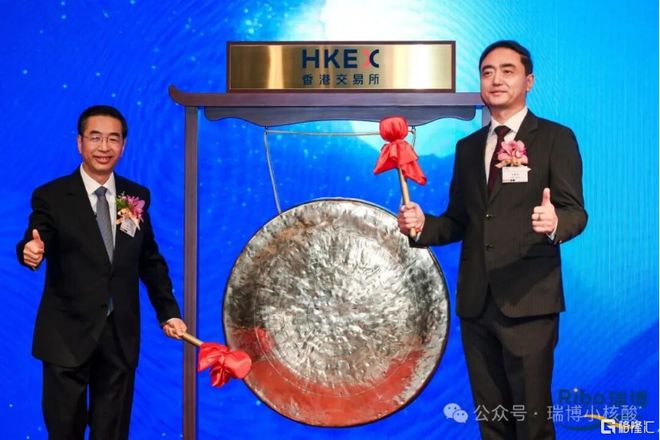
新年江苏“第一股”!瑞博生物在港交所上市
Zheng Quan Shi Bao Wang· 2026-01-09 06:11
Group 1 - Suzhou Rebio Technology Co., Ltd. successfully listed on the Hong Kong Stock Exchange on January 9, becoming the first listed company in Jiangsu province this year [1] - The company issued 31.61 million shares at a price of HKD 57.97 per share, raising over HKD 1.8 billion in total [1] - Rebio, founded in 2007 and headquartered in Suzhou, focuses on the research and development of small nucleic acid drugs, utilizing RNA interference (RNAi) technology to develop innovative therapies for major diseases [1] Group 2 - Rebio's research pipeline covers various diseases, particularly chronic diseases, with seven self-developed drugs currently in clinical trials, four of which are in Phase II [1] - The core product, RBD4059, is the world's first clinical-stage small nucleic acid drug for treating thrombotic diseases, offering significant advantages over traditional treatments, such as extended efficacy and lower bleeding risks [1] - With Rebio's listing, the number of companies listed from Suzhou on the Hong Kong Stock Exchange has increased to 42, further expanding the biopharmaceutical sector in the region [2]