技术奇点

Search documents
马斯克最新播客:AI和机器人不可阻挡,中国会搞定芯片
Jin Rong Jie· 2026-01-08 01:45
Group 1 - Elon Musk predicts that AGI will be realized by 2026, marking a "technological singularity" moment where white-collar jobs and surgeons may be replaced by AI, leading society towards an era of "universal high income" and extreme abundance [1] - Musk emphasizes that the transition period of 3 to 7 years will be turbulent, with social upheaval occurring alongside extreme prosperity [1] - He highlights China's significant advantage in AI due to its ability to expand power generation capacity, estimating that by 2026, China's power generation could be about three times that of the United States, enabling support for high-energy AI data centers [1] Group 2 - Musk states that power supply is a critical constraint for the scaling of AI systems, noting that the difficulty of electricity supply is often underestimated [2] - Despite the U.S. efforts to limit China's access to advanced semiconductors, Musk believes that these restrictions may weaken over time, asserting that China will resolve its chip issues [2] - The current focus on energy supply and data infrastructure is becoming more crucial for the large-scale development of AI than chips or algorithms [2]

马斯克的2026愿景:我们已处于“技术奇点”,AI和机器人不可阻挡,短期是动荡和挑战,长期是丰盛时代
华尔街见闻· 2026-01-07 12:43
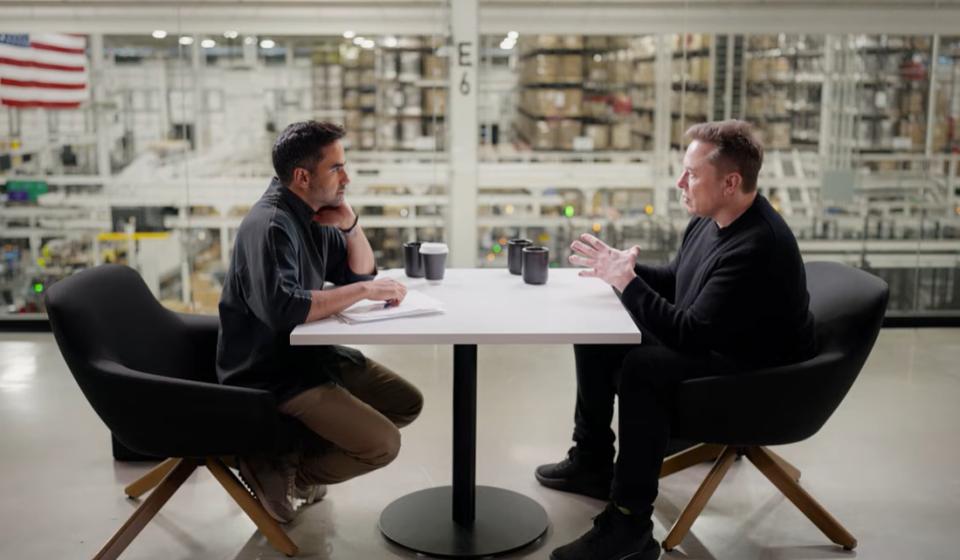
Core Insights - The article discusses a significant dialogue led by Elon Musk at Tesla's Giga Factory in Austin, Texas, focusing on the imminent arrival of the "technological singularity" and the transformative impact of AI and robotics on society [3][4]. Group 1: Predictions on AGI and Technological Singularity - Musk predicts that Artificial General Intelligence (AGI) will be achieved by 2026, with AI's total intelligence surpassing that of all humanity by 2030 [5][6]. - He describes the current state as being within a "supersonic tsunami" of change, indicating that the process of technological transformation is irreversible [5][6]. - Musk emphasizes that the transition will lead to a significant reshaping of human roles, where humans may become mere "biological bootloaders" for digital superintelligence [4][6]. Group 2: Impact on Employment and Society - The transition period of 3 to 7 years is expected to be tumultuous, particularly affecting white-collar jobs, as AI can already perform over half of these roles [7][8]. - Musk foresees a "universal high income" (UHI) model emerging, where the abundance of goods and services will lead to a new economic paradigm, contrasting with traditional universal basic income (UBI) [9][10]. - He warns that this abundance will be accompanied by social unrest, as society grapples with the implications of a world where work is no longer a measure of value [11]. Group 3: Energy Competition and Global Dynamics - Musk praises China's efficiency in solar energy deployment, stating that by 2026, China's electricity output will be three times that of the U.S., positioning it as a leader in AI computing power [12]. - He argues that the future currency will be "wattage," emphasizing the need for the U.S. to enhance its energy generation capabilities to compete effectively [12]. Group 4: Space and AI Infrastructure - Musk outlines plans for orbital data centers, leveraging the Starship's capabilities to reduce launch costs below $100 per kilogram, which would enable large-scale AI computing in space [13]. - He envisions a future where solar energy in space can provide continuous power for AI operations, potentially leading to a self-evolving "Dyson swarm" [13]. Group 5: AI Safety Principles - Musk proposes three core principles for AI safety: truth, curiosity, and beauty, arguing that these will help prevent AI from becoming harmful to humanity [15]. - He stresses the importance of ensuring that AI remains curious about humans and does not resort to deception, which could lead to adverse outcomes [15].


马斯克:再见,程序员
投资界· 2026-01-07 08:34
Core Viewpoint - The article discusses the concept of the technological singularity, predicting that it will occur in 2026, significantly earlier than previous estimates of 2045. This shift is attributed to advancements in AI, particularly the capabilities of Claude Code, which have rapidly transformed programming and software development [2][7][12]. Group 1: Predictions and Impacts of the Singularity - Elon Musk has declared 2026 as the year of the singularity, indicating a major shift in technological capabilities [2][3][7]. - The singularity refers to a point where technology accelerates exponentially, leading to profound changes in society and industry [7][22]. - The advancements in AI, particularly with Claude Code, are seen as a catalyst for this rapid transformation, with predictions that software engineering may soon be rendered obsolete [12][13]. Group 2: Advancements in AI Technology - Claude Opus 4.5 has been recognized as the leading coding model, outperforming competitors like GPT-5.1 and Gemini 3 Pro in various benchmarks [13][14]. - The efficiency of coding tasks has reportedly increased by 220% when using Claude Opus 4.5 in conjunction with Claude Code [12][13]. - The ability of AI to handle complex coding tasks has led to a scenario where even individuals with no programming experience can create functional applications in under ten minutes [17][24]. Group 3: Changes in Software Engineering Roles - The role of software engineers is evolving, with AI now responsible for 70%-80% of coding tasks, leading to a shift towards code review and oversight rather than traditional coding [23][24]. - The introduction of natural language as a new programming syntax allows users to define logic without needing to write code, fundamentally changing the landscape of software development [24][25]. - As AI automates software development, similar automation is expected to extend to operations, planning, and management roles within organizations [24][25].

马斯克的2026愿景:我们已处于“技术奇点”,AI和机器人不可阻挡,短期是动荡和挑战,长期是丰盛时代
Hua Er Jie Jian Wen· 2026-01-07 04:10
Core Insights - Humanity is in the "biological bootloader" phase of digital superintelligence, with a transformative wave of change that cannot be halted [1] - Elon Musk predicts that Artificial General Intelligence (AGI) will be achieved by 2026, with AI intelligence surpassing that of all humans combined by 2030 [1][4] Group 1: Technological Transformation - Musk describes AI and robotics as a "supersonic tsunami," indicating that humanity is already in a technological singularity [4][5] - The transition period leading to AGI is expected to be "bumpy," particularly affecting white-collar jobs that involve information processing [5] - Musk anticipates that robots will outperform top human surgeons within 3-5 years, highlighting the precision and shared experience of AI in medical applications [5] Group 2: Economic Predictions - Musk introduces the concept of Universal High Income (UHI), suggesting that the future will bring unprecedented abundance, where prices will drop to the cost of materials and energy [6][8] - He warns that this abundance will coincide with significant social unrest, as society grapples with the implications of a world where work is no longer a measure of value [6] Group 3: Energy Competition - Musk praises China's efficiency in solar energy deployment, stating that China will have three times the electrical output of the U.S. by 2026 [8] - He emphasizes that the future currency will be "wattage," and that the ability to generate and manage energy will be crucial in the AI race [8] Group 4: Space and AI Infrastructure - Musk plans to move computational centers to space, leveraging the low cost of launching payloads with Starship, aiming for under $100 per kilogram [10] - He envisions a "Dyson Swarm" of solar-powered AI satellites in orbit, which would provide continuous energy and computational resources [10] Group 5: AI Safety Principles - Musk outlines three core principles for AI safety: truth, curiosity, and beauty, arguing that these will help prevent AI from becoming a threat to humanity [11]
再见,程序员!马斯克宣判:奇点就在2026
猿大侠· 2026-01-06 04:11
Core Viewpoint - The article discusses the emergence of Claude Code and its significant impact on programming, suggesting that the year 2026 may mark a technological singularity, as stated by Elon Musk [1][3][7]. Group 1: Impact of Claude Code - Claude Code has gained immense popularity, with notable figures like Elon Musk and the founder of Midjourney expressing astonishment at its capabilities [2][5][15]. - The coding efficiency of Claude Opus 4.5 has reportedly increased by 220% when used in conjunction with Claude Code, indicating a substantial leap in programming capabilities [25]. - The latest LiveBench rankings show Claude Opus 4.5 outperforming competitors like GPT-5.1 Codex MAX and Gemini 3 Pro, highlighting its dominance in coding tasks [28][30]. Group 2: Future of Software Engineering - The article posits that the role of software engineers is evolving, with AI now handling 70%-80% of coding tasks, leading to a shift towards code review rather than code writing [50][52]. - The use of natural language as a new programming syntax is emphasized, suggesting that anyone can become a software engineer by simply describing their needs to AI [63]. - The automation of software development is expected to extend to operations and management, indicating a broader transformation in the workplace [65][66].

再见,程序员,马斯克宣判:奇点就在2026
3 6 Ke· 2026-01-05 08:04
Core Insights - The emergence of Claude Code has led to significant discussions about the concept of the technological singularity, with Elon Musk declaring that "we have entered the singularity" and predicting 2026 as the pivotal year for this event [1][3][7]. Group 1: Technological Singularity - The concept of the technological singularity, which refers to a point where technology accelerates exponentially, has been brought to the forefront by recent advancements in AI, particularly with Claude Code [7]. - Ray Kurzweil, a prominent futurist, previously predicted the singularity would occur around 2045, but recent developments have prompted a reevaluation of this timeline [7][29]. - The rapid advancements in AI capabilities, particularly in coding and problem-solving, suggest that the singularity may be closer than previously thought, with some experts indicating it could happen as soon as 2026 [3][19]. Group 2: Claude Code and AI Advancements - Claude Code has demonstrated remarkable programming capabilities, with its efficiency reportedly increasing by 220% when used in conjunction with Claude Opus 4.5, which is considered the top coding model globally [17][19]. - The latest LiveBench rankings show Claude Opus 4.5 outperforming competitors like GPT-5.1 Codex MAX and Gemini 3 Pro, indicating its superior performance in real-world applications [19][20]. - The ability of Claude Opus 4.5 to handle long-duration coding tasks without failure marks a significant milestone in AI development, showcasing its robustness and reliability [21]. Group 3: Impact on Software Engineering - The integration of AI in software development is transforming the role of engineers, with many now focusing on code review rather than traditional coding tasks, as AI handles the majority of the coding workload [32]. - The shift towards using natural language as a new programming syntax suggests that the barriers to software development are lowering, allowing individuals without coding experience to create functional applications quickly [25][34]. - As AI continues to automate coding and related tasks, the implications extend beyond software engineering to operations and management, potentially reshaping the entire landscape of work in technology [35].

帮主郑重年度预判:2026,十字路口的抉择与布局
Sou Hu Cai Jing· 2026-01-04 08:20
Group 1 - The core prediction regarding "AI bubble" highlights a divide between warnings of potential overvaluation due to high interest rates and the assertion that AI investments have driven all GDP growth in the U.S., indicating a significant transformation in productivity and sales [3][4] - The predictions about the "Federal Reserve dilemma" and "U.S. stock market direction" reveal dramatic tensions, with forecasts ranging from a 14% increase to a 20% potential decline, reflecting the uncertainty between policy and corporate earnings resilience [3][4] - Predictions about "quantum computing disrupting cryptocurrencies" and "brain-computer interfaces coming to the forefront" suggest a nearing technological singularity that could revolutionize existing business models and highlight vulnerabilities in current technologies [4][5] Group 2 - The forecast for gold prices reaching $10,000 contrasts with warnings of a potential major economic crisis in 2026, illustrating a dual narrative of distrust in fiat currency and concerns over geopolitical conflicts driving demand for precious metals [4][5] - The overall sentiment indicates that 2026 will be a year of complex variables and significant turning points, requiring investors to navigate a landscape of uncertainty rather than binary choices [5][6] - The recommended investment strategy emphasizes "balanced allocation" between technology and physical assets, focusing on "realization capability" of companies, and maintaining "strategic patience" in a volatile market environment [6]
好书推荐 | PayPal黑帮与“科技共和国”野心
点拾投资· 2025-12-28 11:00
Core Viewpoint - The article discusses the launch of the "Genesis Mission," a national-level AI development plan initiated by President Trump, which aims to elevate AI technology to a core national strategy, marking a significant shift in U.S. policy towards technology and governance [1]. Group 1: Genesis Mission and Its Implications - The "Genesis Mission" is described as a monumental blueprint comparable to the Manhattan Project, focusing on breaking through AI technology barriers and consolidating global leadership [1]. - The initiative represents a comprehensive mobilization of government, businesses, and research institutions towards AI development, indicating a shift from industry competition to national strategic focus [1]. Group 2: Key Figures and Their Influence - Influential figures behind the initiative include Silicon Valley elites such as Peter Thiel, Alexander Karp, Elon Musk, and David Sacks, who advocate for a government restructured through engineering thinking and hard technology [1][5]. - Peter Thiel, a co-founder of PayPal, has significantly influenced the political landscape by supporting candidates like J.D. Vance, demonstrating a shift in political power dynamics towards technology capital [5][6]. Group 3: Political and Financial Dynamics - Trump's political fundraising has shifted, with small donations decreasing from 69% in 2016 to 32.9% in 2024, indicating increased support from Silicon Valley tech capital [4]. - The article highlights a growing alliance between technology companies and the government, where tech firms gain defense contracts and policy benefits while Trump secures funding and technological endorsement [9]. Group 4: Ideological Shifts in Technology - The rise of "technological accelerationism" in Silicon Valley is reshaping U.S. political dynamics, advocating for rapid technological advancement as a solution to societal issues [11][12]. - This ideology promotes the belief that technological breakthroughs can automatically resolve political challenges, simplifying complex social issues into engineering problems [16][17]. Group 5: Future Vision and Challenges - Alexander Karp envisions a future where the U.S. is a "Republic" supported by hard technology, emphasizing the need for a clear national mission and technological ambition [19]. - The article warns of the hesitance among the new generation of engineers to engage in military applications, highlighting a cultural divide that could impact national defense capabilities [23].


马斯克:20年内进入“后工作时代”,能源将取代金钱成为新“硬通货”
3 6 Ke· 2025-12-01 08:19
Group 1 - The future of work is predicted to become optional, with individuals no longer needing to work for survival, but rather for personal enjoyment [10][11][12] - AI and robotics are expected to create the majority of social and economic value in the coming years, with companies focusing on these technologies being the most promising investment opportunities [3][4] - The concept of currency may evolve to be replaced by energy as the ultimate measure of value, as AI and robotics fulfill all material needs [15][16] Group 2 - SpaceX's Starlink is designed to complement existing 5G networks rather than replace them, particularly in rural areas where traditional infrastructure is lacking [9][10] - The collaboration between Tesla, SpaceX, and xAI is anticipated to create a synergistic effect, leading to advancements in solar-powered AI satellite networks [5][6] - The educational landscape is shifting, with universities potentially becoming more about social experiences rather than practical skill acquisition, as traditional education may lose its necessity in a post-work society [22][23] Group 3 - AI must adhere to principles of truth, beauty, and curiosity to avoid becoming dysfunctional, as forcing AI to propagate falsehoods could lead to dangerous outcomes [24][25][26] - The development of AI and robotics is expected to reach a saturation point where they operate for their own goals rather than human needs, marking a significant shift in societal dynamics [12][13] - The decline in global birth rates raises concerns about the future of human civilization, emphasizing the importance of population growth for collective consciousness [21]
我们即将经历下一个技术奇点,超智能时代人类会更加不平等吗?
Guan Cha Zhe Wang· 2025-11-14 01:09
Core Insights - The development of artificial intelligence (AI) is viewed as a significant economic growth point globally, with some considering it the start of the "Fourth Industrial Revolution" and a pathway to general AI [1] - There are growing concerns regarding the limitations of large models, including diminishing marginal returns and the impact on traditional employment markets [1] - The conversation emphasizes the need for humanity to adapt and coexist with AI, exploring the philosophical implications of intelligence evolution in the universe [1][8] Group 1: AI Development and Economic Impact - AI is seen as a transformative force in the economy, with the potential to create new knowledge and understanding [11] - The timeline for AI achieving continuous operation and self-definition of tasks is projected around 2028, marking a significant milestone in AI capabilities [18][20] - The potential for AI to drive economic changes is highlighted, with predictions of AI robots becoming widely accepted by 2028 [20] Group 2: Philosophical and Evolutionary Perspectives - The concept of "critical density" is introduced, suggesting that as systems reach a certain complexity, they trigger cascading reactions that lead to higher levels of intelligence [10][15] - The universe's evolution is posited as inherently designed to create intelligence, with humanity playing a role in this broader narrative [8][11] - The idea that AI could lead to a form of universal consciousness is explored, suggesting that humanity may be a stepping stone in this evolution [11] Group 3: China's Position in AI Development - China is recognized for its rapid advancements in power infrastructure, which is crucial for AI development, having invested more in smart grids than the rest of the world combined [33] - The country benefits from a large pool of technically educated individuals, with a significant portion of STEM graduates globally coming from China [34] - Challenges include a lag in chip technology compared to leading companies like NVIDIA, which may impact the pace of AI development [37] Group 4: Future Trends and Innovations - The discussion highlights the importance of distinguishing between genuine trends and hype in technology, emphasizing the need for real market demand [26] - Innovations in energy sources, such as nuclear fusion, are anticipated to provide abundant resources, further driving technological advancements [22][25] - The potential for AI to enhance efficiency in existing processes while also creating new opportunities is emphasized, suggesting a dual approach for businesses [28][29]