数字化改造

Search documents
环境指标向好 产业转型加快 安徽马鞍山绿色发展动能强劲
Jing Ji Ri Bao· 2026-01-03 22:07
Group 1 - The core viewpoint of the articles highlights Ma'anshan City's commitment to ecological priority and green development, leading to significant improvements in environmental indicators and production living conditions [1][2] - Ma'anshan City has transitioned from "manufacturing along the river" to "intelligent manufacturing along the river," achieving a cumulative elimination of 4.99 million tons of outdated steel production capacity over the past decade [1] - The city has established a green manufacturing system, with 23 national-level green factories and 3 national-level green parks, where the output value of green factories accounts for over 40% of the total industrial output value [1] Group 2 - The city has promoted digital transformation in 1,432 large-scale industrial enterprises, achieving a transformation rate of 86.4%, with a numerical control rate of key processes reaching 74.9% [1] - Ma Steel's special steel plant has implemented automated operations for material handling, resulting in a 90% reduction in dust emissions compared to before the transformation [1] - Ma'anshan City is advancing the "waste-free city" initiative, utilizing various technologies for pollution source detection and management, with PM2.5 average concentration meeting national secondary standards for four consecutive years [2]
安徽马鞍山绿色发展动能强劲
Jing Ji Ri Bao· 2026-01-03 22:00
Group 1 - The core viewpoint of the articles highlights Ma'anshan's commitment to ecological priority and green development, leading to significant improvements in environmental indicators and the production and living environment [1][2] - Ma'anshan has transitioned from "manufacturing along the river" to "intelligent manufacturing along the river," achieving a cumulative elimination of 4.99 million tons of outdated steel production capacity over the past decade [1] - The city has established a green manufacturing system, with 23 national-level green factories and 3 national-level green parks, where the output value of green factories accounts for over 40% of the total industrial output value [1] Group 2 - A total of 1,432 industrial enterprises above designated size have undergone digital transformation, achieving a transformation rate of 86.4%, with the CNC rate of key processes reaching 74.9% [1] - The implementation of smart sensing devices and 5G technology has led to a 90% reduction in dust emissions at the Ma Steel special steel plant compared to before the transformation [1] - Ma'anshan is advancing the "waste-free city" initiative, utilizing various technological means for pollution source detection and management, with PM2.5 average concentration meeting national secondary standards for four consecutive years [2]

滴滴美团京东集体杀入家政赛道,万亿市场争夺战打响
Sou Hu Cai Jing· 2025-12-29 02:20
Core Viewpoint - The entry of major internet companies like Didi, Meituan, and JD into the home service market signifies a strategic shift to tap into a massive, underexplored market, aiming to leverage their existing user bases and technological advantages to create new growth opportunities [4][15]. Group 1: Market Overview - The home service market in China is projected to reach a revenue of 1.23 trillion yuan in 2024, with an expected growth to 1.8 trillion yuan by 2025, representing a 120% increase from 2020 and an annual compound growth rate exceeding 18% [5]. - The industry employs over 30 million people and has more than 1.7 million companies, indicating a significant workforce and business presence [5]. - The market is characterized by a "dumbbell structure," with high-end and basic services coexisting, where sectors like elderly care, maternal and infant care, and high-end cleaning are leading the growth [6]. Group 2: Competitive Landscape - Major players are entering the home service sector to capture a share of the trillion-yuan market, focusing on high-frequency user engagement and business synergy [4][6]. - The home service industry is currently fragmented, with no dominant players, providing an opportunity for tech giants to leverage their user base and technology to gain market share [6][7]. - The entry of these companies is expected to lead to the emergence of concentrated market leaders, as they utilize their technological capabilities to standardize services and improve quality [7][15]. Group 3: Business Strategies - Companies like JD are integrating home services with their e-commerce platforms to enhance customer retention and drive repeat purchases, while Meituan and Didi are utilizing their logistics and driver networks to optimize service delivery [9][10]. - The use of AI and smart scheduling by these companies aims to reduce response times and improve service quality, thereby increasing consumer trust [10][11]. - The initial phase of these services often involves subsidized pricing to quickly build market presence, similar to the early days of ride-hailing services [11][13]. Group 4: Future Outlook - The home service market is expected to grow significantly, with projections indicating a market size exceeding 2.5 trillion yuan by 2030, maintaining a compound annual growth rate of over 15% [7]. - The integration of technology and service in the home service sector is transforming it from a low-end labor market to a modern service industry that emphasizes quality and consumer trust [7][15]. - The competition among major players is not merely about market share but about establishing a comprehensive ecosystem that connects various aspects of home and lifestyle services [15].




烟台黄渤海新区澎湃“绿色动能”
Xin Lang Cai Jing· 2025-12-25 09:09
Group 1 - The core viewpoint emphasizes the importance of industry in promoting green, low-carbon, and high-quality development, particularly in Yantai's Huangbohai New Area, which focuses on intelligent and digital transformation to drive low-carbon industrial transition [1] Group 2 - Yantai Aichuang Robot Technology Co., Ltd. is advancing digital transformation by building a smart factory for high-end hydraulic motors and pumps, significantly improving production efficiency and product quality [3] - Longyuan Power Group Co., Ltd. is developing plasma ignition technology to replace fuel oil, resulting in substantial cost reductions [3] - Taihe New Materials Group Co., Ltd. has achieved industry-leading results in water and energy savings, as well as carbon reduction, through self-developed green dyeing technology that allows for rapid dyeing at room temperature without additives [3] Group 3 - The Huangbohai New Area is systematically promoting green transformation by innovatively constructing a four-layer green manufacturing evaluation framework, which includes regional, park, enterprise, and product levels [3] - The area has implemented an upgrade path covering the entire product lifecycle, low-carbon production lines, and smart supervision, prioritizing enterprises with strong supply chain collaboration for demonstration and cultivation [3] Group 4 - The construction of green factories has become a significant achievement in the low-carbon practices of enterprises, transitioning from "single-point breakthroughs" to "cluster progress" across various fields such as chemicals, new energy, and equipment manufacturing [3] - The region has received approvals for 2 national green parks, 11 national green factories, 1 national green supply chain enterprise, 2 national green design products, 1 provincial green park, 15 provincial green factories, and 5 provincial green supply chain enterprises [3]
新能源+数字化+银发经济,马来西亚的真“机会”在哪里?| 卓立出海谈
吴晓波频道· 2025-12-18 00:29
Group 1 - The article discusses the dual nature of opportunities and challenges in the Malaysian market for Chinese companies venturing abroad, emphasizing the need to understand local business logic beyond the typical Chinese perspective [1][2] - Malaysia is positioned as a buffer zone amid the US-China trade war, attracting interest from major powers due to its industrial advantages and high-tech capabilities, making it a desirable partner for both China and the US [3][4][6][7] - The article highlights the importance of localizing business strategies for Chinese companies, as many have struggled due to a lack of understanding of local culture, user experience, and language [11][15][18] Group 2 - The article identifies key sectors with growth potential in Malaysia, including renewable energy, digital technology, healthcare, and elder care, suggesting that Chinese companies should align their offerings with local needs [19][30] - It points out that the service sector in Malaysia surpasses manufacturing, providing a fertile ground for digital industries to thrive [20] - The discussion includes the necessity for infrastructure development, such as charging stations for electric vehicles, to support the growth of new industries [20][22] Group 3 - The article emphasizes the need for Chinese companies to engage with local communities and integrate into the local ecosystem to avoid missing opportunities [30] - It also mentions that many Chinese enterprises view Malaysia merely as a production base to circumvent tariffs, which is not a sustainable approach [17][30] - The importance of government collaboration in implementing technological advancements and regulatory frameworks is highlighted as essential for successful market entry [28][29]

创新突围,中小企业如何发力?
Xin Hua Wang· 2025-12-12 14:43
Group 1 - The core viewpoint emphasizes the importance of small and medium-sized enterprises (SMEs) as vital components of the national economy and as drivers of technological innovation and progress [1][2] - The 2025 China SME Development Conference highlighted strategies for high-quality development during the 14th Five-Year Plan, focusing on leveraging digital technologies to enhance productivity [1] - Liu Chongming from Shanghai Heihu Technology Co., Ltd. discussed how advanced technologies like cloud computing, IoT, and blockchain help manufacturing companies break data silos, leading to improved operational efficiency [1] Group 2 - Zhejiang Yada Green Energy has established a comprehensive industrial layout through a model of "core technology R&D + four-level manufacturing system + global service," breaking foreign monopolies in key areas [2] - The 14th Five-Year Plan encourages the development of specialized, innovative SMEs and the cultivation of unicorn companies, while also supporting high-tech enterprises [2] - Li Zibin, President of the China SME Association, urged SMEs to embrace challenges, innovate, and focus on digital transformation to enhance their competitiveness in the market [2]
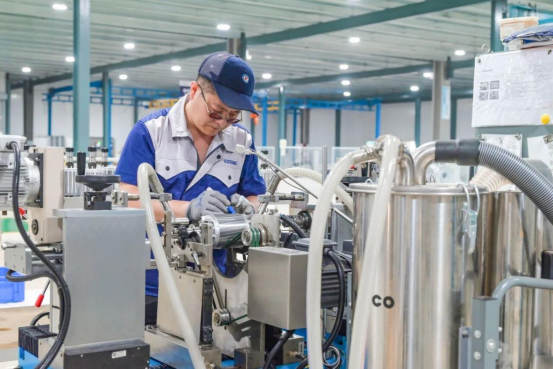
佳电股份:目前公司正在开展机器手代替人工数字化改造
Zheng Quan Ri Bao Zhi Sheng· 2025-12-03 13:37
Core Viewpoint - The company is implementing robotic automation to replace manual labor in its production processes, with a focus on digital transformation by 2026 [1] Group 1: Automation Initiatives - The company is currently utilizing robotic arms in the assembly of stator iron cores, welding of stator iron cores, and rotor painting [1] - By 2026, the company plans to further enhance the application of robotic arms in the welding process to replace manual labor [1]

“平台+美妆产业”双向赋能
Mei Ri Shang Bao· 2025-10-31 00:22
Core Insights - The "beautiful economy" in Hangzhou is thriving, with a complete industrial chain supporting the beauty and cosmetics sector, which has surpassed a scale of 30 billion yuan [1] - Hangzhou is leveraging its digital economy advantages to enhance the beauty industry through digital transformation and ecosystem improvement [1] Industry Overview - The beauty industry in Hangzhou has reached a scale of over 30 billion yuan, positioning it as a leader in the national cosmetics sector [1] - The Qiantang District, where the intelligent factory of Huaxizi is located, has gathered over 100 beauty enterprises, generating total revenue in the hundreds of millions [3] Technological Advancements - Huaxizi's intelligent factory features 7 production lines with an annual output of 50 million products, utilizing advanced international equipment and achieving a 100% connectivity rate for monitoring devices [2] - The factory has implemented IoT technology for digital management, allowing for traceability and optimization of production processes [2] Infrastructure Development - The MoShang PARK international beauty fashion industry base is set to invest over 4 billion yuan, aiming to become a national hub for beauty and fashion enterprises [4] - The Hangzhou government has initiated reforms to facilitate the registration of domestic cosmetics, enhancing the ecosystem for the beauty industry [4] Future Prospects - The integration of digital workshops and a robust industrial ecosystem is driving the beauty industry in Hangzhou, with data and algorithms playing crucial roles in production efficiency [5] - The "platform + beauty industry" model is emerging as a significant engine for propelling Chinese beauty products onto the global stage [5]
“数字员工”让生产线变“聪明”
Ren Min Ri Bao· 2025-10-25 12:40
Core Viewpoint - The article highlights the successful digital transformation of Suzhou Huaxing Optoelectronics Technology Co., Ltd., focusing on the implementation of artificial intelligence in its production processes, which has significantly improved efficiency and product quality [2][3]. Group 1: Digital Transformation - The company has implemented a digital transformation strategy aimed at reducing costs and enhancing competitiveness by creating a digital brain for its complex production line [3]. - The digital transformation involved a dedicated team of experienced engineers and the introduction of AI technology to manage production processes intelligently [3]. Group 2: Operational Improvements - The introduction of "digital employees" has allowed for real-time monitoring and defect correction, improving the production process by quickly identifying and repairing issues without human intervention [2][3]. - The company's yield rate has increased from 95% to 98%, and operational costs have decreased by 7.74%, while overall labor productivity has surged by 123.91% [3]. Group 3: Production Efficiency - The production cycle for liquid crystal panels has been reduced from seven to eight days to just four days due to the implementation of the digital brain [3]. - The AI system has proven to be reliable, even outperforming experienced workers in identifying and addressing potential equipment failures [3].
迎战三重考验 中国外贸人求变突围进行时
证券时报· 2025-09-22 00:19
Core Viewpoint - Despite the challenges posed by global economic recovery and trade protectionism, China's foreign trade has shown resilience, with a year-on-year growth of 3.5% in the first eight months of the year, reaching a total trade value of 29.57 trillion yuan [3][4]. Group 1: Resilience in Foreign Trade - The export value in August was 2.3 trillion yuan, marking a 4.8% year-on-year increase, with six consecutive months of growth [3][4]. - The decline in exports to the U.S. was significant, with a 25% drop in the first half of the year, yet overall exports still grew by 32% [3][4]. - Factors contributing to this resilience include the upgrading of industrial chains and product structures, a diversified market strategy, and supportive policies such as export credit insurance and tax rebates [3][4]. Group 2: Industry Adaptation Strategies - Companies are diversifying their production bases, with some establishing factories in countries like Bangladesh and Cambodia to mitigate tariff impacts [4]. - The market diversification strategy is being emphasized, as evidenced by increased exports to ASEAN and EU markets, which grew by 9.7% and 4.3% respectively in the first eight months [4]. - The shift towards smaller, faster orders has prompted companies to adopt smart manufacturing and digital transformation to enhance flexibility and efficiency [8]. Group 3: Challenges Ahead - Uncertainty in tariff policies, increasing order fragmentation, and intensified market competition are significant challenges facing the foreign trade sector [6][7]. - The export to the U.S. saw a 33.1% year-on-year decline in August, highlighting the impact of tariff uncertainties on business expectations [6][7]. - The shift to smaller orders has led to increased production costs and inefficiencies, particularly for companies that have not yet undergone technological upgrades [8]. Group 4: Future Directions - To address these challenges, a collaborative approach between policy and enterprises is essential, focusing on market and product diversification [10]. - Companies are encouraged to innovate trade models and enhance product value, particularly in high-value sectors like new energy and smart manufacturing [11]. - The emphasis on sustainable products is growing, with companies like Jida (Shanghai) Textile Co. planning to develop eco-friendly clothing to meet consumer demand for sustainability [11].