海外降息

Search documents
基本?有?撑,政策端有扰动
Zhong Xin Qi Huo· 2025-09-05 05:11
Group 1: Report Industry Investment Rating - The mid - term outlook for the industry is "Oscillation", indicating that the expected price fluctuations are within plus or minus one standard deviation in the next 2 - 12 weeks [7][97] Group 2: Core Viewpoints of the Report - The short - term impact of military parade production restrictions has ended, and enterprises in the industrial chain are resuming production. Hot metal is expected to return to a high level of 240,000 tons per day, supporting the demand for furnace materials. The performance of peak - season demand and domestic and foreign macro - policies will further intensify the sector's fluctuations [7] - Future market focus will revolve around "downstream inventory replenishment", "peak - season demand", and "overseas interest rate cuts", and attention should be paid to the possibility of the sector rising under the resonance of these three factors [1] Group 3: Summary by Related Catalogs 1. Iron Element - Overseas mine shipments and arrivals at 45 ports increased month - on - month as expected. Due to the military parade production restrictions, hot metal production decreased significantly, but since September 4th, blast furnaces in Tangshan have resumed production intensively. It is expected that the impact on hot metal production reduction will be limited, and it is expected to return to a high level next week. The total iron ore inventory has increased slightly. If downstream inventory replenishment starts before the National Day, the fundamentals are supported, and the future price is expected to oscillate. For scrap steel, the fundamental contradictions are not prominent. The low profit of electric furnaces and tight resources are expected to keep the short - term price oscillating [2] 2. Carbon Element - After the military parade, steel mills will enter the peak - production season, and the short - term price is expected to remain oscillating under demand support. After the military parade, coal mines will gradually resume production but are unlikely to reach the previous high. The arrival of the downstream demand peak season still supports the coking coal price [2] 3. Alloys - For manganese silicon, the prices of manganese ore and coke are weak, the cost support is insufficient, and the market supply - demand expectation is pessimistic. In the long - term, there is still significant downward pressure on the price, and attention should be paid to the reduction range of raw material costs. For silicon iron, the current cost still provides some support, but in the long - term, as the market supply - demand relationship becomes looser, the price center will tend to decline, and attention should be paid to the coal market dynamics and the adjustment of electricity costs in the main production areas [2] 4. Glass and Soda Ash - Glass has weak real - world demand, but there are expectations for the peak season and policies. After the mid - stream inventory reduction, there may still be a wave of oscillations. In the long - term, market - oriented capacity reduction is needed, and if the price returns to fundamental trading, it is expected to decline oscillatingly. Soda ash still has an oversupply situation. After the futures price decline, spot trading has increased slightly, and it is expected to run with wide - range oscillations in the future. In the long - term, the price center will decline to promote capacity reduction [3] 5. Individual Product Analysis - **Steel**: The fundamentals are weak, with both supply and demand decreasing and inventory accumulating rapidly. After the military parade, hot metal production may recover, and attention should be paid to the release of short - term inventory replenishment demand during the peak season, which may support the price [8] - **Iron Ore**: Supply and inventory are stable, and there is an expectation of demand recovery. The fundamentals are supported, and the future price is expected to oscillate [9] - **Scrap Steel**: The daily consumption has decreased slightly, and the price is expected to oscillate due to low electric - furnace profits and tight resources [10] - **Coke**: After the military parade, steel mills will enter the peak - production season, and the short - term price is expected to oscillate [11] - **Coking Coal**: After the military parade, coal mines will gradually resume production but are unlikely to reach the previous high. The arrival of the downstream demand peak season still supports the price [12] - **Glass**: Real - world demand is weak, but there are peak - season and policy expectations. After mid - stream inventory reduction, there may be oscillations. In the long - term, market - oriented capacity reduction is needed, and the price is expected to decline oscillatingly [12] - **Soda Ash**: The oversupply situation remains unchanged. After the futures price decline, spot trading has increased slightly, and it is expected to run with wide - range oscillations. In the long - term, the price center will decline to promote capacity reduction [15] - **Manganese Silicon**: The cost support is weak, and there is significant downward pressure on the price in the long - term. Attention should be paid to the reduction range of raw material costs [16] - **Silicon Iron**: The current cost provides some support, but in the long - term, the price center will tend to decline. Attention should be paid to the coal market dynamics and the adjustment of electricity costs in the main production areas [17]
双焦偏弱震荡为主
Qi Huo Ri Bao· 2025-09-05 00:36
Group 1 - Recent adjustments in coking coal prices are influenced by weak demand and limited supply disruptions, with expectations of limited downward space due to pre-holiday stockpiling and seasonal demand [1][3] - The coking coal market has seen a rise in auction failure rates, particularly in Hebei, while other regions maintain good profitability and operational activity [1][2] - Current prices for Shanxi low-sulfur coking coal range from 1400 to 1450 RMB/ton, while Mongolian coal prices are between 950 to 980 RMB/ton [1] Group 2 - Coking coal supply is expected to increase due to higher import volumes, despite some coal mines tightening production [2] - Coking profits have improved, leading to increased production activity, although environmental restrictions have a temporary impact [2][3] - The demand side shows resilience with high furnace iron output remaining above 2.4 million tons monthly, but overall demand pressure persists [2][3] Group 3 - The overall market for coking coal is under pressure with weak price performance, while coking profits are recovering, leading to a potential slowdown in purchasing by steel mills [3] - The cost support for coking coal is diminishing, and the market is facing adjustment pressures, although seasonal expectations and pre-holiday stockpiling may limit further declines [3]
华西证券:沪指创近10年新高,增量资金来自何方?
Sou Hu Cai Jing· 2025-08-24 09:11
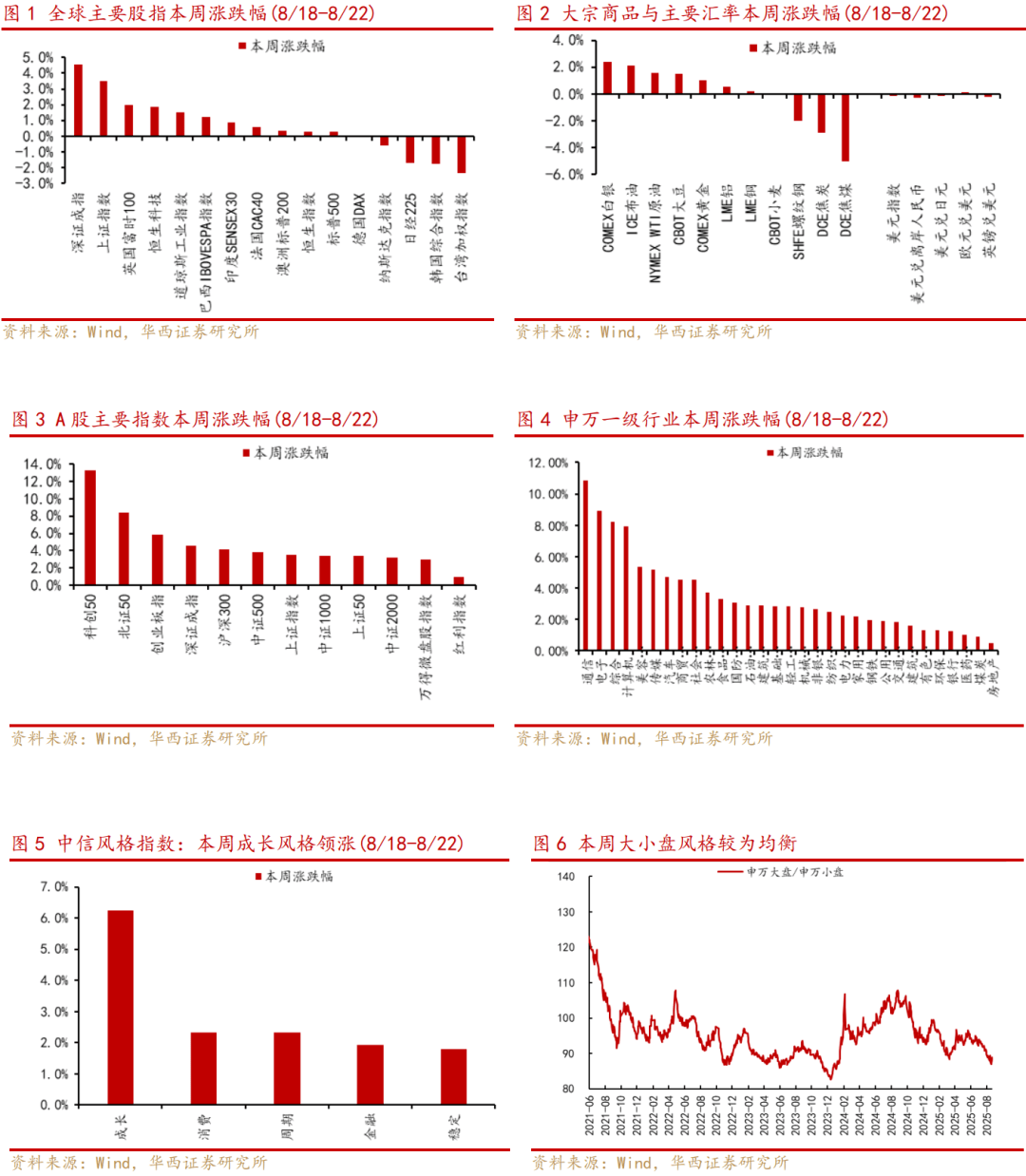
Market Review - The Chinese stock market continues to lead globally, with the Shenzhen Composite Index and Shanghai Composite Index rising by 4.6% and 3.5% respectively, with the Shanghai Index surpassing 3,800 points, a ten-year high [1] - A-share trading volume has increased significantly, with margin trading balances exceeding 2.1 trillion yuan, and the proportion of financing purchases in total A-share trading surpassing 11%, the highest since February 2020, indicating an increased risk appetite in the market [1] - Growth sectors such as semiconductors, CPO, and robotics remain strong, with the Sci-Tech Innovation 50 Index soaring by 13.31% [1] - Following Powell's speech, U.S. Treasury yields fell, the dollar index declined, and the offshore RMB appreciated against the dollar [1] Market Outlook - Multiple sources of incremental capital are entering the market, signaling the beginning of a "slow bull" cycle for A-shares [1] - The current bull market has evolved since the "924" rally, with long-term funds such as insurance and pension funds continuously increasing their holdings in A-shares over the past three years [1] - Financing funds and private equity trading remain active, with foreign investment interest in A-shares also rising [1] - There are early signs of residents moving deposits, which could lead to increased capital inflow into the market through ETFs, direct stock holdings, and public funds, becoming a key driver for the "slow bull" trend [1] Key Focus Areas - Recent market attention is on overseas monetary policy, with Powell's dovish signals increasing expectations for a rate cut in September [2] - The A-share bull market has seen a 57% increase in financing balances since the "924" rally began, with the proportion of financing purchases rising from 7.5% to 11% [3] - Long-term funds, including insurance and pension funds, have been steadily increasing their holdings in A-shares, with insurance funds and pensions holding 3.57% and 1.8% of A-share market capitalization respectively as of Q1 2025 [4] - There is a trend of residents reallocating their assets from real estate to financial assets, with potential for significant capital inflow into the stock market [5] Industry and Theme Focus - Industry focus is on new technologies and growth areas such as domestic computing power, robotics, and AI applications, alongside sectors like large finance and new consumption [6] - Thematic investment interests include self-controllable technologies, military industry, low-altitude economy, and marine technology [7]


中银航空租赁(02588.HK):交付改善下经营指标加速兑现
Ge Long Hui· 2025-08-23 11:31
Core Viewpoint - The company reported a 6% year-on-year increase in revenue to $1.24 billion for 1H25, while net profit decreased by 26% to $342 million, primarily due to a one-time impact from the return of two Russian aircraft in 1H24. Excluding this impact, core net profit increased by 20%, aligning with expectations [1]. Group 1: Financial Performance - The company achieved a capital expenditure of $1.9 billion in 1H25, marking a 138% year-on-year increase, with a total of 24 aircraft delivered, an increase of 6 aircraft year-on-year and 4 aircraft quarter-on-quarter [1]. - The operating lease fleet's net book value increased by 1% year-to-date to $18.2 billion, with a total fleet size of $22.2 billion, reflecting a 2% increase from the beginning of the year [2]. - The net leasing yield for operating leases rose by 0.5% year-on-year to 7.5%, driven by the introduction of high-rent value new aircraft [2]. Group 2: Growth Prospects - The company signed its largest aircraft order in history during 1H25, increasing the order book by 132 aircraft year-on-year to 351 aircraft, with a total capital expenditure of approximately $20 billion [2]. - The company maintains a 100% utilization rate for its fleet, with an average aircraft age of 5 years and an average remaining lease term of 7.9 years, ensuring a robust and predictable rental income structure [2]. - The current market value of the operating lease fleet is at a 15% premium to its book value, amounting to approximately $2.8 billion, which supports the company's asset stability and potential performance [2]. Group 3: Financing and Cost Structure - The company's funding cost remained stable at 4.6% year-on-year, with total debt increasing by 2%, benefiting from internal cash flow and low-interest debt refinancing [3]. - A potential easing of overseas monetary policy could lead to a reduction in financing costs, with a projected increase in net profit of approximately $2.5 million for every 10 basis points decrease in financing costs [3]. Group 4: Valuation and Outlook - The company maintains its earnings forecast, currently trading at 1.0x and 0.9x P/B for 25e and 26e, respectively, with a target price of HKD 81.40, indicating a 13% upside potential [3].