灯塔工厂

Search documents
国泰海通|计算机:AI点亮灯塔工厂,引领智能制造新范式
国泰海通证券研究· 2025-11-24 12:10
Core Insights - The article emphasizes the evolution of lighthouse factories as key carriers of new productive forces and new industrialization, driven by AI and the "14th Five-Year Plan" [1][3] - It highlights the increasing influence of AI on lighthouse factories, positioning AI+ manufacturing as a top-level driver for the development of these factories [2][3] Group 1: Lighthouse Factory Development - Lighthouse factories have transitioned from being technology models to global smart manufacturing hubs, representing the highest level of global smart manufacturing [2] - The assessment focus of lighthouse factories has evolved from single-point applications of Industry 4.0 to comprehensive operational upgrades that include sustainability, supply chain resilience, talent systems, and customer orientation [2] - The latest lighthouse factories have significantly improved key performance indicators such as labor productivity and delivery cycles, with AI applications reducing defect rates, energy consumption, and production cycles [2] Group 2: Policy and Market Dynamics - The Chinese government has integrated digitalization, networking, intelligence, and greening into the main line of manufacturing development, viewing smart and lighthouse factories as important carriers of new productive forces [3] - Local governments are providing financial subsidies, pilot demonstrations, and industrial funds to cultivate lighthouse factories, creating a complete policy chain from diagnosis to demonstration [3] - The industry layout of lighthouse factories in China is extending into high-tech fields, with core operational indicators significantly surpassing the global average [3] Group 3: Domestic Industry Collaboration - Domestic industrial software and automation vendors are becoming the core drivers of the lighthouse factory ecosystem, focusing on industrial software, automation control, industrial internet, and AI models [3] - These companies are providing comprehensive capabilities from "factory operating systems" to scenario-based solutions, enhancing the digital foundation of lighthouse factories [3]


AI点亮灯塔工厂,引领智能制造新范式
Haitong Securities International· 2025-11-24 11:42
Investment Rating - The report recommends a positive investment outlook on the AI-enabled manufacturing sector, particularly focusing on industrial software and automation companies that facilitate the digital transformation of lighthouse factories [3]. Core Insights - The report emphasizes that lighthouse factories are evolving into key carriers of new productivity and industrialization, driven by AI and the "14th Five-Year Plan" [1]. - It highlights the significant role of domestic industrial software and automation vendors in this ecosystem, which are becoming the core driving force behind the development of lighthouse factories [1]. Summary by Sections 1. From Technical Benchmark to Ecological Leadership - Lighthouse factories are recognized as the most advanced factories globally, representing the highest level of smart manufacturing [7]. - The focus of lighthouse factories has shifted from single-point applications of Industry 4.0 to comprehensive operational upgrades, emphasizing customer-centricity, production efficiency, supply chain resilience, sustainability, and talent development [10][12]. - The application of AI technologies is increasingly significant, with generative AI and predictive maintenance technologies notably reducing defect rates, energy consumption, and production cycles [16]. 2. Policy and AI Dual Empowerment - National policies are driving the rapid development of lighthouse factories, with a focus on digitalization, networking, intelligence, and green development [35]. - As of September 2025, China has 85 lighthouse factories, accounting for 42.29% of the global total, showcasing its leadership in this sector [20][22]. - The distribution of lighthouse factories in China shows a trend of coastal concentration with inland regions catching up, supported by local government initiatives [39][42]. 3. Domestic Industrial Software and Automation Vendors as Key Drivers - Hikvision is highlighted for its "Hikvision Guanlan" model, which empowers smart IoT scenarios and supports the transformation of leading factories into lighthouse factories [54]. - The report discusses the significant advancements made by various companies, including Dahua Technology, Zhongkong Technology, and others, in enhancing supply chain collaboration and digital transformation [54][56].




国泰海通:AI点亮灯塔工厂 引领智能制造新范式
智通财经网· 2025-11-24 02:12
Core Insights - The report from Guotai Junan highlights the evolution of lighthouse factories as key carriers of new productive forces and new industrialization, driven by AI and the "14th Five-Year Plan" [1][2] - The integration of AI into manufacturing is seen as a top-level driver for the development of lighthouse factories, with a focus on digital transformation through industrial software and automation vendors [1] Group 1: Lighthouse Factory Evolution - Lighthouse factories have transitioned from being technology models to global smart manufacturing hubs, representing the highest level of intelligent manufacturing [1] - These factories leverage new technologies such as IoT, AI, cloud computing, and robotics to achieve comprehensive automation, precision, and sustainability in production processes [1] - The assessment focus of lighthouse factories has evolved from single-point applications of Industry 4.0 to a comprehensive operational upgrade that includes sustainability, supply chain resilience, talent systems, and customer orientation [1] Group 2: Policy and AI Driving Growth - The Chinese government has integrated digitalization, networking, intelligence, and greening into the main line of manufacturing development, viewing smart and lighthouse factories as crucial for new productive forces and advanced manufacturing clusters [2] - Local governments are providing financial subsidies, pilot demonstrations, and industrial funds to cultivate smart and lighthouse factories, creating a complete policy chain from diagnosis to demonstration [2] - The industry layout of lighthouse factories in China is extending into high-tech fields, with core operational indicators significantly surpassing the global average [2] Group 3: Domestic Industrial Software and Hardware Vendors - Domestic companies are focusing on industrial software, automation control, industrial internet, and AI models to provide comprehensive capabilities for lighthouse factories, from "factory operating systems" to scenario-based solutions [3]

联合利华:中国为跨国企业创新和可持续发展提供坚实基础
Sou Hu Cai Jing· 2025-10-29 15:36
Core Viewpoint - The article highlights the significance of foreign investment in China's manufacturing sector, emphasizing the role of companies like Unilever in driving innovation and efficiency through advanced technologies and management practices [1][14]. Group 1: Foreign Investment and Manufacturing Innovation - The "14th Five-Year Plan" suggests expanding high-level opening-up and creating a win-win cooperation environment, with foreign investment present in all 31 major categories and 548 subcategories of China's manufacturing industry [1]. - Unilever's Hefei factory is recognized as a "lighthouse factory," showcasing how foreign enterprises contribute to the modernization of China's industrial system [1][3]. Group 2: Automation and Production Efficiency - The Hefei factory operates 24/7 with automated production lines, utilizing technologies such as preventive maintenance and 3D printing, which minimizes the need for manual labor [5][12]. - The factory's innovative pull-based automatic replenishment system has reduced the material ordering and delivery process from 12 hours to just 3 hours, achieving 100% pull-based production [9][11]. Group 3: Flexibility and Responsiveness - Emergency orders that previously took 2-3 days to process can now be completed in just 2 hours, with production line switching taking as little as 10 minutes, demonstrating the factory's flexibility in adapting to market changes [11]. - The strong supply chain in China supports the development of flexible production lines, allowing companies like Unilever to respond quickly to consumer demands [11][14]. Group 4: Talent and Digital Transformation - The Hefei region has seen the emergence of numerous national-level excellent factories and digital-leading enterprises within five years, attracting a large pool of talent and serving as a model for the digital transformation of manufacturing [16].


从“追赶者”向“领跑者”跃迁 “灯塔”之光照亮“中国智造”
Yang Shi Wang· 2025-10-27 04:34
Group 1 - The manufacturing industry is crucial for the national economy, with an expected increase in value added of 8 trillion yuan during the "14th Five-Year Plan" period, contributing over 30% to global manufacturing growth [1] - The "15th Five-Year Plan" emphasizes the acceleration of building a manufacturing powerhouse and establishing a modern industrial system centered on advanced manufacturing [1] - China leads the world in the number of "lighthouse factories," accounting for over 40% globally, showcasing its strength and competitiveness in the manufacturing sector [3] Group 2 - The SANY Heavy Energy's Shaoshan blade factory has been recognized as the world's first "lighthouse factory" in the wind power industry, reflecting the shift towards intelligent, green, and integrated development [5] - The factory can produce 118-meter-long blades, reducing production time from over 40 hours to around 30 hours [7] - As Asia's largest single wind turbine blade production workshop, it can accommodate 12 molds simultaneously, producing approximately 3,000 blades annually [9] Group 3 - The cost of blades typically accounts for 20% to 30% of the total cost of a wind turbine, making their production efficiency critical [10] - The 118-meter blade has a rotor diameter of 242 meters and a rated power of 7.7 megawatts, capable of generating 7 to 8 kilowatt-hours per rotation [11] - The factory's digital platform allows for real-time monitoring of production conditions and data, enabling 360-degree online monitoring and lean management [15] Group 4 - In October, the factory operated at full capacity, producing 174 blades, with over 100 sets delivered, indicating a significant production cycle [16] - The digital platform has reduced defects by 20% and shortened delivery times by approximately 34% [19] - The wind turbine installation capacity in China has been growing rapidly, with an expected annual increase of over 110 gigawatts during the "15th Five-Year Plan" period [21] Group 5 - Wind turbine equipment prices have risen significantly, with land-based turbine prices increasing by 8% and offshore turbine prices by 12% in the first eight months of 2025 [23] - The SANY Heavy Energy Shaoshan factory exemplifies the collaborative advantages of the wind power industry in Hunan, promoting digital transformation across the sector [25] - The factory's advancements contribute to China's wind power industry transitioning from a "follower" to a "leader" on the global stage [53] Group 6 - The factory has implemented a digital quality system, creating a traceable and optimizable manufacturing paradigm, moving towards a paperless operation [40][42] - The integration of automation and intelligent equipment has significantly improved production efficiency, reducing labor costs by 75% [51] - The development of "lighthouse factories" has stimulated technological upgrades across the entire supply chain, enhancing regional economic vitality [55]

海康威视(002415):“物联感知十AI”赋能灯塔工厂,点亮中国智造未来
Haitong Securities International· 2025-10-24 15:11
Investment Rating - The report maintains an "Outperform" rating for the company, with a target price of RMB 40.98 per share based on a 2025 PE of 28x [4][22]. Core Insights - The company is positioned to benefit from innovation and overseas market expansion, with AI expected to enhance future growth prospects. EPS estimates for 2025-2027 are RMB 1.47, 1.68, and 1.97 respectively [4][22]. - The concept of "Lighthouse Factory," introduced by WEF and McKinsey, emphasizes the integration of advanced technologies like IoT, AI, and big data to achieve significant improvements in production efficiency and sustainability. China leads globally with 85 such factories, accounting for 42.29% of the total [4][23][24]. Financial Summary - Total revenue is projected to grow from RMB 89.34 billion in 2023 to RMB 117.62 billion by 2027, reflecting a CAGR of approximately 10.3% [3]. - Net profit attributable to the parent company is expected to recover from RMB 11.98 billion in 2024 to RMB 18.03 billion in 2027, with a notable increase of 17.0% in 2027 [3]. - The company’s net asset return is forecasted to improve from 14.8% in 2024 to 17.6% in 2027 [3]. Business Strategy - The company focuses on "IoT sensing, AI, and big data" to enhance its product offerings, creating a comprehensive IoT data entry system that supports AI algorithm improvements [4][24]. - Recent collaborations, such as with Haier, aim to accelerate digital transformation across various sectors, including smart manufacturing and supply chain management [15][16]. Market Position - The company has established itself as a leader in the security industry, leveraging its technological capabilities to provide customized digital solutions across multiple industrial sectors [4][25]. - The report highlights successful implementations of its technology in various industries, such as steel and cement, showcasing significant improvements in operational efficiency and safety [11][25].
“灯塔工厂”纳入“十五五”规划的预期持续强化,智能制造赛道受市场关注,科创机械ETF(588850)早盘涨超1%
Mei Ri Jing Ji Xin Wen· 2025-10-21 02:22
Group 1 - The "Lighthouse Factory" concept is gaining attention in the capital market as it is included in the "14th Five-Year Plan," highlighting its role in smart manufacturing [1] - The Sci-Tech Mechanical ETF (588850) has seen a significant increase, with a cumulative rise of 33.14% in the third quarter of this year [1] - China currently has 85 Lighthouse Factories, accounting for 43.4% of the global total, maintaining its position as the world leader [1] Group 2 - The Ministry of Science and Technology emphasizes that technological and industrial innovation are essential for developing new productive forces during the "14th Five-Year Plan" [1] - China is making advancements in artificial intelligence and brain-computer interface technologies, creating new competitive advantages [2] - The Sci-Tech Mechanical Index reflects the performance of major listed companies in sectors such as urban rail equipment, industrial automation, and engineering machinery [2]
中控技术:正积极参与人工智能“灯塔工厂”的建设与打造
Ge Long Hui· 2025-10-20 08:05
Core Viewpoint - The core feature of "Lighthouse Factories" is the large-scale application of IoT, AI, and big data analytics, significantly enhancing production efficiency and resource utilization while achieving breakthroughs in sustainable development [1] Policy Support - The government is vigorously supporting the development of industrial AI through a series of policies aimed at promoting the intelligent transformation of manufacturing to enhance national competitiveness [1] - The State-owned Assets Supervision and Administration Commission (SASAC) has deployed the "AI+" initiative, which includes multiple approaches such as R&D and application of large models, promoting high-value scenario applications, enhancing intelligent computing power supply, and strengthening element support [1] - The Ministry of Industry and Information Technology (MIIT) has released the "Implementation Plan for Promoting Equipment Updates in the Industrial Sector," which further details policy requirements to promote the intelligent and digital transformation of industrial equipment [1] Technological Development - The MIIT and seven other departments have issued the "Implementation Opinions on Promoting Innovation and Development of Future Industries," emphasizing the need to break through key technologies for humanoid robots and promote their widespread application in intelligent manufacturing [1] - The integration of humanoid robots with AI technology aims to form core competitiveness with independent intellectual property rights [1] Company Initiatives - The company is actively participating in the construction and development of AI-driven "Lighthouse Factories," innovating and fully implementing a new industrial AI-driven enterprise intelligent operation framework of "1+2+N" [1] - The company is applying advanced products and technologies such as the Universal Control System (UCS), Time Series Large Model (TPT), million-point real-time database, and online calorific value analyzer to help enterprises build globally leading smart factories and create world-class industry benchmark projects [1] - The company plans to continue deepening innovation and application in industrial AI to assist more enterprises in achieving intelligent transformation [1]
【金牌纪要库】2025年工程机械行业复苏趋势显著,出口成为重要增长引擎,这两家企业三季度出口增速均超30%
财联社· 2025-10-20 04:54
Group 1 - The core viewpoint of the article highlights the significant recovery trend in the engineering machinery industry by 2025, with exports becoming a crucial growth engine, as evidenced by two companies achieving over 30% export growth in the third quarter [1] - New growth drivers in the engineering machinery sector include nuclear fusion, deep-sea technology, and humanoid robots, with several companies already securing contracts or initiating new business ventures in these areas [1] - Sany Heavy Industry has established a significant first-mover advantage in the lighthouse factory sector, with its intelligent warehousing system achieving over 40% penetration in Sany's lighthouse factories [1]


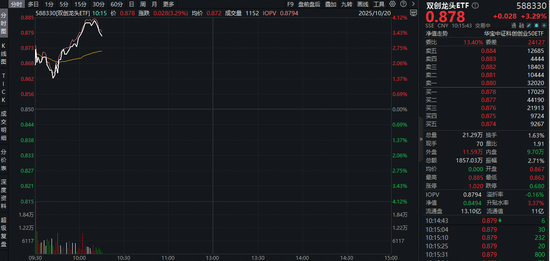
易中天大涨!硬科技宽基——双创龙头ETF(588330)猛拉4%,机构:海外大客户上修2026年1.6T光模块采购计划
Xin Lang Ji Jin· 2025-10-20 02:28
Core Viewpoint - The technology sector is experiencing a significant rebound, particularly in the ChiNext and STAR Market, with the Double Innovation Leader ETF (588330) showing strong performance and recovery of key moving averages [1][3]. Group 1: Market Performance - The Double Innovation Leader ETF (588330) saw an intraday increase of up to 4%, currently up by 3.29%, recovering above the 5-day moving average [1]. - Major stocks in the optical module sector, including Tianfu Communication, Zhongji Xuchuang, and Xinyi Sheng, have shown substantial gains, with Tianfu Communication rising over 13% and Zhongji Xuchuang over 11% [3][5]. Group 2: Stock Highlights - Top performing stocks include: - Tianfu Communication: +13.29%, market cap of 129.1 billion [5]. - Zhongji Xuchuang: +11.95%, market cap of 46.474 billion [5]. - Xinyi Sheng: +8.71%, market cap of 34.18 billion [5]. - Huazhong Micro: +6.93%, market cap of 7.25 billion [5]. - Yangguang Electric: +5.98%, market cap of 317 billion [5]. Group 3: Industry Trends - Recent reports indicate that overseas clients have significantly increased their procurement plans for 1.6T optical modules, with orders rising from 10 million to 20 million units, driven by the acceleration of GB300 and subsequent Rubin platform deployments [5]. - The Ministry of Industry and Information Technology has launched a special initiative to develop a city-wide "millisecond computing" network by 2027, emphasizing the importance of optical communication technology in overcoming traditional computing network limitations [6]. Group 4: Investment Strategy - The current technology market is viewed as being in the first phase of explosive growth, with significant potential in sectors highlighted in the "14th Five-Year Plan," particularly in intelligent manufacturing and lighthouse factories [7]. - Guosen Securities maintains that technology remains the main theme of the market, with AI driving growth across multiple industries [8]. - Investing in broad-based indices like the Double Innovation Leader ETF is recommended to mitigate risks and capture sector rotations, as it provides exposure to various technology sub-sectors [9][10].