
煤炭市场供需

Search documents
【资讯】12月8日煤焦信息汇总
Xin Lang Cai Jing· 2025-12-08 12:16
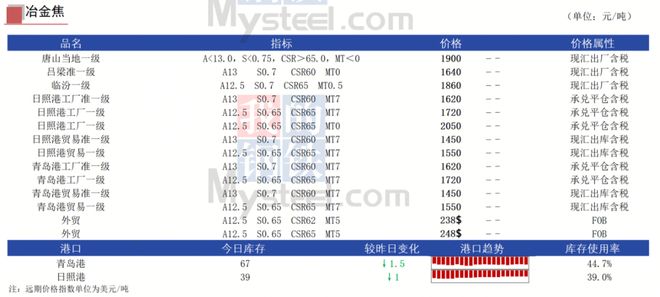
Group 1: Market Overview - On August 8, the port coke spot market showed weak performance, with domestic trading atmosphere being subdued due to the influence of futures trends and expectations of coke prices from production areas [1] - The external trade demand remained average, leading to stable port prices for foreign trade coke [1] - The future trends of coke prices will depend on downstream steel mill profit levels, changes in coking coal costs, and futures market sentiment [1] Group 2: Regional Price Stability - In the Linfen market, coke prices remained stable, with major steel mills in Hebei reducing coke prices by 50-55 yuan/ton starting from August 1 [2] - The overall production pace of coking enterprises in Linfen was normal, with low inventory levels and general profitability [2] - Downstream steel demand was cautious, primarily focusing on essential purchases, with expectations for short-term price stability [2] Group 3: Price Data - Current prices for various types of metallurgical coke in different regions are as follows: - Linfen first-class dry quenching metallurgical coke at 1840 yuan/ton [2] - Taiyuan first-class dry quenching metallurgical coke at 1840 yuan/ton [2] - Jinzhong first-class dry quenching metallurgical coke at 1860 yuan/ton [3] - Other regional prices include: - Tangshan first-class coke at 1900 yuan/ton [4] - Lüliang first-class coke at 1640 yuan/ton [4] Group 4: Coking Coal Market - On August 8, the coking coal market in Jinzhong showed a stable to weak trend, with most coal mines maintaining normal production levels [6] - The overall market transaction atmosphere was flat, with cautious purchasing behavior from steel enterprises focusing on inventory consumption [6] - In the Lüliang market, coking coal prices showed slight stabilization, with some coal types indicating short-term stabilization characteristics [7] Group 5: Import and Export Trends - In November, India imported 1597.9 million tons of coal, a year-on-year increase of 5.17% [17] - China's coal imports in November reached 4405.3 million tons, a month-on-month increase of 231.6 million tons, but a year-on-year decrease of 12.0% [17] - Shaanxi Coal Industry reported a coal production of 1479 million tons in November, a year-on-year increase of 5.18% [17]


银河期货煤炭日报-20251128
Yin He Qi Huo· 2025-11-28 11:36
Group 1: Report Information - Report Date: November 28, 2025 [1] - Report Type: Coal Daily Report - Researcher: Zhang Mengchao [5] - Qualification Number: F3068848 [5] - Investment Consulting Qualification Number: Z0017786 [5] - Contact Information: zhangmengchao_qh@chinastock.com.cn [5] Group 2: Market Review - On November 28, port market quotations continued to decline, with increased willingness of traders to sell, and the mainstream price range further moved down. The 5500 - kcal coal was quoted at 820 - 825 yuan/ton, the 5000 - kcal coal at 720 - 725 yuan/ton, and the 4500 - kcal coal at 620 - 625 yuan/ton in the port market. Different regions had different price ranges for various coal types [2]. Group 3: Important Information - From January to October this year, national railways累计 sent 3.378 billion tons of goods, a year - on - year increase of 3%, reaching a record high for the same period. The average daily loading was 186,000 cars, a year - on - year increase of 4% [3]. Group 4: Logical Analysis Supply - The impact of production restrictions still exists. The coal mine operating rates in major coal - producing areas of Shanxi, Shaanxi, and Inner Mongolia were generally stable. As of November 27, the coal mine operating rate in Ordos was 78%, and in Yulin it was 46%. The daily average coal output of Ordos and Yulin was over 4 million tons, and the domestic supply tended to be loose. However, in late November, the coal output in major producing areas was running at a low level, and the supply tightened [4]. Import - China's procurement demand weakened, while international coal prices continued to rise. Indonesia's Ministry of Energy and Mineral Resources lowered the coal production target to 700 million tons, but the actual implementation still depends on China's demand [4]. Demand - This week, the demand was mediocre. China's procurement demand weakened, Japan and South Korea's procurement performance was average, and there was still no improvement in India's procurement demand. Power plant loads were maintained between 60 - 70%, and the operation was relatively stable. Downstream power plants mainly relied on long - term agreement coal to replenish inventory, with limited demand for market coal. Non - power industries purchased on demand and had a significantly lower acceptance of high - priced coal [4]. Inventory - Railway transportation returned to normal. The average daily transportation volume of the Datong - Qinhuangdao Line was 1.3 million tons, and the number of approved carriages by Huhehaote Railway Bureau was around 30 trains. The port inventory was generally stable. As of November 28, the inventory of Bohai Rim ports was 25.12 million tons, returning to the high level of the same period. Coastal power plants had low daily consumption but continuous inventory depletion, while inland power plants had a neutral inventory [4]. Price Forecast - Currently, the port FOB price is weakly回调. The pit - mouth safety supervision has been lifted, the coal mine operating rate has increased, production has risen, and the demand for chemical coal is okay, so the pit - mouth price has weakly declined. It is expected that coal prices will be weak in the short term [4]
银河期货煤炭日报-20251125
Yin He Qi Huo· 2025-11-25 11:54
Group 1: Report Overview - Report Title: Coal Daily Report, November 25, 2025 [1] - Report Type: Energy and Chemical Research Report [6][9] Group 2: Market Review - Spot Market: On November 25, port market thermal coal quotes showed signs of weakness. 5500 kcal coal was quoted at 830 - 840 yuan/ton, 5000 kcal at 730 - 740 yuan/ton, and 4500 kcal at 630 - 640 yuan/ton. Different regions had varying non - power enterprise coal prices [2]. Group 3: Important News - National Railway Freight: From January to October this year, national railways cumulatively transported 3.378 billion tons of goods, a 3% year - on - year increase, reaching a record high for the same period. The average daily loading was 186,000 cars, a 4% year - on - year increase [3]. Group 4: Logical Analysis Supply - Domestic Supply: As of November 23, the coal mine start - up rate in Ordos was 78%, and in Yulin it was 46%. The daily coal output of the two cities was over 4 million tons, and the domestic supply was becoming more abundant [4]. - Import: Chinese procurement demand weakened, while international coal prices continued to rise. Indonesia's Energy and Mineral Resources Ministry lowered the coal production target to 700 million tons, but the actual implementation still depends on Chinese demand [4]. Demand - General Demand: This week, demand was mediocre. Chinese procurement demand weakened, while that of Japan and South Korea was average, and India's procurement demand showed no improvement. Heating load growth did not meet expectations, and power plant daily consumption increased slowly, with power plant loads generally operating in the 60% - 70% range [4]. - Coal Procurement: Power plants mainly pulled long - term contract supplies, with extremely limited demand for market coal. They had a very low acceptance of high - priced coal and strong willingness to bargain, leading to a stalemate in market transactions [4]. Inventory - Port Inventory: Railway transportation returned to normal. The average daily transport volume of the Datong - Qinhuangdao line was 1.3 million tons, and the number of approved trains by Hohhot Railway Bureau was around 30. Port inventory remained stable, with the inventory of Bohai Rim ports at 24.85 million tons as of November 25, at a neutral level in recent years [4]. - Power Plant Inventory: Coastal power plant daily consumption was low, but inventory continued to decline. Inland power plant inventory was at a neutral level [4]. Price Forecast - Overall: In late November, coal production in major producing areas was low. Power plant inventory continued to decline, and import profits were available. Coastal power plants increased procurement. Port inventory fluctuated within a range. It is expected that coal prices will be weak in the short term [4]. Group 5: Related Charts - The report provides charts showing the inventory and daily consumption data of various ports and power plants from 2022 to 2025, including national ports, Bohai Rim ports, downstream ports, etc. [7][8]
银河期货煤炭日报-20251124
Yin He Qi Huo· 2025-11-24 12:29
1. Report Industry Investment Rating - Not provided in the content 2. Core View of the Report - The coal price is expected to be weak in the short term. As of late November, the coal production in major producing areas is running at a low level, the supply is tightening, the power plant inventory is continuously decreasing, the import profit is available, the port inventory fluctuates within a range, the power plant daily consumption hovers at a low level, and the coal consumption is average, but the coastal power plant inventory is lower than the same period and continues to make rigid - demand purchases, leading to a continuous increase in the port FOB price. The increase in pit - mouth price has narrowed [4]. 3. Summary by Related Catalogs Market Review - On November 24, the port market showed a continuous game between buyers and sellers, and the overall quotation remained stable. The 5500 - kcal coal was quoted at 840 - 850 yuan/ton, the 5000 - kcal coal at 740 - 750 yuan/ton, and the 4500 - kcal coal at 640 - 650 yuan/ton. In Inner Mongolia, Shanxi and other regions, the prices of different - calorie non - power enterprise coal were also within certain ranges. The mainstream quotation of 5500 - kcal thermal coal at Jiangnei Port was 890 - 900 yuan/ton, and the 5000 - kcal coal was quoted at 790 - 800 yuan/ton [2]. Important News - From January to October this year, the national railways cumulatively sent 3.378 billion tons of goods, a year - on - year increase of 3%, setting a record high for the same period; the average daily loading was 186,000 cars, a year - on - year increase of 4% [3]. Logic Analysis - **Supply**: The impact of production restrictions still exists. The coal mine start - up rates in major coal - producing areas of Shanxi, Shaanxi and Inner Mongolia are generally stable. As of November 23, the coal mine start - up rate in Ordos was 78%, and that in Yulin was 46%. The daily average coal output of Ordos and Yulin was over 4 million tons, and the domestic supply tended to be loose. Entering late November, the coal output in major producing areas was running at a low level, the coal start - up rates in Ordos and Yulin were stable, and the daily average output was around 3.8 million tons, with supply tightening [4]. - **Import**: China's demand has weakened, but the international coal price has still risen. The precipitation in Indonesia still affects the tight supply of goods, the number of overseas cargoes is small, and the miners have a strong willingness to hold up prices [4]. - **Demand**: This week, the demand performance was average. China's procurement demand weakened, Japan and South Korea's procurement performance was average, and India's procurement demand still did not improve. With the deepening of winter, the demand for heating coal has increased significantly, but the growth momentum of coal - consumption demand in the industrial industry is insufficient due to the overall economic situation. Power plants are mainly cautious in procurement, mainly locking in part of the coal source through long - term contracts and flexibly adjusting the market coal according to market dynamics [4]. - **Inventory**: Railway transportation has returned to normal. The daily average transportation volume of the Datong - Qinhuangdao Line is 1.3 million tons, and the number of approved wagons by the Hohhot Railway Bureau is around 30 trains. The port inventory is generally stable. As of November 21, the inventory of Bohai - Rim ports was 24.6 million tons, at a neutral level over the years. The daily consumption of coastal power plants is low, but the inventory is continuously decreasing, and the inventory of inland power plants is neutral [4].
【资讯】11月21日煤焦信息汇总
Xin Lang Cai Jing· 2025-11-21 14:32
Group 1 - The average profit for independent coking plants in China is 19 CNY per ton of coke, with regional variations such as 20 CNY in Shanxi and 80 CNY in Shandong [1] - The average daily coke production from 247 sampled steel mills is 46.22 thousand tons, with a capacity utilization rate of 85.23% [1] - Coking coal inventory has increased to 797.08 thousand tons, with an available days supply of 12.97 days [1] Group 2 - Recent market conditions for coking coal have weakened, with the average profit for coke increasing by 53 CNY per ton, reaching a two-month high [2] - Independent coking enterprises have seen a 12.3% increase in coke inventory, totaling 652.9 thousand tons, while steel mill coke inventory has slightly decreased [2] - There are mixed opinions on future price adjustments, with some suggesting that weak downstream demand may lead to price reductions [2][3] Group 3 - The metallurgical coke prices in the Lüliang market have stabilized after a recent increase of 50-55 CNY per ton [3] - The average price for various grades of metallurgical coke ranges from 1685 to 1805 CNY per ton [3] Group 4 - The online auction prices for high-sulfur coking coal in the Lüliang market have decreased, with transaction prices between 1220 and 1250 CNY per ton [5] - The overall market for coking coal in the Jinzhong area is showing a weak trend, with prices remaining under pressure [6] Group 5 - The import market for coking coal is showing a weak trend, with Australian coking coal prices remaining stable at around 214.0 USD per ton [7] - The Mongolian coking coal market is also experiencing a downturn, with prices declining due to weak demand [8] Group 6 - China's coal imports for October 2025 reached 31.14 million tons, marking a 14.2% year-on-year decline [16] - The average coal price in Shanxi province was reported at 955.92 CNY per ton, with a 2.9% increase week-on-week [17]
银河期货煤炭日报-20251120
Yin He Qi Huo· 2025-11-20 11:31
Group 1: Report Information - Report Title: Coal Daily Report, November 20, 2025 [1] - Report Type: Energy and Chemical Research Report [6][9] - Researcher: Zhang Mengchao [5] - Contact Information: zhangmengchao_qh@chinastock.com.cn [5][13] Group 2: Market Review - Spot Market: On November 20, the port market showed a stalemate between supply and demand, with overall stable quotes. Different calorific value coal prices are provided for various regions including ports, Inner Mongolia, Yulin, Shanxi, and Jiangnei [2] Group 3: Important Information - Power Generation: In October, the power generation of industrial enterprises above designated size was 800.2 billion kWh, a year - on - year increase of 7.9%, 6.4 percentage points faster than in September. From January to October, the power generation was 8062.5 billion kWh, a year - on - year increase of 2.3% [3] Group 4: Logic Analysis - Supply: The impact of production restrictions still exists. The coal mine operating rates in the main coal - producing areas of Shanxi, Shaanxi, and Inner Mongolia are generally stable. As of November 18, the coal mine operating rate in Ordos was 78%, and in Yulin was 46%. The daily coal output of Ordos and Yulin was over 3.9 million tons, and the domestic supply tightened overall [4] - Import: Chinese demand weakened, but international coal prices still rose. Indonesian precipitation affected the supply, and overseas cargo volumes were limited, with miners having a strong willingness to hold prices [4] - Demand: This week's demand was average. Chinese procurement demand weakened, while that of Japan and South Korea was average, and India's procurement demand did not improve. Most power plants' operating loads were in the 60% - 70% range, and their inventories were at medium - to - high levels [4] - Inventory: Railway transportation returned to normal. The daily average transportation volume of the Datong - Qinhuangdao Line was 1.3 million tons, and the number of approved trains by the Hohhot Railway Bureau was around 30. Port inventory was generally stable. As of November 20, the inventory of Bohai Rim ports was 24.48 million tons, at a neutral level in history [4] - Price Forecast: It is expected that coal prices will remain stable in the short term. The coal mine output in the main producing areas is low, power plant inventories are decreasing, and the import profit is open. Coastal power plants are increasing procurement, and port prices have risen [4] Group 5: Related Charts - Charts include coal inventories and consumption data of various regions and power plants from 2022 to 2025, such as national port inventory, power plant inventory, and daily consumption [7][8]
银河期货煤炭日报-20251119
Yin He Qi Huo· 2025-11-19 09:31
Group 1: Market Review - On November 19, the port market showed a stalemate between supply and demand, with overall stable quotes. The quotes for 5500 - calorie coal were 840 - 850 yuan/ton, 5000 - calorie coal were 740 - 750 yuan/ton, and 4500 - calorie coal were 640 - 650 yuan/ton. In different regions, non - electric enterprise coal prices also had corresponding ranges [2]. Group 2: Important Information - On November 14, the National Bureau of Statistics released data showing that the power production growth of above - scale industries in China accelerated. In October, the power generation of above - scale industries was 800.2 billion kWh, a year - on - year increase of 7.9%, 6.4 percentage points faster than in September; the daily average power generation was 25.81 billion kWh. From January to October, the power generation of above - scale industries was 8062.5 billion kWh, a year - on - year increase of 2.3% [3]. Group 3: Logic Analysis - Supply: The impact of production restrictions still exists. The coal mine operating rates in the main coal - producing areas of Shanxi, Shaanxi, and Inner Mongolia were generally stable. As of November 18, the coal mine operating rate in Ordos was 78%, and in Yulin was 46%. The daily average coal output of Ordos and Yulin was over 3.9 million tons, and the domestic supply tightened overall. Import: China's demand weakened, but international coal prices still rose. Demand: This week, the demand was average. China's procurement demand weakened, Japan and South Korea's procurement was average, and India's procurement demand still did not improve. Supply: The rainfall in Indonesia still affected the tight supply of goods, the number of overseas cargoes was small, and miners were more willing to hold prices. Most power plants' operating loads were in the range of 60% - 70%, and the overall inventory of power plants was at a medium - high level. In market procurement, most power plants preferred to fulfill long - term contracts, and some power plants, expecting the subsequent market coal price to rise, chose to conduct a small amount of tender procurement for market coal. Inventory: Railway transportation returned to normal. The daily average transportation volume of the Datong - Qinhuangdao Line was 1.3 million tons, and the number of approved trains by the Hohhot Railway Bureau was around 30. The port inflow was stable, and the outflow remained high. As of November 19, the inventory of Bohai Rim ports was 24.4 million tons, at a neutral level over the years. The daily consumption of coastal power plants was low, but the inventory continued to decline, while the inventory of inland power plants was neutral. Overall, in mid - November, the coal production in the main producing areas was low. The coal operating rates in Ordos and Yulin were stable, with a daily average output of around 3.8 million tons, and the supply tightened. The power plant inventory continued to decline, the import profit was realized, and coastal power plants increased their procurement efforts. The port inflow and outflow were at low levels, and the port inventory fluctuated within a range. As the high - temperature weather across the country subsided, the daily consumption of power plants hovered at a low level, and the coal consumption was average. However, the inventory of coastal power plants was lower than the same period, and they continued to make rigid - demand purchases. The port FOB price rose continuously. With strengthened safety supervision at the mine mouth, the coal mine operating rate was low, and the production was average. The demand for chemical coal was acceptable, and the increase in the mine - mouth price narrowed. It is expected that the coal price will slow down in the short term [4].
银河期货煤炭日报-20251111
Yin He Qi Huo· 2025-11-11 09:16
Report Summary 1. Report Industry Investment Rating No information provided. 2. Core View of the Report - The coal price is expected to slow down its upward trend in the short term. The supply is tightening as the coal production in major producing areas is running at a low level, and the coal prices at ports have been rising continuously. However, with the decrease in power plant consumption and the relatively stable port inventory, the upward momentum of coal prices is expected to weaken [4]. 3. Summary by Relevant Sections Market Review - On November 11, the port thermal coal market remained in a stalemate, with the supply and demand sides in a continuous game. The prices of different calorific value coal types in various regions are as follows: 5500 - kcal coal is priced at 840 - 850 yuan/ton in ports, 590 - 630 yuan/ton in Inner Mongolia for non - power enterprises, 620 - 670 yuan/ton in Shanxi for non - power enterprises, and 890 - 900 yuan/ton in Jiangnei ports; 5000 - kcal coal is priced at 740 - 750 yuan/ton in ports, 500 - 540 yuan/ton in Inner Mongolia for non - power enterprises, 550 - 600 yuan/ton in Shanxi for non - power enterprises, and 790 - 800 yuan/ton in Jiangnei ports; 4500 - kcal coal is priced at 640 - 650 yuan/ton in ports, 435 - 475 yuan/ton in Inner Mongolia for non - power enterprises, and 470 - 520 yuan/ton in Shanxi for non - power enterprises. The price of 6000 - kcal coal in Yulin for non - power enterprises is in the range of 680 - 710 yuan/ton, and the price of 5800 - kcal coal is in the range of 640 - 670 yuan/ton [2]. Important Information - In October 2025, China imported 4173.7 million tons of coal, a decrease of 451.1 million tons or 9.75% compared with the same period last year, and a decrease of 426.60 million tons or 9.27% compared with September. From January to October 2025, China imported a total of 38762.30 million tons of coal, a year - on - year decrease of 11% [3]. Logical Analysis - **Supply**: The impact of production restrictions still exists. The coal mine operating rates in major coal - producing areas of Shanxi, Shaanxi, and Inner Mongolia are generally stable. As of November 10, the coal mine operating rate in Ordos is 71%, and that in Yulin is 46%. The daily average coal output of Ordos and Yulin is more than 390 million tons, and the domestic supply is generally tightening. The coal prices have generally risen due to strong Chinese procurement demand [4]. - **Demand**: The procurement demand in China is relatively strong, while that in Japan and South Korea is average. The overall market sentiment has improved driven by Chinese buyers. Most power plants are operating at a load of about 70%, and the number of available days of power plant inventory is at a medium - to - high level, with a relatively stable overall operation. Some power plants mainly rely on long - term contract fulfillment and basically achieve a balance between intake and consumption, while a few power plants make small - scale market purchases according to their own inventory structures [4]. - **Inventory**: Railway transportation has returned to normal. The daily average transportation volume of the Datong - Qinhuangdao Line is 1.3 million tons, and the number of approved trains by the Hohhot Railway Bureau is around 30. The port inventory is generally stable. As of November 10, the inventory of Bohai Rim ports is 22.91 million tons, at a neutral level over the years. The daily consumption of coastal power plants is low, but the inventory is continuously decreasing, and the inventory of inland power plants is neutral [4]. - **Overall Situation**: In mid - November, the coal production in major producing areas is running at a low level, the coal operating rates in Ordos and Yulin are stable, and the daily average output is around 3.8 million tons, with supply tightening. The power plant inventory is continuously decreasing, the import profit is available, and coastal power plants are increasing their procurement efforts. The port intake and output are at a low level, and the port inventory fluctuates within a range. With the end of the high - temperature period across the country, the daily consumption of power plants is hovering at a low level, and the coal consumption is average. However, the inventory of coastal power plants is lower than the same period, and they continue to make rigid - demand purchases, leading to a continuous increase in the port FOB price. The coal mine operating rate is low due to strengthened safety supervision at the mine mouth, and the output is average. The demand for chemical coal is acceptable, and the increase in the mine - mouth price has narrowed. It is expected that the coal price will mainly slow down its upward trend in the short term [4].
银河期货煤炭日报-20251110
Yin He Qi Huo· 2025-11-10 09:45
Group 1: Market Review - On November 10, port market quotes were firm. The 5500 - kcal coal was quoted at 840 - 850 yuan/ton, the 5000 - kcal at 740 - 750 yuan/ton, and the 4500 - kcal at 640 - 650 yuan/ton. Coal prices in different regions varied [2]. Group 2: Important Information - In October 2025, China imported 4173.7 million tons of coal, a decrease of 451.1 million tons (9.75%) compared to the same period last year and a decrease of 426.60 million tons (9.27%) compared to September. From January to October 2025, China imported 38762.30 million tons of coal, a year - on - year decrease of 11% [3]. Group 3: Logic Analysis - Supply: Restrictions on production still had an impact. The coal mine operating rates in major coal - producing areas of Shanxi, Shaanxi, and Inner Mongolia were generally stable. As of November 10, the coal mine operating rate in Ordos was 71%, and in Yulin it was 46%. The daily coal output of Ordos and Yulin was over 390 million tons, and the domestic supply tightened [4]. - Import: China's procurement demand was strong, and coal prices generally rose. Indonesia's precipitation affected coal production and transportation, leading to a tight market supply [4]. - Demand: Most power plants maintained a load of around 70%. Power plant inventory days were at a medium - to - high level. Some power plants mainly fulfilled long - term contracts, achieving a balance between intake and consumption, while a few made small - scale market purchases [4]. - Inventory: Railway transportation returned to normal. The daily transportation volume of the Datong - Qinhuangdao line was 1.3 billion tons, and the number of approved trains by the Hohhot Railway Bureau was around 30. Port inventory was generally stable. As of November 10, the inventory of Bohai Rim ports was 2237 million tons, at a neutral level in history. Coastal power plants had low daily consumption but their inventory was continuously decreasing, while inland power plants had neutral inventory [4]. - Outlook: In mid - November, coal production in major producing areas was low. The coal operating rates in Ordos and Yulin were stable, with a daily output of around 380 million tons, and the supply tightened. Power plant inventory continued to decline, import profit margins opened up, and coastal power plants increased their procurement. Port intake and output were at low levels, and port inventory fluctuated within a range. As the high - temperature weather subsided nationwide, power plant daily consumption remained low, and coal consumption was average. However, coastal power plant inventory was lower than the same period, with continuous rigid - demand procurement. Port FOB prices continued to rise. With strengthened safety supervision at the mine mouth, the coal mine operating rate was low, production was average, and the demand for chemical coal was fair, so the mine - mouth price rose firmly. It was expected that coal prices would rise in the short term [4].
兖煤澳大利亚(03668) - 季度报告截至2025年9月30日止季度
2025-10-20 08:31
澳洲證券交易所、香港交易及結算所有限公司及香港聯合交易所有限公司對本公告的內容概不負 責,對其準確性或完整性亦不發表任何聲明,並明確表示概不就因本公告全部或任何部分內容而 產生或因倚賴該等內容而引致的任何損失承擔任何責任。 Yancoal Australia Ltd ACN 111 859 119 兗煤澳大利亞有限公司* (於澳大利亞維多利亞州註冊成立的有限公司) (香港股份代號:3668) (澳洲股份代號:YAL) 季度報告 截至2025年9月30日止季度 2025年10月20日刊發 * 仅供识别 本季度兗煤澳洲的可記錄總工傷頻率降至 5.71,仍然低於可比較行業加權基準。1 儘管本季度受到降雨因素干擾,但原煤總產 量與公司預測一致。商品煤總產量為1,230萬 噸(100%基準),與前一季度持平。如預期, 由於彌補了第二季度末因天氣因素導致船運 延遲而產生的銷售缺口,本季度的權益銷量 高於權益產量。 2025年第三季度整體煤炭銷售價格為140澳 元/噸,其中動力煤銷售價格保持穩定,冶金 煤銷售價格環比下降1%,銷售價格綜合反映 了煤炭價格指數、匯率和銷售合約結構的滯 後效應。 2025年運營指引(保持不變) ...