白酒行业周期

Search documents
白酒行业周期专题2:以史为镜,当前时点为什么我们认为白酒进入布局阶段?
Guoxin Securities· 2025-10-28 10:59
Investment Rating - The report maintains an "Outperform" rating for the liquor industry [5][6] Core Viewpoints - The current market for the liquor sector shows divergence, with significant year-on-year performance declines expected for Q3 2025, yet both valuation and holdings are at low levels, indicating potential positive changes in supply and demand dynamics [1][4] - Historical analysis from 2013-2015 suggests that the current cycle has strong similarities, indicating that buying opportunities may accelerate [1][4] - The report anticipates a two-phase recovery in industry valuations, with the first phase driven by demand recovery and the second phase contingent on improved supply-demand relationships and market confidence in long-term liquor assets [4][17] Summary by Sections Price and Performance Analysis - Most companies confirmed their stock price bottoms between Q4 2013 and Q1 2014, with performance declines starting in Q3 2013, while stock prices remained relatively stable [2][7] - The report highlights that stock price performance is closely linked to fundamental performance, with regional leaders showing less decline compared to the overall market [2][13] Company Strategies - Companies are leveraging channels to enhance brand and product advantages during the adjustment phase, with a focus on maintaining brand strength for high-end products [3][30] - Regional leaders are concentrating on core markets and enhancing distribution channels, while expansion-oriented companies are increasing their presence in mid-to-low-end products [3][30] Investment Recommendations - The report suggests that the industry is entering a layout phase, recommending investments in stable-performing companies with long-term growth potential, such as Luzhou Laojiao, Guizhou Moutai, and Shanxi Fenjiu, while also monitoring Wuliangye and Yanghe for potential recovery [4][5]






茅台再次换帅,其中有3个关键点
虎嗅APP· 2025-10-26 03:15
Core Viewpoint - The recent leadership change at Kweichow Moutai, with Chen Hua replacing Zhang Deqin as chairman, reflects the company's operational challenges amid a declining liquor industry, raising questions about the impact of such changes on future performance [3][4][6]. Group 1: Leadership Change - Chen Hua, previously the director of the Guizhou Provincial Energy Bureau, has taken over as chairman of Kweichow Moutai, marking the third leadership change in five years [3][13]. - The sudden nature of this leadership change has sparked mixed reactions, with some viewing it as a response to operational difficulties while others see potential for new strategies under the new chairman [4][5][6]. Group 2: Operational Challenges - Kweichow Moutai is facing significant operational challenges, with forecasts indicating a decline in revenue and net profit growth rates for Q3, following a trend of decreasing growth from double digits in Q1 to single digits in Q2 [7][9]. - The overall liquor market is experiencing a downturn, with sales during the recent holiday season dropping by 20%-30%, and prices for Moutai products falling below 1700 yuan per bottle due to promotional activities [8][9]. - The company is under pressure to manage inventory and stabilize pricing while meeting performance targets set by the provincial government, which complicates the new chairman's role [15]. Group 3: Historical Context and Future Outlook - Historical data suggests that leadership changes in the liquor industry often coincide with broader market recoveries, but the current environment indicates that Kweichow Moutai's challenges are not yet resolved [18][22]. - The previous chairman, Zhang Deqin, had initiated strategies aimed at transforming the brand's market approach, but his abrupt departure raises concerns about continuity and the effectiveness of these strategies [11][12]. - The new chairman's background in energy management may provide fresh perspectives on operational efficiency, but the existing challenges of inventory and pricing remain significant hurdles [15].


白酒半年报复盘及周期推演
2025-09-24 09:35
Summary of the White Wine Industry Conference Call Industry Overview - The white wine industry is experiencing a downturn, with both volume and price declining during the Mid-Autumn Festival and National Day gifting season, indicating weakened demand [1][4] - The second quarter saw a 5% decline in revenue and an 8% drop in net profit for white wine companies, with gross margin growth slowing and net profit margin reaching a four-year low [1][5][9] Key Insights and Arguments - Market research from Henan Bai Rong indicates a significant reduction in gifting demand, with per capita spending decreasing and gift box prices falling below early-year levels [1][4] - The decline in contract liabilities and cash received from sales reflects insufficient willingness and ability for downstream payments, exacerbated by channel pressures and inverted pricing [1][7] - Historical analysis suggests that the bottom of wholesale prices provides stronger support for stock prices than the bottom of financial reports [1][12] - The reasonable price range for Moutai is estimated between 1,500 and 1,800 RMB, with current prices nearing dealer cost lines but not yet reaching calculated lows [1][15][16] Financial Performance - The second quarter's financial reports reveal a significant gap between actual sales performance and reported data, leading to further adjustment expectations [1][5][8] - The competitive landscape is intensifying, with companies resorting to increased spending to maintain market share, resulting in lower net profit margins [1][6][9] Future Outlook - The third quarter is expected to see further declines in revenue and net profit growth, potentially indicating the industry is nearing a cyclical low [1][17] - The third quarter report is crucial for future performance expectations, as a poor showing could signal improvements in subsequent quarters due to the smoothing nature of white wine sales [1][19] - Long-term prospects suggest that the white wine industry may evolve into a dividend asset characteristic, with growth rates stabilizing in the single digits due to limited new capacity and increased focus on return on equity (ROE) [2][21] Additional Considerations - The stability of Moutai's dealer network and their strong financial health reduce the risk of panic selling, which could help maintain price stability in the short term [1][16] - The market's focus on the third quarter's performance may provide insights into whether the industry has reached its cyclical low, influencing investor decisions [1][18][19] - Companies with strong brand, channel, and product capabilities are likely to perform better in the current competitive environment, with leading firms showing greater certainty in their performance [1][20]
董广阳:白酒的投资逻辑
YOUNG财经 漾财经· 2025-09-23 08:17
Core Viewpoint - The white liquor industry is undergoing its fourth paradigm shift, characterized by low valuations and high dividend yields, indicating a potential new cycle beginning soon [4][5][29]. Group 1: Industry Background - The white liquor industry has experienced significant adjustments over the past few years, similar to the consumer electronics sector, with new consumption patterns emerging [5][6]. - The macroeconomic environment is changing, with a shift in China's economic structure towards emerging industries, while the export share is increasing despite global trade tensions [9][11]. - The consumption ratio in China remains low compared to developed countries, suggesting that the current weak consumption may lead to future growth opportunities [11][12]. Group 2: Industry Characteristics - The white liquor industry exhibits three main commercial characteristics: the trumpet effect, the flywheel effect, and the leader effect [13][14]. - The trumpet effect amplifies demand through various channels, leading to inventory buildup during positive cycles and exacerbating downturns during negative cycles [13]. - The flywheel effect indicates that price changes can lead to significant variations in volume, revenue, and profit, creating multiplier effects that can result in substantial investment opportunities [14]. - The leader effect shows that leading companies can drive growth in the entire industry, with subsequent investments cascading down to lower-tier brands [14]. Group 3: Historical Cycles - Historical patterns indicate that the current cycle resembles previous ones, with significant price increases followed by adjustments, suggesting a potential recovery phase is approaching [17][18]. - The industry has seen a narrowing of performance volatility over the years, indicating improved stability and predictability in earnings and dividends [15]. Group 4: Future Outlook - The current adjustment phase is expected to conclude by 2025, with signs indicating a new upward cycle may begin soon [18][20]. - The demand structure is evolving, with traditional consumption patterns declining while new consumer groups emerge, particularly as prices decrease [24][25]. - Companies that adapt to new retail channels and diversify their product lines are likely to perform better in the changing market landscape [25][26]. Group 5: Investment Considerations - The investment landscape is shifting, with leading companies expected to maintain their competitive edge despite market fluctuations [35]. - The focus should be on companies that demonstrate adaptability to market changes and maintain strong cash flow, as these factors will influence stock price recovery [35].

飞天稳盘、系列酒承压,茅台上半年9%增长达标
Hua Er Jie Jian Wen· 2025-08-13 06:31
Core Viewpoint - Kweichow Moutai has delivered a mid-year financial report that reflects both stability and pressure amid a challenging macroeconomic environment and industry adjustments [1] Financial Performance - In the first half of the year, total revenue reached 91.094 billion yuan, a year-on-year increase of 9.16%, while net profit attributable to shareholders was 45.403 billion yuan, up 8.89% [2] - In the second quarter, revenue was 38.788 billion yuan, showing a year-on-year growth of 7.28%, and net profit attributable to shareholders was 18.555 billion yuan, increasing by 5.25% [2] - Moutai's revenue from liquor sales was 75.6 billion yuan, reflecting a year-on-year growth of 10.4% [7] Market Environment - The macroeconomic and cyclical pressures in the liquor industry remain unchanged, particularly during the traditional off-season in the second quarter [3] - The company adopted a strategy of controlling volume and stabilizing prices, facing challenges from high inventory and cash flow pressures in the distribution channels [3][4] Sales and Distribution - The total contract liabilities decreased significantly from 10 billion yuan last year to 5.5 billion yuan, representing a year-on-year decline of 45% [3] - Actual sales revenue in the second quarter saw a year-on-year decline of 3.1%, aligning with a 4.6% drop in sales cash receipts [3] - The company is focusing on stabilizing the pricing strategy for its flagship product, Feitian Moutai, while optimizing channel and product structures to explore new growth opportunities [5] Product Strategy - Moutai has increased the market supply of 1L products and introduced new offerings such as the Snake Year Zodiac Moutai and the Shengle Feitian series to cater to diverse consumer demands [5][8] - The introduction of non-standard products and the sale of kilogram-packaged Feitian Moutai have partially mitigated the impact of volume control on the 500ml Feitian Moutai [6] Cash Flow and Financial Health - The company's operating cash flow net amount dropped significantly by 64.2%, from 36.6 billion yuan last year to 13.1 billion yuan [11] - This decline is attributed to reduced deposits from group member units and increased statutory reserves and non-withdrawable interbank deposits [12] Distribution Channels - Revenue from direct sales channels grew by 18.62% to 40 billion yuan, with iMoutai contributing 10.8 billion yuan, a year-on-year increase of 5% [9] - The number of domestic distributors reached 2,280, with a net increase of 137, marking a recent high [10]
珍酒李渡(6979.HK):市场纾困、业绩出清 为未来蓄势
Ge Long Hui· 2025-08-10 03:21
Core Viewpoint - The liquor industry is facing sales pressure, with significant short-term performance decline for Zhenjiu and Lidu, as they focus on market relief and inventory control [1][2] Group 1: Financial Performance - Zhenjiu and Lidu expect revenue for the first half of 2025 to be between 2.4 billion to 2.55 billion yuan, representing a year-on-year decline of 38.3% to 41.9% [1] - Expected net profit attributable to shareholders is projected to decrease by 23% to 24%, with adjusted net profit (non-IFRS) anticipated to decline by 39% to 40% [1] Group 2: Market Challenges - The decline in liquor consumption is attributed to economic uncertainties and recent policy impacts, particularly affecting business banquets, social gatherings, and gift-giving scenarios [1] - The high-end product segment, particularly Zhen30 and above, is impacted by downward price adjustments in premium liquor, leading to a focus on volume control and price stabilization [1] Group 3: Strategic Initiatives - The company plans to launch a new flagship product, Dazhen, in June 2025, targeting a market gap between Zhen15 and Zhen30, with positive sales progress expected [2] - The chairman is actively promoting the brand through personal marketing efforts on social media platforms [2] - The company aims to enhance its existing flagship products' competitive edge through refined sales strategies and increased market penetration [2] Group 4: Product Expansion - A high-end beer brand named "Niushi" is set to launch on August 8, with the first product priced at 88 yuan per 375ml aluminum bottle [2] - The company is focusing on emerging consumer trends and plans to develop products tailored for specific occasions like birthdays and weddings [2] Group 5: Long-term Growth Potential - The company is recognized as a rare listed entity in the liquor sector, with strong operational momentum and significant future growth potential [2] - Zhenjiu is positioned in the second tier of the liquor market, with opportunities to leverage brand and channel advantages in a concentrated market [2] - Lidu is seen as a rising star in the high-end segment, with innovative marketing strategies enhancing its market presence [2]
上半年业绩预告发布,解析珍酒李渡(6979.HK)价值和中长期机会
Ge Long Hui· 2025-08-06 03:53
Core Insights - The Chinese liquor industry is currently facing significant challenges due to a combination of policy adjustments, changes in consumer behavior, and intense competition, leading to decreased demand, falling prices, weakened consumption scenarios, and high inventory levels [1] - Many listed liquor companies have reported poor performance in the first quarter, with notable declines in revenue and profits [1][2] Industry Performance - Six A-share liquor companies have issued profit warnings for the first half of the year, with Water Well expected to see a revenue decline of 12.84% and a net profit drop of 56.52%, while other companies like Jiu Gui and Huang Tai are also experiencing significant losses [1] - The overall performance of the liquor industry is undergoing a phase of adjustment, which is seen as a natural response to the current market pressures [3] Resilience and Recovery - The liquor industry has historically shown resilience and the ability to recover from downturns, with companies that survive downturns often reaching new heights in subsequent cycles [5] - Companies with strong fundamentals, such as Zhen Jiu Li Du, are expected to perform better during this adjustment period due to their stable market position and proactive strategies [7] Strategic Innovations - Zhen Jiu Li Du is adapting to market changes by launching products that offer high quality at competitive prices, such as the "Da Zhen・Zhen Jiu," which targets consumers seeking value [9] - The company is also reforming its distribution channels by collaborating with high-quality distributors and exploring new sales avenues, including corporate group purchases and cross-industry partnerships [9] Market Outlook - The global capital market is experiencing volatility, but there is optimism for recovery, with significant gains in major indices since April [10] - The liquor sector is currently undervalued, with a low fund holding ratio and attractive dividend yields, making it a potential target for investment as market conditions improve [11][14] Investment Appeal - Zhen Jiu Li Du's current valuation is competitive compared to leading A-share liquor companies, and its strong cash flow and dividend history enhance its attractiveness to investors [15] - The combination of low valuation and resilient performance positions Zhen Jiu Li Du favorably in a turbulent market, likely attracting more investment [15][17] Conclusion - Despite current challenges, the liquor industry is expected to rebound as economic conditions improve and consumer confidence returns, with Zhen Jiu Li Du positioned to lead this recovery [16][17]
贵州茅台,加速下跌!
格隆汇APP· 2025-06-13 11:12
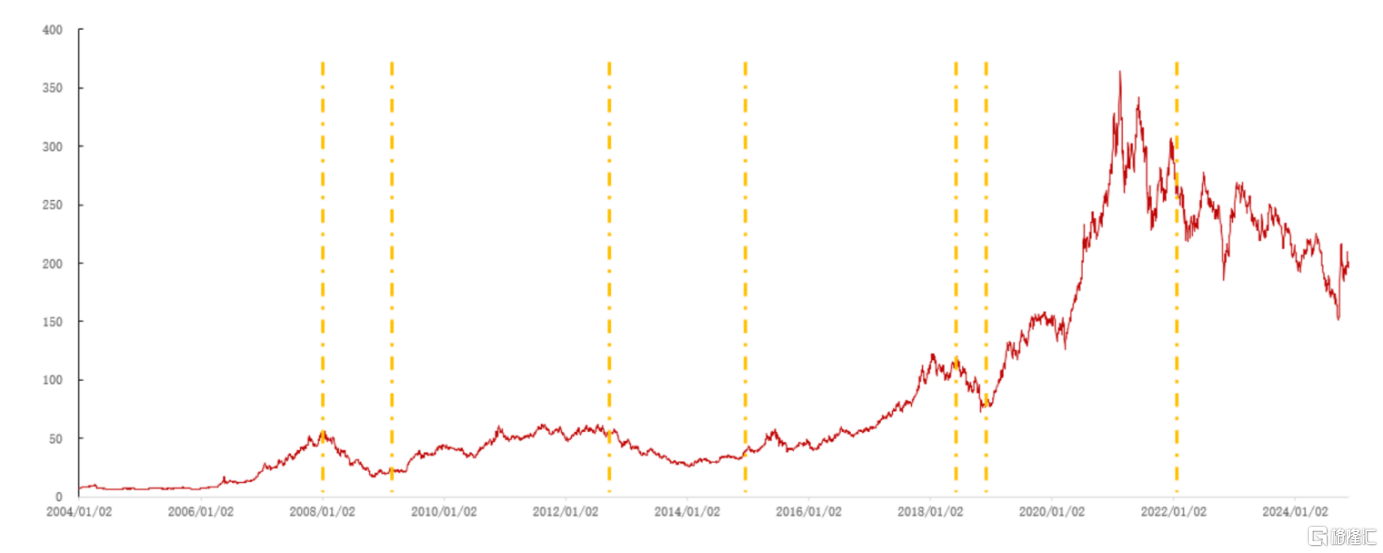
Core Viewpoint - The recent decline in Kweichow Moutai's stock price has raised concerns, with a drop of nearly 13% from its peak of 1645 CNY per share to 1427 CNY, significantly underperforming the Shanghai Composite Index [1][3][4] Group 1: Stock Performance - Kweichow Moutai's stock has been in a weak downward trend for over four years since reaching a historical high of 2400 CNY in early 2021, with a decline of more than 40% from that peak [3][4] - The overall performance of the liquor sector has been poor, with Kweichow Moutai and other leading liquor companies experiencing significant declines in stock prices, with Moutai down 12.56% over the past 20 trading days [10][11] Group 2: Policy Impact - A new regulation effective from May 18, 2025, prohibits the serving of liquor at official meals for civil servants, which has drastically changed market expectations for future liquor consumption [6][7] - Despite a reduced reliance on government consumption, the loss of this segment is expected to impact broader business and social dining scenarios [8][9] Group 3: Market Dynamics - The liquor industry is facing a contraction in consumption scenarios, exacerbated by the new regulations, leading to a significant drop in wholesale sales [10][12] - Kweichow Moutai's wholesale prices have been declining, with the price for a case dropping to 2025 CNY and for individual bottles to 1960 CNY, marking a decline of over 12% compared to earlier this year [14][16] Group 4: Inventory and Supply - Current inventory levels for Kweichow Moutai are substantial, with approximately 120 million bottles in circulation and production capacity expected to add another 130 million bottles, indicating a potential oversupply [17] - Reports indicate that the liquor wholesale price index has been below 100 since last year, with a 12.5% year-on-year decline in production as of March [18][20] Group 5: Consumer Trends - The younger generation shows a declining interest in traditional liquor, with only 13% of young consumers preferring liquor over other beverages, leading to a significant generational gap in consumption [26][30] - New consumption trends favor lighter beverages and experiences, with younger consumers increasingly gravitating towards products that align with their lifestyle preferences [28][29] Group 6: Industry Evolution - The liquor industry has matured over the past two decades, transitioning through various phases, and is now characterized by a strong competitive landscape [24][25] - Despite attempts by liquor companies to innovate and adapt, such as Kweichow Moutai's forays into cross-industry products, these efforts have not gained significant traction [31][32]

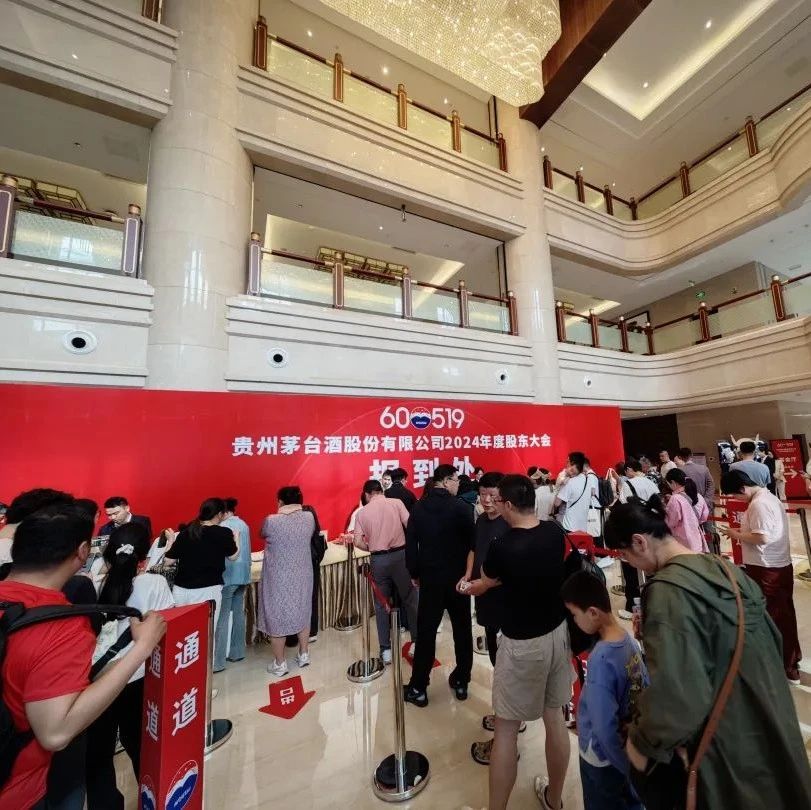
茅台千人股东大会:管理层系统性答疑巩固投资者信心 低姿态倾听回应股东“长情”
2 1 Shi Ji Jing Ji Bao Dao· 2025-05-20 04:34
Core Viewpoint - The 2024 annual shareholders' meeting of Kweichow Moutai showcased strong investor engagement and management's commitment to navigating the current adjustment cycle in the liquor industry while maintaining growth and profitability [1][3]. Group 1: Shareholder Engagement - Over 1,400 shareholders attended the meeting, leading to a venue change due to high registration numbers, reflecting strong loyalty among long-term investors [1]. - Management adopted a welcoming approach, treating shareholders like family, with dedicated transport and hospitality services [1]. - The management team, including Chairman Zhang Deqin, actively engaged with shareholders, expressing gratitude and addressing their concerns [1][3]. Group 2: Financial Performance - Kweichow Moutai reported a total revenue of 174.144 billion yuan and a net profit of 86.228 billion yuan for 2024, achieving over 15% growth and setting new historical records [3]. - The company’s dividend distribution plan was overwhelmingly approved, with a cash dividend of 276.24 yuan per 10 shares, totaling approximately 34.671 billion yuan [10]. Group 3: Strategic Outlook - Management emphasized the importance of maintaining confidence and resilience to navigate the current liquor industry cycle, citing past successes in overcoming challenges [6][7]. - The company plans to enhance its marketing strategies and focus on internationalization and youth engagement as part of its medium- to long-term strategies [8][9]. - Kweichow Moutai aims to build a more resilient ecosystem by understanding stakeholder needs and fostering a collaborative environment [9]. Group 4: Shareholder Returns and Value Creation - Kweichow Moutai has implemented a share buyback program, with plans to repurchase shares worth up to 6 billion yuan, having already completed a significant portion of this plan [12]. - The company’s commitment to value creation is evident in its consistent dividend increases and share repurchase initiatives, reinforcing investor confidence [10][12].
直击贵州茅台股东大会:董事长张德芹详解如何穿越本轮周期!
券商中国· 2025-05-19 15:42
Core Viewpoint - Guizhou Moutai has demonstrated strong performance in 2024, achieving all core indicators above the initial target of approximately 15% growth, despite challenges in the broader liquor industry [3][7]. Financial Performance - In 2024, Guizhou Moutai reported total revenue of 174.14 billion yuan, a year-on-year increase of approximately 15.66%, and a net profit of about 86.23 billion yuan, up 15.38% [7]. - For Q1 2025, the company achieved total revenue of 51.44 billion yuan, reflecting a year-on-year growth of 10.67%, and a net profit of 26.85 billion yuan, up 11.56% [7]. - The cash flow from operating activities reached 92.46 billion yuan, marking a 38.85% increase [14]. Industry Context - The liquor market is currently facing increased competition and a shift to a stock competition phase, with 8 out of 24 listed liquor companies experiencing revenue declines in 2024 [8]. - Despite the challenges, the fundamental demand for liquor remains, providing a basis for future growth in the industry [9]. Strategic Insights - Chairman Zhang Deqin emphasized three beliefs regarding the liquor industry: confidence in Moutai's quality and culture, belief in its innovation and adaptability, and trust in its service capabilities [8]. - The company is transitioning from a focus on scale to prioritizing quality, adapting to changing consumer behaviors and market conditions [9]. Product and Market Development - Moutai's flagship product continues to be a strong revenue driver, with revenue from Moutai liquor reaching 145.93 billion yuan, a 15.28% increase, while the Moutai 1935 series generated over 24.6 billion yuan, growing 19.65% [13]. - The company is implementing a three-step internationalization strategy, with overseas revenue surpassing 5.19 billion yuan in 2024 [18]. Management and Governance - Zhang Deqin's leadership has been characterized by practical approaches to market changes, focusing on consumer demographics and service enhancements [11]. - The management team is committed to maintaining a strong brand identity and quality standards, which are seen as essential for navigating current market challenges [17].