
石油供应中断

Search documents
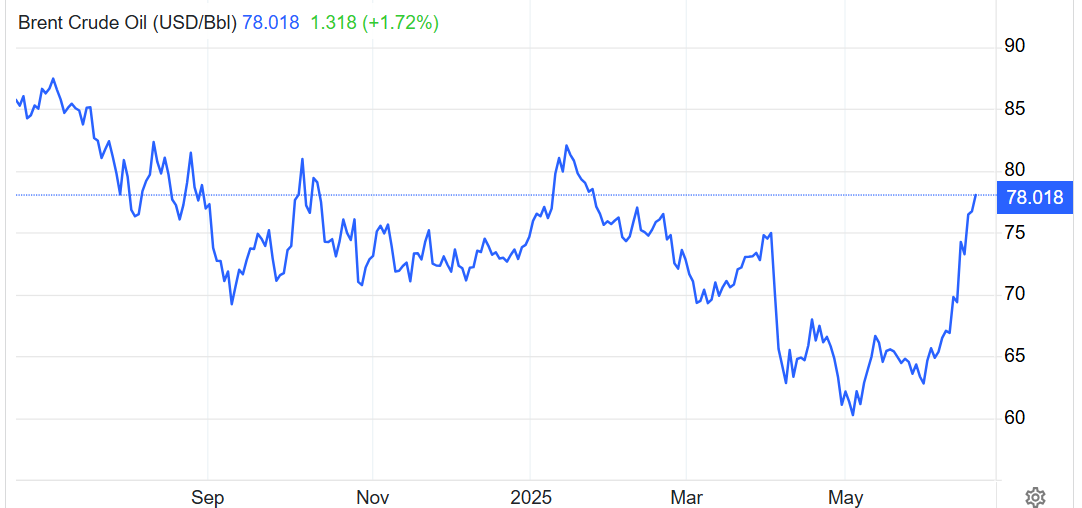
伊朗政界封锁霍尔木兹的声音愈发响亮 布伦特原油冲向100美元?
智通财经网· 2025-06-19 13:47
Core Viewpoint - Iran's potential closure of the Strait of Hormuz could significantly impact global oil prices, with predictions suggesting prices may exceed $100 per barrel, potentially reaching $120-$130 under severe geopolitical conditions [1][5]. Group 1: Iran's Position and Threats - A senior Iranian lawmaker stated that Iran could retaliate against enemies by closing the Strait of Hormuz, although another lawmaker indicated this would only occur if Iran's core interests were threatened [1][2]. - The Iranian parliament's National Security Committee member mentioned that Iran has various ways to respond to threats, with the closure of the Strait being a significant option [1]. - The closure of the Strait is seen as a legitimate response if the U.S. formally supports Israel in military actions against Iran [2]. Group 2: Economic Implications - Approximately 25% of the world's daily oil consumption, around 18 million barrels, passes through the Strait of Hormuz, making it a critical shipping route for oil and gas [2]. - Clarkson's data indicates that 11% of global maritime trade transits through the Strait, including 34% of seaborne crude oil exports and 30% of liquefied petroleum gas exports [3]. - The economic risks associated with closing the Strait are high for Iran, as its economy heavily relies on oil exports, and such a move could isolate Iran from Gulf Cooperation Council (GCC) countries [4][6]. Group 3: Market Reactions and Predictions - Morgan Stanley predicts that if the Strait is closed, oil prices could surge to the $120-$130 range, with Brent crude futures already rising above $78 per barrel due to escalating geopolitical tensions [5]. - Analysts generally view the complete closure of the Strait as a low-probability event, with a more likely scenario being a reduction in Iranian oil exports rather than a total blockade [3].

特朗普言论引发中东局势升级担忧 油价单日暴涨4.4% 布油突破76美元
智通财经网· 2025-06-18 01:59
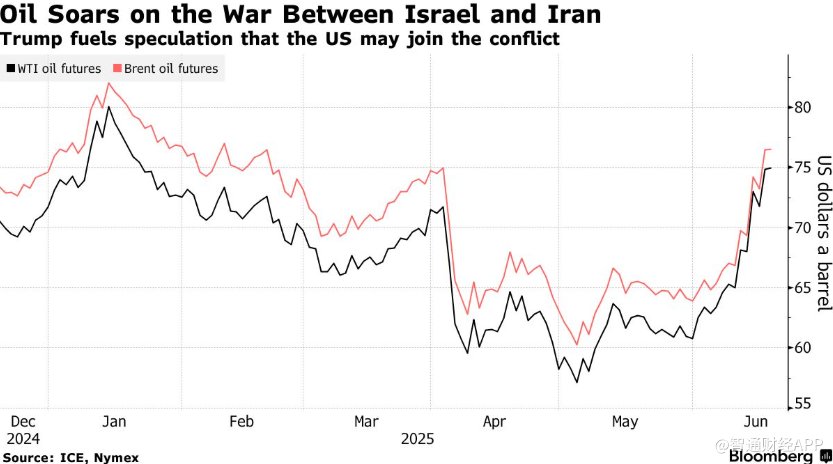
Group 1 - Oil prices have surged to a nearly five-month high due to concerns over potential disruptions in Middle Eastern oil supply following speculation about U.S. involvement in attacks on Iran [1][4] - Brent crude oil has risen by 4.4% in the previous trading session, surpassing $76 per barrel, while WTI crude is close to $75 per barrel [1][4] - The Middle East accounts for approximately one-third of global oil production, and any escalation in conflict could lead to further increases in oil prices [1][4] Group 2 - The primary concern in the oil market is centered around the Strait of Hormuz, through which about one-fifth of global oil production passes [4] - Trump's demands for Iran to "unconditionally surrender" and threats against Iranian leadership indicate a lack of diplomatic solutions, raising the risk of oil price spikes due to potential export disruptions or blockade of the Strait [4] - Recent U.S. industry data shows a decline of over 10 million barrels in crude oil inventories, which, if confirmed, would represent the largest drop since last summer [4]
巨震10%!国际油价高开低走,中东局势升级风险可控?
Di Yi Cai Jing· 2025-06-17 00:21
Core Viewpoint - The ongoing conflict between Israel and Iran has led to significant fluctuations in international oil prices, raising concerns about potential disruptions in oil supply and the role of OPEC in filling any production gaps [1][2][5]. Group 1: Oil Price Movements - International oil prices surged over 13% following Israel's attack on Iran, reaching a new high for the year, but later experienced a decline, reflecting market uncertainty regarding the Middle East situation [2][3]. - Approximately 20% of global oil consumption, equating to about 18 to 19 million barrels per day, is transported through the Strait of Hormuz, making it a critical chokepoint for oil supply [2]. Group 2: OPEC's Role and Production Capacity - OPEC's latest market report maintains its forecast for global oil demand growth at 1.29 million barrels per day for this year and 1.28 million barrels per day for next year, driven by strong air travel and road traffic [5]. - OPEC+ producers have the capacity to increase production to offset any potential disruptions, with remaining capacity roughly equivalent to Iran's current production of about 3.3 million barrels per day [5]. - The next OPEC+ meeting is scheduled for July 6, where members are expected to agree on further production increases to regain market share [6]. Group 3: Geopolitical Tensions and Supply Risks - The conflict has raised concerns about the potential for broader regional warfare, which could threaten energy infrastructure, although current production and export capabilities remain unaffected [3][4]. - Analysts warn that any disruption in Iranian oil exports could lead to increased global shipping and insurance costs, impacting refinery margins, particularly in Asia [5].
伊朗再提封锁霍尔木兹海峡
第一财经· 2025-06-16 11:45
Core Viewpoint - The article discusses the potential implications of Iran's threats to block the Strait of Hormuz, a critical passage for global oil trade, amidst rising tensions in the region, particularly between Iran and Israel [2][4]. Group 1: Strait of Hormuz and Oil Trade - The Strait of Hormuz is referred to as the "oil valve" of the Middle East, with approximately 20 million barrels of crude oil and condensate passing through daily, accounting for about one-third of global oil trade [2]. - Iran's consideration of blocking the Strait, although not yet acted upon, has heightened market anxiety, especially following escalated conflicts with Israel [2][4]. - Historically, Iran has threatened to block the Strait but has not implemented such actions, as it would be detrimental to its own interests, given its reliance on oil exports through this route [4][5]. Group 2: Regional Relations and Military Actions - Improved relations between Iran and neighboring Gulf countries, particularly the reconciliation between Iran and Saudi Arabia in March 2023, suggest that Iran is unlikely to pursue aggressive actions that would jeopardize regional stability [5]. - The article highlights past incidents where Iran has demonstrated its capability to disrupt oil transport, such as the seizure of a British oil tanker in 2018 and attacks on Saudi oil facilities in 2019, which resulted in a 50% drop in Saudi oil production [5]. - The potential for military conflict is underscored by recent airstrikes between Israel and Iran, raising concerns about the safety of nuclear facilities in Iran and the risk of broader regional conflict [7][8].

摩根大通:若区域冲突进一步扩大油价或重见每桶120美元 看好中石油
news flash· 2025-06-16 05:56
Group 1 - Morgan Stanley predicts that if regional conflicts escalate, oil prices could rise to $120 per barrel [1] - The bank's forecast for Brent crude oil futures in Q1 next year is set at $55 per barrel, excluding geopolitical risk premiums or significant oil supply disruptions [1] - The bank recommends increasing positions in high-quality Asian energy companies, specifically China National Petroleum Corporation (00857.HK), raising its H-share target price to HKD 8 due to breakthroughs in Xinjiang gas fields [1] Group 2 - The bank advises selling China Petroleum & Chemical Corporation (00386.HK), anticipating disappointing Q2 performance [1] - The most bearish outlook is on airline stocks, particularly Air China (00753.HK) and China Southern Airlines (01055.HK) [1] - For shipping companies, higher freight rates are expected to offset the negative impact of increased fuel costs, with a preference for Evergreen Marine and China COSCO Shipping Corporation (01919.HK) [1]


伊以冲突升级危及石油供应 交易员押注油价飙涨
智通财经网· 2025-06-16 01:18
Core Viewpoint - The recent escalation of conflict between Israel and Iran has led to a significant increase in oil prices, with Brent crude rising over 5.5% and WTI approaching $75 per barrel, raising concerns about potential disruptions in oil supply from the Middle East [1][3]. Group 1: Oil Price Movements - Oil prices experienced their largest increase in three years last Friday, rising over 13% before slightly retracting [3]. - Brent crude is currently priced above $76 per barrel, while WTI is nearing $75 per barrel [1]. Group 2: Geopolitical Risks - Analysts are preparing for potential further disruptions in oil supply due to the ongoing conflict, particularly as Israel targets Iran's energy infrastructure [3]. - The closure of the Strait of Hormuz, a critical shipping route for oil, could lead to prices soaring to $130 per barrel, exacerbating global inflation [3]. Group 3: Market Reactions - The market is showing increasing concern over supply risks, with significant buying of call options indicating expectations for oil prices to rise above $80 [6]. - The price spread between two nearby December contracts has increased by $1.29 per barrel, reflecting heightened supply-demand concerns [6]. Group 4: Current Supply Situation - Despite the ongoing conflict, major oil facilities have not yet been damaged, providing some reassurance to the market [9]. - The International Energy Agency has indicated that global oil supply remains adequate, even with recent increases in OPEC+ production [9].
【环球财经】以伊冲突推高地缘政治风险溢价 国际油价13日上涨超7%
Xin Hua Cai Jing· 2025-06-14 01:31
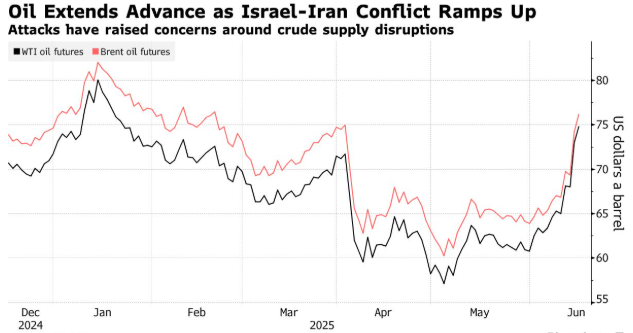
Geopolitical Impact on Oil Prices - The military strikes by Israel against Iran have heightened geopolitical risks in the Middle East, leading to significant fluctuations in international oil prices, with a closing increase of over 7% on June 13 [1][3] - As of the close on June 13, light crude oil futures for July delivery rose by $4.94 to $72.98 per barrel, marking a 7.26% increase, while Brent crude for August delivery increased by $4.87 to $74.23 per barrel, a 7.02% rise [1] Market Reactions and Concerns - Investors are concerned about potential retaliatory actions from Iran, which could escalate military conflicts and disrupt oil supplies, particularly if Iran targets U.S. or Israeli interests [3][5] - The price of oil briefly surged by 12% to over $77 per barrel due to fears of Iranian retaliation, indicating a shift in market focus from trade policies to geopolitical tensions [3] Oil Supply and Production Insights - Reports indicate that Israel's military actions have not yet disrupted Iran's oil infrastructure, allowing Iran to continue exporting oil [5] - Iran's average daily oil production was reported at 3.305 million barrels in April, and the International Energy Agency is monitoring the situation closely [4][5] Strategic Reserves and Market Stability - The International Energy Agency has 1.2 billion barrels of emergency oil reserves available, which could be utilized if necessary [5] - Analysts suggest that if Iranian oil production is temporarily interrupted, other OPEC countries could increase production to compensate, and the U.S. could release strategic oil reserves if market conditions tighten [5] Inflation and Price Projections - Rising energy prices could reverse the recent trend of declining inflation, with current comfortable oil price levels identified between $60 and $65 per barrel [6] - If tensions escalate and Iran closes the Strait of Hormuz, oil prices could potentially spike to $120 per barrel, significantly impacting inflation rates in the U.S. [6]
荷兰国际:霍尔木兹海峡航运严重中断足以令油价升至120美元
news flash· 2025-06-13 04:06
Core Viewpoint - The analysis from ING suggests that disruptions in the Strait of Hormuz could significantly impact oil prices, potentially pushing Brent crude to $120 per barrel if supply interruptions occur [1] Group 1: Supply Risks - If Iranian midstream and upstream assets are targeted, up to 1.7 million barrels per day of export supply could be at risk, shifting the oil market from surplus to deficit in the second half of the year [1] - A severe disruption in the Strait of Hormuz could threaten approximately 14 million barrels of oil supply per day [1] Group 2: Price Projections - The current expectation is for Brent crude prices to stabilize around $75 per barrel, with potential spikes to $80 per barrel under certain conditions [1] - If supply disruptions persist until the end of the year, Brent crude prices could exceed historical highs, surpassing the nearly $150 per barrel peak seen in 2008 [1]
关注部分地区石油供应中断,油价上涨
Guang Jin Qi Huo· 2025-05-29 13:31
Report Summary 1. Report Industry Investment Rating No relevant information provided. 2. Core Views of the Report - On May 28 (Wednesday), the WTI July crude oil spot contract on the New York Mercantile Exchange closed up $0.95 per barrel to $61.84 per barrel, a gain of 1.56%. The Brent July crude oil spot contract on the Intercontinental Exchange closed up $0.81 per barrel to $64.9 per barrel, a gain of 1.26% [1]. - OPEC+ will hold another round of negotiations this Saturday, and may reach an agreement to further accelerate oil production increases in July. Representatives said that the 8 gradually increasing OPEC+ member countries participating on Saturday may agree to increase production by 411,000 barrels per day in July, consistent with the increases in May and June [2]. - Data from the American Petroleum Institute (API) showed that U.S. crude oil and gasoline inventories declined last week, while distillate inventories rose. As of the week ending May 23, U.S. crude oil inventories decreased by 4.24 million barrels, gasoline inventories decreased by 528,000 barrels, and distillate inventories increased by 1.3 million barrels. Analysts previously predicted that U.S. crude oil inventories would increase by about 100,000 barrels, distillate inventories would increase by about 500,000 barrels, and gasoline inventories would decrease by about 500,000 barrels [3]. - Concerns about the risk of oil supply disruptions in parts of Canada and Libya are temporarily supporting oil prices. With the arrival of the seasonal peak season for oil, there is some upward momentum for oil prices, but the upside is limited. The upward pressure comes from uncertain tariff policies and OPEC+'s determination to increase production. In the long term, as the supply side maintains an upward trend while demand is constrained by the dim economic recovery prospects and the substitution of new energy, oil prices still have room to decline [4]. 3. Summaries by Relevant Catalogs 3.1 Price Movement - On May 28, WTI July crude oil spot contract rose $0.95/barrel to $61.84/barrel, up 1.56%, and Brent July crude oil spot contract rose $0.81/barrel to $64.9/barrel, up 1.26% [1]. 3.2 OPEC+ Meeting - OPEC+ will negotiate on Saturday and may agree on a 411,000 - barrel - per - day production increase in July for 8 member countries, same as May and June [2]. 3.3 U.S. Inventory - As of May 23, U.S. crude oil inventories decreased 4.24 million barrels, gasoline inventories decreased 528,000 barrels, and distillate inventories increased 1.3 million barrels, different from analysts' predictions [3]. 3.4 Market Outlook - In the short - term, oil prices are supported by supply disruptions and have upward momentum in the seasonal peak, but limited by tariff policies and OPEC+ production increase. In the long - term, supply growth and demand constraints may lead to price drops [4].