原油看涨期权

Search documents
黄金暴跌原油跳涨为何反向?沃什政策信号引爆全球资产重定价
Sou Hu Cai Jing· 2026-02-06 15:19
Core Insights - The sudden divergence in the prices of gold and oil highlights a significant shift in market dynamics triggered by hawkish comments from Federal Reserve Vice Chairman Waller, indicating a potential end to quantitative easing [1][3] Group 1: Market Reactions - Gold futures plummeted by 9% within 15 minutes, while Brent crude oil prices surged past $70, showcasing an unusual separation between these traditionally correlated safe-haven assets [1] - Waller's remarks on "potentially ending quantitative easing early" prompted algorithmic traders to react swiftly, leading to a massive sell-off in gold futures, with over 200 tons sold during the Asian trading session [3][5] Group 2: Asset Sensitivity to Interest Rates - The sharp decline in gold prices is attributed to its nature as a "long-duration zero-coupon bond," where a 20 basis point increase in the 10-year Treasury yield significantly raises the opportunity cost of holding gold [5] - In contrast, the oil market's rally is driven by geopolitical risks, particularly tensions in the Middle East, overshadowing the impact of the Fed's tapering [5] Group 3: Trading Dynamics - The market witnessed a flash crash in gold due to the magnetic effect of algorithmic trading, with over 80 CTA funds triggering stop-loss orders as gold fell below the critical support level of $5,450 [5] - Conversely, algorithmic trading in the oil market acted as an accelerator for price increases, generating substantial buy orders as Brent crude surpassed a three-month high of $68 [5] Group 4: Long-term Implications - A significant revaluation is underway, with record outflows from gold ETFs and a surge in oil call option volumes to a five-year high, indicating a shift in how inflation-hedging assets are perceived [7] - The divergence between gold and oil may signal a more enduring style shift in investment strategies, reminiscent of the post-2008 bull market in gold, suggesting that 2025 could mark a new era for commodity rotation [7]


原油市场风向生变! 伊朗风险引爆“上行保险”抢购潮 布油看涨期权交易量创纪录
Zhi Tong Cai Jing· 2026-01-13 01:57
Core Viewpoint - The oil market is experiencing a significant shift due to rising geopolitical risks in Iran, leading to a record surge in bullish oil options trading as traders seek to hedge against potential supply disruptions [1][3][6]. Group 1: Market Dynamics - Brent crude oil futures prices have increased by over 6% since last Wednesday, driven by concerns over supply threats from escalating protests in Iran and potential military actions by the U.S. government [2][6]. - On Monday, over 556,000 bullish options contracts were traded, marking a historic high, with a focus on near-term contracts [1][3]. - The implied volatility and premiums for bullish oil bets have risen to their highest levels since June of the previous year, indicating increased demand for upward protection [1][3]. Group 2: Geopolitical Factors - The situation in Iran remains volatile despite claims from Tehran that protests have been quelled, with reports suggesting that U.S. President Trump is inclined to initiate new strikes against Iran [3][6]. - The geopolitical tensions have led to a significant shift in market sentiment, with traders moving from bearish to bullish positions in response to potential supply disruptions [4][6]. Group 3: Supply Concerns - Iran's daily oil exports account for approximately 2% of global demand, and any disruption could alleviate concerns about an impending oversupply in the global oil market [6][7]. - Reports indicate that oil inventories at a major Iranian export terminal have decreased by about 20% since the beginning of the year, suggesting either a strategic transfer of oil or damage to energy infrastructure due to protests [7].
原油:大幅上涨
Guan Tong Qi Huo· 2025-06-18 10:04
Report Industry Investment Rating - The report does not mention a specific industry investment rating [1] Core View of the Report - Recently, the supply and demand of crude oil have improved, combined with a sharp increase in geopolitical risks, leading to a significant rise in prices. However, OPEC+ has sufficient idle capacity, and the long - term production increase of OPEC+ and the trade war will drag down future demand. Geopolitical risks are still high, and crude oil prices are volatile. It is recommended to operate cautiously and lightly buy crude oil call options [1] Summary by Related Catalogs Strategy Analysis - OPEC+ agreed to increase oil production by 411,000 barrels per day in July, with continuous production increases. Saudi Arabia hopes to accelerate production increases in the future, but OPEC+ production growth is lower than expected. Supply pressure has been relieved due to factors such as wildfires in Canada, the deadlock in the US - Iran nuclear agreement negotiations, and a decline in US oil drilling rig numbers. On the demand side, US economic data is better than expected, and market risk appetite has recovered. However, the pessimistic expectations of the global trade war on the economy have not been fully reversed, and the EIA has raised the forecast of global oil inventory growth in 2025. It is recommended to lightly buy crude oil call options and pay attention to the expansion of conflicts in the Middle East [1] Futures and Spot Market Quotes - Today, the main crude oil futures contract 2508 rose 6.17% to 552.7 yuan per ton, with a minimum price of 530.2 yuan per ton and a maximum price of 556.3 yuan per ton. The open interest increased by 4,936 to 38,030 lots [2] Fundamental Tracking - OPEC maintains the global crude oil demand growth rate in 2025 at 1.3 million barrels per day and in 2026 at 1.28 million barrels per day. EIA lowers the US crude oil production forecast in 2026 by 120,000 barrels per day to 13.37 million barrels per day, and raises the global oil inventory growth forecast in 2025. IEA lowers the global crude oil demand growth rate in 2025 and 2026 by 20,000 barrels per day respectively. US EIA data shows that the US crude oil inventory decreased more than expected, but the refined oil inventory increased more than expected, resulting in an overall increase in oil inventories [3] Supply - side - OPEC's April crude oil production increased by 128,000 barrels per day to 26.838 million barrels per day, and its May 2025 production increased by 184,000 barrels per day to 27.022 million barrels per day, mainly driven by Saudi Arabia. US crude oil production increased by 20,000 barrels per day to 13.428 million barrels per day in the week of June 6. The four - week average supply of US crude oil products increased, and the weekly demand for gasoline and diesel increased, driving a 1.20% increase in the single - week supply of US crude oil products [4]
中东风险持续升温 原油看涨期权交投异常活跃
news flash· 2025-06-16 08:38
Group 1 - The core sentiment in the oil options market is bullish due to escalating conflicts between Israel and Iran [1] - There has been unusually high trading activity in call options, with thousands of contracts traded at strike prices above $80 per barrel for August [1] - Approximately 2,000 contracts for August Brent call options were executed at strike prices of $100 and $101, indicating strong market interest [1]
伊以冲突升级危及石油供应 交易员押注油价飙涨
智通财经网· 2025-06-16 01:18
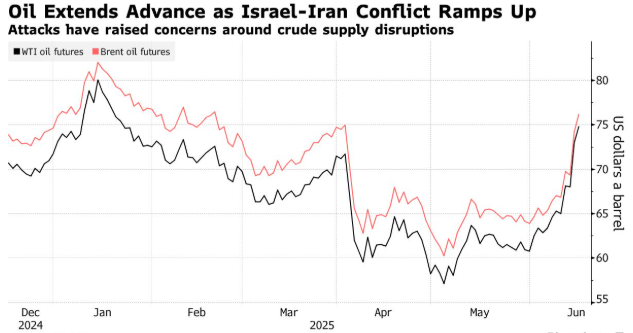
Core Viewpoint - The recent escalation of conflict between Israel and Iran has led to a significant increase in oil prices, with Brent crude rising over 5.5% and WTI approaching $75 per barrel, raising concerns about potential disruptions in oil supply from the Middle East [1][3]. Group 1: Oil Price Movements - Oil prices experienced their largest increase in three years last Friday, rising over 13% before slightly retracting [3]. - Brent crude is currently priced above $76 per barrel, while WTI is nearing $75 per barrel [1]. Group 2: Geopolitical Risks - Analysts are preparing for potential further disruptions in oil supply due to the ongoing conflict, particularly as Israel targets Iran's energy infrastructure [3]. - The closure of the Strait of Hormuz, a critical shipping route for oil, could lead to prices soaring to $130 per barrel, exacerbating global inflation [3]. Group 3: Market Reactions - The market is showing increasing concern over supply risks, with significant buying of call options indicating expectations for oil prices to rise above $80 [6]. - The price spread between two nearby December contracts has increased by $1.29 per barrel, reflecting heightened supply-demand concerns [6]. Group 4: Current Supply Situation - Despite the ongoing conflict, major oil facilities have not yet been damaged, providing some reassurance to the market [9]. - The International Energy Agency has indicated that global oil supply remains adequate, even with recent increases in OPEC+ production [9].