算力需求

Search documents
【风口研报】国内少数具备X86、ARM等多架构BIOS及BMC固件开发能力的厂商,AI应用打开新成长曲线
财联社· 2026-02-12 12:06
Core Viewpoint - The article highlights the emerging growth opportunities in the AI sector, particularly for companies with diverse BIOS and BMC firmware development capabilities across multiple architectures such as X86, ARM, and MIPS. The demand for AI applications is expected to create new business spaces, driven by the HarmonyOS business and the transition of AI assistants from chat-based interactions to task-oriented functionalities [1]. Group 1 - Domestic companies with capabilities in X86, ARM, and MIPS architectures are positioned to benefit from the growth in AI applications [1] - The HarmonyOS business is anticipated to generate new emerging business opportunities [1] - The price increase by Zhiyuan reflects a significant rise in demand for computing power, indicating a shift in AI assistants from conversational to task-oriented usage [1]


春节错月致1月CPI同比涨幅回落,反内卷带动相关领域价格改善
Di Yi Cai Jing· 2026-02-11 04:17
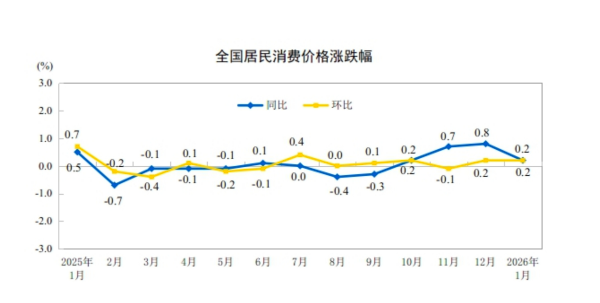
Group 1: Consumer Price Index (CPI) - In January, the CPI increased by 0.2% month-on-month and year-on-year, reflecting a decrease of 0.6 percentage points compared to December [1] - The decline in CPI is attributed to the Spring Festival timing and a significant drop in energy prices, which decreased by 5.0%, impacting CPI by approximately 0.34 percentage points [3] - Core CPI, excluding food and energy, rose by 0.8% year-on-year and 0.3% month-on-month, marking the highest increase in six months, indicating a steady recovery in consumer demand [3] Group 2: Producer Price Index (PPI) - The PPI rose by 0.4% month-on-month in January, marking the fourth consecutive month of increase, with an expansion of 0.2 percentage points from the previous month [5] - Factors contributing to the PPI increase include the ongoing construction of a unified national market and rising demand in certain industries [5] - Prices in sectors such as photovoltaic, battery, cement, and steel have shown positive improvements due to the "anti-involution" policies implemented last year [5] Group 3: Industry-Specific Price Changes - In January, prices for cement manufacturing and lithium-ion battery manufacturing increased by 0.1%, continuing a four-month upward trend [5] - The price of photovoltaic equipment and components shifted from a 0.2% decrease to a 1.9% increase, while basic chemical raw materials saw a 0.7% increase [5] - The prices of non-ferrous metal mining and smelting industries rose significantly, with silver smelting prices increasing by 38.2% and copper smelting by 8.4% [6] Group 4: Future Price Trends - The National Bureau of Statistics indicates that favorable factors for moderate price recovery are accumulating, supported by policies aimed at boosting consumption and stabilizing market expectations [6] - The implementation of coordinated fiscal and financial policies is expected to gradually expand consumer demand, providing a foundation for stable price operations [6] - Emphasis on industry self-regulation and capacity management is anticipated to further enhance price recovery in key sectors [6]
算力需求有望持续增长,资金持续布局上游半导体设备,半导体设备ETF(159516)近20日净流入超82亿元
Mei Ri Jing Ji Xin Wen· 2026-02-11 02:44
Core Viewpoint - The construction of AI infrastructure is currently in a phase of large-scale investment, with significant year-on-year increases in capital expenditures from the four major overseas CSP vendors, indicating an impending explosive growth in demand for computing power [1] Group 1: Semiconductor Industry Insights - The global semiconductor industry is projected to reach a record high sales figure of $791.7 billion by 2025, entering a comprehensive price increase cycle [1] - The price increase trend is rapidly spreading from memory chips to power chips, analog chips, and MCUs, driven by the rapid development of downstream sectors such as AI data centers, new energy vehicles, energy storage, and industrial control [1] - The explosive growth of AI servers has become a significant source of demand increment in the semiconductor sector [1] Group 2: Market Dynamics - The current demand in the electronics industry is continuously recovering, with effective supply clearance and rising prices for memory chips [1] - The domestic production efforts in China have exceeded expectations, indicating a strong push towards localization in the semiconductor industry [1] Group 3: ETF and Index Information - The semiconductor equipment ETF (159516) tracks the semiconductor materials and equipment index (931743), focusing on the materials and equipment segments of the semiconductor industry [1] - The index selects securities from companies engaged in the research, production, and manufacturing of semiconductor materials and equipment, reflecting the overall market performance and technological advancement trends in the upstream semiconductor sector [1]
重磅!2025年中国光模块行业政策汇总及解读(全)
Qian Zhan Wang· 2026-02-04 07:11
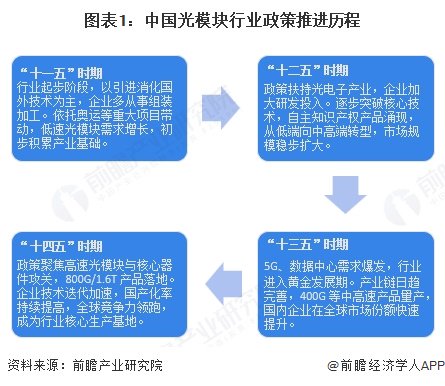
Core Insights - The Chinese optical module industry has evolved from technology introduction during the "11th Five-Year Plan" to achieving technological independence, product upgrades, and scale expansion, becoming a core player in the global optical module market during the "14th Five-Year Plan" period, focusing on high-end and domestic production driven by 5G and computing power demands [1] National Policy Summary - Recent policies in China show a collaborative effort between national and local governments, focusing on technological breakthroughs and practical applications in the optical module industry. The Ministry of Industry and Information Technology (MIIT) has issued multiple documents, including the "2025-2026 Action Plan for Stable Growth in the Electronic Information Manufacturing Industry," which aims to promote the trial of 10G optical networks and the layout of computing power infrastructure [4][5] - Key areas of focus include integrating CPO (Co-Packaged Optics) and high-speed optical modules into critical technological breakthroughs, supporting the mass production of products like 800G and 1.6T [4][5] Provincial Policy Summary - Various provinces have developed their own policies aligned with the national "14th Five-Year Plan," emphasizing the development of optical communication, millimeter-wave, 5G enhancement, and quantum communication technologies. Local governments are also providing funding support for core technology research and development [13] - For instance, Beijing's policies include promoting advanced packaging technology for 1.6T silicon optical modules and enhancing broadband network capabilities to support user experiences exceeding 100 Mbps by 2025 [14] - Shanghai's initiatives focus on deploying 50G PON and 400G optical transmission technologies, aiming to create a fully optical direct connection network for data centers [17] Industry Development Trends - The optical module industry is expected to see significant growth driven by the increasing demand for high-speed data transmission in AI, industrial internet, and other applications. Policies are encouraging the development of high-reliability, low-power products suitable for industrial scenarios [4][5] - The goal is to enhance the domestic production rate of key components and technologies, with specific targets set for the market share of domestic CPO modules to reach 40% by 2025 [5][6] Investment Opportunities - The ongoing policy support and technological advancements present substantial investment opportunities in the optical module sector, particularly for companies involved in high-speed optical modules and related technologies. The focus on domestic production and technological independence further enhances the attractiveness of this sector for investors [1][4][5]




投资前瞻:沪市首份年报将出炉,CME上调期货保证金
Sou Hu Cai Jing· 2026-02-02 02:31
Market News - The central bank will have a total of 17,615 billion yuan in reverse repos maturing this week, with specific maturities of 1,505 billion yuan, 4,020 billion yuan, 3,775 billion yuan, 3,540 billion yuan, and 4,775 billion yuan from Monday to Friday. Additionally, 7,000 billion yuan in 91-day reverse repos will mature on Wednesday [1] - The official manufacturing PMI for January in China has returned to the contraction zone at 49.3%, a decrease of 0.8 percentage points month-on-month. The non-manufacturing PMI also fell to 49.4%, down 0.8 percentage points, indicating a decline in manufacturing and non-manufacturing activity due to seasonal factors and insufficient market demand [2] - A series of new regulations will take effect starting in February, including the "Encouragement of Foreign Investment Industry Catalog (2025 Edition)" and various regulations aimed at promoting fair competition and addressing issues in government procurement [3] - The U.S. Labor Department is set to release the January non-farm payroll report, with expectations of an increase of 64,000 jobs and an unemployment rate holding steady at 4.4% [4] Sector Events - The AWE Asia 2026, an Asian virtual reality XR industry exhibition, will be held in Singapore from February 2 to 4, featuring a new Gaming Hub section for XR game creators and developers [5] - The 2026 Brain-Computer Interface Developers Conference will take place in Tianjin on February 3-4, focusing on open-source technology and commercial applications in the brain-computer interface sector [6] - A seminar on the review of the photovoltaic industry in 2025 and outlook for 2026 will be held in Beijing on February 5, inviting industry leaders and experts to analyze the development of the photovoltaic sector [7] - The Chicago Mercantile Exchange has announced an increase in margin requirements for platinum and palladium futures, effective after the market closes on February 2 [8] Individual Company News - Minexplosion Optoelectronics plans to acquire 51% of Xiamen Xizhi Precision Technology Co., Ltd. in cash, with the stock resuming trading on February 2. This acquisition will expand the company's business into high-end PCB drilling technology [10] - Vanke A announced the suspension of multiple domestic corporate bonds due to changes in subsequent transfer arrangements, effective from February 2 [11] - Jihua Group is planning a change in control as its major shareholder is in discussions to transfer part of its stake, leading to a suspension of trading from February 2 [12] Lock-up Expiration - A total of 42 companies will have lock-up shares released this week, amounting to 4.657 billion shares with a total market value of 1,036.69 billion yuan based on the closing price on January 30. The peak release day is February 2, with 18 companies releasing shares worth 607.1 billion yuan, accounting for 58.56% of the week's total [13][14] New Stock Calendar - Two new stocks are set to be issued this week, with a total issuance of approximately 54.53 million shares and expected fundraising of 1.558 billion yuan [17] Institutional Outlook - CITIC Securities indicates that space photovoltaic technology is transitioning from concept to large-scale deployment, driven by new demands from "space computing + AI" and the global competition for low Earth orbit resources [18][19] - CITIC Securities also predicts that demand for computing power will continue to rise, supported by the increasing need for cloud computing resources and ongoing iterations of AI models [20] - Huatai Securities notes that the recent performance of A-share real estate stocks has outperformed the market, driven by low valuations and improving fundamentals [21] - ShenGang Securities suggests that the white liquor sector may see a recovery in market performance ahead of fundamental improvements, with potential opportunities arising from inventory clearance and operational improvements [22]

宏景科技20260201
2026-02-02 02:22
摘要 红景科技主动调整业务结构,算力业务成为主要收入和利润来源,尽管 前期传统业务的收款计提导致利润有所调整,但整体转型进展显著,为 未来发展奠定基础。 公司对 2026 年发展前景充满信心,受益于充裕的在手订单、智能体爆 发及大厂 AI 资本开支增加,预计今年算力需求将远超去年,同时交付能 力显著提升。 红景科技看好国内云大厂出海带来的机会,凭借早期算力布局和丰富经 验,在海外市场具备竞争优势,并能赢得更多信任,预计今年海外市场 将有具体落地项目。 公司与腾讯等大厂保持紧密合作,为其提供不同方式的支撑与支持,腾 讯 AI 业务的增长将为红景科技带来新的业务机会,共同推动 AI 商业化 发展。 全球范围内面临芯片和电力短缺挑战,北美能源紧缺,东南亚电力资源 欠缺,红景科技提前布局相关地区,以应对未来算力需求的大幅增长。 Q&A 红景科技在 2025 年的业绩表现如何,主要有哪些因素影响了公司的收入和利 润? 2025 年,红景科技的算力业务已经占公司收入的 95%以上。传统业务由于政 府和国企在财政方面的压力,从 2024 年、2025 年开始,公司主动控制了很 多传统订单。因此,大部分收入和利润来自于算力业 ...
未知机构:海外云服务商及算力涨价近期多个海外云服务商及算力相关服务出现涨价-20260202
未知机构· 2026-02-02 02:10
Summary of Conference Call Records Industry Overview - The records discuss the cloud services and semiconductor industries, particularly focusing on pricing trends and demand dynamics related to AI and optical components. Key Points Cloud Services Pricing Trends - Recent price increases have been observed among multiple overseas cloud service providers and related computational power services. Google has raised global data transmission service prices, with North America seeing a 100% increase. Amazon has also increased EC2 capacity block instance prices [1] - AIDC prices exhibit quarterly volatility, with significant price increases expected starting from Q3 and Q4 of 2025. In Q1 2023, a price spike occurred due to major companies building AI computational power clusters [1] - CPU prices are anticipated to rise significantly starting January 2026, with market expectations indicating a sustained upward pricing trend [1] AI-Driven Demand for Computational Power - The demand for AI computational power is evolving, transitioning from training to inference by the second half of 2025, with a shift to the Agent era expected in 2026. This transition is projected to substantially increase computational power demand [2] - The Agent era will drive demand in three main areas: - Increased resource consumption in multi-turn dialogue scenarios - High concurrency scenarios resembling multiple virtual employees working simultaneously, leading to a significant rise in CPU demand - The need for high precision in task flow restoration, which will accelerate storage demand due to the accumulation of task flow errors [2] - The explosive demand is causing supply shortages, leading to price increases in upstream storage, CPU, and AIDC sectors, which will eventually affect cloud service pricing [2] Cloud Service Price Increase Expectations - The imbalance in supply and demand is the core logic behind the price increases in cloud services. The upward pressure from upstream price increases is expected to be passed down, resulting in higher cloud service prices [2] - Overseas cloud service providers are likely to show price increase signs soon, while domestic cloud services may follow suit after 2026, indicating a strong sustainability in the overall price increase trend [2] Optical Fiber Pricing Dynamics - Traditional G652G optical fiber is currently experiencing rapid price increases, driven by structural changes on both supply and demand sides: - Supply has been stabilized and is relatively low due to continuous capacity clearance from 2018-2019 and 2022-2024 - Demand is significantly boosted by the development of AI and drone industries, particularly for high-end optical fibers in North America and domestic G6PA1 products, leading to a supply-demand gap in traditional optical fibers [2] Optical Chip Supply and Demand - The demand for optical modules is projected to be around 20-30 million units for 1.6T modules and 40-50 million units for 800G modules in 2026, with expectations of doubling by 2027 [3] - The value of optical chips in optical modules is increasing with product generational upgrades, with current 200G high-end optical chip prices doubling compared to 100G [3] - Supply constraints are influenced by long delivery cycles for core equipment and rising costs due to increased prices of upstream indium phosphide substrates, with a current optical chip shortage of 25%-30% [3] Isolator and Upstream Material Price Increases - Isolators, which protect light sources and enhance signal integrity, are in demand in line with laser usage. The production of the core material, the Faraday rotator, is dominated by two overseas companies, while domestic production is gradually increasing [3] - Prices for Faraday rotators have been rising since Q3 2025, with upstream rare earth material prices also on the rise, further driving up isolator prices in 2026 [4]
投资前瞻:沪市首份年报将出炉,CME上调期货保证金
Wind万得· 2026-02-01 22:37
// 市场要闻 // 1、央行公开市场将有17615亿元逆回购到期 Wind数据显示,本周央行公开市场将有17615亿元逆回购到期,其中本周一至本周五分别到期1505亿元、4020亿元、3775亿元、3540亿元、4775亿元。此 外,本周三将有7000亿元91天期买断式逆回购到期。 2、成品油将迎调价窗口 根据"十个工作日"原则,本轮调价窗口为2月3日24时。据测算截至1月30日第八个工作日,参考原油品种均价为64.09美元/桶,变化率为4.68%,对应的国 内汽柴油零售价均上调190元/吨。 3、中国1月官方制造业PMI重回收缩区间 中国1月官方制造业PMI为49.3%,环比下降0.8个百分点;非制造业PMI为49.4%,下降0.8个百分点;综合PMI产出指数为49.8%,下降0.9个百分点。国家 统计局指出,1月份,部分制造业行业进入传统淡季,加之市场有效需求仍显不足,制造业景气水平有所回落。受建筑业等行业景气度下降等因素影响,1 月非制造业商务活动指数有所回落,金融市场活跃度较高。 4、一批新规将自2月起施行 一批新规将自2月起施行,具体包括:《鼓励外商投资产业目录(2025年版)》;《制止滥用行政权 ...

“易中天”集体上涨!300394,股价新高
Shang Hai Zheng Quan Bao· 2026-01-30 04:40
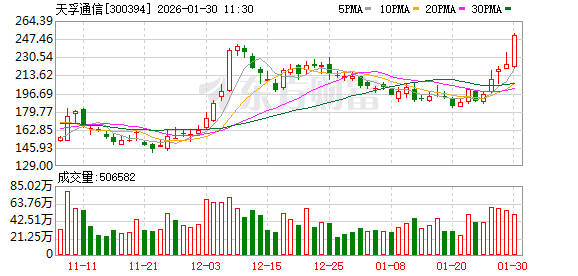
1月30日,A股三大指数早盘涨跌不一,截至午间休市,沪指跌1.19%,深证成指跌0.96%,创业板指涨 0.8%。沪深北三市半日成交19514亿元,较上日缩量836亿元。 盘面上,亚太交易时段国际金银价跳水,黄金股、有色资源股大幅回调,中金黄金等多股跌停。另一方 面,粮食、农业股逆势走强,登海种业等股封板。算力硬件股盘中同样拉升,天孚通信(300394)大涨 超10%创出历史新高,中际旭创、新易盛涨超4%。 行业层面,近期,海外推理和训练算力需求旺盛,亚马逊云和谷歌云双双涨价。推理侧, MoltBot(原 ClawdBot)、Claude Code等Agent产品加速落地,对于云计算资源的需求显著增加,2026年年初以来 Token调用量已经连续2-3周高速增长。训练侧,Grok-5、Veo4等模型仍然在持续迭代,工业界持续探索 Scaling上限,从而支撑训练算力需求。 中信证券研报认为,尽管当前AI应用大规模商业化落地能见度仍然不足,但展望未来3-6个月,随着推 理端AI应用落地的密集催化叠加训练端模型的持续迭代,预判算力需求仍有望进一步上行,一旦美股 财报季算力需求得到确认,前期压制算力板块情绪与估值的 ...


首都在线20260129
2026-01-30 03:11
Summary of Conference Call for Capital Online Company Overview - **Company**: Capital Online - **Industry**: Cloud Computing and Data Center Services Key Points Financial Performance and Projections - **2025 Performance Forecast**: Expected net profit loss of **CNY 160 million to 175 million** with revenue between **CNY 1.2 billion to 1.3 billion** [2][3] - **Strategic Shift**: Reduction of low-margin IPC business, with revenue share dropping from **55%** to focus on computing cloud and intelligent computing cloud, which are expected to account for **28%** and **20-24%** of revenue respectively [2][3] - **Intelligent Computing Cloud Growth**: Anticipated growth rate of **40%-60%** for intelligent computing cloud business [2][3] Pricing Strategy - **Cloud Service Price Increase**: Planned price increase of **15%-20%** for cloud services due to rising hardware costs (storage and memory prices up **50%-70%**, other hardware up **15%-20%**) and increased market demand [2][3][9] - **Future Price Trends**: Expected continuation of price increases in **Q2 2026** driven by rising base equipment costs and sustained demand, particularly from advancements in large model technologies [3][6][12] Market Demand and Supply Chain - **Strong Demand for Intelligent Computing**: Increased demand driven by the launch of technologies like Zhiyu Huazhang and MiniMax, with government support for application scenarios [2][7] - **IDC Business Recovery Potential**: IDC prices are stabilizing despite previous competition and price wars, with rising costs for new data centers due to commodity price increases [8][23] Strategic Developments - **Expansion Plans**: Active development of intelligent computing centers in locations such as Dallas, Hebei, Anhui, and Hainan, with plans for global service nodes and exploration of commercial aerospace computing [4][16] - **Collaboration with Major Clients**: Ongoing discussions with large enterprises for tailored services, contrasting with standardized offerings from larger competitors [20] Future Outlook - **Growth Expectations**: Optimistic internal growth target of **50%-60%** for 2026, despite supply chain challenges [4][14] - **Investment in Infrastructure**: Significant capital investment planned for building computing centers, with potential funding through new financial instruments and industry funds [21] - **Focus on Domestic and International Markets**: Plans to expand services internationally, particularly in the US and Europe, while enhancing competitiveness through localized service offerings [16] Additional Insights - **Client Order Management**: 90% of orders are on short-term contracts, allowing for quicker adjustments to pricing strategies [11][10] - **Sustainability of Price Increases**: Price increases are expected to be sustainable due to ongoing demand and rising costs, with potential for additional increases in the future [6][25] - **Adaptation to Market Changes**: The company is adapting its strategies to meet evolving client needs and market conditions, particularly in the context of AI advancements and the fourth industrial revolution [25]