
精细化运营

Search documents
碧桂园服务(06098)预期2025年实现综合收入约482亿-485亿元 同比增长9.6%至10.2%
智通财经网· 2026-02-27 14:11
Core Viewpoint - Country Garden Services (碧桂园服务) expects to achieve a comprehensive revenue of approximately RMB 48.2 billion to 48.5 billion in 2025, representing a growth of 9.6% to 10.2% compared to the same period in 2024, driven by effective market expansion and refined operations [1] Financial Performance - The company anticipates an unaudited net profit of approximately RMB 450 million to 650 million for 2025, a significant decrease from approximately RMB 1.8745 billion in 2024 [1] - The expected unaudited net profit attributable to shareholders is projected to be around RMB 500 million to 700 million, down from approximately RMB 1.8084 billion in 2024 [1] - The decline in net profit is primarily due to increased credit impairment losses from the proactive cleaning of long-aged trade receivables and a decrease in fair value changes of contingent consideration related to past acquisitions [1] Core Profit - The company expects to achieve an unaudited core net profit attributable to shareholders of approximately RMB 2.4 billion to 2.7 billion in 2025, compared to approximately RMB 3.0381 billion in 2024 [1] Operational Efficiency - The company focuses on enhancing customer satisfaction through refined project management and digital transformation to reduce costs and improve efficiency, maintaining a stable fundamental performance in its core business [2] - The unaudited gross profit for the current year is estimated to be between RMB 8.2 billion and 8.7 billion, slightly above the RMB 8.4 billion recorded in 2024 [2] Financial Health - The company maintains a healthy financial position with robust cash flow from operating activities, estimating a net cash flow from operating activities of no less than approximately RMB 2.4 billion for the year ending December 31, 2025, down from approximately RMB 3.873 billion in 2024 [2] - The total amount of unaudited bank deposits and structured deposits is expected to be no less than RMB 17.7 billion as of December 31, 2025, compared to approximately RMB 18.1786 billion on December 31, 2024 [2] Dividend Policy - To further protect shareholder interests and demonstrate long-term investment value, the board anticipates a cash dividend target of no less than RMB 1.5 billion for the fiscal year 2026, subject to the company's dividend policy and necessary approvals [2]

子不语(02420.HK):预计2025年度净利润同比增长约75%至85%
Ge Long Hui· 2026-02-27 12:28
Core Viewpoint - The company expects significant revenue and profit growth for the fiscal year ending December 31, 2025, driven by brand development, sales network expansion, and operational efficiency improvements through AI [1] Revenue Summary - The company anticipates a revenue increase of approximately 35% to 45% compared to the revenue of RMB 3,325.1 million for the fiscal year ending December 31, 2024 [1] Profit Summary - The company projects a profit increase of about 75% to 85% compared to the profit attributable to shareholders of approximately RMB 150.8 million for the fiscal year ending December 31, 2024 [1] Operational Factors - Key factors contributing to the growth include enhanced brand building, extensive multi-channel sales network development, strong market performance of new products, and a focus on refined operations utilizing AI to significantly improve management efficiency [1]
证券代码:688617 证券简称:惠泰医疗 公告编号:2026-007
Zhong Guo Zheng Quan Bao - Zhong Zheng Wang· 2026-02-26 22:48
Group 1 - The company reported a revenue of 258,392.73 million RMB for the reporting period, representing a growth of 25.08% compared to the same period last year [3] - The net profit attributable to the parent company's owners was 82,063.66 million RMB, an increase of 21.91% year-on-year [3] - The net profit after deducting non-recurring gains and losses was 79,087.59 million RMB, reflecting a growth of 23.00% compared to the previous year [3] - The total assets at the end of the reporting period amounted to 365,185.66 million RMB, which is a 22.52% increase from the beginning of the reporting period [3] Group 2 - The company implemented a capital reserve conversion plan during the reporting period, resulting in a 44.80% increase in share capital, with a distribution of 4.5 shares for every 10 shares held [4] - The growth in operating performance was attributed to continuous market expansion efforts, effective marketing activities, and a focus on core products such as PFA [3] - The company emphasized cost control, directing R&D and sales expenses towards market promotion and clinical validation of core products, optimizing expenditure structure and achieving synchronized growth in net profit and revenue [3]

透视区域性银行“家底”: 精细化运营成破局关键
Zhong Guo Zheng Quan Bao· 2026-02-26 20:30
Core Insights - The banking industry is transitioning from scale expansion to quality prioritization amid narrowing interest margins and intensified competition [1] Group 1: Regional Performance - Major banking sectors in Beijing, Jiangsu, and Zhejiang show significant asset scale advantages, with Beijing's total assets reaching 38.11 trillion yuan, Jiangsu at 36.72 trillion yuan (10.35% growth), and Zhejiang at 33.45 trillion yuan [2] - In the western regions, banks in Shaanxi and Chongqing are also experiencing steady asset growth, with Shaanxi's total assets at 9.54 trillion yuan (6.40% YoY growth) and Chongqing at 8.76 trillion yuan [2] - The pressure on liabilities and cost control is a core challenge for banks, with Ningxia's deposits growing by 10.43% YoY to 1.09 trillion yuan as of January 2026 [2] Group 2: Asset Quality - The overall non-performing loan (NPL) ratio remains within a reasonable range, with Zhejiang's NPL ratio at 0.83% (down 0.01 percentage points) and Jiangxi at 1.33% [3] - However, some regions like Hebei are experiencing rising risk indicators, with NPL balance increasing from 167.25 billion yuan to 214.36 billion yuan, leading to an NPL ratio rise of 0.45 percentage points to 2.09% [3] - The regulatory focus for 2026 will be on risk prevention and high-quality development, with efforts to address existing risks and prevent new ones [3] Group 3: Interest Margin Challenges - The banking sector faces common challenges with net interest margins under pressure, with the net interest margin for commercial banks at 1.42% as of Q4 2025 [4] - Different types of banks show varied net interest margin performance, with rural commercial banks achieving a higher margin of 1.60% [5] - Some banks are stabilizing their margins through refined liability management, with Hangzhou Bank reporting stabilization in net interest margin due to effective cost control and active asset deployment [5]



透视区域性银行“家底”:精细化运营成破局关键
Zhong Guo Zheng Quan Bao· 2026-02-26 20:28
Core Insights - The banking sector is transitioning from scale expansion to quality prioritization amid narrowing interest margins and intensified competition [1][3] Group 1: Regional Performance - Major banking sectors in Beijing, Jiangsu, and Zhejiang show significant asset scale advantages, with total assets of 38.11 trillion yuan, 36.72 trillion yuan (up 10.35% year-on-year), and 33.45 trillion yuan respectively [1] - In the western regions, banks in Shaanxi and Chongqing are also experiencing steady asset growth, with Shaanxi's total assets reaching 9.54 trillion yuan (up 6.40% year-on-year) and Chongqing's at 8.76 trillion yuan [1] Group 2: Asset Quality - The overall non-performing loan (NPL) ratio in the banking sector remains within a reasonable range, with Zhejiang's NPL ratio at 0.83% (down 0.01 percentage points) and Jiangxi's at 1.33% [2] - However, some regions like Hebei are facing rising risk indicators, with NPL balance increasing from 167.25 billion yuan to 214.36 billion yuan, leading to an NPL ratio rise of 0.45 percentage points to 2.09% [2] Group 3: Regulatory Focus - The Financial Regulatory Bureau emphasizes risk prevention, strong supervision, and promoting high-quality development, aiming to prevent systemic financial risks [3] - In 2026, the focus will be on effectively addressing risks in small and medium financial institutions and managing existing risks [3] Group 4: Interest Margin Challenges - The banking sector is under pressure from low interest rates and NPLs, prompting a search for new growth avenues [3] - The net interest margin (NIM) for commercial banks was reported at 1.42% in Q4 2025, stabilizing at this level for three consecutive quarters, with rural commercial banks showing a higher NIM of 1.60% [3][4] Group 5: Strategic Responses - Some banks are stabilizing their NIM through refined liability management, as seen in Hangzhou Bank's recent investor relations report [4] - The banking sector is expected to see continued effects from reduced deposit costs, with potential short-term NIM rebounds anticipated [4]
瑞幸咖啡2025年营收突破492亿元,门店超3万家,咖啡价格战正在悄悄转向
Sou Hu Cai Jing· 2026-02-26 12:51
Group 1 - The core viewpoint of the news is that Luckin Coffee has reported significant growth in its financial performance for the year 2025, with total net revenue reaching 49.288 billion RMB, a year-on-year increase of 43.0% [1] - The total gross merchandise volume (GMV) for the year was 56.649 billion RMB, reflecting a year-on-year growth of 42.3% [1] - Self-operated stores remain the primary source of revenue, contributing 36.243 billion RMB, which is a 41.6% increase year-on-year, while franchise store revenue grew even more significantly by 49.7% to 11.594 billion RMB [1] Group 2 - In Q4 2025, Luckin Coffee's total net revenue was 12.777 billion RMB, showing a year-on-year growth of 32.9% [1] - The revenue from self-operated stores in Q4 was 9.547 billion RMB, up 32.0% year-on-year, while franchise store revenue reached 2.847 billion RMB, a 39.2% increase [1] - However, the net profit for Q4 decreased by 38% to 0.5182 billion RMB [1] Group 3 - Luckin Coffee expanded its store network significantly, adding 8,708 new stores in 2025, bringing the total number of stores to 31,048 by year-end [1] - The cumulative number of transaction customers exceeded 450 million [1] Group 4 - The industry is experiencing a shift from intense price wars to refined operations, with a report indicating that the competitive landscape is improving [2] - Kudi Coffee has reduced the number of low-priced products and increased the prices of core items by 30% to 60% [2] - Delivery platform subsidies continue to boost sales in the ready-to-drink beverage sector, with a recent promotion leading to over 1 million orders within three hours [2]

惠泰医疗2025年度归母净利润8.21亿元,同比增长21.91%
Zhi Tong Cai Jing· 2026-02-26 12:37
Core Insights - Huatai Medical (688617.SH) reported a revenue of 2.584 billion yuan for the year 2025, representing a year-on-year growth of 25.08% [1] - The net profit attributable to the parent company's owners reached 821 million yuan, with a year-on-year increase of 21.91% [1] Performance Drivers - The company's continuous market expansion and various promotional activities have enhanced its operational advantages in R&D, technology, quality, market, and channels, leading to improved product coverage and hospital admission rates [1] - The company emphasizes cost control, focusing R&D and sales expenses on the market promotion, clinical validation, and iterative development of core products like PFA, optimizing expenditure structure and rhythm through refined operations and scaled operations, achieving synchronized growth in net profit and revenue [1]
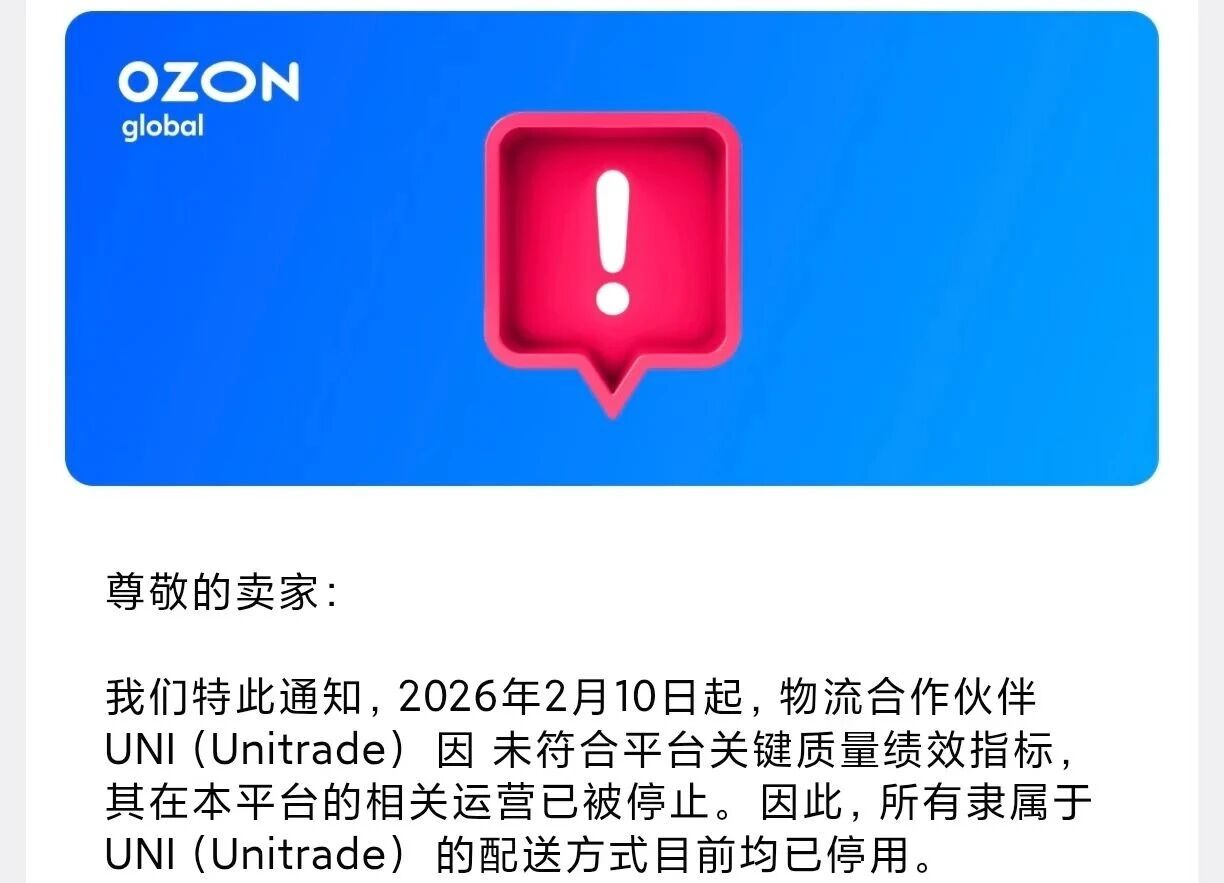
Ozon发货方式大调整!UNI物流被终止,超全Ozon发货指南轻松搞定物流难题!
Jin Tou Wang· 2026-02-24 07:31
Core Viewpoint - Ozon has terminated its partnership with logistics provider UNI due to consistent failures in meeting key performance indicators, impacting seller operations and user experience [1][3]. Group 1: Termination of Partnership - Ozon's decision to end the collaboration with UNI is a response to frequent issues such as lost packages, unexplained delays, and improper charges, affecting thousands of orders and nearly a hundred sellers [3]. - The termination is effective from February 10, 2026, with all UNI delivery methods being discontinued immediately [1]. Group 2: Logistics Strategy Reconstruction - The selection criteria for logistics partners need to be restructured, emphasizing service stability, compliance, and alignment with platform standards over mere price advantages [4]. - Sellers are advised to develop a competitive logistics strategy by focusing on a "stability-first" evaluation system, assessing historical performance metrics like loss and delay rates, compliance capabilities, risk management, and system integration [5]. Group 3: Cost and Efficiency Strategies - With the new regulations, sellers should adopt a flexible logistics model to maximize efficiency, such as prioritizing FBO for large items and combining FBP and FBO strategies based on market validation [6]. - Utilizing overseas warehouse resources remains a viable option for sellers to balance cost and delivery efficiency [6]. Group 4: Tools for Precision Operations - The introduction of specialized ERP tools is essential for achieving refined operations amidst complex logistics options and stringent platform assessments [7]. - The "Miaoshou ERP" tool integrates deeply with Ozon, offering comprehensive management capabilities and has been recognized for its efficiency [9]. Group 5: Alternative Service Providers - In addition to official logistics, sellers should consider specialized freight forwarders and logistics providers focused on the China-Russia route to diversify their logistics options [12]. - Miaoshou ERP aggregates over 100 cross-border freight forwarders and 490 logistics providers, allowing sellers to create a backup pool of quality service providers [12]. Group 6: Industry Shift - The termination of UNI signifies a significant shift in the Russian e-commerce landscape, moving from rapid expansion to a focus on refined operations, where logistics is a critical competitive factor affecting store performance and customer experience [14].

新手必看:视频号VS抖音,3大关键选对平台
Sou Hu Cai Jing· 2026-02-22 18:33
Core Insights - The article discusses the challenges faced by new content creation and marketing teams in choosing between platforms like Douyin and WeChat Video, highlighting issues such as high customer acquisition costs and long conversion paths [1] - It emphasizes the shift in the self-media ecosystem from a "traffic dividend" era to one focused on "refined operations," necessitating a systematic approach to address key challenges in acquiring precise traffic, generating quality content, and retaining public domain users [1] Group 1: Evolution of Self-Media Tools - The evolution of self-media tools reflects a history of competing with platform rules and managing labor costs, transitioning from manual operations to automated tools, which, while improving efficiency, also presented challenges such as data silos and high risks of account bans [4] - The main trend is moving from single-point tools to integrated platforms that adapt deeply to platform ecosystems, focusing on compliance rather than rule-breaking [4] Group 2: Integrated and Automated Solutions - Integrated, intelligent, and compliant operational platforms are becoming key solutions, exemplified by the Heihu AI public account, which integrates functions like precise customer acquisition and content matrix cloning [5] - The platform's multi-engine adaptive algorithm addresses the significant differences in traffic distribution rules and user interaction preferences across platforms like Douyin, Kuaishou, and Xiaohongshu [5] Group 3: Automation and Efficiency Gains - The fully automated operational system of Heihu AI has shown significant results, such as a 280% increase in enrollment for an educational institution within six months and a 60% reduction in customer acquisition costs [6] - The automation process includes identifying potential customers from peer fan lists and comments, AI-driven bulk outreach, and 24/7 automated responses, effectively navigating platform restrictions on direct contact information [6] Group 4: Future Challenges and Human Element - While integrated systems enhance operational certainty and reduce labor costs, challenges remain in areas requiring deep emotional understanding and unique brand storytelling, where AI still has limitations [7] - The future direction may involve a deeper integration of intelligent systems with human creativity, positioning technology as an amplifier of creative insights rather than a replacement [7] - Choosing the right platform is crucial, but selecting a system that can sustainably and compliantly drive growth on that platform is even more critical for self-media practitioners [7]

荣万家高管变动引关注,战略转型与行业挑战并存
Jing Ji Guan Cha Wang· 2026-02-21 01:30
Management Changes - In 2025, a trend of real estate executives transitioning to key positions in property companies emerged, with Wu Qiuyun from Rongwanjia being a notable example. This shift reflects the industry's strategic transition from scale expansion to refined operations, aiming to enhance operational efficiency through the cross-regional management and full-chain capabilities of real estate executives [1]. Financial Performance - The mid-year report for 2025 indicated that the company's revenue increased by 1.7% to 1.012 billion, while net profit rose by 2.0% to 95 million. The gross profit margin improved to 25.6%. The proportion of third-party managed area continued to expand, indicating a gradual reduction in reliance on associated real estate parties [2]. - Rongwanjia is transitioning from traditional property management to a comprehensive urban service provider, driven by a 31.4% year-on-year revenue growth in urban services and business services. The management changes may be related to the deepening of this strategic shift [2]. Stock Performance - As of February 20, 2026, the company's stock price was reported at 1.29 HKD, with significant volatility observed over the past five days, including a single-day drop of 10% on February 16. However, trading volume and turnover rate remained low, with a turnover rate of 0.03% on that day, indicating low market liquidity [3]. - The Hong Kong property sector faced overall pressure, with a notable single-day decline of 7.56% in 2025, and Rongwanjia experienced a significant drop during the same period, reflecting common challenges within the industry [3]. Event Impact - The introduction of executives with real estate backgrounds may strengthen the company's cost control and business expansion capabilities, particularly in non-residential sectors and urban service areas [4].