
美国政治极化

Search documents
美国联邦政府“停摆”刷新纪录(深度观察) 政治极化加剧经济民生困境
Ren Min Ri Bao· 2025-11-10 22:18
Group 1 - The U.S. Senate has advanced a temporary federal funding bill, likely to pass in the final vote, amid a record 41-day government shutdown impacting American livelihoods and the economy [1][2][3] - The funding bill aims to provide financial support to most federal agencies until January 30, 2026, and includes funding for the Department of Agriculture, Veterans Affairs, and military construction projects [2][3] - The political deadlock is primarily due to disagreements over the timing of votes on healthcare subsidies under the Affordable Care Act, with both parties unable to reach a compromise [3] Group 2 - The government shutdown has directly affected federal employees, with at least 670,000 workers furloughed and approximately 730,000 working without pay, leading to financial distress for many [4] - Low-income groups relying on social safety nets are facing severe challenges, including the suspension of the Supplemental Nutrition Assistance Program, which affects over 40 million people [5] - The aviation sector has seen a reduction in domestic flights, with over 10,000 flight delays and more than 3,200 cancellations reported, impacting travel plans as the holiday season approaches [6][7] Group 3 - The economic impact of the shutdown is significant, with estimates suggesting a loss of approximately $7 billion for every four weeks of the shutdown, potentially lowering GDP growth for the year [6][7] - Consumer confidence has declined, with the index dropping to its lowest level since June 2022, leading to reduced spending on non-essential items [7] - The shutdown has exposed weaknesses in the U.S. economic governance system, affecting both domestic and international confidence in U.S. political stability [8]
美国政府停摆40天后终现转机
Bei Jing Shang Bao· 2025-11-10 14:24
Government Shutdown Overview - The U.S. Senate passed a temporary funding bill to end a 40-day government shutdown, alleviating market concerns about economic impacts [2][3] - The bill will fund the government until January 30, 2026, and passed with a vote of 60 to 40 [3] - The bill still requires final approval from both the Senate and House before being sent to the President for signing [3] Political Dynamics - The shutdown was primarily caused by disputes over the Affordable Care Act (ACA) health insurance subsidies, with Democrats insisting on extending subsidies as a condition for funding [4][5] - Both parties made concessions, with Democrats yielding more ground than Republicans, indicating a shift in their negotiation stance [4][5] - The political polarization and weaponization of budget issues have increased, reflecting a broader trend in U.S. politics [5] Economic Impact - The uncertainty from the shutdown has negatively affected market sentiment, with key economic data releases delayed [6] - Consumer confidence has dropped to its lowest level in over three years, slightly above historical lows [6] - The shutdown has contributed to a decline in stock indices, with the Nasdaq Composite falling 3% in the past week, marking its worst weekly performance since April [6] Industry Effects - The airline industry has been significantly impacted, with major airlines forced to cancel thousands of flights due to the shutdown [7] - If the shutdown continues, the cancellation rate for flights during the Thanksgiving holiday could rise to 20% [7] - The economic growth for Q4 could be halved if the shutdown persists, with potential negative growth predicted if it disrupts holiday travel [7]


美国政府何时重开?
HTSC· 2025-11-10 07:42
Government Shutdown Duration and Impact - As of November 9, the U.S. government has been shut down for 40 days, marking a historical record[2] - The shutdown is primarily due to political polarization, with both parties believing it benefits them[2] - It is expected that the government will remain closed for at least another 1-2 weeks, likely reopening before Thanksgiving (November 27)[3] Economic and Employment Effects - The shutdown has resulted in at least 670,000 federal employees being furloughed and approximately 730,000 working without pay[10] - If the shutdown continues until December 1, the total unpaid wages could reach approximately $21 billion[10] - The impact on GDP growth for Q4 2025 is projected to be a reduction of over 1 percentage point, with a rebound expected in Q1 2026[5] Data Release Delays - Key economic data for September and October, including non-farm payrolls and CPI, have been delayed due to the shutdown[4] - If the government reopens in 1-2 weeks, some data may be released shortly thereafter, but the timing remains uncertain[19] - October non-farm payroll data may be published alongside November data in early December[20] Market and Policy Implications - The shutdown has led to a rise in the Treasury General Account (TGA) balance by $62.7 billion, which may tighten liquidity marginally[36] - The Federal Reserve is expected to lower interest rates once in December 2025 and potentially 1-2 more times in June 2026[37] - The reopening of the government is anticipated to alleviate some liquidity pressures in the market[36]
国际时政周评:美国国内议程重回关注
CMS· 2025-11-09 11:02
Election Results - The Democratic Party achieved significant victories in local elections, including New York City, New Jersey, and Virginia, which are traditionally Democratic strongholds[4] - The election results may not indicate a nationwide trend due to the polarized political climate in the U.S., with Trump's policies potentially increasing Democratic voter turnout[12] Supreme Court Proceedings - The U.S. Supreme Court began hearings on the legality of Trump's comprehensive tariff policies, with conservative justices expressing skepticism about the president's authority to impose large-scale tariffs[13] - The court's decision could take weeks to months, providing the Trump administration time to refine its tariff policies[14] Economic Implications - The ongoing government shutdown, which has reached a historic duration, is contributing to market instability and a lack of official economic data, leading to declines in major U.S. stock indices[12] - Economic issues are expected to become central in the upcoming midterm elections, aligning with the administration's need to stabilize the economy before the elections[11] Geopolitical Tensions - Ongoing geopolitical conflicts, including the Russia-Ukraine situation and tensions in the Middle East, are expected to persist, with potential impacts on U.S. foreign policy and trade[16][17] - The U.S. is focusing on strategic industries in its tariff policies, particularly in sectors like semiconductors and critical minerals[15] Market Performance - Major U.S. stock indices, including the Dow Jones and S&P 500, experienced declines of 1.2% and 1.6% respectively, attributed to the government shutdown and lack of market guidance[5] - The Hang Seng Index and Shanghai Composite Index showed positive performance, with increases of 1.3% and 0.8% respectively, indicating regional market resilience[5]
政府破纪录“停摆”拖累美国经济
Bei Jing Shang Bao· 2025-11-05 14:10
Economic Impact - The ongoing government shutdown has the potential to negatively impact overall economic growth, with the Congressional Budget Office estimating a decrease in the annual GDP growth rate by 1 to 2 percentage points in Q4 2023, translating to a loss of $7 billion to $14 billion depending on the duration of the shutdown [4][6] - Consumer confidence is expected to be directly affected, as federal employees face delayed wages and contractors experience payment delays, which could impact the traditional holiday shopping season if the shutdown persists [4][6] - The shutdown has already caused significant disruptions in various sectors, including aviation, with over 3.2 million travelers affected by flight delays or cancellations since the shutdown began [3][4] Aviation Sector - Approximately half of the major air traffic control facilities in the U.S. are experiencing staffing shortages, particularly in the New York area where nearly 90% of air traffic controllers are absent [3] - The Department of Transportation has warned that if the shutdown continues, it may have to close certain airspaces due to staffing and safety pressures, potentially leading to longer wait times at airports during the busy Thanksgiving travel season [3][4] Healthcare and Food Assistance - The shutdown has halted the distribution of funds for the Supplemental Nutrition Assistance Program, affecting over 40 million Americans, with emergency funds being utilized to cover only part of the month's assistance [3][4] - The inability to pass a temporary funding bill has led to significant increases in health insurance premiums, with estimates suggesting an additional $1,000 per year for individuals without government subsidies [2][4] Political Stalemate - The political deadlock between the Republican and Democratic parties continues, with no clear resolution in sight, as both sides appear to be using the shutdown as a political tool rather than seeking a compromise [7][8] - Recent attempts to advance a temporary funding bill have failed to secure the necessary votes, indicating a deepening divide and a lack of urgency to resolve the crisis [7][8]
国际观察丨“极不光彩的纪录!”——美国停不下来的联邦政府“停摆”
Xin Hua Wang· 2025-11-05 11:26
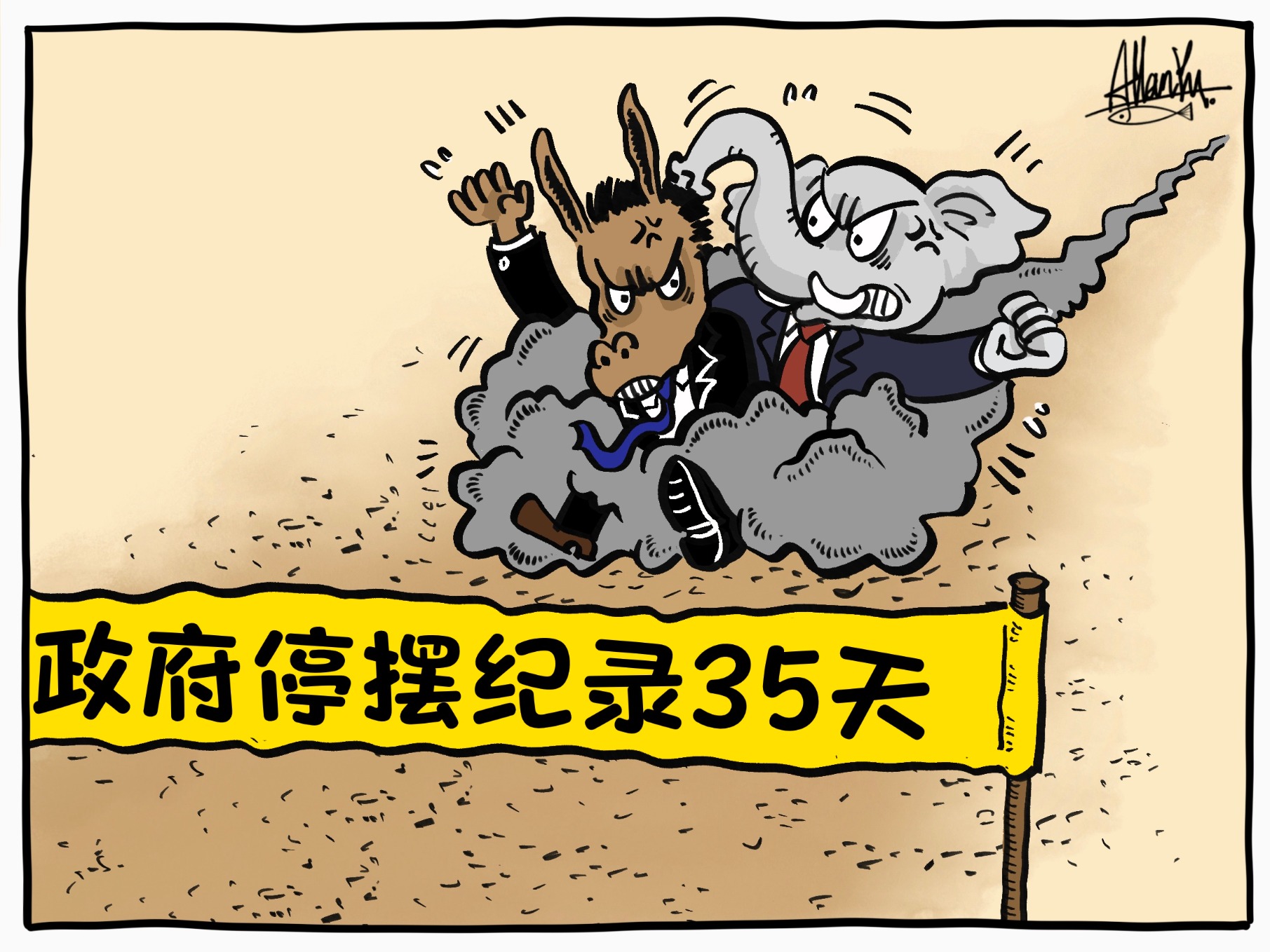
Core Points - The U.S. federal government shutdown has reached its 36th day, marking the longest shutdown in U.S. history, surpassing the previous record of 35 days from late 2018 to early 2019 [1][2] - The ongoing shutdown is a result of escalating political conflicts between the Democratic and Republican parties, with both sides prioritizing political gains over addressing public welfare [1][3] Political Dynamics - The shutdown began on October 1 when the Senate failed to pass a temporary funding bill before government funds were exhausted, leading to a political stalemate primarily over healthcare and welfare spending [2][3] - The Republican party, particularly under Trump's influence, aims to use the shutdown to push for government downsizing and to expand executive power, while the Democrats are leveraging the situation to solidify their political agenda ahead of the midterm elections [2][3] Economic Impact - The Congressional Budget Office estimates that the prolonged shutdown could reduce the U.S. GDP growth rate by 1 to 2 percentage points in Q4, with each week of the shutdown costing approximately $15 billion [3][5] - The shutdown has severely affected various sectors, including food assistance programs, healthcare, and transportation, leading to significant disruptions in services and economic activities [3][4][5] Historical Context - The phenomenon of government shutdowns has become increasingly common in U.S. politics, with 15 instances recorded since 1980, and the current situation reflects a growing trend of political polarization and dysfunction [6][7] - Previous shutdowns have typically lasted only a few days, but recent events indicate a shift towards longer and more contentious standoffs between the two parties [6][7] Public Sentiment - Public opinion polls indicate widespread dissatisfaction with both parties, with a significant majority of Americans feeling that neither party is addressing their needs effectively [8][9] - The ongoing shutdown has led to a decline in trust towards Congress, with approval ratings dropping to 15%, highlighting a growing disconnect between elected officials and the electorate [9][10] Governance Issues - Analysts attribute the recurring shutdowns to systemic governance failures, suggesting that the budgetary process in Congress requires substantial reform to prevent future crises [9][10] - The current political climate reflects a lack of willingness among elected officials to compromise, resulting in a governance model that increasingly fails to serve the public interest [9][10]
【环球财经】将破纪录——美国停不下来的联邦政府“停摆”
Xin Hua She· 2025-11-05 01:08
Core Points - The U.S. federal government shutdown has reached its 36th day, breaking the previous record of 35 days from late 2018 to early 2019, marking the longest shutdown in U.S. history [2][3] - The ongoing shutdown reflects deepening political polarization between the Democratic and Republican parties, with both sides prioritizing political gains over addressing public welfare [2][4] Summary by Sections Government Shutdown Duration and Impact - The current shutdown is unprecedented, with the Senate failing to pass a temporary funding bill before the government ran out of money on October 1, leading to 14 rejections of such bills [3] - The Congressional Budget Office estimates that the prolonged shutdown could reduce the U.S. GDP growth rate by 1 to 2 percentage points in Q4 [4] - The BBC estimates that each week of the shutdown costs the U.S. economy approximately $15 billion [4] Effects on Public Services - The shutdown has severely impacted various public services, including the suspension of the Supplemental Nutrition Assistance Program (SNAP) for the first time in 60 years, which has been described as having "disastrous" consequences [6] - In the healthcare sector, the new enrollment period for the Affordable Care Act began on November 1, but uncertainty over funding could lead to significant premium increases for 2026 [6] Transportation Sector Disruptions - Thousands of air traffic controllers and security personnel have been working without pay, leading to significant flight delays and cancellations, which could have broader economic repercussions on tourism and business travel [7] Political Dynamics - The shutdown has become a political tool for both parties, with Republicans aiming to push for government downsizing and Democrats using the situation to rally support around healthcare issues for the upcoming midterm elections [3][4] - Polls indicate that a majority of Americans feel both parties are disconnected from public interests, with low approval ratings for Congress [14][16] Systemic Issues - Analysts suggest that the frequent and prolonged shutdowns are symptomatic of deeper systemic issues within U.S. governance, including a lack of political compromise and accountability among elected officials [16][17] - The current political climate has led to a perception of governmental incompetence, damaging both domestic and international confidence in U.S. governance [17]
国际观察丨将破纪录——美国停不下来的联邦政府“停摆”
Xin Hua Wang· 2025-11-05 00:42
Core Points - The U.S. federal government shutdown has reached its 36th day, breaking the previous record of 35 days set in late 2018 to early 2019, marking it as the longest shutdown in U.S. history [2][3] - The ongoing shutdown is a result of escalating political conflicts between the Democratic and Republican parties, with both sides prioritizing political gains over addressing public welfare [2][3][13] - The shutdown has significant economic implications, with the Congressional Budget Office estimating a potential decline in the U.S. GDP growth rate by 1 to 2 percentage points in Q4, and a loss of approximately $15 billion for each week the shutdown continues [5][8] Political Dynamics - The failure to pass a temporary funding bill in the Senate has occurred 14 times, with both parties using the shutdown to advance their political agendas rather than seeking a resolution [3][9] - The Republican party, under the Trump administration, aims to leverage the shutdown to implement government downsizing and expand executive power, while the Democrats are using a hardline stance to consolidate party unity and focus on healthcare issues for the upcoming midterm elections [3][5] - The political polarization has intensified, with both parties engaging in blame-shifting rather than constructive negotiations, leading to a perception among the public that both parties are equally at fault [13][15] Societal Impact - The shutdown has severely affected various social welfare programs, including the Supplemental Nutrition Assistance Program (SNAP), which has halted benefits for the first time in its 60-year history, leading to potential catastrophic consequences for food security [7][8] - The healthcare sector is also impacted, with the Affordable Care Act's enrollment process facing disruptions due to unresolved funding issues, potentially resulting in significant premium increases for 2026 [7][8] - Transportation services have been disrupted, with thousands of air traffic controllers and security personnel working without pay, leading to increased flight delays and cancellations, which could have broader economic repercussions [8][9] Historical Context - The frequency and duration of government shutdowns have increased over the years, evolving into a political norm characterized by extreme partisanship and a lack of compromise [9][11] - Historical instances of shutdowns date back to 1976, with the longest previous shutdown occurring from late 2018 to early 2019, which lasted 35 days and resulted in an estimated $3 billion loss to the GDP [11][12] - Experts attribute the current shutdown crisis to systemic governance failures, suggesting that the budgetary process in Congress requires significant reform to prevent future occurrences [17][18]
将破纪录——美国停不下来的联邦政府“停摆”
Xin Hua She· 2025-11-04 23:19
Core Points - The U.S. federal government shutdown has reached its 36th day, breaking the previous record of 35 days set in late 2018 to early 2019, marking it as the longest shutdown in U.S. history [1][2] - The ongoing shutdown is a result of escalating political conflicts between the Democratic and Republican parties, with both sides prioritizing political gains over addressing public welfare [1][9] Summary by Sections Shutdown Duration and Impact - The current shutdown is characterized as "extremely disgraceful," with the Senate failing to pass a temporary funding bill before the government ran out of money [2] - Experts estimate that the shutdown could reduce the U.S. GDP growth rate by 1 to 2 percentage points in Q4, with losses of approximately $15 billion for each week the shutdown continues [3] Effects on Public Services - The shutdown has severely impacted various public services, including food assistance and healthcare programs, with the Supplemental Nutrition Assistance Program halting benefits for the first time in 60 years [3][4] - Thousands of air traffic controllers and security personnel are working without pay, leading to significant flight delays and cancellations, which could have broader economic repercussions [4] Political Dynamics - The shutdown reflects a growing trend of political polarization, with both parties using the situation to advance their agendas rather than seeking compromise [6][8] - Historical context shows that the frequency and duration of shutdowns have increased, with the last major shutdown occurring during the Trump administration over border wall funding [7][10] Public Sentiment and Governance Issues - Polls indicate that a majority of Americans feel both parties are disconnected from the public's needs, with low approval ratings for Congress [9][10] - Analysts suggest that the root cause of the shutdowns lies in systemic governance failures, with calls for reform in the congressional budgeting process [10][11]
美政府或将走向史上最长“停摆”
Sou Hu Cai Jing· 2025-11-01 23:04
Group 1 - The U.S. federal government shutdown has lasted for a month, with both Republican and Democratic parties in a deadlock, impacting various aspects of American life, economy, and government operations [1][2] - A recent poll indicates that 45% of Americans blame Trump and the Republican Party for the shutdown, while only 33% hold the Democratic Party responsible [1] - The current shutdown may become the longest in U.S. history, reflecting a failure of the political system to resolve budgetary disputes [2][3] Group 2 - The direct cause of the shutdown is the Senate's failure to pass a temporary funding bill before federal funds ran out, highlighting the increasing polarization and confrontation between the two parties [2] - Historically, government shutdowns have been a result of budgetary battles, with the current situation indicating a lack of willingness to negotiate and a focus on political gain [2][3] - The ongoing shutdown signals a dysfunction in government operations, with the potential for such shutdowns to become a new normal in U.S. politics [3] Group 3 - The Federal Reserve recently lowered the federal funds rate target range by 25 basis points to between 3.75% and 4.00%, marking the fifth rate cut since September 2024 [4] - Economic indicators show a slowdown in job growth and an increase in unemployment, with inflation remaining high, which the Fed Chairman Powell noted could be impacted by the shutdown [4] - The Congressional Budget Office warned that the shutdown could result in economic losses ranging from $7 billion to $14 billion if it continues [4] Group 4 - The shutdown has severely affected air traffic control, leading to significant flight delays, with up to 53% of delays attributed to staff shortages, compared to an average of 5% before the shutdown [6] - Approximately 13,000 air traffic controllers and 50,000 airport security personnel have been forced to work without pay, creating financial stress that could compromise safety [6] - The shutdown has broader implications for public services, with delays in housing assistance, medical services, and the closure of national parks, significantly impacting ordinary citizens [6]