
股市回调

Search documents
【百利好指数专题】货币宽松开启 股指还有新高
Sou Hu Cai Jing· 2025-11-06 09:55
Group 1 - The Federal Reserve has lowered the benchmark interest rate by 25 basis points to a range of 3.75% to 4.00%, marking the second rate cut of the year and the fifth since September 2024, indicating the start of a monetary easing cycle in the U.S. [1] - The labor market has shown signs of slowing down, with rising unemployment rates, prompting the Federal Reserve to implement two rate cuts this year to prevent further deterioration in the job market [3] - There is internal disagreement within the Federal Reserve regarding whether to continue rate cuts in December, with some officials advocating for a wait-and-see approach to observe a complete economic cycle before making further decisions [3] Group 2 - The stock market has shown a clear upward structure without signs of a major top, as the market breadth has not exhibited significant divergence, and trading volumes have remained stable [4] - Historical patterns indicate that small-cap and micro-cap stocks typically show weakness before a market bubble peaks, but current observations do not suggest significant deterioration in these stocks [4] - The current stock market valuation may be approaching high levels, but the formation of a valuation bubble is expected to take time, and there are no clear signals of a major market top [4] Group 3 - A potential 5% pullback in the stock market could attract significant buying interest, leading to new historical highs shortly after [4] - In the event of extreme market conditions, such as a major internal collapse or a shift in the Federal Reserve's monetary policy, there could be a risk of an 8% or more deep correction, making it difficult for indices to quickly reach new highs [5] - Technically, the Nasdaq is in a clear upward trend, with recent breakthroughs above 25,000 and 26,000, and the focus remains on whether prices can pull back to the 25,250 to 25,400 range for buying opportunities [5]


英伟达市值破5万亿美元创新高,科技股普跌引发市场波动担忧
Sou Hu Cai Jing· 2025-11-05 06:00
Core Viewpoint - The U.S. stock market experienced a decline on November 4, 2025, with major tech companies seeing significant drops in their stock prices, indicating a cautious market sentiment [2] Group 1: Market Performance - On November 4, 2025, all three major U.S. stock indices closed lower, with large tech companies like Intel, Tesla, and Nvidia experiencing declines of over 6%, 5%, and 3% respectively [2] - Nvidia's market capitalization decreased by approximately $199 billion, equivalent to about 1.42 trillion RMB, reflecting the overall cautious sentiment in the market [2] Group 2: Future Market Outlook - Financial institution leaders predict a potential market correction of 10% to 20% within the next 12 to 24 months, advising investors to prepare for volatility [2] - Some executives believe that the market can withstand a 10% to 15% adjustment unless there is a severe macroeconomic shock [2] Group 3: Nvidia's Business Developments - Despite recent stock price pressures, Nvidia has successfully expanded its business partnerships, leading to a market capitalization milestone of $5 trillion, making it the first company to reach this level [2] - Nvidia's market value increased from $4 trillion to $5 trillion in just four months [2] Group 4: Executive Wealth and Company Impact - Nvidia's rising market value has created three new billionaires this year, including board member Brooke Seawell, whose net worth surged due to stock price increases [2] - CEO Jensen Huang ranks ninth on the global billionaire list with a personal net worth of $175.7 billion, having increased by $61.3 billion since the beginning of the year [2]

凯投宏观:亚洲股市回调是对美股下跌的直接反映 对后续抛售加剧存疑
Ge Long Hui A P P· 2025-11-05 03:31
Core Viewpoint - The recent pullback in Asian stock markets appears to be a direct reaction to the decline in U.S. technology stocks, particularly affecting tech-heavy indices in Asia like the South Korean market [1] Group 1: Market Reaction - Asian markets, especially those dominated by technology, have shown strong performance recently, leading to larger losses when market sentiment shifts [1] - The potential for continued declines in Asian markets is questioned, particularly if U.S. tech stock sell-offs intensify [1] Group 2: Valuation Comparison - Despite the recent pullback, Asian valuations remain relatively low compared to the U.S., which may limit the downside potential for a global market downturn [1]
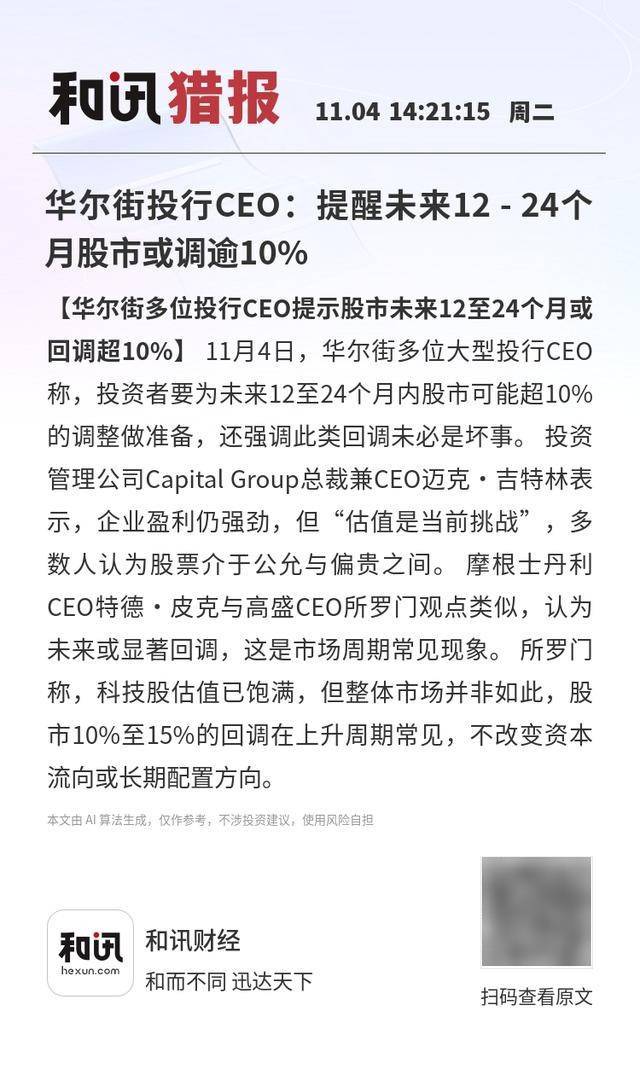
华尔街投行CEO:提醒未来12 - 24个月股市或调逾10%
Sou Hu Cai Jing· 2025-11-04 07:28
Core Insights - Multiple CEOs from major Wall Street investment banks have indicated that investors should prepare for a potential market correction exceeding 10% within the next 12 to 24 months, suggesting that such adjustments are not necessarily negative [1] Group 1: Market Outlook - Capital Group's President and CEO Mike Gitlin stated that corporate earnings remain strong, but the current challenge lies in valuations, with most believing that stocks are between fair and overvalued [1] - Morgan Stanley CEO Ted Pick and Goldman Sachs CEO David Solomon share similar views, indicating that a significant market correction is a common occurrence in market cycles [1] - Solomon noted that while technology stock valuations are high, the overall market is not necessarily overvalued, and a 10% to 15% correction is typical during an upward cycle, which does not alter capital flows or long-term allocation strategies [1]
华尔街高管警示美股未来或显著回调 但健康调整属市场常态
Ge Long Hui A P P· 2025-11-04 06:15
Core Insights - Major Wall Street investment bank CEOs indicate that investors should prepare for a potential market adjustment of over 10% within the next 12 to 24 months, suggesting that such pullbacks are not necessarily negative [1] Group 1: Market Outlook - Capital Group's CEO Mike Gitlin states that corporate earnings remain strong, but valuation poses a current challenge [1] - Gitlin notes that most investors perceive stocks to be between fair and overvalued, with few considering them to be between cheap and fair [1] - Morgan Stanley's CEO Ted Pick and Goldman Sachs' CEO David Solomon echo similar sentiments, predicting significant pullbacks as a common occurrence in market cycles [1] Group 2: Sector Analysis - Solomon highlights that technology stock valuations are quite full, although the overall market is not in the same position [1] - He points out that a 10% to 15% market pullback is typical during upward cycles and does not alter capital flows or long-term allocation strategies [1]


财报季开启,华尔街大型银行或表现亮眼
美股研究社· 2025-10-13 12:32
Core Viewpoint - Major banks on Wall Street are poised for a strong third-quarter earnings season, with analysts expecting a 6% profit increase compared to the same period last year [3][4]. Group 1: Earnings Expectations - Analysts predict that the core loan, trading, and investment banking revenues of major banks will see comprehensive growth, marking the seventh consecutive quarter of growth for investment banking and trading revenues, excluding Wells Fargo [4]. - The stock prices of Citigroup, Goldman Sachs, JPMorgan Chase, and Morgan Stanley have risen between 23% and 40% this year, outperforming the S&P 500 index by at least 9 percentage points [4]. Group 2: Market Conditions - The current market environment is characterized by high activity levels due to geopolitical dynamics, interest rate, and exchange rate fluctuations, contributing to a favorable outlook for banks [4]. - Despite earlier uncertainties caused by regulatory policies, global corporate merger and acquisition activity has surpassed $1 trillion, with a rebound in IPOs, corporate bond issuances, and syndicated loans [5]. Group 3: Management Insights - Bank executives expressed optimism regarding investment banking progress and the resilience of the U.S. economy during a Barclays conference, indicating that they are actively engaging with clients about the impacts of regulatory policies [5]. - Increased compensation costs across banks are seen as a reflection of heightened investment banking and trading activities, termed as "benign spending" by JPMorgan's co-head of commercial and investment banking [5]. Group 4: Concerns and Risks - JPMorgan CEO Jamie Dimon and Goldman Sachs CEO David Solomon warned of potential stock market corrections in the next two years, citing concerns over trade, tax, and immigration issues [6]. - Recent bankruptcies in the U.S. automotive sector have raised concerns about the credit environment, particularly regarding high-yield bonds and opaque markets [6][7]. Group 5: Credit Exposure - Documents reveal that JPMorgan and Fifth Third Bank have credit exposure to Tricolor, while larger creditors in the First Brands bankruptcy include Jefferies, UBS, and First Citizens Bank [7]. - Jefferies has reported $715 million in receivables related to the bankrupt First Brands Group, leading to a 20% drop in its stock price since being identified as a creditor [8].



Stock Markets Have Been Looking for the Next Big Risk. They May Have Found It.
Barrons· 2025-10-10 16:50
Market Overview - U.S. stocks experienced 33 trading days without a 1% pullback, indicating muted volatility and a bullish market trend leading to record highs [1] - This trend was abruptly interrupted as investors identified vulnerabilities in the market as the year-end approaches [1] Trade Relations - President Trump's threat of "massive" tariffs on China and the possibility of canceling a meeting with President Xi Jinping could escalate the ongoing trade war, impacting market stability [2] - The tariff threat is part of a series of retaliatory measures in the U.S.-China trade dispute that has persisted for several months [3]
重大!高盛公开唱空:股市将回调!是否可信,又是套路吗?
Sou Hu Cai Jing· 2025-10-05 21:40
Group 1 - Goldman Sachs warns that the stock market may experience a significant correction in the next one to two years, citing the AI boom as a potential risk similar to the internet bubble [1][3] - CEO David Solomon compares the current AI-driven market to the 1990s internet bubble, suggesting that a withdrawal of investments could lead to a market downturn [3][12] - The S&P 500's cyclically adjusted price-to-earnings ratio has surged to 38 times, indicating a historical high and raising concerns about market concentration risk [3][12] Group 2 - Goldman Sachs has a history of making inaccurate predictions regarding bank stocks, such as its 2023 report on China Merchants Bank, which underestimated the actual non-performing loan ratio [5][9] - The current market environment is complicated by high global government debt and rising interest rates, which could impact stock market stability [5][12] - There is a divergence in market reactions to Goldman Sachs' warnings, with some investors reducing their positions while others see potential buying opportunities [8][12] Group 3 - Retail investors are particularly vulnerable to panic selling in response to institutional warnings, as evidenced by the significant volume of high-risk options trading [8][12] - Goldman Sachs' contradictory stance—warning of an AI bubble while acknowledging the long-term potential of technology—raises questions about its motives [8][12] - Other financial institutions, like Morgan Stanley and Bank of America, are also issuing warnings about market risks, contributing to a confusing landscape for investors [12][13]

突发警告!高盛:股市将回调!
天天基金网· 2025-10-05 02:47
Core Viewpoint - The article discusses the potential market correction anticipated by Goldman Sachs CEO David Solomon, following the AI-driven stock market highs, suggesting that the market may be overvalued and could experience a downturn in the next 12 to 24 months [3][4][5]. Group 1: Market Trends and Predictions - Solomon warns that the market often runs ahead of actual potential when new technologies emerge, leading to a separation of winners and losers [3]. - The AI hype has driven stock indices to record highs, despite earlier weaknesses due to external factors like trade policies [4]. - Concerns are raised about a potential "bubble" in AI investments, with prominent figures like Jeff Bezos and Leon Cooperman expressing caution about the current market phase [5]. Group 2: Investment Sentiment - Solomon emphasizes that while some investors may incur losses, he remains optimistic about the long-term potential of AI technology and its integration into businesses [6]. - The excitement surrounding AI has led to an elongation of risk curves, with investors focusing on potential gains while downplaying risks [5]. - The article highlights a general sentiment of caution among investors, with warnings about the risks associated with AI trading resembling historical speculative bubbles [5].

高盛掌门人警告:股市将回调!但对人工智能依然乐观
Zhong Guo Ji Jin Bao· 2025-10-05 00:03
Group 1 - Goldman Sachs CEO David Solomon warns of a potential market pullback in the next 12 to 24 months following the AI-driven stock market highs [1][2] - Solomon highlights historical patterns where new technologies lead to market exuberance, often resulting in a separation of winners and losers, similar to the internet bubble of the late 1990s [1][2] - Concerns about a "bubble" in the AI sector are echoed by other industry leaders, including Jeff Bezos, who describes the current AI environment as an "industrial-level bubble" [2] Group 2 - Despite the anticipated market corrections, Solomon remains optimistic about the potential of artificial intelligence, emphasizing the excitement around technological advancements and new company formations [3] - The current AI investment climate is characterized by significant capital inflows and a focus on major tech companies like Microsoft, Alphabet, Palantir, and Nvidia [1]