
资产重新定价

Search documents
大规模的存款搬家,开始出现了?
大胡子说房· 2025-09-18 11:15
Core Viewpoint - The article highlights a significant shift in deposit trends, indicating a movement of funds from traditional bank deposits to non-bank financial institutions, driven by the rising interest in the capital market and a more rational approach to investment by residents and enterprises [2][9][10]. Summary by Sections Deposit Data - In August, new corporate deposits increased by 299.7 billion yuan, a year-on-year decrease of 50.3 billion yuan [3]. - New household deposits were 110 billion yuan, down 600 billion yuan compared to last year [3]. - In July, the stock of household deposits was approximately 1.11 trillion yuan, reflecting a year-on-year reduction of 780 billion yuan [4]. Non-Bank Financial Institutions - Non-bank financial institutions, such as brokerages, funds, and insurance companies, saw a significant increase in deposits, with an addition of 1.18 trillion yuan in August, a year-on-year increase of 550 billion yuan [6]. - In July, the increase in non-bank deposits was even higher at 2.14 trillion yuan [7]. - Cumulatively, non-bank deposits increased by 5.87 trillion yuan in the first eight months of the year, marking a historical high for the same period [8]. Fund Movement and Market Sentiment - The outflow of deposits from banks to non-bank institutions suggests a growing interest in the capital market, indicating a large-scale "deposit migration" [9]. - This migration is characterized by a more rational approach, with funds moving towards stable financial products rather than high-risk investments [12]. - Popular products include those with relatively fixed returns, which have attracted significant interest compared to traditional deposits [14]. Market Dynamics - The article notes that the current deposit migration is still in its early stages, with a substantial amount of funds yet to enter the market [16]. - The speed of deposit migration is closely linked to the performance of stock indices, with a notable increase in new account openings in August, reaching approximately 2.65 million, a 35.1% month-on-month increase and a 165% year-on-year increase [19][20]. - The article emphasizes that the attitude of the public towards the capital market is directly correlated with the market's performance [23]. Future Outlook - The potential acceleration of deposit migration will depend on the speed of index increases, with rapid gains likely to encourage more retail investors to enter the market [22][24]. - The article concludes that the current wave of deposit migration is expected to surpass previous instances, driven by a collective effort to restore asset prices and ensure widespread participation in market gains [26][28].


行情变了,新的财富机会来了
大胡子说房· 2025-09-11 12:07
Core Viewpoint - The current bull market in the domestic capital market is characterized by a lack of clear initiation signals and a slow upward movement, indicating a unique underlying logic compared to previous bull markets [1][3]. Group 1: Market Characteristics - The bull market has not been triggered by any significant events or signals, unlike past bull markets which had clear catalysts [1]. - The index has risen slowly from 3300 points in June to 3800 points over nearly three months, contrasting with previous rapid increases [1]. - The underlying logic of this market is believed to be valuation repair and asset repricing, as current valuations are considered too low [3][4]. Group 2: Valuation and Pricing - The current asset prices are significantly undervalued, deviating from their true value due to various influencing factors [3][4]. - The average price-to-earnings (P/E) ratio of the A-share market is around 15 times, while major indices like the CSI 300 have an average P/E of about 12 times, both of which are lower than their U.S. and European counterparts [4]. - The market capitalization to GDP ratio for A-shares is only 74%, much lower than that of the U.S. (over 200%) and Japan (150%) [4][5]. Group 3: Economic Context - The capital market's development in the domestic context has lagged behind economic growth and global trends, indicating a significant undervaluation [5]. - The repair of asset valuations is seen as a necessary step for economic recovery, especially in light of potential liquidity releases from the U.S. [9]. Group 4: Policy Implications - Recent policies aimed at reducing fund purchase costs and restarting government bond trading are designed to attract more capital into the market [6][7]. - The easing of monetary policy and liquidity expansion by the central bank is expected to support asset price recovery [8]. Group 5: Future Outlook - The current market conditions suggest that asset prices are likely to continue rising, presenting a significant wealth opportunity for investors [9]. - Investors are encouraged to participate in this market to benefit from the ongoing asset repricing [9].

10年期国债收益率升至1.73%!债基遭遇千亿赎回,股市走强冲击债市
Sou Hu Cai Jing· 2025-07-27 16:54
Core Viewpoint - The bond market is experiencing significant adjustments due to multiple factors, leading to a continuous rise in yields, with the 10-year treasury yield reaching 1.7325% and the 30-year yield at 1.9475%, both at year-high levels [1][2] Group 1: Market Dynamics - A notable change in market risk appetite is the core driver putting pressure on the bond market, with the stock market breaking key levels and the Shanghai Composite Index nearing 3600 points, showing a weekly increase of 1.67% [2][3] - Commodity prices have surged, with lithium carbonate futures rising over 7% and polysilicon prices hitting new highs, which diminishes the relative attractiveness of bond assets [2][3] Group 2: Liquidity and Institutional Behavior - The liquidity situation has worsened since mid-July, with significant fluctuations in funding rates and the central bank's operations showing a net withdrawal of funds, leading to a spike in the 10-year treasury yield [2][4] - Institutional investors are accelerating withdrawals from the bond market, with redemption pressures on bond funds increasing significantly, and the net subscription index for public bond funds remaining negative since July 21, reaching a record single-day redemption of 29.2 on July 24 [4][5] Group 3: Future Market Expectations - There is a divergence in expectations regarding the future trajectory of the bond market, with some institutions cautious about the potential for further rate increases, while others believe yields are still at historical lows and may rise due to stable economic growth and improving inflation [5] - The current adjustment in the bond market is viewed as manageable, with the 10-year treasury yield rising approximately 7 basis points, which is still within a controllable range compared to historical adjustments [5]

美元仍无可替代?高盛:资产分散压力或引发价格风暴
Hua Er Jie Jian Wen· 2025-07-07 07:18
Core Viewpoint - Global investors are questioning the dominance of the US dollar, but alternatives are limited, which may lead to significant market volatility and revaluation of nominal asset prices [1][2]. Group 1: Limited Alternatives to the Dollar - Goldman Sachs analysts highlight that despite rising demand for diversification away from dollar assets, credible alternative assets are scarce, with only Swiss francs, precious metals, and Bitcoin being viable options [2]. - The market capacity of these alternatives is significantly lower than that of the dollar, which could result in "non-linear" price volatility if large-scale investments flow into them [2]. - The case of the Swiss franc illustrates this issue, as its strength has prompted the Swiss National Bank to revert to a zero interest rate policy, indicating the limits of even high-quality alternative currencies [2]. Group 2: Impact of Currency Fluctuations on Asset Allocation - Large-scale diversification away from dollar assets could not only affect the foreign exchange market but also lead to a revaluation of global equity markets and other nominal assets [3]. - Despite a weak performance of the dollar in the first half of the year, demand for dollar assets remains strong, particularly in the tech and AI sectors, driven by institutional investments [3]. - Goldman Sachs anticipates that the Federal Reserve will cut interest rates three times in the next six months and two more times in the first half of 2026, which may lead to further adjustments in the dollar's exchange rate [3].

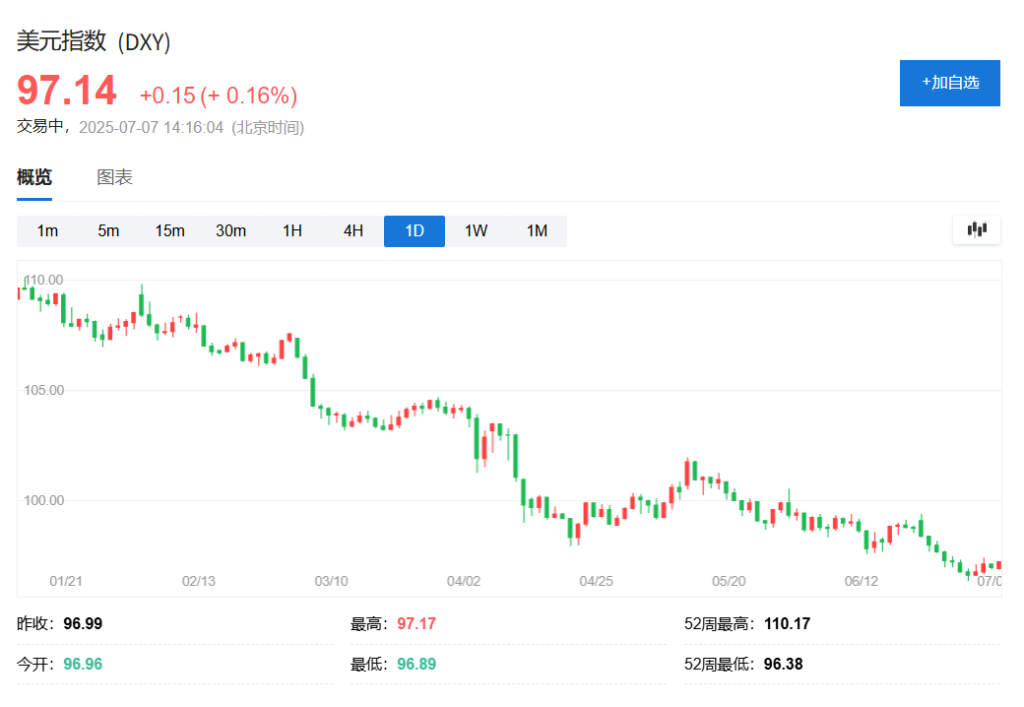
IMF世界经济展望报告:政策转变和情绪恶化可能引发资产进一步重新定价,导致外汇汇率大幅调整。
news flash· 2025-04-22 13:10
Core Insights - The IMF World Economic Outlook report indicates that policy shifts and deteriorating sentiment may trigger further asset repricing, leading to significant adjustments in foreign exchange rates [1] Group 1 - The report highlights the potential for substantial foreign exchange rate adjustments due to changes in policies and market sentiment [1]