
资本利得

Search documents
固收策略报告:2.3%的久期机会值得博弈吗-20250622
SINOLINK SECURITIES· 2025-06-22 15:22
Group 1 - The core viewpoint of the report highlights the unexpected strong performance of long-term credit bonds, with the China Bond 10-year and above implied AA+ full price index increasing by 0.9% in the past week and 1.5% for the month [2][12] - The report identifies four key characteristics of the current long-term credit bond trading: accelerated allocation pace, significant decline in transaction yields, strong performance of 20 to 30-year bonds, and increased trading volume [3][16] - The report notes that as of June 20, 63% of credit bonds with a maturity of over one year are concentrated at yields below 2%, compared to 59% at the beginning of January, indicating a need for mid to long-term asset allocation to achieve yields above 2% [4][46] Group 2 - The report discusses the different triggers for market performance in the interbank and exchange markets, with insurance and funds being the main net buyers of credit bonds over 7 years, and funds showing a significant increase in net buying [4][47] - The report emphasizes that the rapid decline in yields raises concerns, including the proximity of various bond yields to their annual lows, the lack of comparative advantage for long-term credit bonds against government bonds, and the increasing contribution of capital gains to overall returns [5][56] - The report suggests that while the short-term performance of credit bonds over 7 years is strong, the high demands on trading capabilities and the underlying market fragility necessitate a cautious approach, recommending a focus on 3-year city investment bonds for better opportunities [5][31]
点评报告:票息为盾,提前“卡位”利差压缩行情
Changjiang Securities· 2025-06-12 02:45
1. Report Industry Investment Rating - Not provided in the content 2. Core Viewpoints of the Report - In the context of a volatile bond market and a passive widening of credit spreads, investors should prioritize high - coupon assets for certain returns and prepare in advance for the spread compression market driven by the seasonal inflow of wealth management funds in July [1][5]. - The current core contradiction in the credit bond market is the co - existence of weakening allocation demand and a passive widening of spreads in a volatile environment. Investors should seize pricing deviation opportunities under the protection of coupon safety cushions [5]. - The volatile market pattern caused by the interplay of multiple factors will continue, providing tactical opportunities for layout during market adjustments [6]. - The coupon strategy is the optimal solution in a volatile market, and portfolios should be constructed in a stratified manner according to the characteristics of liabilities [7]. - Investors should "pre - position" for the seasonal spread compression market in July and seize structural opportunities in specific bond varieties [8]. 3. Summary by Relevant Catalog 3.1 Yield and Spread Overview 3.1.1 Yields and Changes of Each Tenor - Yields of various types of bonds at different tenors are presented, along with their weekly changes and historical percentiles. For example, the 0.5 - year Treasury yield is 1.41%, down 4.0bp from last week, with a historical percentile of 8.4% [14]. 3.1.2 Spreads and Changes of Each Tenor - Credit spreads of various types of bonds at different tenors are shown, including their weekly changes and historical percentiles. For instance, the 0.5 - year credit spread of public non - perpetual urban investment bonds is 25bp, up 2.1bp from last week, with a historical percentile of 12.7% [16]. 3.2 Yields and Spreads of Credit Bonds by Category (Hermite Algorithm) 3.2.1 Yields and Spreads of Urban Investment Bonds by Region - **Yields and Changes of Each Tenor**: Yields of public non - perpetual urban investment bonds in different provinces at key tenors, their weekly changes, and historical percentiles are provided. For example, the 0.5 - year yield of Anhui's public non - perpetual urban investment bonds is 1.77%, up 2.6bp from last week, with a historical percentile of 1.1% [19]. - **Spreads and Changes of Each Tenor**: Credit spreads of public non - perpetual urban investment bonds in different provinces at key tenors, their weekly changes, and historical percentiles are given. For example, the 0.5 - year credit spread of Anhui's public non - perpetual urban investment bonds is 30.41bp, up 4.6bp from last week, with a historical percentile of 7.2% [22]. - **Yields and Changes of Each Implied Rating**: Yields of public non - perpetual urban investment bonds in different provinces for each implied rating, their weekly changes, and historical percentiles are presented. For example, the AAA - rated yield of Anhui's public non - perpetual urban investment bonds is 1.80%, up 3.8bp from last week, with a historical percentile of 5.1% [26]. - **Spreads and Changes of Each Implied Rating**: Credit spreads of public non - perpetual urban investment bonds in different provinces for each implied rating, their weekly changes, and historical percentiles are shown. For example, the AAA - rated credit spread of Anhui's public non - perpetual urban investment bonds is 28.96bp, up 4.8bp from last week, with a historical percentile of 32.2% [31]. - **Yields and Changes of Each Administrative Level**: Yields of public non - perpetual urban investment bonds in different provinces at each administrative level, their weekly changes, and historical percentiles are provided. For example, the provincial - level yield of Anhui's public non - perpetual urban investment bonds is 1.80%, up 3.5bp from last week, with a historical percentile of 3.7% [35].
信用周报:利差大幅收窄后信用债如何配置?-20250518
Huachuang Securities· 2025-05-18 14:43
Group 1: Report Industry Investment Rating - Not provided in the content Group 2: Core Viewpoints of the Report - In the current bond market, short - term credit bond yield decline and spread narrowing space are limited. Traders can wait for a better position after market adjustment to participate in the game, and currently focus on certain coupon opportunities and consider allocation from the perspective of absolute yield [3][27] - Different investment strategies should be adopted according to the stability of the liability side. For those with weak liability - side stability, focus on 2 - 3y medium - and low - grade varieties and some 4 - 5y high - coupon, medium - quality individual bonds; for those with strong liability - side stability, allocate 4 - 5y varieties [3][4][27] Group 3: Summary by Relevant Catalogs I. How to Allocate Credit Bonds after a Significant Narrowing of Spreads (1) Credit Bond Market Review - This week, the capital price was low at first and then high. The Sino - US economic and trade joint statement significantly reduced bilateral tax rates, boosting risk appetite. Under the stock - bond seesaw effect, the bond market was under pressure. Interest - rate bond yields rose across the board, while credit bond yields showed a differentiated trend and performed better than interest - rate bonds. Bank secondary and perpetual bonds with significantly narrowed spreads performed weakly, with yields rising slightly and spreads narrowing passively. The yields of other credit varieties generally declined for 1 - 4y and rose for 5 - 15y, with spreads narrowing significantly for 1 - 4y and passively narrowing for 5 - 15y, with a smaller narrowing amplitude at the long end [1][11] (2) Credit Strategy: Focus on Certain Coupon Opportunities - **Current Credit Spread Level**: 1 - 2y variety spreads have been compressed to an extreme level, while the medium - and long - term spreads still have some room compared to last year's lowest point. In a volatile bond market environment, the further compression space of credit spreads may be relatively limited [14][24] - **Current Credit Bond Yield Level**: Currently, the yields of various credit varieties can generally achieve positive carry. Different varieties have different yield levels compared to R007 [25] II. Key Policies and Hot Events - On May 15th, the General Office of the Communist Party of China Central Committee issued the "Opinions on Continuously Promoting Urban Renewal Actions", which mentioned improving diversified investment and financing methods and encouraging financial institutions to participate in urban renewal [33] - On May 15th, Vanke announced that its major shareholder, Shenzhen Metro Group, would provide a loan of up to 1.552 billion yuan to the company to repay the principal and interest of bonds issued in the public market [33] - On May 13th, seven departments jointly issued policies to include high - quality enterprise science and technology innovation bonds in the benchmark market - making varieties to improve their liquidity [34] III. Secondary Market - This week, credit bond yields showed a differentiated trend, and credit spreads generally narrowed. Different types of bonds, such as urban investment bonds, real - estate bonds, cyclical bonds, and financial bonds, had different yield and spread changes [36][37] IV. Primary Market - This week, the issuance scale of credit bonds was 122.3 billion yuan, a decrease of 47.5 billion yuan compared to the previous week, and the net financing amount was - 15.7 billion yuan, a decrease of 19.7 billion yuan compared to the previous week. The issuance scale of urban investment bonds was 30.2 billion yuan, a decrease of 50.9 billion yuan compared to the previous week, and the net financing amount was - 24.6 billion yuan, a decrease of 5.4 billion yuan compared to the previous week [6] V. Trading Liquidity - This week, the trading activity in the inter - bank market and the exchange market of credit bonds increased. The trading volume in the inter - bank market increased from 432 billion yuan last week to 550.1 billion yuan, and the trading volume in the exchange market increased from 234.1 billion yuan last week to 336.2 billion yuan [6] VI. Rating Adjustment - This week, there were 2 entities with downgraded ratings and 3 entities with upgraded ratings [6]
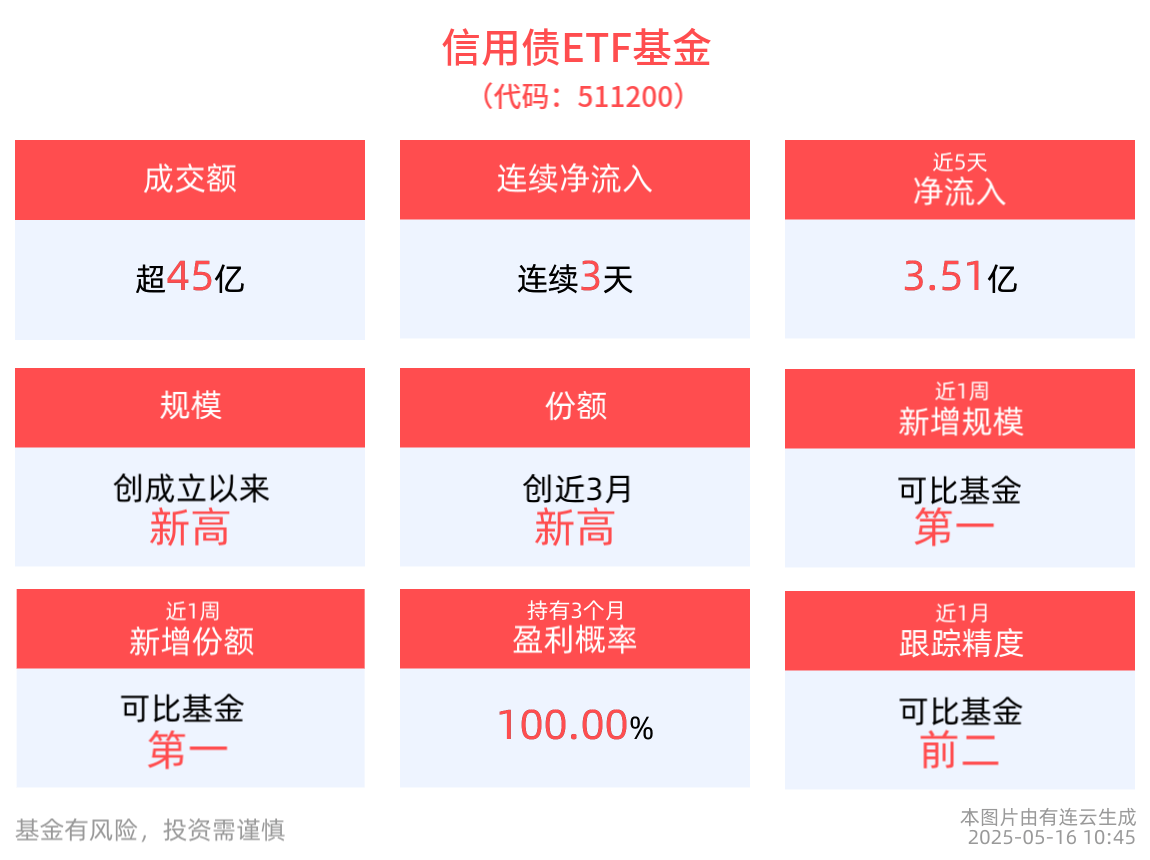
成交额超45亿元,信用债ETF基金(511200)连续3天净流入
Sou Hu Cai Jing· 2025-05-16 03:02
Group 1 - The credit bond ETF fund (511200) is experiencing a tight balance between long and short positions, with the latest quote at 100.39 yuan [3] - The fund's liquidity is active, with an intraday turnover of 106.41% and a transaction volume of 4.573 billion yuan, while the average daily transaction volume over the past week is 4.342 billion yuan [3] - The fund's latest scale has reached 4.299 billion yuan, marking a new high since its establishment [3] - The fund's latest share count is 42.8075 million, also a new high in the past three months [3] - The fund has seen continuous net inflows over the past three days, with a maximum single-day net inflow of 130 million yuan, totaling 280 million yuan, and an average daily net inflow of 93.4509 million yuan [3] - The management fee rate of the fund is 0.15%, and the custody fee rate is 0.05%, which are the lowest among comparable funds [3] - As of May 15, 2025, the fund's tracking error over the past month is 0.005%, indicating high tracking precision compared to similar funds [3] Group 2 - The credit bond ETF fund closely tracks the Shanghai benchmark market-making corporate bond index, exhibiting characteristics of medium to short duration, which implies relatively low interest rate risk [4] - The low duration of medium to short bonds results in smaller price fluctuations due to interest rate changes, aligning well with conservative investment demands [4] - In a declining interest rate environment, there are opportunities to capture capital gains from the decline in risk-free interest rates and the compression of spreads [4]

信用债久期策略:信用债拉久期吗?
SINOLINK SECURITIES· 2025-05-12 04:35
Group 1: Monetary Policy Impact - The central bank unexpectedly advanced the timing of interest rate cuts and reserve requirement ratio reductions, implementing a package of ten monetary policy measures to address global economic uncertainties and trade tensions[12] - The 7-day reverse repurchase rate was lowered by 10 basis points to 1.4%, contributing to a decline in short-term bond yields[12] - The yield on 1-year government bonds has dropped to 1.4%, while the 10-year government bond yield stabilized around 1.63%[12] Group 2: Market Behavior and Trends - Despite a significant decline in yields, buying interest in medium and short-term bonds remains restrained, with trading volumes not reflecting the expected demand[15] - The proportion of credit bonds yielding below 2.2% has risen to 77%, indicating a lack of attractive investment opportunities in the current market[36] - The trading volume of 3-year and shorter credit bonds has decreased, with a notable drop in weekly turnover rates[23] Group 3: Investment Strategies - Investors are advised to focus on 2-year credit bonds, particularly high-quality city investment bonds rated AA(2), to ensure a balanced yield amidst market volatility[50] - The strategy of extending duration in credit bonds is limited due to low yields and the risk of capital loss, with many investors preferring to maintain short-duration positions[6] - The yield on 4 to 5-year secondary capital bonds has fallen below the upper limit of 10-year government bonds plus 30 basis points, raising concerns about low risk-reward ratios[49]
多策略矩阵系列之一:利用多资产生息策略穿越资产周期
GOLDEN SUN SECURITIES· 2025-02-26 03:20
Key Points of the Report - The report emphasizes the importance of "multi-asset multi-strategy" approaches in navigating low risk premium and low interest rate environments, suggesting a shift from traditional top-down asset allocation to a bottom-up absolute return strategy that focuses on strategy configuration [1][7][10] - The effectiveness of income strategies is based on the premise that markets often overestimate the downside risk of capital gains while underestimating the compensatory ability of income returns, creating opportunities for excess returns [1][17][21] Section Summaries 1. Logic and Effectiveness of Income Strategies - Active asset allocation is crucial in the current market due to declining risk premiums in domestic assets, with the Sharpe ratio for risk parity strategies dropping from 1.02 (2005-2011) to 0.6 (2012-2023) [7][8] - Income strategies are defined as the sum of income returns and capital gains, with a focus on capturing structural pricing inefficiencies in the market [10][13] 2. Equity Income: Dividend + Net Buyback - The income yield for A-shares is 2.4%, compared to 3.0% for U.S. stocks, with the gap primarily attributed to net buyback rates [2][30] - A shareholder return portfolio designed based on income logic achieved an annualized return of 20.4%, outperforming the CSI Dividend Index by 9.2% [2][42] 3. Bond Income: Coupon + Roll Yield - The original roll yield strategy has performed well over the past decade, but faces challenges in a low interest rate environment. The enhanced roll yield strategy achieved an annualized return of 5.2% with a maximum drawdown of 2.8% [2][3] 4. Commodity Income: Roll Yield - Empirical studies indicate that roll yield is a primary source of long-term returns in commodity futures, with specific ETFs like soybean meal ETF being identified as suitable for income strategies [2][4] 5. Convertible Bond Income: Bond Floor and Equity Dividend - Convertible bonds provide both bond floor income and equity dividends, with strategies designed to optimize returns based on these dual sources [3][5] 6. Income Strategy Design - The income-focused Fund of Funds (FOF) strategy has achieved an annualized return of 8.7% since 2018, while the income fixed income+ strategy yielded 6.9% [3][4]