
集采政策

Search documents
德展健康,创5年来最大亏损
Shen Zhen Shang Bao· 2026-01-31 09:29
Group 1 - The company, Dezhan Health, forecasts a significant loss of between 175 million to 350 million yuan for 2025, marking the largest loss in five years, compared to a loss of 20.41 million yuan in 2024 [1] - From 2021 to 2025, the company has reported losses in four out of five years, with a profit of 83 million yuan only in 2023 [1] - The company attributes the expected losses to ongoing investments in nurturing business and R&D, the impact of centralized procurement policies on revenue, and impairment provisions for long-term equity investments and goodwill [1] Group 2 - Dezhan Health, originally Tianshan Textile, is the only listed pharmaceutical and health company within the Xinjiang state-owned asset system [1] - On September 16, 2025, the company underwent a management change, appointing Wei Zheming as chairman and Liu Wei as co-chairman and general manager, along with several other executive appointments [1] - On December 13, 2025, Wang Shubin, who had been in the role for less than three months, resigned from his position as vice president due to personal reasons [2] - The company is involved in a lawsuit related to a contract dispute between its former controlling shareholder and another company, which has been filed in the Beijing Third Intermediate People's Court [2] - Dezhan Health is among over 12 pharmaceutical companies implicated in a bribery case involving a hospital's pharmacy director [2][3]



蓝帆医疗公布2025年业绩预告,拐点孕育,修复在途
Sou Hu Cai Jing· 2026-01-31 07:51
Core Viewpoint - 蓝帆医疗预计2025年将面临6.5亿至8.5亿元的亏损,但心脑血管事业部的强劲增长和健康防护事业部的毛利率回升为未来业绩改善提供了希望 [1] Group 1: Health Protection Business - 健康防护事业部的亏损扩大主要由于固定资产减值计提和中美经贸关系波动 [2] - PVC手套出口业务在中美经贸磋商后企稳,行业价格在2025年末回升,健康防护业务的毛利率在第四季度回正 [2] - 公司通过"减重"措施集中释放不利因素,为未来利润增长奠定基础 [2] Group 2: Cardiovascular Business - 心脑血管业务的扭亏证明了公司在高值耗材领域的竞争力,冠脉药物球囊在国家集采中的表现优异 [3] - 集采政策的转变为具备创新能力的企业带来长期利好,公司的创新管线储备决定了未来增长潜力 [3] - 公司在冠脉介入领域的多款创新产品获批,CE认证的冠脉血管内冲击波治疗系统为进入全球市场提供机会 [3] Group 3: Overall Outlook - 蓝帆医疗似乎已走出利空阶段,心脑血管业务的增长提供了安全垫,健康防护业务的周期触底提供了弹性空间 [3] - 公司有望迎来业绩与估值的双重提升 [3]

海南海药:预计2025年净亏损3.5亿元—4.3亿元
Ge Long Hui A P P· 2026-01-30 13:05
Core Viewpoint - Hainan Haiyao expects a net loss of 350 million to 430 million yuan in 2025 due to intensified market competition and various policy impacts [1] Group 1: Financial Outlook - The company anticipates a net loss ranging from 350 million to 430 million yuan for the year 2025 [1] - Increased depreciation expenses are expected as raw material projects transition to fixed assets [1] - High interest expenses are anticipated due to a large scale of interest-bearing liabilities, which will further impact the company's performance [1] Group 2: Market and Policy Environment - The competitive landscape is expected to intensify due to the influence of medical insurance and centralized procurement policies [1] - The company's innovative drugs have not yet been launched, and newly listed generic drugs have not gained significant market volume [1]

辰光医疗:预计2025年全年归属净利润亏损5300万元至6600万元
Sou Hu Cai Jing· 2026-01-29 12:19
辰光医疗2025年三季报显示,前三季度公司主营收入6774.26万元,同比下降21.33%;归母净利 润-1933.07万元,同比下降21.77%;扣非净利润-2148.9万元,同比下降3.01%;其中2025年第三季度, 公司单季度主营收入2038.99万元,同比下降29.57%;单季度归母净利润-451.3万元,同比上升3.33%; 单季度扣非净利润-528.12万元,同比上升9.47%;负债率48.48%,投资收益23.9万元,财务费用385.49 万元,毛利率49.73%。 以上内容为证券之星据公开信息整理,由AI算法生成(网信算备310104345710301240019号),不构成 投资建议。 证券之星消息,辰光医疗发布业绩预告,预计2025年全年归属净利润亏损5300万元至6600万元。 公告中解释本次业绩变动的原因为: 2025年度公司营业收入有所下降,公司营收增长仍受磁共振整机行业竞争格局影响。2025年中国磁共振 系统市场保持持续竞争态势,特别是头部企业针对集采"带量采购,以量换价"的政策,医学影像设备行业中 标价同比大幅下降,因此公司的1.5T磁共振系统销售收入受到影响。此外公司7.0T ...
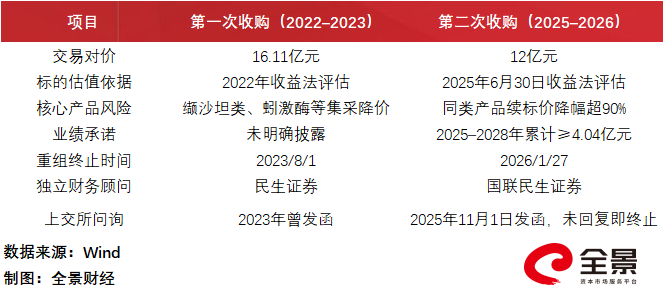
阳光诺和收购同一标的两次失败 国联民生证券开年三连阻 | A股融资快报
Quan Jing Wang· 2026-01-29 12:09
Core Viewpoint - Sunshine Nuohuo (688621.SH) has officially terminated its plan to acquire 100% equity of Langyan Life, marking the second failed attempt since 2022, amid challenges from policy changes and valuation disputes [1][3]. Group 1: Acquisition Attempts - The first acquisition attempt in 2022 was priced at 1.611 billion yuan, while the second attempt in 2025 was reduced to 1.2 billion yuan, a 25.5% decrease [2][4]. - The core products of Langyan Life, including Valsartan and Entecavir, faced significant price reductions due to centralized procurement, impacting revenue and profit forecasts [3][4]. - The termination of the first acquisition occurred on August 1, 2023, and the second on January 27, 2026, with both attempts facing scrutiny from the Shanghai Stock Exchange [2][5]. Group 2: Financial Performance and Market Conditions - Langyan Life's revenue dropped from 617 million yuan in 2022 to 465 million yuan in 2023, with net profit falling from approximately 80 million yuan to 36.71 million yuan [3][4]. - The company set a performance commitment for the second acquisition, requiring a cumulative net profit of at least 404 million yuan from 2025 to 2028 [2][4]. - Despite a report suggesting opportunities from a shift towards quality in procurement policies, market skepticism regarding the sustainability of Langyan Life's profitability persisted [5][6]. Group 3: Regulatory and Advisory Context - Guolian Minsheng Securities served as the independent financial advisor for both acquisition attempts, facing challenges in transaction structuring and compliance due to market conditions [6][8]. - The Shanghai Stock Exchange raised multiple inquiries regarding the fairness of pricing and the feasibility of performance commitments during the second acquisition attempt [4][5]. - Sunshine Nuohuo stated that the termination of the acquisition would not significantly impact its operational and financial status, projecting a revenue increase of 10.57% to 27.15% for 2025 [7][8].


穿越集采周期后的结构性跃迁:通化东宝如何重塑“内分泌龙头的成长叙事”?
Quan Jing Wang· 2026-01-26 11:57
Core Viewpoint - Tonghua Dongbao is expected to achieve a significant turnaround in its financial performance for 2025, with a projected net profit of approximately 1.242 billion yuan and a net profit excluding non-recurring gains of about 402 million yuan, both showing a substantial recovery compared to the previous year [1] Group 1: Performance Highlights - The company's insulin analog products are experiencing rapid growth, with sales increasing by over 100% year-on-year, becoming the main driver of revenue growth [2] - In Q3 2025, revenue from insulin analogs surpassed that of traditional human insulin, marking a key milestone in product upgrade [2] - Tonghua Dongbao's market share in the insulin sector remains second in the industry, with human insulin market share rising to 45.5%, maintaining the leading position domestically [2] Group 2: R&D Progress - The company is increasing R&D investment, advancing multiple innovative drug projects in the metabolic disease field [3] - Significant progress has been made with GLP-1 drugs, including the completion of Phase III clinical trials for semaglutide and positive results from Ib phase trials for a GLP-1/GIP dual-target agonist [3] - The company is also accelerating the development of insulin combination formulations and has received marketing approval for a gout drug, showcasing a diversified pipeline [3] Group 3: International Expansion - Tonghua Dongbao's internationalization has accelerated, with several core products achieving registration and market access breakthroughs in emerging markets [4] - The company is implementing a dual-output model of "raw materials + formulations," with significant progress in the internationalization of insulin analogs and human insulin [4] - The strategy includes breakthroughs in mature markets and rapid access in emerging markets, gradually building a sales network across multiple regions [4] Group 4: Shareholder Returns and Talent Incentives - The controlling shareholder, Dongbao Industrial Group, has increased its stake by 228 million yuan, reflecting confidence in the company's future [5] - The company plans to repurchase shares worth 20 to 40 million yuan for employee stock ownership or equity incentives, aiming to align interests among shareholders, the company, and employees [6] Group 5: Value Reassessment - Experts believe that as the revenue share of insulin analogs continues to rise, Tonghua Dongbao's profit structure and growth quality are expected to improve further [7] - The company is constructing a new growth pattern through the volume increase of insulin analogs, gradual realization of innovative drugs, and accelerated internationalization [7]

华海药业(600521.SH):预计2025年度净利润同比降低约70%到80%
Ge Long Hui A P P· 2026-01-26 10:03
Core Viewpoint - Huahai Pharmaceutical (600521.SH) expects a significant decline in net profit for the fiscal year 2025, with projections indicating a decrease of approximately 70% to 80% compared to the previous year [1] Financial Performance - The estimated net profit attributable to shareholders for 2025 is projected to be between 224 million and 335 million yuan [1] - The estimated net profit excluding non-recurring gains and losses is expected to be between 113 million and 226 million yuan, reflecting a decline of about 80% to 90% year-on-year [1] Business Challenges - Domestic formulation business faces pressure from expanded domestic centralized procurement policies, leading to intensified price competition and a decline in sales revenue [1] - The raw material pharmaceutical industry is experiencing severe competition due to overcapacity and price pressures, with new product development facing delays, resulting in decreased sales revenue [1] - Increased investment in the research and development of innovative biological drugs has led to a significant rise in R&D expenses [1] Non-Operating Gains - Non-operating gains increased by approximately 100 million to 130 million yuan, primarily due to fair value changes in financial assets and gains from the sale of partial equity [1]

华海药业:预计2025年度净利润同比降低约70%到80%
Ge Long Hui· 2026-01-26 10:02
Core Viewpoint - Huahai Pharmaceutical (600521.SH) expects a significant decline in net profit for the fiscal year 2025, projecting a range of 224 million to 335 million yuan, representing a year-on-year decrease of approximately 70% to 80% [1]. Financial Performance - The company's net profit attributable to shareholders is expected to drop sharply, with a forecasted range of 113 million to 226 million yuan for net profit excluding non-recurring gains and losses, indicating a year-on-year decline of about 80% to 90% [1]. - The report highlights a substantial decrease in both net profit and net profit excluding non-recurring gains and losses compared to the same period last year [1]. Business Challenges - Domestic formulation business is facing pressure due to the expansion and deepening of domestic centralized procurement policies, leading to continuous price pressure and intensified competition. Additionally, the sales revenue from existing products is declining, while new products are taking time to ramp up, negatively impacting profits [1]. - The raw material pharmaceutical industry is experiencing fierce competition characterized by overcapacity and price pressure. New product development is hindered by long development cycles and significant impacts from changing internal and external business environments, resulting in decreased sales revenue and profits [1]. - The company is accelerating the progress of its biopharmaceutical innovation projects, leading to a substantial year-on-year increase in R&D expenditures [1]. Non-Operating Gains - Non-operating gains have increased by approximately 100 million to 130 million yuan year-on-year, primarily due to increased fair value changes of financial assets measured at fair value and gains from the sale of certain equity interests [1].
合富中国:预计2025年净亏损2500万元~3600万元
Mei Ri Jing Ji Xin Wen· 2026-01-25 09:00
每经AI快讯,1月25日,合富中国(603122)发布2025年年度业绩预告,预计归属于上市公司股东的净 利润为-3600万元到-2500万元,与上年同期相比将出现亏损。业绩变动原因:受集采政策影响,客户采 购价格下降、订单波动,叠加人员优化与能力升级投入及研发投入增加。 ...

博晖创新:预计2025年净亏损5900万元-1.17亿元
Ge Long Hui· 2026-01-22 08:55
Core Viewpoint - The company, 博晖创新, is expected to report a net loss ranging from 117 million to 59 million yuan for 2025, with a non-recurring net loss estimated between 87 million and 44 million yuan, primarily due to declining revenues and increased competition in the market [1] Group 1: Financial Performance - The company's operating revenue has decreased year-on-year, leading to a significant decline in net profit attributable to shareholders [1] - The decline in revenue is attributed to the implementation of centralized procurement policies affecting the pricing of HPV products and a reduction in market demand for certain testing products [1] - The gross profit margin has decreased year-on-year due to intensified market competition in the biopharmaceutical sector, particularly for human albumin and intravenous immunoglobulin products [1] Group 2: Operational Challenges - A subsidiary, 博晖生物制药 (河北), incurred a compensation payment of 46 million yuan due to the termination of a business partnership [1] - Another subsidiary, 廊坊博晖, has resumed production but has not fully recovered in market sales, resulting in continued losses [1] - The company has made provisions for impairment on inventories and development expenditures related to HPV testing products due to significant price declines [1] Group 3: Non-Recurring Losses - The expected non-recurring losses for 2025 are estimated to be between 15 million and 30 million yuan, primarily due to the write-off of non-current assets, compensation payments, and government subsidies [1] - In the previous year, the non-recurring losses were reported at 308,380 yuan [1]
