颠覆式创新

Search documents
上海未来产业基金扩募至150亿元 加注颠覆式创新及前沿平台性技术
Xin Hua Cai Jing· 2025-09-28 06:41
Group 1 - Shanghai Future Industry Fund has successfully completed its expansion, increasing its scale from 10 billion to 15 billion yuan, with 8 billion yuan already paid in [1] - The fund has invested in cutting-edge fields such as controllable nuclear fusion, quantum computing, AI for Science, and brain-computer interfaces [1] - The next steps for the fund include focusing on disruptive innovation and early-stage investments in frontier platform technologies, while building a collaborative network of innovative resources [1] Group 2 - The fund aims to leverage fiscal funds to stimulate investment and ecological cooperation with more excellent sub-funds and projects [1] - The initiative supports the construction of Shanghai as an international science and technology innovation center, injecting strong momentum into the future industrial development of Shanghai [1]

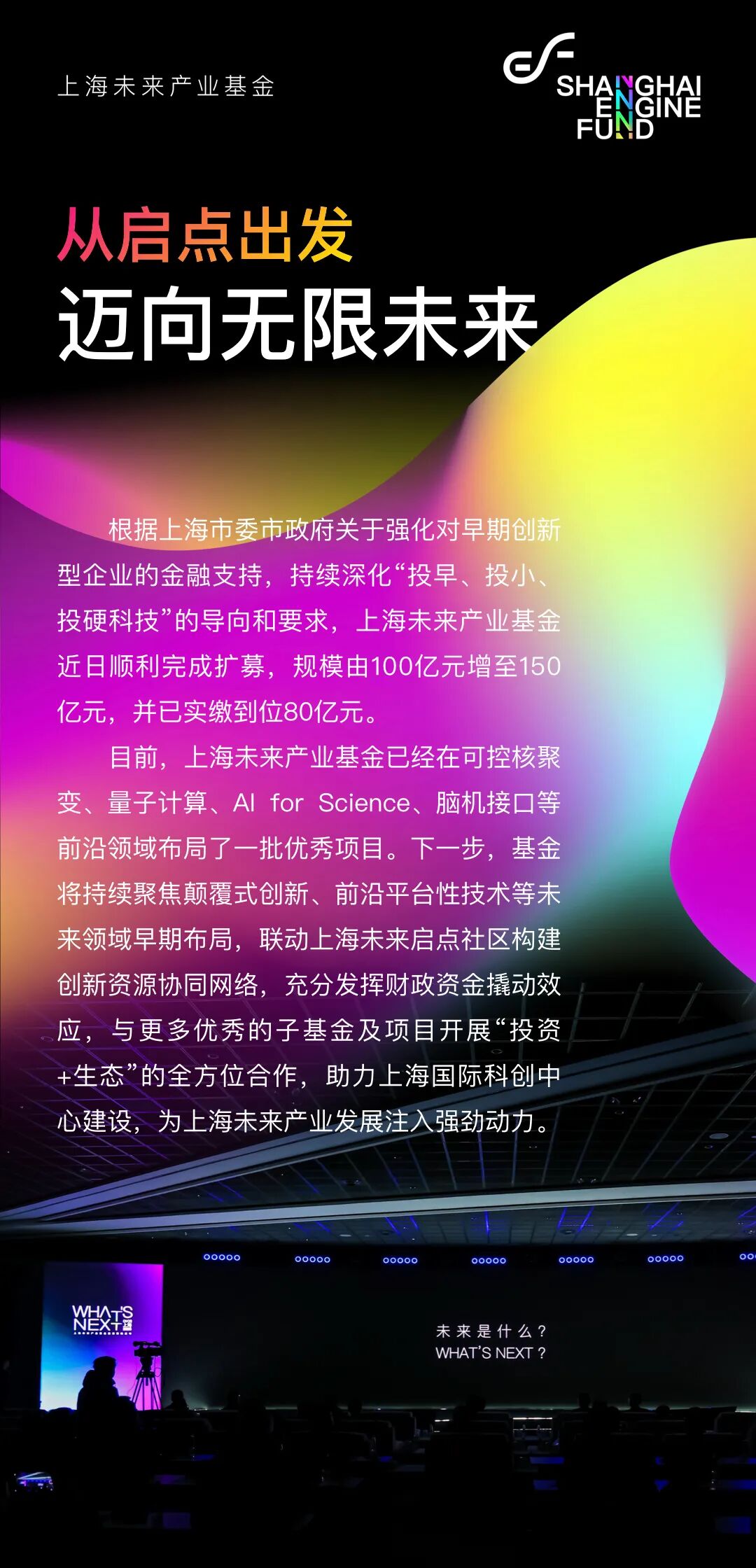
上海未来产业基金扩募至150亿元 加注颠覆式创新及前沿和早期技术投资
Zheng Quan Shi Bao Wang· 2025-09-28 05:39
Core Insights - Shanghai Future Industry Fund has successfully completed an expansion, increasing its scale from 10 billion to 15 billion yuan, with 8 billion yuan already paid in [1] - The fund has invested in cutting-edge fields such as controllable nuclear fusion, quantum computing, AI for science, and brain-computer interfaces [1] - The fund aims to focus on disruptive innovation and early-stage investments in frontier platform technologies, while collaborating with the Shanghai Future Qidian community to build an innovative resource synergy network [1] - The initiative is designed to leverage fiscal funds to stimulate investment and ecological cooperation with more excellent sub-funds and projects, contributing to the construction of Shanghai as an international science and technology innovation center [1]
双“英”恩仇:英特尔和英伟达的三十年
Jing Ji Guan Cha Wang· 2025-09-26 16:50
Core Insights - Nvidia's founder Jensen Huang announced a $5 billion investment in Intel, marking a significant collaboration between the two companies after decades of rivalry in the chip industry [1] - This partnership aims to develop the revolutionary "Intel x86 with RTX" chip, which could reshape the semiconductor landscape [1] - The historical context of Nvidia and Intel's competition highlights the evolution of the chip industry and the potential for major shifts in market dynamics [1] Historical Context - In 1992, Jensen Huang and his co-founders recognized the growing demand for graphics processing, leading to the establishment of Nvidia [2][3] - Nvidia's early struggles were contrasted with Intel's dominance in the CPU market, which held over 80% market share in the early 1990s [3] - Despite initial indifference, Intel allowed Nvidia to find its footing in the market, leading to the launch of the NV1 chip in 1995 [4] Competitive Dynamics - Nvidia's introduction of the GeForce 256 in 1999 marked its rise in the GPU market, while Intel remained focused on CPUs [5] - The relationship began to sour as Nvidia challenged Intel's chipset business with its nForce chipset in 2001, leading to legal disputes [6][8] - Nvidia's strategic shift towards collaboration with AMD and increased patent control followed its legal battles with Intel [8] Market Evolution - By 2010, Nvidia had established a stronghold in the discrete GPU market, while Intel struggled with its Larrabee project aimed at competing in the GPU space [9][10] - Nvidia's CUDA architecture revolutionized computing by enabling parallel processing, positioning it as a leader in the GPU market [12][13] - The emergence of AI in 2012 further solidified Nvidia's dominance, as its GPUs became essential for deep learning applications [16] Manufacturing Strategies - Intel's manufacturing model faced challenges with delays in its 10nm process, while Nvidia adopted a fabless model, outsourcing production to TSMC [18][19] - This strategic choice allowed Nvidia to focus on innovation and design, while Intel's manufacturing setbacks contributed to its decline [19] Current Landscape - The partnership between Nvidia and Intel represents a significant shift in the semiconductor industry, as both companies seek to adapt to changing market conditions [20][21] - However, the competitive landscape has evolved, with AMD gaining market share and specialized chips emerging as alternatives to traditional GPUs [22][23] - Geopolitical factors also play a crucial role in shaping the future of the semiconductor industry, impacting both companies' strategies [24][26] Conclusion - The collaboration between Nvidia and Intel signifies a new chapter in their long-standing rivalry, but the future remains uncertain as the industry continues to evolve [24][26]


超10亿美元打水漂,“科技狂人”马斯克为什么被AI绊倒?
3 6 Ke· 2025-09-11 08:28
Group 1 - The core point of the article is the announcement of the termination of Tesla's "Dojo Supercomputer Project," which was once considered a significant initiative in AI training but ultimately failed after five years of operation [1][3] - Elon Musk had previously expressed confidence in the project, claiming it would achieve "computing supremacy" by 2026, highlighting the abruptness of the project's closure [3][5] - The project was led by Peter Bannon, a key figure recruited from Apple, who has since left to start a new venture [1][3] Group 2 - Tesla has raised approximately $17.6 billion and generated over $60 billion in total revenue, with a peak market value of $1.3 trillion [3][5] - SpaceX, another Musk venture, has an estimated investment of $20 billion to $30 billion and is projected to generate over $10 billion in revenue from subscription services by 2025 [5][6] - Despite high revenues, both Tesla and SpaceX have faced challenges in profitability, with Tesla's net profit significantly lower than that of competitors like TSMC and BYD [5][6] Group 3 - The Dojo supercomputer was designed to train Tesla's Full Self-Driving (FSD) system, utilizing a high-performance D1 chip that offers 3 to 4 times the computing power of NVIDIA's A100 chip [20][22] - The Dojo system was intended to achieve an astonishing computing capability of 100 Exa-FLOPS, but faced significant delays and compatibility issues due to its unique architecture [20][22] - Musk's decision to halt the project reflects a strategic pivot, as he has begun procuring NVIDIA H100 chips and collaborating with TSMC and Samsung for alternative AI solutions [24][25] Group 4 - The failure of the Dojo project is attributed to high costs and a significant gap between investment and returns, compounded by Musk's expansive business ambitions [25][27] - Musk's focus on cost management has led to innovative strategies in battery production and rocket manufacturing, but the same approach has created challenges in the AI sector [27][30] - The competitive landscape in AI has intensified, with Musk acknowledging the need for alternative solutions as Tesla has shifted 70% of its training tasks back to cloud platforms like AWS and Google Cloud [41][43]


瞭望 | 凿穿未来产业“冻土层”
Xin Hua She· 2025-09-02 08:54
Core Viewpoint - The article emphasizes the need to reconstruct the technology service framework to bridge the gap between innovation and industry, addressing the challenges posed by rapid technological breakthroughs and traditional service limitations [1][4][14]. Group 1: Challenges in Future Industry Development - Future industries face three main challenges: technological ambiguity, ownership dilemmas, and capital gaps [3]. - Disruptive innovations often break traditional technological evolution paths, leading to non-linear and explosive advancements, creating a technological fog [3]. - Breakthroughs in future industries typically arise from interdisciplinary collaboration, complicating ownership determination due to fragmented contributions [3]. - Early validation of disruptive technologies requires long-term capital support, but the risk-averse nature of financial systems creates a capital gap [3]. Group 2: Reconstructing Technology Service Framework - The Shanghai Technology Exchange (STE) is redefining its role from a transaction facilitator to an ecosystem builder, focusing on risk-sharing and standard-setting [4][5]. - STE is developing a technology assessment system and industry mapping to enhance strategic planning capabilities and support the transformation of research outcomes into market applications [5][6]. Group 3: Comprehensive Mechanism for Technology Transfer - STE is establishing a comprehensive mechanism from identification to transformation, addressing the challenges of identifying and converting future industries [6]. - A precise identification system has been created, integrating policy, talent, industry, and technology maps to predict technology maturity [6][7]. - STE has pioneered a dynamic segmentation mechanism for rights confirmation based on R&D milestones, creating a complete closed-loop system for rights registration and technology maturity assessment [7][8]. Group 4: Innovation in Financial Support - STE is innovating financial models to create a value-sharing system, transitioning from simple credit support to long-term value sharing [11][12]. - The STE has facilitated 1,673 projects in the biopharmaceutical sector, with a total transaction amount of 28.839 billion yuan, demonstrating its role in enhancing financing options for innovative enterprises [11]. Group 5: Building a Vibrant Technology Service Ecosystem - STE is enhancing the infrastructure for technology factor markets, exploring new financial tools like technology asset securitization and intellectual property insurance [13]. - The STE aims to integrate China's innovation ecosystem into the global landscape, promoting collaboration in capital, incubation, policy, and technology [14].
技术构筑护城河,康师傅以颠覆式创新重塑速食行业估值逻辑
Ge Long Hui A P P· 2025-09-02 08:26
Core Viewpoint - The emergence of new consumption trends is reshaping market competition, driven by the generational shift in mainstream consumer groups, particularly urban middle-class and younger demographics who prioritize quality and experience over mere affordability [1][18]. Group 1: Industry Trends - The rapid rise of food delivery and instant retail is providing consumers with diverse quick meal solutions, prompting traditional fast food industries to accelerate transformation and innovation [1]. - The Chinese instant noodle market, with a consumption of 42.2 billion servings in 2023, shows significant growth potential compared to Japan and South Korea, indicating a shift in consumer demands towards quality and convenience [18]. Group 2: Company Innovation - Kang Shifu has launched the "Special Fresh Boiled Noodles," a groundbreaking product that utilizes a unique single-basket boiling technique, addressing the industry's core innovation pain points [2][7]. - The product achieved remarkable market performance, with over 100,000 orders within three days of launch and 140,000 orders within a week, becoming a top seller in its category on Douyin [4][12]. Group 3: Competitive Advantage - The "Special Fresh Boiled Noodles" differentiates itself through technological innovation, moving beyond traditional flavor enhancement methods to redefine the standard of deliciousness in instant noodles [7][9]. - Kang Shifu has established a new industry standard for fresh boiled noodles, creating a technical and value moat with its "5132 Fresh Boiling Standard" [9][11]. Group 4: Market Strategy - The product targets the dual consumption needs of modern young consumers who seek both convenience and high quality, effectively reshaping their perception of instant noodles [11][12]. - Kang Shifu's pricing strategy aligns with dine-in and delivery options, aiming to create new profit growth points within the instant noodle sector [12][13]. Group 5: Capital Market Implications - The successful launch of "Special Fresh Boiled Noodles" signals Kang Shifu's capability for disruptive innovation, which is crucial for long-term investment value in the capital market [12][15]. - The product's rapid sell-out serves as a catalyst for changing market perceptions, demonstrating consumer demand for high-end instant food products and reinforcing Kang Shifu's brand influence [15][17].

赛道Hyper | 荣耀Magic V系列折叠屏重塑欧洲市场
Hua Er Jie Jian Wen· 2025-08-29 07:31
Core Insights - Honor's new foldable flagship Magic V5 was launched in London, featuring the world's first on-device voice large model for efficient AI call translation, marking a new offensive in the European high-end market [1][10] - Honor is leveraging foldable screen products to establish competitiveness in the global high-end market, with a projected 377% year-on-year sales growth in the European foldable screen market in 2024, increasing its market share to 34%, second only to Samsung [2] - The success in Europe reflects not only product breakthroughs but also the strategic logic and execution capabilities of Chinese brands in the global high-tech market [4] Market Strategy - Honor's strategy in the high-end foldable screen market is based on technological innovation and differentiated design rather than price competition, directly challenging existing market structures [8] - The European high-end foldable screen market has been dominated by Samsung's Galaxy Z series, which has established a strong brand recognition and service system [6][7] - Honor's approach combines foldable screens with AI technology to create new value spaces in niche scenarios, shifting consumer focus towards innovation and experience rather than brand history or price [13] Product Features - The domestic version of Honor Magic V5 is recognized for its lightweight design and high performance, being referred to as a "PC that fits in your pocket," making AI terminals a reality [9] - The overseas version of Magic V5 features the world's first on-device voice large model, enabling offline AI call translation, enhancing cross-language communication [10][15] - The innovative features of Magic V5 cater to the extreme demands of European high-end users for portability, durability, and user experience [11] Global Expansion - Honor's strategic breakthrough in the European market is part of a broader global strategy, with significant growth in Southeast Asia and the Middle East, where smartphone shipments increased by 121% and 95% year-on-year, respectively [3][18] - The company's multi-market strategy allows for risk diversification and enhances long-term growth potential, with different regions serving distinct strategic functions [20] Brand Positioning - Honor's brand narrative has shifted from "Made in China" to "Innovation from China," emphasizing its technological advancements and unique value propositions [5][34] - The integration of foldable screens and AI capabilities not only enhances user experience but also drives hardware, software, and service innovation, forming a comprehensive competitive advantage [30][29] - Honor's marketing strategy includes leveraging social media, local KOL partnerships, and community operations to convey its brand story, enhancing international recognition [24][25] Future Outlook - As foldable screen technology matures and AI integration continues, Honor has significant expansion opportunities in the European and global high-end markets [26] - The company plans to deepen user engagement, expand experience store coverage, and continuously innovate while adjusting product offerings to meet regional market demands [27] - Honor's comprehensive strategy demonstrates that sustainable internationalization involves creating unique value through technology, user experience, and academic validation, rather than relying solely on product exports [35]

李善友教授重磅新课|为竞争建模:拆解价值网,重构创新维度
混沌学园· 2025-07-24 08:04
Core Insights - A significant statistic reveals that 63% of companies fail due to being trapped in mainstream value networks, while those choosing edge value networks have a success rate of 37% [1][5][9] - The competition among companies is not merely about products or technologies, but rather a battle between value networks [1][8] Group 1: Course Overview - The course titled "Modeling Competition: Deconstructing Value Networks and Reconstructing Innovation Dimensions" will be led by Professor Li Shanyou, focusing on a methodology developed over 10 years of research [2][30] - The course aims to provide actionable competitive modeling methodologies for decision-makers and entrepreneurs facing growth challenges [2][5] Group 2: Key Values of the Course - The course addresses the growth dilemma, emphasizing that 63% of companies fail due to their choice of value networks, rather than technological or managerial shortcomings [5][6] - It challenges the conventional understanding of competition, asserting that the real competition occurs between value networks rather than individual companies [8][9] Group 3: Value Network Competition Theory - The course will explore the concept of disruptive innovation, highlighting that disruption arises from the combination of new technologies and new markets [10][21] - It will provide insights into how companies can transition from being disrupted to actively disrupting their competitors by understanding their value network positioning [10][21] Group 4: Course Content and Methodology - The course will utilize the "One Thinking, Three Stages of Innovation" framework to help participants build competitive models and identify breakthrough points [14][15] - Participants will learn to identify key market entry points in edge markets through the lens of disruptive innovation [17][18] Group 5: Target Audience - The course is designed for various stakeholders, including corporate decision-makers, entrepreneurs, innovation managers, and those seeking cognitive upgrades [27][30] - It aims to equip participants with tools to diagnose their company's value network and develop strategies for competitive advantage [28][30]

别逼自己扮“大厂”了,真的会出事
3 6 Ke· 2025-07-21 23:26
Core Insights - The current competitive landscape among major internet companies is intense, with significant financial implications and stock price declines due to aggressive market strategies [2][3][4] - There is a growing recognition that mid-sized companies, or "mid-tier firms," are thriving by focusing on core competencies, maintaining stable cash flows, and avoiding the pitfalls of large-scale operations [1][11][18] Group 1: Major Companies' Challenges - Major companies are engaged in fierce competition, particularly in the food delivery sector, leading to substantial financial losses and stock price drops [2][4] - A notable employee resignation letter from Alibaba highlights internal issues such as strategic inconsistency and management inefficiencies, reflecting broader challenges faced by large firms [3][4] - The concept of "diseases of large companies" is discussed, emphasizing the difficulties in coordination and innovation that arise as companies grow [5][6][10] Group 2: Mid-Tier Companies' Strategies - Mid-tier companies are successfully navigating the market by concentrating on their main business areas and avoiding the distractions of chasing every trend [11][12] - For instance, Ctrip has demonstrated resilience and profitability by focusing on its core OTA business, achieving a 16% growth in Q1 2025 and maintaining a net profit margin of 31% [11][13] - Mid-tier firms are also prioritizing decision-making efficiency by simplifying organizational structures, as seen in Ctrip's shift to a matrix management model [14] Group 3: Innovation and Adaptation - Mid-tier companies are leveraging AI and other technologies to enhance existing business models rather than pursuing overly ambitious technological goals [15][16] - The approach of mid-tier firms is characterized by a focus on practical profitability and manageable growth, contrasting with the often chaotic expansion strategies of larger firms [18] - The article suggests that the future may require a balance between growth and sustainability, with mid-tier firms providing a viable alternative to the traditional "grow big" mentality [18]




别逼自己扮“大厂”了,真的会出事
混沌学园· 2025-07-21 09:48
Core Viewpoint - The article discusses the contrasting fortunes of large internet companies and smaller, more agile firms, suggesting that the latter are thriving by focusing on core competencies and maintaining strong cash flow, while large companies are struggling with internal issues and fierce competition in the market [1][5][36] Group 1: Large Companies' Challenges - The competition among major internet companies has intensified, leading to aggressive price wars and significant financial losses, with a projected total investment of 25 billion yuan in the food delivery sector by major players in Q2 alone [3][4] - Internal issues within large companies are highlighted, including employee dissatisfaction and strategic misalignment, as evidenced by a viral resignation letter from an Alibaba employee criticizing the company's management and innovation challenges [4][6] - The concept of "diseases of large companies" is introduced, indicating that as companies grow, they face coordination problems and inefficiencies that hinder their ability to innovate and adapt [8][9][10] Group 2: The Rise of Mid-Sized Companies - Mid-sized companies, defined as those between startups and large enterprises, are finding success by focusing on their core business areas rather than trying to compete directly with larger firms [20][21] - Examples of successful mid-sized companies like Ctrip demonstrate that maintaining a strong focus on core competencies and efficient cash flow management can lead to sustainable growth, with Ctrip reporting a 16% growth in Q1 2025 and a net profit of 4.3 billion yuan [21][26] - Mid-sized companies are adopting strategies that prioritize business model innovation over technological advancements, allowing them to leverage AI effectively while ensuring profitability [27][28] Group 3: Lessons for Companies - The article emphasizes that mid-sized companies are not merely smaller versions of large firms but are instead following a more pragmatic approach to business, focusing on profitability and manageable organizational structures [31][36] - Companies are advised to avoid blindly mimicking large firms' strategies and instead focus on their unique value propositions and customer needs, promoting a long-term, sustainable growth mindset [34][35] - The need for regular self-assessment is highlighted, encouraging companies to evaluate their management practices and avoid the pitfalls associated with large company dynamics [36]