
AI算力基建

Search documents
透过ASML 2025全年财报,看增长背后的结构变化
3 6 Ke· 2026-02-10 03:09
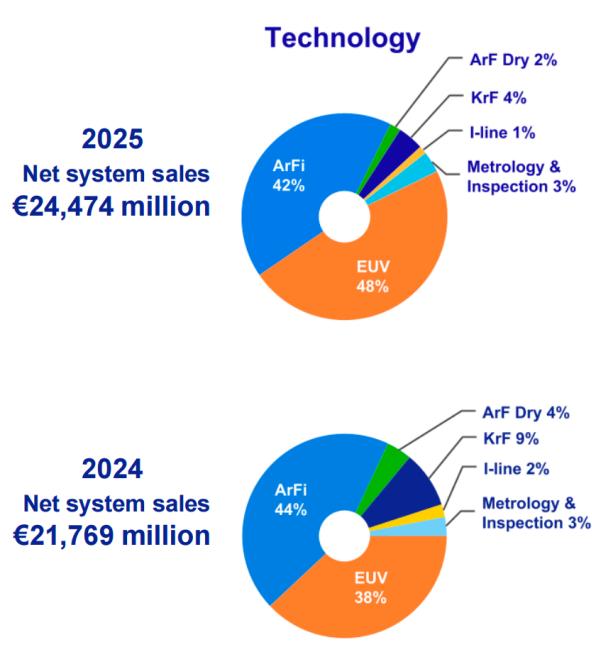
Core Viewpoint - The semiconductor industry is transitioning from a traditional cycle dominated by mobile and PC devices to a multi-driven evolution represented by "AI computing infrastructure" as of early 2026. The demand for logic chips and HBM (High Bandwidth Memory) in data centers is surging due to the explosion of generative AI applications in 2025, driving a new wave of investment in advanced processes and mature processes alike [1]. Group 1: ASML's Financial Performance - In 2025, ASML achieved a net sales of approximately €32.7 billion, a gross margin of about 52.8%, and a net profit of around €9.6 billion, marking a record-breaking performance [2]. - ASML's order backlog reached approximately €38.8 billion by the end of 2025, providing high visibility for revenue growth in 2026 and beyond [2]. - The sales of ASML's EUV (Extreme Ultraviolet) systems reached €11.6 billion in 2025, a year-on-year increase of 39%, with EUV accounting for 48% of the company's system revenue [2]. Group 2: Equipment Types and Market Dynamics - EUV's share in revenue structure is increasing, while DUV (Deep Ultraviolet) remains a core device in semiconductor manufacturing, fulfilling the majority of lithography tasks [4]. - ASML emphasizes that DUV lithography machines will continue to play a crucial role in the industry, with high-end DUV systems evolving to meet advanced process requirements [4]. - DUV's application is expanding from "front-end wafer manufacturing" to "advanced packaging and 3D integration," indicating a dual-track growth structure supported by both EUV and DUV technologies [5]. Group 3: Demand Drivers in China - ASML's net system sales in China accounted for 33% of total sales in 2025, demonstrating strong resilience and demand in the Chinese market despite export control concerns [6]. - The growth in demand for DUV equipment in China is driven by the expansion of mature processes (28nm and above) in automotive electronics, industrial automation, IoT, and home appliance chips [6]. - AI's demand is creating a "spillover effect," with significant needs for supporting chips produced mainly by DUV processes, further driving orders for DUV equipment [7]. Group 4: Advanced Packaging and System Performance - The acceleration of 2.5D/3D packaging line construction in Chinese foundries is enhancing system-level performance, aligning with ASML's investments in advanced packaging equipment [8]. - ASML expects its revenue share from China to stabilize around 20% in 2026, reflecting a return to "normalization" rather than a decline in demand [8]. Group 5: ASML's Strategic Transformation - ASML is transitioning from a "cyclical equipment vendor" to a "structural platform company," providing comprehensive solutions around lithography [9]. - The revenue from installed base services reached approximately €8.2 billion in 2025, indicating a shift towards a balanced revenue structure that includes lifecycle services [10]. - ASML's ambition to reach €60 billion in revenue by 2030 is supported by the increasing demand for AI-related infrastructure and services [13]. Group 6: Stock Buyback and Future Outlook - ASML announced a stock buyback plan of up to €12 billion, reflecting management's confidence in future cash flow strength while continuing significant R&D investments [14]. - The company is positioned as an essential infrastructure platform in the digital civilization landscape, providing "manufacturing certainty" beyond merely selling lithography machines [16].


透过ASML 2025全年财报,看增长背后的结构变化
半导体行业观察· 2026-02-10 01:14
Core Viewpoint - The semiconductor industry is transitioning from a traditional cycle dominated by mobile and PC devices to a multi-driven evolution represented by "AI computing infrastructure" as of early 2026 [1] Group 1: ASML's Financial Performance - In 2025, ASML achieved a record net sales of approximately €32.7 billion, a gross margin of about 52.8%, and a net profit of around €9.6 billion [4] - ASML's order backlog reached approximately €38.8 billion by the end of 2025, providing high visibility for revenue growth in 2026 and beyond [4] - The sales of ASML's EUV systems reached €11.6 billion in 2025, a year-on-year increase of 39%, with EUV accounting for 48% of the company's system revenue [4] Group 2: Equipment Demand Dynamics - EUV systems are becoming the core production tool for advanced processes, while DUV systems remain essential in the semiconductor manufacturing ecosystem [7] - DUV systems are expected to continue playing a major role in the industry, with significant demand for high-end DUV systems like the latest ArF immersion lithography machine [7][8] - DUV applications are expanding from "front-end wafer manufacturing" to "advanced packaging and 3D integration," indicating a dual-track growth structure for ASML [8] Group 3: Market Resilience in China - ASML's net system sales in the Chinese market accounted for 33% of total sales in 2025, exceeding previous expectations [9] - The strong demand in China is driven by the growth of mature processes (28nm and above) and the urgent need for domestic chip production [10] - AI's demand is creating a "spillover effect," with many supporting chips produced using DUV processes, further driving ASML's orders [11] Group 4: Advanced Packaging and System Performance - The acceleration of 2.5D/3D packaging production lines in China is enhancing system-level performance, aligning with ASML's investments in advanced packaging equipment [12] - ASML expects its revenue share from China to stabilize around 20% in 2026, reflecting a return to "normalization" rather than a decline in demand [12] Group 5: Transition to a Platform Company - ASML is evolving from a "cyclical equipment vendor" to a "structural platform company," providing comprehensive solutions around lithography [14] - The company's measurement and inspection systems saw a 28% year-on-year increase in sales, indicating a shift towards a balanced revenue structure [15] - ASML's installed base revenue reached approximately €8.2 billion in 2025, becoming the second-largest revenue source after system sales [15] Group 6: Future Growth Projections - ASML projects net sales for 2026 to be between €34 billion and €39 billion, with a gross margin maintained at 51%-53% [18] - The company aims to reach total revenues of €44 billion to €60 billion by 2030, with AI as a key driver of future growth [18] - A significant stock buyback plan of up to €12 billion has been announced, reflecting management's confidence in future cash flow [19]
国泰海通|有色:关注企稳后的布局机会
国泰海通证券研究· 2026-02-09 13:58
Group 1: Precious Metals - The core viewpoint emphasizes the importance of macroeconomic factors on metal prices, particularly in a tight supply-demand balance, with monetary policy, macro expectations, geopolitical dynamics, and supply disruptions being critical influences [1] - Recent adjustments in precious metal prices are attributed to a decline in risk appetite, influenced by disappointing earnings reports from US tech stocks and expectations of a strong dollar and Federal Reserve's balance sheet reduction [1] - China's central bank continued gold purchases in January, and the increase in gold ETF holdings will support gold prices [1] Group 2: Copper - Ongoing macroeconomic pressures are impacting copper prices, with expectations of strategic reserves providing some support [2] - The establishment of a "copper concentrate strategic reserve" aims to enhance resource control and mitigate overseas supply disruptions, while AI-driven infrastructure demands are expected to support copper prices [2] - Despite macroeconomic pressures, copper prices are anticipated to stabilize due to strategic premium support [2] Group 3: Aluminum - Aluminum prices are under pressure due to a combination of macroeconomic factors and seasonal demand weakness, with a decline in processing rates observed [2] - The ISM services PMI in the US returned to expansion, but lower-than-expected ADP employment figures contributed to price fluctuations [2] - Social inventory trends indicate a continued accumulation during the off-season [2] Group 4: Tin - Tin prices are experiencing downward pressure due to macroeconomic factors and reduced funding, but there is resilience in downstream purchasing as prices decline [2] - Increased activity in the Indonesian tin market and supply recovery in Myanmar may lead to marginally looser supply conditions [2] Group 5: Energy Metals - Demand for lithium remains strong despite a four-week inventory reduction, with expectations of preemptive battery demand due to changes in export tax policies [3] - The cobalt sector faces high prices due to tight raw material supplies, while companies are extending their reach into downstream markets to enhance competitive advantages [3] - Rare earth prices, particularly for praseodymium and neodymium oxides, are rising due to tight supply-demand dynamics [3] Group 6: Strategic Metals - Tungsten prices are on the rise due to long-term contracts and supply-demand dynamics, with a notable increase in prices across the industry [3] - The uranium market is seeing long-term contract prices reach a ten-year high, driven by rigid supply and ongoing nuclear power development [3]

国泰海通:关注企稳后的有色金属布局机会
智通财经网· 2026-02-09 06:20
Group 1: Precious Metals - The decline in market risk appetite has led to adjustments in precious metal prices, with gold supported by continued purchases from the People's Bank of China and rising ETF holdings [2] - Silver prices are influenced by stable leasing rates and a rapid decline in U.S. silver inventories [2] Group 2: Copper - The expectation of strategic reserves for copper provides support despite macroeconomic pressures, with a focus on upstream resources to counter overseas supply disruptions [3] - The demand for copper is driven by AI computing infrastructure and grid modernization, indicating strong resilience in pricing [3] Group 3: Aluminum - Aluminum prices are under pressure due to seasonal demand weakness, with a decline in processing rates and an increase in social inventory [4] - The macroeconomic environment shows mixed signals, with the ISM services PMI returning to expansion but ADP employment figures falling short of expectations [4] Group 4: Tin - Tin prices are under downward pressure due to overseas macroeconomic factors and reduced funding, but there is increased purchasing interest from downstream sectors as prices decline [5] - The supply side may see marginal easing with increased activity in Indonesian tin transactions and the resumption of production in Myanmar [5] Group 5: Energy Metals - Lithium demand remains strong despite a four-week inventory reduction, with expectations of preemptive battery demand due to changes in export tax policies [6] - Cobalt prices are high due to tight upstream raw material supply, while companies are extending their reach into electric new energy sectors to enhance competitive advantages [6] Group 6: Rare Earths - The supply-demand balance for light rare earths remains tight, with prices continuing to rise due to pre-holiday stocking needs [7] - The investment value of rare earths as a strategic resource is highlighted, with specific companies recommended for investment [7] Group 7: Strategic Metals - Tungsten prices are experiencing a systematic increase driven by supply-demand dynamics, with significant price hikes reported by leading companies [8] - The market for uranium is expected to continue rising due to persistent supply-demand gaps and the development of nuclear power [9]

有色金属:关注企稳后的布局机会
GUOTAI HAITONG SECURITIES· 2026-02-09 05:15
Investment Rating - The report assigns an "Overweight" rating for the non-ferrous metals industry [4] Core Insights - The report emphasizes the importance of macroeconomic factors such as monetary policy, macro expectations, geopolitical dynamics, and supply disruptions in influencing metal price trends [2] - The report highlights the need to focus on investment opportunities following stabilization in the market [8] Summary by Sections 1. Industry and Stock Performance - The non-ferrous metals sector experienced a decline of 8.51% last week, underperforming major indices [14][16] 2. Metal Prices and Inventory - Copper prices decreased by 3.45% to 100,100 CNY/ton, while aluminum prices fell by 5.07% to 23,315 CNY/ton [24] - SHFE gold prices dropped by 8.92% to 1,090.12 CNY/gram, while COMEX gold rose by 5.13% to 4,988.60 USD/ounce [26] - SHFE silver prices decreased by 37.17% to 18,799 CNY/kg, with COMEX silver down by 1.28% to 77.53 USD/ounce [26] 3. Macro Data Tracking - The report tracks key macroeconomic indicators, including the U.S. CPI and PCE, which show a year-on-year increase of 2.7% and 2.79%, respectively [29][30] - China's CPI and PPI for December were reported at 0.8% and -1.9%, respectively [30] 4. Precious Metals: Low Inventory Disturbances - The report notes that low inventory levels continue to disrupt precious metal prices, with significant fluctuations observed in both gold and silver markets [52][53] 5. Copper: Price Fluctuations - The report indicates that copper prices are expected to fluctuate, with supply-side adjustments and demand dynamics playing crucial roles [65][72] 6. Aluminum: Price Adjustments - Aluminum prices are under pressure due to macroeconomic sentiment and seasonal demand fluctuations, with a noted decrease in processing rates [10][80] 7. Energy Metals: Strong Demand - The report highlights robust demand for energy metals, particularly lithium, despite some price pressures due to macroeconomic factors [89][92] 8. Rare Earths: Price Trends - Prices for rare earth elements, particularly praseodymium and neodymium oxides, continue to rise, supported by tight supply conditions [11]





科创芯片强势反弹,芯原股份一度涨超10%,科创芯片ETF汇添富(588750)涨超2%!存储芯片巨头重构合约规则,“超级周期”持续演绎
Xin Lang Cai Jing· 2026-02-09 02:24
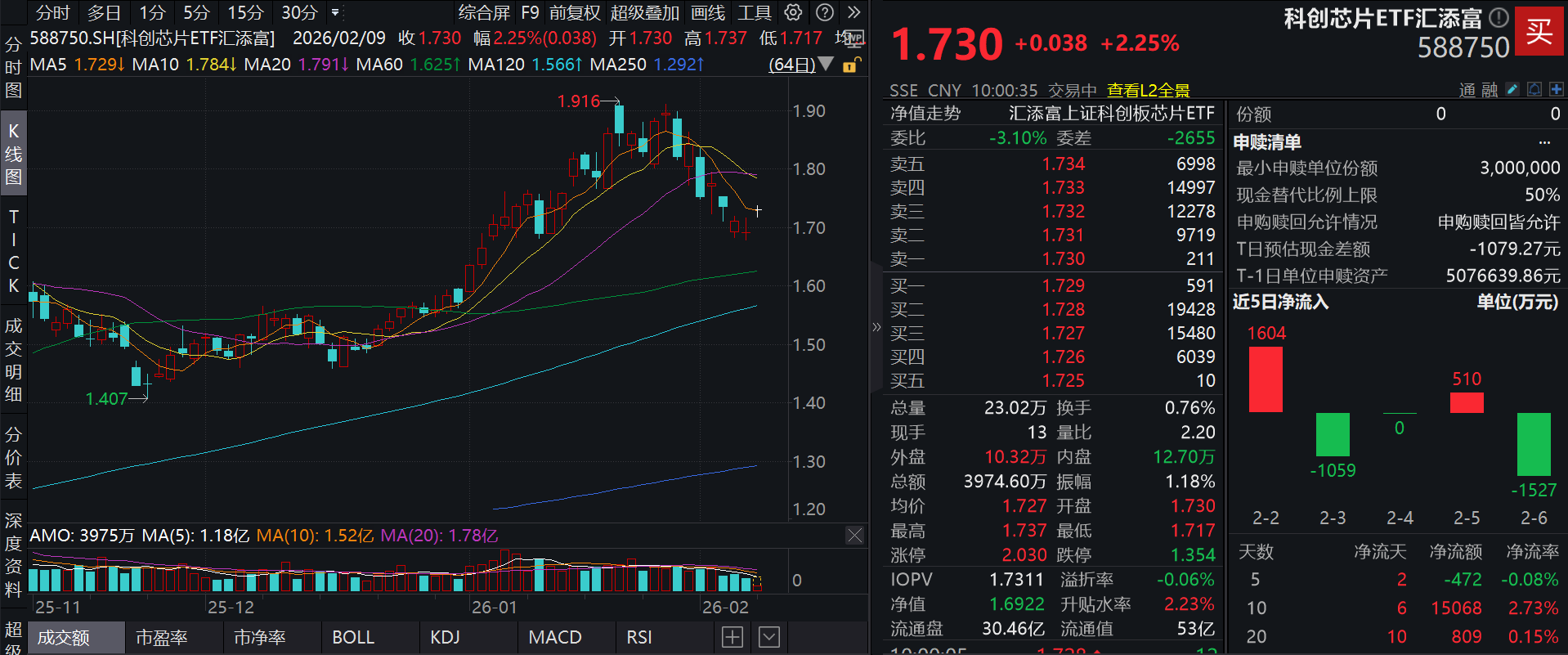
Core Viewpoint - The semiconductor sector, particularly the Sci-Tech Innovation Board chip index, is experiencing significant growth, driven by strong demand for AI infrastructure and a shift in contract frameworks among major memory chip manufacturers [4][5]. Group 1: Market Performance - As of February 9, 2026, the Sci-Tech Innovation Board chip index (000685) rose by 2.19%, with notable gains from component stocks such as Xinyuan Co. (up 9.11%) and Zhongchuan Special Gas (up 6.19%) [1]. - The Huatai-PineBridge Sci-Tech Chip ETF (588750) increased by 2.25%, reaching a latest price of 1.73 yuan, and has seen a cumulative rise of 6.42% over the past three months [1]. - The ETF's trading volume showed a turnover rate of 0.76%, with a total transaction value of 39.74 million yuan [1]. Group 2: Fund Size and Flow - The latest size of the Huatai-PineBridge Sci-Tech Chip ETF reached 5.155 billion yuan, ranking 2nd among comparable funds [3]. - Over the past six months, the ETF's shares increased by 1.422 billion shares, marking significant growth and ranking 2nd among comparable funds [3]. - The ETF experienced a net outflow of 15.2731 million yuan recently, but in the last 10 trading days, there were net inflows on 6 days, totaling 151 million yuan [3]. Group 3: Industry Trends - Major memory chip manufacturers like Samsung, SK Hynix, and Micron are transitioning to short-term contracts with a price adjustment mechanism, reflecting a shift in market power towards suppliers [4]. - The Semiconductor Industry Association (SIA) projects total industry sales to reach $791.7 billion in 2025, with a 26% growth expected in 2026, indicating a rapid approach to the $1 trillion milestone [4]. - Tech giants such as Google and Amazon are significantly increasing their capital expenditures for AI infrastructure, with projections of $175-185 billion and $200 billion respectively for 2026, nearly doubling year-on-year [4]. Group 4: Investment Opportunities - The Sci-Tech Chip sector is positioned to benefit from both AI demand and domestic substitution trends, suggesting a favorable environment for index-based investments [5]. - The Sci-Tech Chip ETF focuses on the core segments of the semiconductor industry, with a high concentration in advanced upstream and midstream sectors, achieving a 96% representation [6]. - The index has shown a net profit growth rate of 94% for the first three quarters of 2025, significantly outperforming peers, with an expected annual growth rate of 97% [8].

中资矿业密集并购扩版图 紫金55亿加元刷新单笔纪录 洛阳钼业40天完成巴西三座金矿交割
Jin Rong Jie· 2026-02-04 23:45
Group 1 - The global mining merger and acquisition activity is increasing, with Chinese mining companies notably expanding their presence through acquisitions of quality non-ferrous mineral resources [1] - Luoyang Molybdenum has made two significant acquisitions in gold assets within eight months, including the purchase of Lumina Gold and a 100% stake in three Brazilian gold mines from Equinox Gold Corp, adding a total of 501.3 million ounces of gold resources [1] - Zijin Mining announced a record acquisition of Canadian United Gold for CAD 5.5 billion, while Shengda Resources completed a cash acquisition of a 60% stake in Yichun Jinshi Mining for CNY 500 million [1] Group 2 - Non-ferrous mineral prices are at high levels, driving record profits for leading mining companies; Luoyang Molybdenum expects a net profit of CNY 20 billion to CNY 20.8 billion for 2025, a year-on-year increase of 47.8% to 53.7% [2] - Zijin Mining anticipates a net profit of CNY 51 billion to CNY 52 billion for the same period, with a year-on-year growth of 59% to 62%, benefiting from rising prices and production volumes of core mineral products [2] - The global mining industry is consolidating, with Rio Tinto and Glencore in preliminary talks to create the largest mining company to expand copper production, and Anglo American and Teck Resources initiating a merger to rank among the top five copper mining companies [2]


小金属回调整理,稀有金属ETF(562800)聚焦板块投资机遇,资金关注度不减
Xin Lang Cai Jing· 2026-01-30 03:18
Core Viewpoint - The rare metals sector is experiencing a correction, with the China Rare Metals Theme Index dropping by 8.85% as of January 30, 2026, driven by global inflation expectations and geopolitical tensions that enhance the monetary and security attributes of rare metals [1]. Group 1: Market Performance - The three major A-share indices opened lower, with significant declines in rare metals, particularly led by Zhongke Magnetic and other companies like Zhuhai Group and Xiyang Co. [1]. - The top ten weighted stocks in the China Rare Metals Theme Index account for 59.54%, including companies like Luoyang Molybdenum, Northern Rare Earth, and Ganfeng Lithium [1]. Group 2: Supply and Demand Dynamics - The supply side is constrained by resource limitations and tightening policy regulations, while the demand side benefits from the synergy of new energy, high-end manufacturing, and strategic security needs [1]. - Structural demand driven by AI computing infrastructure, grid upgrades, and solid-state battery industrialization is expected to elevate the price center of various rare metals, transitioning them from cyclical commodities to strategic assets [1]. Group 3: Investment Tools - The rare metals ETF (562800) tracks the China Rare Metals Theme Index, providing a convenient tool for investors looking to gain exposure to the rare metals sector [1]. - Investors can also consider the rare metals ETF linked fund (014111) to explore investment opportunities in the rare metals sector [2].
四大证券报头版头条内容精华摘要_2026年1月30日_财经新闻
Xin Lang Cai Jing· 2026-01-29 23:09
Group 1 - The State Council of China has issued a work plan to accelerate the cultivation of new growth points in service consumption, which includes optimizing loan interest subsidy policies for service industry entities and encouraging financial institutions to increase credit support for these sectors [1][5] - The work plan outlines 12 specific measures aimed at stimulating development in key areas such as transportation, housekeeping, and the automotive aftermarket, thereby reducing uncertainties for enterprises entering and expanding in the service consumption market [5][22] Group 2 - The Ministry of Civil Affairs is exploring the establishment of a civil affairs technology innovation fund through investment financing and charitable donations to support the research and industrialization of suitable technology products [2][18] - The goal is to enhance the innovation system by 2030, increase technological investment, and improve innovation levels, ultimately leading to breakthroughs in key technologies and the emergence of leading talents and enterprises in civil affairs technology [2][18] Group 3 - There is a significant performance divergence among funds labeled as "cyclical," with some funds focusing heavily on the non-ferrous sector for maximum elasticity, while others adopt a diversified approach across multiple cyclical areas for varied returns [3][19] - This divergence raises questions about fund positioning and the active management capabilities of fund managers, with market expectations influencing single-strategy approaches [19] Group 4 - Major central banks, including the Federal Reserve, have opted to maintain current interest rates, indicating a slowdown in the pace of global interest rate cuts, which could have significant implications for global asset allocation [4][21] - The Federal Reserve's decision to keep the federal funds rate unchanged at 3.5% to 3.75% reflects internal divisions, with some members advocating for a rate cut, highlighting the challenges of maintaining independence amid political pressures [6][23] Group 5 - The demand for optical fiber in the telecommunications industry is surging due to the construction of AI data centers, with Meta committing to pay $6 billion for fiber optics from Corning by 2030 [7][24] - The rapid growth of AI applications is expected to drive higher bandwidth requirements, influencing the demand trajectory for optical fiber and related industries [24] Group 6 - The REITs market is witnessing innovation with the launch of mixed-asset REITs, as demonstrated by the recent expansion of the Zhonghang Jingneng photovoltaic REIT, which combines hydropower and solar assets [8][25] - This development marks a significant step in diversifying public REITs and revitalizing dormant assets [25] Group 7 - The Ministry of Industry and Information Technology is addressing "involution" in the photovoltaic industry by promoting coordinated efforts to regulate competition and enhance industry standards [9][26][27] - The focus is on using market-oriented and legal methods to foster healthy competition and rational development within the photovoltaic sector [27] Group 8 - The consumer electronics industry is facing a cost defense battle due to skyrocketing storage prices, with major companies like Samsung and SK Hynix raising NAND flash supply contract prices by over 100% [10][28] - The ongoing supply tightness in DRAM is also contributing to rising prices, impacting the overall cost structure of consumer electronics [28] Group 9 - The Norwegian Government Pension Fund Global reported a 15.1% return in 2025, with its total assets reaching approximately 15.47 trillion RMB, highlighting the fund's robust performance [11][29] - This fund is one of the largest sovereign wealth funds globally, indicating strong investment management capabilities [29] Group 10 - China is planning to expand its "space+" future industries, focusing on commercial space applications and infrastructure development, which includes initiatives in space resource management and space tourism [12][30] - The China Aerospace Science and Technology Corporation is leading these efforts, aiming to foster collaboration across the industry chain [30] Group 11 - The China Commercial Rocket Corporation is preparing for the first flights of reusable rockets this year, emphasizing the importance of resource coordination and successful recovery operations [13][31] - This initiative is part of a broader strategy to enhance China's capabilities in commercial spaceflight [31] Group 12 - The AI industry is experiencing a surge in new model releases, with major companies like Tencent and Baidu competing for application traffic through significant promotional efforts [14][32] - The release of advanced AI models, such as Alibaba's Qwen3-Max-Thinking, reflects the rapid evolution and competitive landscape of the AI sector [32] Group 13 - The chemical sector is gaining attention in the A-share market, with chemical ETFs seeing significant growth in their share volumes as the sector aligns with cyclical market trends [15][33] - The recovery of profitability in the chemical industry is enhancing its appeal for investment, particularly in the context of "anti-involution" strategies [33] Group 14 - Several banks have adjusted the margin requirements for personal clients trading in Shanghai Gold Exchange's deferred contracts, increasing the margin ratio from 44% to 60% for specific gold and silver contracts [16][34] - This adjustment reflects changing market conditions and regulatory responses within the financial sector [34]
AI算力基建需求旺盛 光纤行业有望迎新周期
Shang Hai Zheng Quan Bao· 2026-01-29 18:40
Group 1 - Meta will pay Corning $6 billion by 2030 for fiber optic cables used in AI data centers, highlighting the surge in demand for fiber optics due to overseas AI data center construction [1] - The demand for fiber optic cables is strong in overseas markets, particularly in Southeast Asia, while domestic demand is currently less significant [2] - The average weighted price for fiber optic cable in a recent tender by China Mobile was 53.85 yuan per core kilometer, a decrease of 26.2% from the previous tender, with an implied fiber price of approximately 18.85 yuan per core kilometer, down 35.4% from the previous year [2] Group 2 - The traditional fiber optic supply may shrink due to manufacturers shifting production capacity towards AI-related multimode and specialty fibers, potentially leading to price increases for traditional fiber cables by 2026 [3] - The specialty fiber business is expected to experience explosive growth driven by the AI computing wave, benefiting companies with a comprehensive layout in the fiber optic cable industry [3] - The global digital economy and intelligent computing demand are driving the entire industry chain towards efficiency, sustainability, and intelligence, with companies like Jinpan Technology expanding their product offerings in the AIDC sector [5] Group 3 - Industrial Fulian reported strong customer demand for AI computing, with cloud service providers expected to increase capital expenditures, leading to a projected 40% annual growth in total capital spending, surpassing $600 billion by 2026 [6]