
低利率环境

Search documents
低利率环境下保险业突围
Zheng Quan Ri Bao· 2025-08-08 07:24
Core Viewpoint - The introduction of insurance products with a predetermined interest rate of 1.5% reflects a historical low, driven by a dynamic adjustment mechanism linking predetermined rates to market rates, impacting both consumers and insurance companies [1][2]. Liability Side Transformation - Some insurance companies have launched participating insurance products with a predetermined interest rate of 1.5%, which is below the regulatory upper limit, indicating a trend of rising product prices or declining yields for consumers [2]. - The decline in interest rates presents both opportunities and challenges for insurance companies, allowing them to reduce new policy liability costs while potentially compressing profit margins due to lower investment returns [2][3]. - Insurance companies are actively transforming their liability side by promoting floating yield products and enhancing the comprehensive value of policies through improved services and expanded coverage [2][3]. Investment Strategy - The insurance industry is increasingly focusing on equity investments as a response to the new interest rate environment, with regulatory support facilitating higher equity asset investment ratios [4][5]. - Insurance companies are optimizing their asset allocation by increasing long-term bond investments and enhancing their equity investment strategies to secure stable long-term returns [5][6]. - The trend shows a significant increase in equity investments, with insurance firms actively investing in high-dividend assets and new sectors like renewable energy and AI [6]. Balancing "Three Differences" - The industry aims for sustainable development through regulatory support and continuous innovation, focusing on balancing mortality, expense, and interest differences [7][8]. - Recommendations include optimizing reserve discount rates to reflect actual market interest rates and enhancing risk management to support the balance of asset and liability management [7][8]. - Insurance companies are encouraged to develop more protection-oriented products and dynamically manage predetermined interest rates while exploring new investment opportunities [8].
热门基现发行小高峰!这些创新指数也来了
Zheng Quan Shi Bao· 2025-08-08 07:17
Core Insights - The recent surge in the issuance of the CSI A500 index funds has shifted from large public funds to small and medium-sized public funds, with over 75 fund companies participating since Q4 2024 [1][4][3] - The total number of CSI A500 index funds has reached 113, with a total issuance scale of approximately 216.56 billion yuan, and the current scale is about 296.48 billion yuan [4][5] - New strategy indices related to the CSI A500, such as "dividend" and "quality" indices, have been developed, indicating a diversification in fund company strategies [1][6] Fund Issuance Details - As of June 12, there are 9 CSI A500 index-related funds currently being issued, with notable funds from CITIC Jiantou and Guolian An [2][3] - The issuance period for these funds varies, with some starting as early as late May and others beginning in June [2][3] Market Trends - The average unit net value of the 113 CSI A500 index funds is 0.997 yuan, with an average return rate of -0.23% since inception, indicating a significant number of funds are below the 1 yuan mark [5][6] - The market remains optimistic about the CSI A500 index funds, with expectations for new fund products tracking the newly developed indices [6][7] Economic Context - The low interest rate environment is making dividends from listed companies more attractive, potentially increasing stock valuations [7] - Despite some short-term performance declines, overall corporate profits have shown a growth trend, with a year-on-year increase of approximately 3% in Q1 [7]
中泰资管天团 | 蔡凤仪:低利率环境下对利率债投资的再思考
中泰证券资管· 2025-08-07 11:32
Core Viewpoint - The "anti-involution" policy has led to a stronger risk appetite in the equity market and a rapid increase in commodity prices, resulting in rising inflation expectations. This, combined with the US-China tariff disputes and concerns over potential incremental policies from the political bureau meeting at the end of July, has created multiple headwinds for the bond market, particularly long-term interest rate bonds, which have seen rising yields and falling prices, causing significant net value drawdowns in bond funds [1][2]. Summary by Sections Market Conditions - The manufacturing Purchasing Managers' Index (PMI) for July was 49.3%, a decrease of 0.4 percentage points from the previous month, indicating a decline in manufacturing sentiment, suggesting that the fundamentals have not yet shown signs of reversal [1]. Bond Market Analysis - Since the "anti-involution" policy began, the yield on 10-year government bonds has risen from 1.66% to 1.75%, a nearly 10 basis point increase. This adjustment reflects the current market's pricing of strong expectations and the likelihood of no interest rate cuts in the third quarter [2][4]. - The central bank's provision of liquidity has acted as a stabilizer, indicating that the monetary policy stance remains unchanged, which enhances the value of carry trades in the bond market [2]. Investment Strategy - Traditional analytical frameworks remain effective, with the fundamental conditions still determining the long-term direction of the bond market. The monetary policy report from the previous quarter sets the tone for the upcoming quarter, indicating that the bond market lacks a basis for a turnaround [4]. - Identifying key yield anchors for bonds, such as the 10-year government bond yield, is crucial. The difference between the 10-year yield and the DR007 has reached a high of 28 basis points, suggesting a solid safety margin for the current yield [5]. Long-term Outlook - The overall trend for yield is downward, but the rate of decline is expected to slow, with increasing competition in the long-term interest rate bond market. Fund managers should focus on enhancing their predictive and responsive capabilities amid narrow fluctuations to increase returns through tactical trading [8].


理财“保本时代”落幕:券商如何重塑普通人的财富逻辑?
Zheng Quan Ri Bao Wang· 2025-08-07 09:47
Core Insights - The article highlights the shift in wealth management strategies among investors, moving away from traditional bank products to more diversified and flexible solutions offered by securities firms [1][5][6] Group 1: Market Context - Investors are increasingly frustrated with low returns from traditional bank wealth management products, leading to a search for higher-yield alternatives [1] - The domestic low-interest-rate environment is becoming the norm, creating challenges for traditional financial products [2] Group 2: Product Offerings - Ping An Securities has introduced differentiated wealth management solutions tailored to various risk appetites, including low-risk options like government bond repurchase agreements and short-term debt fund combinations [2] - For clients with moderate risk tolerance, Ping An Securities offers a mix of bond funds, high-dividend stocks, REITs, and convertible bonds, aiming for returns that outpace inflation [2][3] - High-net-worth clients are provided with customized solutions, such as the "Ping An 30" stable main account [2] Group 3: Technology and Service Innovation - Ping An Securities leverages technology to enhance stock trading experiences, integrating customer behavior data to create comprehensive client profiles and optimize service delivery [4] - The firm has developed tools for real-time risk monitoring and automated trading strategies, addressing common investor pain points [4] - The introduction of a "core holding + satellite strategy" combines core assets with options for risk protection, enhancing investor confidence [4] Group 4: Strategic Transformation - The role of securities firms is evolving from mere trading platforms to comprehensive wealth management experts, focusing on long-term client relationships [5][6] - Ping An Securities emphasizes a four-dimensional service system that includes efficiency, warmth, value, and consistency, aiming to provide a holistic wealth management experience [5] - The firm aims to accompany clients throughout their investment lifecycle, offering continuous support and tailored advice [6]
瑞士再保险:中国寿险与健康险市场将迎来三大机遇
Zheng Quan Ri Bao Wang· 2025-08-06 08:50
Group 1 - The Chinese life and health insurance market is expected to experience three major opportunities due to demographic changes, healthcare reforms, and increased openness in the medical field [2][3] - The aging population and the rise of the "silver economy" will drive demand for retirement financial services, including risk protection, commercial pension insurance, and long-term care insurance [2] - Healthcare reforms are creating space for innovation in health insurance, such as the introduction of commercial health insurance for new drugs and special treatments, and promoting data sharing between basic medical insurance and commercial health insurance [2] Group 2 - The low interest rate environment poses challenges for the insurance industry, particularly affecting savings-type insurance products [3] - Insurance companies are responding to the low interest rate environment by lowering guaranteed interest rates on life insurance products and promoting dividend-type products [3] - Regulatory bodies are encouraging life insurance companies to increase equity asset allocation to mitigate risks associated with interest rate differentials [3]

今天确实有三个很重要的新闻
表舅是养基大户· 2025-08-05 13:28
Market Overview - The market experienced a rally, with the Shanghai Composite Index rising nearly 1%, reaching a new closing high for the year, driven by strong performance in the banking sector [3][13] - The stock of Upwind X Material surged over 1300% since July, indicating a heated market environment, leading to regulatory measures from the Shanghai Stock Exchange to suspend trading for some investors [2][3] Key News Summaries Free Preschool Education Policy - The State Council issued an opinion on gradually implementing free preschool education, starting with public kindergartens for the final year before primary school, which could later extend to younger classes [5][7] - The policy aims to alleviate financial burdens on families and ensure timely payment of teachers' salaries by including them in the fiscal budget [7][8] - This initiative is viewed as a counter-cyclical adjustment rather than a direct stimulus for birth rates, reflecting the challenges of reversing demographic trends [9] Financial Support for New Industrialization - The central bank and seven ministries released guidelines to stimulate credit demand for manufacturing and other sectors, addressing the current lack of quality credit assets in the banking system [13][15] - The guidelines emphasize a combination of fiscal subsidies and monetary policy tools to support financing needs, particularly for small and medium-sized enterprises [19] - The policy aims to create demand for loans by making borrowing more attractive through interest rate subsidies [18][19] Local Government Debt Management - Recent reports highlighted the government's commitment to addressing hidden local government debt, with a focus on preventing further accumulation of such liabilities [20][22] - The government is taking a strong stance against the previous practices of local governments that led to excessive debt, indicating a shift towards more sustainable fiscal management [23][24] - The ongoing reforms suggest that fiscal policies will remain structurally focused, with potential reintroduction of previously exempt taxes to balance expenditures and revenues [26] Conclusions - The current demographic cycle suggests a prolonged low-interest rate environment, which should be a central theme for investment strategies [26] - The need for market-driven financing alternatives to replace real estate and local government financing is critical, especially under current global economic conditions [26] - Fiscal policies will likely remain tight, with a focus on structural reforms and potential reintroduction of taxes to ensure fiscal sustainability [26]

王小龙:净息差收窄的原因分析与中小银行应对思考
Xin Lang Cai Jing· 2025-08-04 02:52
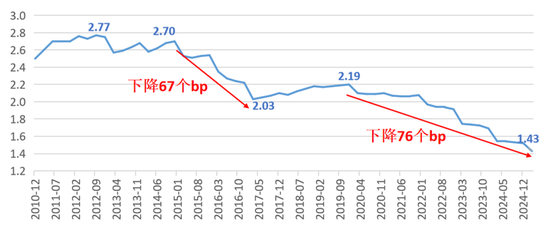
意见领袖 |王小龙 从长周期看,我国银行业净息差经历了两轮下降,分别是2015-2017年一季度和2019年至今,这两个时 间节点值得深入研究。 信贷需求减弱有深层次背景,包括人口红利和人口总数见顶等因素,需求减弱呈现从个人贷款到小企业 再到大企业的传导路径。 当前中小银行面临的压力相对更大,农商行净息差下降最为显著。银行业增量客户增长见顶背景下,大 行下沉对中小银行冲击明显,低利率环境下内卷式竞争加剧。 应对的核心在于战略定力,需要在规模、质量、效益之间做出合理选择,中小银行应立足差异化发展, 通过联合体方式克服规模和范围不经济难题。 ——王小龙 浙江省政协经济委员会副主任、浙江农村商业联合银行原董事长 * 本文为作者在2025年7月6日的CF40双周内部研讨会第458期"低利率、信贷需求与银行业挑战"上所做 的主题演讲,经作者审核。 中国银行业进入低息差低利率时代 净息差是规模、质量、效益不可能三角的核心问题,是当前银行业面临信贷需求不足和低利率环境背景 下生存发展的焦点所在。 从长周期视角观察,近15年来,我国银行业净息差经历了两轮明显的下行周期。第一轮是2015年至2017 年一季度,第二轮是2019 ...
险资缘何频繁举牌上市公司?
Zheng Quan Shi Bao· 2025-08-01 17:15
Group 1 - The core viewpoint is that insurance companies are increasingly investing in the stock market due to low interest rates and the need for higher returns, shifting from real estate investments to equities [1][2] - Insurance funds, which were initially restricted to fixed-income products, have now become more active in the stock market, with significant investments in equities and ETFs [1] - The trend of insurance capital frequently taking significant stakes in listed companies reflects a shift towards long-term investment strategies focused on high dividend-yielding companies [2][3] Group 2 - In 2023, insurance capital made 9 stake acquisitions in 8 listed companies, which increased to 20 acquisitions in 18 companies in 2024, and 21 acquisitions in 17 companies in the first half of 2025 [2] - The amount of capital used for these acquisitions has significantly increased, with China Pacific Insurance investing 8.66 billion HKD in Guangda Environment and Ping An Life investing over 583 billion HKD in China Merchants Bank [2] - The focus of insurance capital has shifted towards H-shares of mainland companies listed in Hong Kong, driven by the AH price difference and the characteristics of the H-share market that favor large capital investments [2]
关注现金流ETF(159399)投资机会,自由现金流资产或成低利率环境下配置焦点
Mei Ri Jing Ji Xin Wen· 2025-08-01 07:03
Core Viewpoint - The low interest rate environment is creating a favorable condition for stable free cash flow, which is becoming the financial foundation for a long-term bull market in A-shares [1] Group 1: Economic Environment and Market Dynamics - The shift in economic operation models is driving a change in stock market pricing logic towards the accumulation of cash flow [1] - The potential return of strong physical re-inflation makes the growth attributes of free cash flow promising [1] Group 2: Investment Opportunities - Leading consumer companies are expected to benefit from increased concentration and possess stronger free cash flow generation capabilities than the industry average [1] - Cyclical resource products are likely to benefit from supply contraction and cash flow recovery due to anti-involution policies [1] - Free cash flow assets may become an important allocation direction in the second half of the market, supported by low interest rates and demand-stimulating policies [1] Group 3: Cash Flow ETF - The cash flow ETF (159399) tracks the FTSE China A-Share Free Cash Flow Focus Index (888888), which selects listed companies with high free cash flow yield across various industries [1] - The index aims to reflect the overall performance of listed companies in the Chinese market that have strong cash flow generation capabilities [1] - Investors without stock accounts can consider the Guotai FTSE China A-Share Free Cash Flow Focus ETF Initiated Link A (023919) and Link C (023920) [1]
信用周报:公募REITs回调,基本面延续一季报-20250728
HTSC· 2025-07-28 14:02
1. Report Industry Investment Rating No relevant content provided. 2. Core Viewpoints of the Report - Since the end of June 2025, affected by factors such as high cumulative gains, stock market diversion, fundamental pressure, mid - year profit - taking, and rising interest rates, REITs have started to correct. Although there are short - term fluctuations and increasing disturbance factors in the second half of the year, it does not change the long - term allocation value of REITs. Attention should be paid to sectors with stable fundamentals such as affordable rental housing, consumption, and municipal environmental protection [1][10][17]. - From July 18th to July 25th, 2025, due to the stock - bond seesaw effect, the bond market corrected, and the yields of credit bonds increased across the board. The net financing of corporate credit bonds decreased, while that of financial credit bonds increased significantly. In secondary trading, medium - and short - duration bonds were actively traded, and the trading of long - duration bonds increased slightly [3][4][5]. 3. Summary by Relevant Catalogs Credit Hotspots: Public Offering REITs Correction, Fundamentals Continuing from the First - Quarter Report - The public offering REITs total return index has fallen by 3.31% since June 20th, 2025, and has returned to the level at the end of May 2025. The upward trend in the first half of the year was mainly due to the low - interest - rate environment and capital under - allocation. Since the end of June 2025, it has started to correct [10]. - The fundamentals in the second - quarter report continued the trend of the first - quarter report. Affordable rental housing had stable performance; consumption was generally stable but more volatile; industrial parks continued to face pressure; warehousing and logistics performed better than industrial parks; highways were greatly affected by road network diversion; municipal environmental protection was generally stable; and the energy sector was highly differentiated [13][14][19]. - In the short term, projects with weak fundamentals face greater pressure due to interest - rate adjustments. In the second half of the year, although capital under - allocation will continue, disturbance factors increase. However, it does not change the long - term allocation value of REITs [17]. Market Review: Stock - Bond Seesaw Leads to Bond Market Correction, Credit Bond Yields Rising Across the Board - From July 18th to July 25th, 2025, due to the stock - bond seesaw effect, the interest - rate bonds corrected across the board, and the yields of credit bonds also increased across the board. The yields of medium - and short - term notes and urban investment bonds in the medium - and short - ends increased by about 10BP, and the spreads of 1 - 3Y varieties increased by about 4BP. The yields of Tier 2 and perpetual bonds generally increased significantly, with the 3 - 10Y varieties increasing by about 12BP [3]. - Last week, the buying demand was still strong. Wealth management products had a net purchase of 16.847 billion yuan, while funds had a net sale of 26.377 billion yuan. The scale of credit bond ETFs was 330.1 billion yuan, a slight year - on - year decrease of 0.17%. The median spreads of public bonds of AAA - rated entities in various industries increased by 3 - 6BP across the board last week. The median spreads of urban investment bonds in most provinces increased, with Inner Mongolia's spreads increasing by more than 10BP [3]. Primary Issuance: Net Financing of Corporate Credit Bonds Declines, Financial Credit Bonds Significantly Increase - From July 21st to July 25th, 2025, corporate credit bonds issued a total of 324 billion yuan, a 15% month - on - month increase; financial credit bonds issued a total of 228.3 billion yuan, a 128% month - on - month increase. The net financing of corporate credit bonds was 28.1 billion yuan, a 39% month - on - month decrease, with urban investment bonds having a net repayment of 26.5 billion yuan and industrial bonds having a net financing of 56.6 billion yuan. The net financing of financial credit bonds was 207.1 billion yuan [4]. - In terms of issuance interest rates, the average issuance interest rates of medium - and short - term notes showed mixed trends, and the average issuance interest rates of corporate bonds showed a downward trend except for AA - rated bonds [4]. Secondary Trading: Medium - and Short - Duration Bonds Actively Traded, Long - Duration Bonds Slightly Increasing - The actively traded entities are mainly medium - and high - grade, medium - and short - term, central and state - owned enterprises. Urban investment bonds' active trading entities are divided into two types: mainstream high - grade platforms in economically strong provinces such as Jiangsu and Guangdong, and core main platforms in relatively high - spread areas of large economic provinces (Shandong, Sichuan, Hunan, etc.). Real - estate bonds' active trading entities are still mainly AAA - rated, with most trading terms within 1 - 3 years. Private - enterprise bonds' active trading entities are also mainly AAA - rated, with most trading terms in the medium - and short - term [5]. - Among actively traded urban investment bonds, the proportion of bonds with a term of more than 5 years in trading volume was 4%, a slight increase from the previous week (3%) [5].