
新型储能

Search documents
万里扬(002434) - 002434万里扬投资者关系管理信息20251205
2025-12-05 09:46
Group 1: Business Overview - The company operates in two main sectors: automotive parts and new energy storage [2] - Automotive parts include R&D, production, and sales of transmission system products for passenger vehicles, commercial vehicles, and new energy vehicles [2] - The new energy storage business focuses on power generation side storage stations, grid side independent storage stations, and user side storage stations [2] Group 2: Passenger Vehicle Transmission Development - The company is expanding its CVT automatic and MT manual transmission products into international markets such as Europe, Southeast Asia, and the Middle East [3] - The growth in electric vehicle (EV) penetration is expected to drive sales of EV reducers and related products [3] Group 3: Commercial Vehicle Transmission Development - The company has a competitive advantage in the light truck transmission market, with significant sales growth in 2025 [4] - Focus on electric products for light trucks, including P2 and PS hybrid systems, with increased single vehicle value compared to manual products [4] - Heavy-duty truck transmission products are a key area for expansion, with performance comparable to international brands and a cost advantage [4] Group 4: Non-Road Transmission System Development - The company is developing products such as electric drive systems for construction machinery and CVTs for high-horsepower tractors [5] - New products have been launched, with positive client feedback and increased single vehicle value compared to passenger vehicle products [5] Group 5: Robotics Components Development - A dedicated robotics subsidiary has been established to focus on precision transmission products for robots [6][7] - The production line for robotic joint precision transmission products is expected to be operational by May 2026 [7] - The product platform includes harmonic reducers and planetary reducers, catering to various robotic applications [7] Group 6: New Energy Storage Business Development - The company has operational grid-side independent storage stations in Zhaoqing and Yiwu, with capacities of 100MW/200MWh and 100MW/200MWh respectively [7] - Ongoing construction of additional storage stations in Foshan and Yiwu, with expected completion by the end of 2025 [7] - The company is actively expanding its footprint in multiple regions for independent storage projects [7]

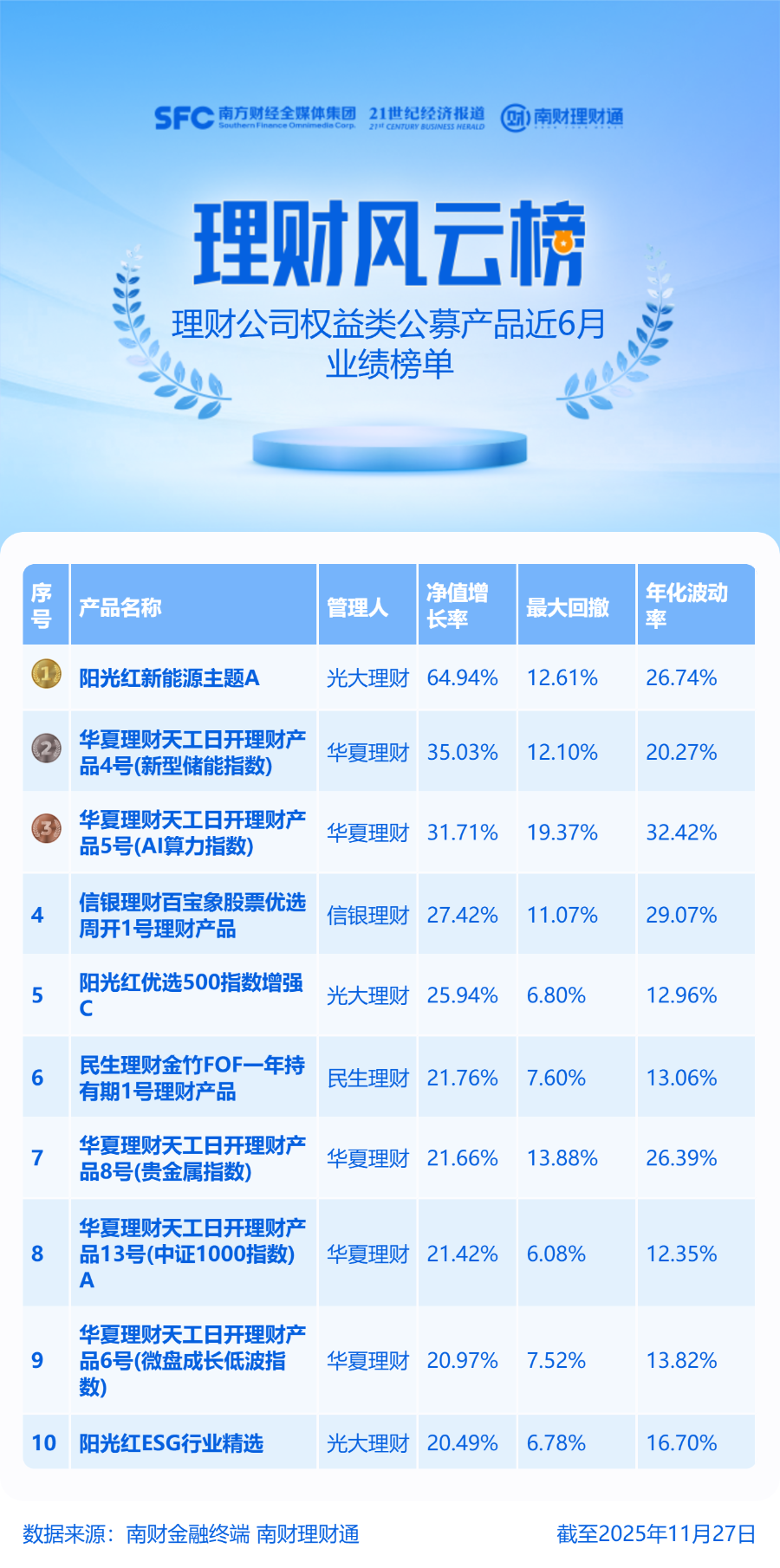
近6个月权益类公募理财业绩冠军三季度遭净赎回超800万份
2 1 Shi Ji Jing Ji Bao Dao· 2025-12-05 03:33
Core Viewpoint - The report highlights the performance of equity public wealth management products over the past six months, indicating a strong growth trend in the A-share market, particularly in the technology and new energy sectors, with significant returns from specific products [6][7]. Group 1: Product Performance - The average net value growth rate of equity public wealth management products is 16.39% over the past six months, with all 37 sample products showing an increase [6]. - The top-performing product, "Yangguang Hong New Energy Theme A" from Everbright Wealth Management, achieved a net value growth rate of 64.94%, significantly outperforming the second-ranked product by nearly 30 percentage points [7]. - Five products on the list had a net value growth rate exceeding 20% in the last month, with an average of 29.13% [7]. Group 2: Industry Trends - The new energy sector has shown strong performance over the past six months, with the underlying index for the top product, the "Yangguang Hong New Energy Theme A," increasing by over 53% [8]. - The product's asset allocation indicates a high concentration in equity assets, with 88.2% of total assets invested in equities, including leading companies in lithium battery materials and wind power [8]. - Despite a net redemption of 801,000 units in the third quarter, the product's net asset value increased by 670,000 yuan, reaching 17.2493 million yuan [8]. Group 3: Risk and Volatility - The products with strong industry characteristics, such as "Yangguang Hong New Energy Theme A," exhibit high volatility, with maximum drawdowns exceeding 12% and annualized volatility rates above 20% [9]. - The annualized returns for "Yangguang Hong New Energy Theme A" were reported at -33.91% for 2023, 16.69% for 2024, and 86.63% year-to-date as of September 30, 2025 [9]. - The product experienced a net value decline of 9.47% from November 13 to November 27, 2025, amid market fluctuations [9].


2025中国储能CEO峰会在福建厦门开幕
Zhong Guo Xin Wen Wang· 2025-12-05 02:13
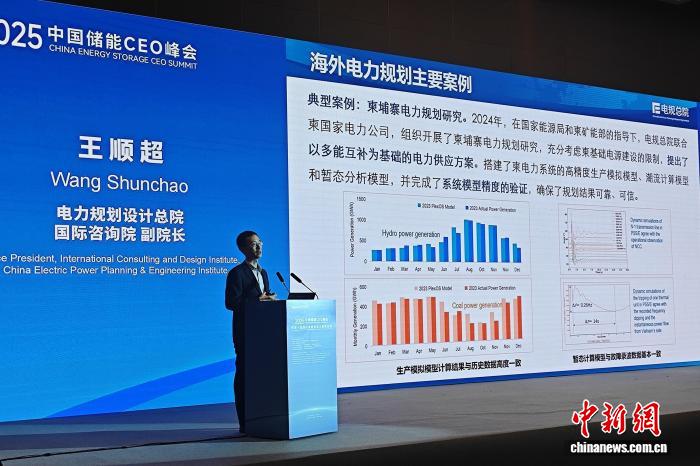
2025中国储能CEO峰会4日在福建厦门开幕。 会上,多位专家学者及企业家以"破浪·共生——共塑2026储能全球化新生态"为主题,围绕国际储能热点 地区和新兴市场、储能+智能制造等话题展开研讨交流。 中国科学院院士、厦门大学能源学院院长郑南峰在开幕式上提出,当前全球能源体系正在经历深刻变 革,储能技术作为能源开发利用和高效保障的关键支撑,在解决能源波动性问题、保障电力系统稳定运 行、促进可再生能源高效利用等方面将发挥重要作用。 "但该产业的规模化、市场化、商业化发展仍然面临诸多问题。"郑南峰表示,期待此次峰会能成为思想 碰撞、凝聚共识的平台,为中国乃至全球的能源转型贡献智慧和力量。 中关村储能产业技术联盟理事长、中国科学院工程热物理研究所所长陈海生介绍,近年来储能技术的应 用场景正从"电力"向"全场景"加速渗透,已深入工业园区、光储充电站、数据中心等几十个领域,从单 一的电网调节,转变为赋能千行百业、提供多元价值的解决方案。 "当前全球有100多个国家承诺净零碳排放目标,新型储能应用规模将持续扩大,人工智能等高技术产业 的发展也将为新型储能带来更广阔的市场空间。"陈海生说,如今中国储能企业正依托先进技术和产业 ...
三峡能源:三峡能源以促进新能源消纳利用和支撑电网安全稳定运行为应用场景
Zheng Quan Ri Bao Zhi Sheng· 2025-12-04 13:36
Core Viewpoint - The company is actively exploring new energy storage solutions to enhance the utilization of renewable energy and support grid stability, with a significant focus on both power generation and grid-side applications [1] Group 1: Company Initiatives - The company has integrated over 2.7 million kilowatts of new energy storage capacity through various forms such as renewable energy paired with storage and independent storage systems [1]

三峡能源:持续探索开展电源侧、电网侧的新型储能研究和示范应用
Zheng Quan Ri Bao Wang· 2025-12-04 11:14
证券日报网讯12月4日,三峡能源(600905)在互动平台回答投资者提问时表示,三峡能源以促进新能 源消纳利用和支撑电网安全稳定运行为应用场景,持续探索开展电源侧、电网侧的新型储能研究和示范 应用,通过新能源配储、独立储能等形式已并网新型储能规模超过270万千瓦,在储能方面具备较为成 熟的开发经验和一定的技术储备。目前各地区在储能方面市场规则有所不同且政策变化较快,公司将紧 密跟踪各地市场对新型储能尤其是配套储能的准入要求和运用情况,根据市场运行特点,合理确定储能 配置原则,制定项目参与电力市场的运营策略,响应电能量、辅助服务等市场价格信号,提升电站整体 收益水平。 ...
碳酸锂数据日报-20251204
Guo Mao Qi Huo· 2025-12-04 03:25
Report Summary 1. Report Industry Investment Rating - Not provided in the given content. 2. Core Viewpoints of the Report - The prices of battery - grade and industrial - grade lithium carbonate, lithium ore, and cathode materials are generally in a declining trend [1][2]. - This week, lithium carbonate production decreased by 265 tons and inventory decreased by 2452 tons [3]. - Currently, the market's core focus is on demand changes. Weekly demand is basically stable, providing support for prices. In the medium - term, due to the release of energy storage demand, prices tend to rise, but there is downward pressure on prices in the short - term [3]. 3. Summary by Related Catalogs Lithium Compounds - The average price of SMM battery - grade lithium carbonate is 94,350 yuan/ton, down 50 yuan; the average price of SMM industrial - grade lithium carbonate is 91,900 yuan/ton, down 50 yuan [1]. - The closing prices of lithium carbonate futures contracts from 2512 to 2604 all showed declines, with a maximum decline of 2.76% [1]. Lithium Ore - Lithium ore prices are generally falling. For example, the price of lithium spodumene concentrate (CIF China) is 1180 yuan/ton, down 4 yuan [1]. Cathode Materials - The average price of lithium iron phosphate (power type) is 39,485 yuan/ton, down 15 yuan; the average price of ternary material 811 (polycrystalline/power type) is 161,700 yuan/ton, down 100 yuan [2]. Price Differences - The difference between battery - grade and industrial - grade lithium carbonate is 2450 yuan/ton, with a change of - 1 yuan [2]. - The difference between battery - grade lithium carbonate and the main contract is 690 yuan/ton, with a change of 2850 yuan [2]. Inventory - The total inventory (weekly, tons) is 115,968 tons, a decrease of 2452 tons; downstream inventory (weekly, tons) is 41,984 tons, a decrease of 2452 tons; other inventory (weekly, tons) is 49,660 tons, an increase of 1780 tons; registered warehouse receipts (daily, tons) is 9652 tons, an increase of 112 tons [2]. Profit Estimation - The cash cost of externally purchased lithium spodumene concentrate is 95,330 yuan/ton, and the profit is - 2287 yuan/ton; the cash cost of externally purchased lithium mica concentrate is 93,827 yuan/ton, and the profit is - 3093 yuan/ton [3]. Industry News - The new energy storage installed capacity in China exceeds 100 million kilowatts, 30 times more than that at the end of the "13th Five - Year Plan", accounting for over 40% of the global total installed capacity [3]. - The market expects that the mining permit for Ningde Times' Xiakeng Mine will be issued in mid - January at the latest, and possibly in December at the earliest, and its impact on prices will gradually decrease [3].
“浙江经验”对广东新型储能的启示:何为“三位一体”协同机制?
2 1 Shi Ji Jing Ji Bao Dao· 2025-12-04 03:01
Core Viewpoint - The article discusses the rapid expansion of China's new energy storage industry, highlighting the issue of "growth-oriented surplus" and the imbalance between manufacturing and application development, particularly in Guangdong and Zhejiang provinces. It emphasizes the need for a shift from a manufacturing-driven to an application-driven model for sustainable development in the energy storage sector [1][2]. Industry Development Foundation - Both Zhejiang and Guangdong are major economic provinces with significant electricity demand, driven by their large industrial bases and urbanization. The transition towards renewable energy and the "dual carbon" goals have increased the demand for new energy storage solutions [3]. - Zhejiang's electricity structure is characterized by a balanced mix of renewable energy, thermal power, and imported electricity, leading to a surge in user-side and grid-side energy storage. In contrast, Guangdong's electricity structure is heavily reliant on high-load industries, necessitating a focus on peak shaving and system stability [4][5]. New Energy Storage Industry Chain Development - Zhejiang focuses on application-driven development, leveraging its strong photovoltaic industry and vibrant private sector to foster innovation in energy storage applications. This has led to the emergence of leading companies in system integration and energy services [6]. - Guangdong, on the other hand, emphasizes manufacturing capabilities, having established a complete energy storage industry chain from battery materials to system integration. This manufacturing-centric approach provides advantages in cost control and international market expansion [7]. Policy and Market Environment - Zhejiang has implemented a multi-faceted policy approach that includes local governance innovations, price incentives, and financial subsidies to stimulate demand and remove market barriers. This has resulted in a mature commercial ecosystem for user-side energy storage [8][9]. - Guangdong's policy framework is characterized by top-down planning and strategic positioning, integrating energy storage into its provincial energy strategy. However, the user-side energy storage market is still in its infancy and requires targeted market and financial tools to accelerate local adoption [10][11]. Policy Precision Guidance - Zhejiang's unique policy framework focuses on creating a comprehensive set of market rules and safety standards, enhancing project efficiency and ensuring safety in energy storage development. This includes significant price signals and local subsidy policies to boost user-side storage investments [10][11]. Scene Innovation Drive - Under the guidance of policies, Zhejiang has seen continuous expansion in energy storage applications, with innovative models emerging in virtual power plants and integrated energy solutions. This multi-layered development provides stable market expectations and fosters technological innovation [12][13]. Industrial Ecosystem Upgrade - Zhejiang has built a symbiotic ecosystem for energy storage, driven by demand and supported by industrial clusters. The province aims to achieve significant revenue and production capacity milestones by 2025, fostering a collaborative development mechanism among various stakeholders [14][15]. Common Challenges Faced by Zhejiang and Guangdong - Both provinces face challenges in policy alignment and market mechanisms, which hinder the large-scale commercialization of new energy storage solutions. Issues include intensified competition within the industry and the need for innovative business models [19]. - Guangdong specifically struggles with the imbalance between its strong manufacturing capabilities and the slower development of application scenarios, leading to a cycle of overcapacity and price declines [20]. Recommendations for Guangdong - Guangdong should establish a long-term support framework for energy storage development, optimizing price mechanisms and ensuring stable returns for investors. This includes enhancing safety standards and lifecycle management for energy storage projects [21][22]. - The province needs to refine its market mechanisms to facilitate diverse revenue channels for energy storage, encouraging participation from various stakeholders and promoting cross-regional trading [22][23]. - Regional collaboration should be emphasized, with different areas focusing on complementary roles within the energy storage ecosystem to enhance overall market integration and efficiency [23].

河南省省长王凯与富士康科技集团董事长刘扬伟举行工作会谈
Ge Long Hui· 2025-12-03 11:05
格隆汇12月3日|据河南日报,河南省省长王凯在郑州与富士康科技集团董事长刘扬伟12月3日举行工作 会谈,共同出席航空港区与富士康科技集团高端电子元器件精密加工制造项目入园签约仪式。王凯指 出,富士康多项业务与河南产业布局关联度高、契合性强,合作基础坚实、潜力巨大。希望富士康进一 步发挥行业领军企业的技术、管理、资金、人才等优势,在先进制造、新型储能、人工智能等领域开展 深层次战略合作,携手实现更高水平的互利共赢。河南将持续优化产业生态、营造良好环境,为广大企 业在豫发展提供更好服务。 ...
碳酸锂数据日报-20251203
Guo Mao Qi Huo· 2025-12-03 04:32
Report Summary 1. Report Industry Investment Rating - No information about the industry investment rating is provided in the report. 2. Core Viewpoints - The current market is mainly concerned about demand changes, with weekly demand remaining stable and prices being supported. In the medium - term, due to the continued release of energy storage demand, prices tend to rise, but there is downward pressure on prices in the short - term [3]. - The news that the certification materials of Ningde Times' Xiakeng Mine are complete and have been received is expected to get the certificate in mid - January at the latest and as early as December, and the subsequent impact of this mine on prices will gradually decrease [3]. 3. Summary by Related Catalogs Lithium Compounds - SMM battery - grade lithium carbonate has an average price of 94,400 yuan/ton, up 2,500 yuan/ton; SMM industrial - grade lithium carbonate has an average price of 91,950 yuan/ton, up 2,000 yuan/ton [1]. - The prices of lithium carbonate futures contracts from 2607 to 2611 are all down, with the decline ranging from 0.64% to 0.94% [1]. Lithium Ore - The price of lithium spodumene concentrate (CIF China) is 1,184 US dollars, down 6 US dollars [1]. - The prices of lithium mica (Li20: 1.5% - 2.0%), lithium mica (Li20: 2.0% - 2.5%), phospho - lithium - aluminum stone (Li20: 6% - 7%), and phospho - lithium - aluminum stone (Li20: 7% - 8%) are down by 20, 25, 150, and 225 respectively [2]. Cathode Materials - The average price of lithium iron phosphate (power type) is 39,500 yuan/ton, up 15 yuan/ton; the prices of ternary materials 811 (polycrystalline/power type), 523 (single - crystal/power type), and 613 (single - crystal/power type) remain unchanged [2]. Price Spreads - The difference between battery - grade and industrial - grade lithium carbonate is 2,450 yuan/ton, with no change; the difference between battery - grade lithium carbonate and the main contract is - 2,160 yuan/ton, up 430 yuan/ton [2]. - The differences between the near - month contract and the first - continuous contract and the second - continuous contract are 2,120 yuan/ton (up 20 yuan/ton) and - 280 yuan/ton (up 160 yuan/ton) respectively [2]. Inventory - The total inventory is 115,968 tons (weekly), down 2,452 tons; the inventory of smelters is 24,324 tons (weekly), down 1,780 tons; the inventory of downstream is 41,984 tons (weekly), down 2,452 tons; the inventory of others is 49,660 tons (weekly), up 1,780 tons; the registered warehouse receipts are 8,992 tons (daily), up 770 tons [2]. Profit Estimation - The cash cost of外购锂辉石精矿 is 95,626 yuan/ton, with a profit of - 2,534 yuan/ton; the cash cost of外购锂云母精矿 is 94,173 yuan/ton, with a profit of - 3,390 yuan/ton [3]. Industry News - The new energy storage installed capacity in China exceeds 100 million kilowatts, 30 times that at the end of the 13th Five - Year Plan, accounting for over 40% of the global total installed capacity. During the peak summer period this year, the peak call of new energy storage exceeded 30 million kilowatts [3]. - This week, lithium carbonate production decreased by 265 tons and inventory decreased by 2,452 tons [3].
全球能源转型分化 坤元资产FOF伙伴以“智慧”答卷回应绿色发展
Cai Fu Zai Xian· 2025-12-03 02:11
Core Viewpoint - The global energy landscape is undergoing significant transformation, with developing countries leading the clean energy trend, particularly China, which is set to surpass coal as the largest source of electricity by mid-2025 [1] Group 1: Strategic Divergence between the US and China - The US is restructuring its energy strategy by focusing on traditional fossil fuels and nuclear energy in response to the AI-driven electricity demand, which has strained its aging power grid [2] - The US Department of Energy plans to procure up to 10 new large nuclear reactors to ensure stable power supply, despite previously supporting a $2 trillion clean energy market [2] - In contrast, China is proactively developing a new energy system with a target of over 180 million kilowatts of new energy storage capacity by the end of 2027, aiming to address the stability issues of high renewable energy integration [3] Group 2: Investment Strategies of Kun Yuan Asset FOF Ecosystem Partners - Kun Yuan Asset's partners are employing a "layered response strategy" to adapt to the changing energy landscape, focusing on immediate certainty, mid-term competitive advantages, and long-term visionary investments [4] - Canadian Solar (Artes) is optimizing its global supply chain and expanding from solar module manufacturing to integrated solar + storage solutions, achieving a 120.9% year-on-year increase in operating cash flow to approximately 5.5 billion yuan [6] - Zhongxin Innovation is transitioning from a follower to a market leader by building a dual-driven model of "power + storage," with total assets projected to exceed 130 billion yuan by mid-2025 [7] Group 3: Technological Innovations and Future Outlook - Star Ring Fusion is pioneering controlled nuclear fusion technology with a cost-effective approach, aiming to achieve commercial viability by the early 2030s while maintaining strong self-sustaining capabilities through intermediate technology sales [8] - The energy revolution and technological advancements are converging, with Kun Yuan Asset focusing on long-term investments in companies that can navigate through cycles and define future energy landscapes [9] - The company aims to activate dual engines of green and digital transformation, collaborating with global partners to create a sustainable future while supporting China's carbon neutrality goals [10][11]